Sales reps spend about 28% of their week selling according to Salesforce, which is the polite way of saying manual research and admin eat the rest of the calendar Salesforce benchmark cited in ZoomInfo's guide. That's the bleeding neck. Most data enrichment tools promise to fill records with more fields, but outbound teams don't lose deals because a company record is missing a headquarters zip code. They lose time because nobody can tell, fast enough, whether this account is worth touching for this product, and what proof point should open the conversation.
That's why generic enrichment and product-anchored research are different jobs. Vendor-anchored enrichment appends firmographics, technographics, or contact data to a record. Product-anchored research starts from what you sell, checks whether the account matches that offer, then returns a usable hook with a source trail. For RevOps leaders, customer success teams, and outbound reps carrying quota, the second workflow is where the value sits.
The market reflects that shift. Data enrichment solutions were valued at $2.37 billion in 2023 and are projected to reach $4.58 billion by 2030, with a 10.1% CAGR Landbase market data. Another market read places the category at $1.97 billion in 2025 and projects $5.48 billion by 2034 at 12.0% CAGR, while also noting B2B contact data can decay by 22.5% to 70.3% annually Enricher.io market data. The practical takeaway is simple. The right tool has to do more than decorate a CRM row. It has to help a rep decide who to research, what to say, and why now.
1. PitchSmart
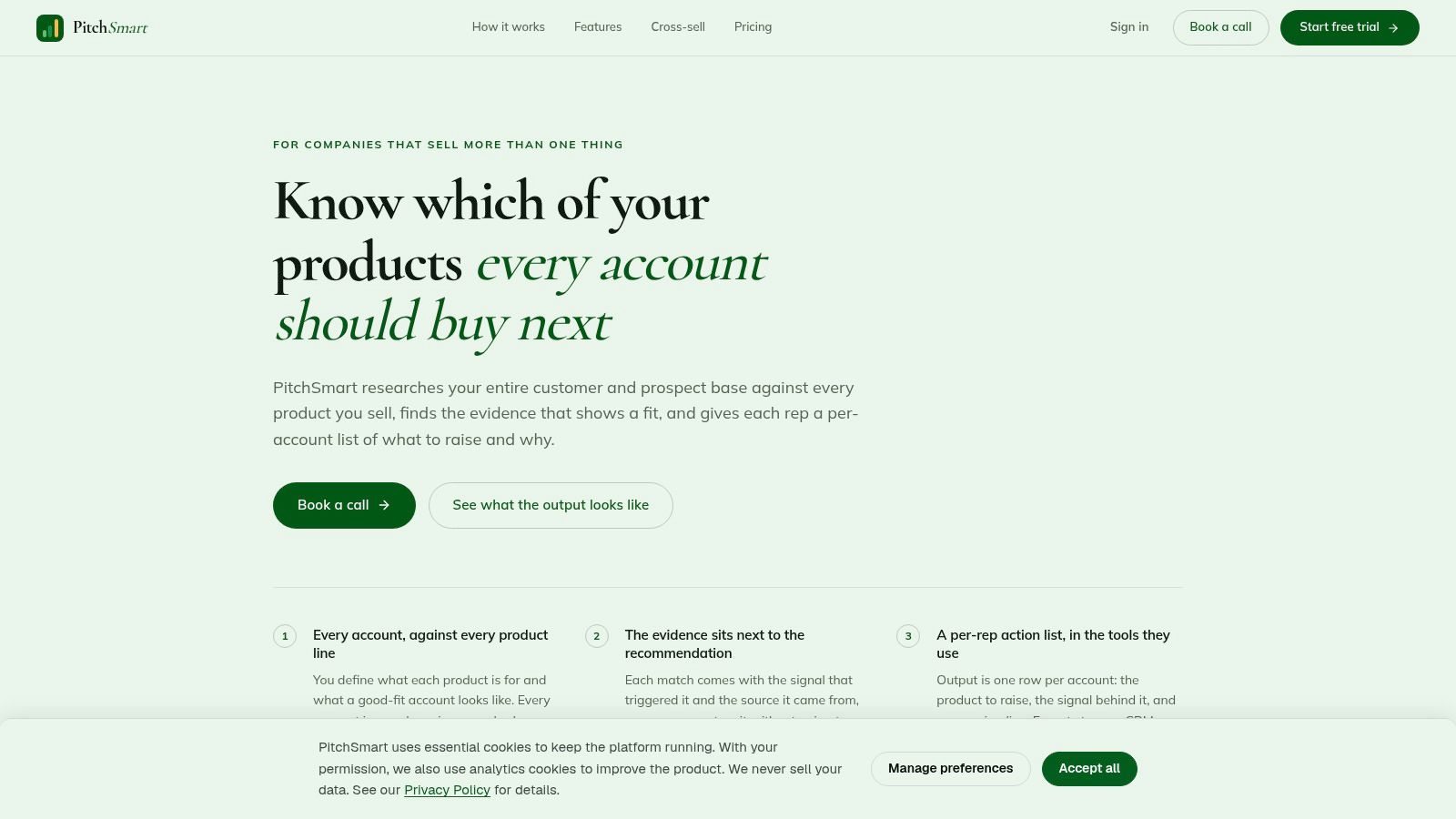
PitchSmart is the rare tool in this category that starts with the seller's product, not the account's generic profile. You define what a good-fit account looks like for each offer, then PitchSmart researches your list against that definition and returns one actionable row per account, including the recommended product, the signal that justified the match, and a source-cited opener. That matters for multi-product B2B companies where a customer can be a fit for one line and a bad fit for another.
A Monday-morning rep use case is straightforward. Upload a list, sync from HubSpot, or run a scoped portfolio project for expansion. PitchSmart researches accounts in parallel, which is a different operating model from clicking through one record at a time and stitching together a guess. The platform says typical runs complete 20 to 50 accounts in under 10 minutes, and exports into Salesforce, HubSpot, Outreach, Apollo.io, Salesloft, and CSV for general use.
Practical rule: if the rep still has to figure out which product to lead with after enrichment, the workflow isn't finished.
What stands out most is traceability. PitchSmart ties every answer back to a public source such as LinkedIn, job posts, press, or filings, so the output isn't a black box score. The company also offers a free single-account research tool, a 14-day full-feature trial with no credit card, and a free tier that preserves previously researched accounts plus 10 new contact researches per month. It's built for the team that needs bulk, customizable lead research with real hooks, not another generic field appender.
Pros
- Product-focused research: matches accounts to the offer you sell, not just to a firmographic segment.
- Traceable output: each row includes the product, signal, source citation, and opener.
- Fast list runs: parallel research across lists, with typical runs of 20 to 50 accounts in under 10 minutes PitchSmart.
- Workflow fit: exports into Salesforce, HubSpot, Outreach, Apollo, and Salesloft.
- Low-friction trialing: free single-account research, plus a no-credit-card trial.
Cons
- Public-signal dependent: private account context won't appear.
- Not a random lookup tool: you get the most value when you define product markers up front.
2. ZoomInfo OperationsOS Enrich
ZoomInfo's enrichment stack fits teams that already live in Salesforce operations and want broad enterprise plumbing around the record. It handles batch and real-time enrichment, normalization, deduplication, routing, and hierarchy mapping, which makes it useful when the problem isn't only missing data, but messy data moving through multiple systems.
The value shows up when a RevOps team wants enrichment tied to operational hygiene. If your routing, account hierarchy, and dedupe logic all depend on one pipeline, a point tool becomes expensive quickly. ZoomInfo's Enrich Premium waterfall also matters for teams that want multiple sources checked in sequence rather than relying on a single provider. That's useful, but it also means governance matters, because credit-based models can get opaque once several teams start using the same pool.
For outbound, the limitation is usually strategic rather than technical. ZoomInfo is strong at telling you who the company is and how it's structured. It's less opinionated about your specific product catalog, so reps still need to map the account back to the motion they're running. If your team's core pain is clean records and enterprise-scale data operations, that's fine. If the pain is figuring out which product to lead with, you'll still need another layer.
Practical rule: tools that fix records are not automatically tools that fix relevance.
Website: ZoomInfo
Internal resource: PitchSmart blog
3. Clearbit by HubSpot
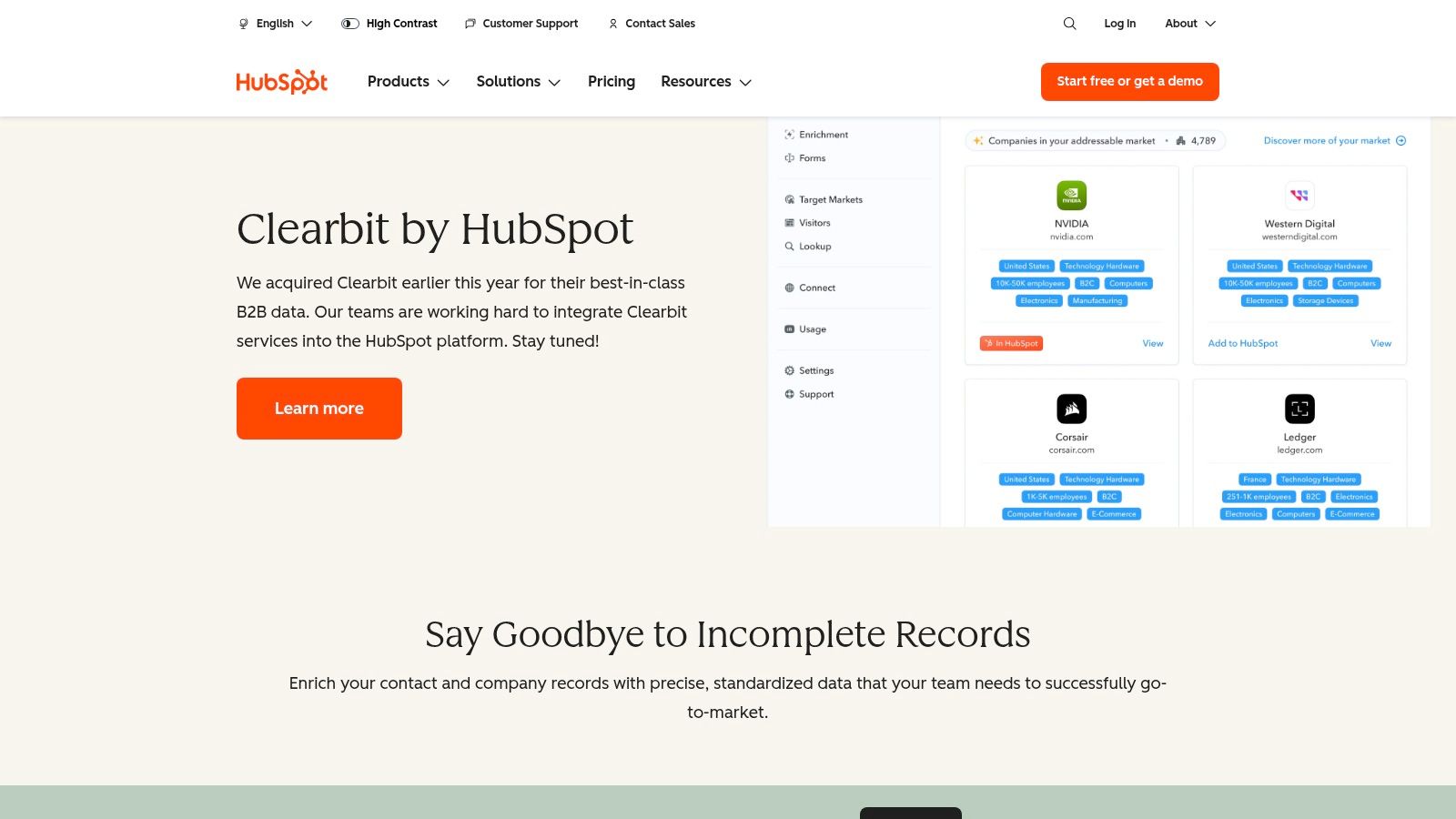
Clearbit fits teams that want enrichment close to the inbound workflow, especially if HubSpot already runs the show. It's strongest where website traffic, form fills, and CRM automation intersect. Company and person enrichment, visitor identification, and reveal-style capabilities make sense when marketing wants to hand sales a cleaner lead with context already attached.
That tight HubSpot alignment is the main reason teams pick it. If your funnel is web-led or product-led, and you're already using HubSpot workflows and reporting, Clearbit can feel native instead of bolted on. The trade-off is that the standalone, low-friction buying motion is much thinner than it used to be, because access is now tied to HubSpot tiers and credits. That pushes it further into platform territory and less into quick, standalone enrichment.
For outbound, the question is whether the record-level data is enough. Clearbit does a solid job on company and contact append, but a rep still has to infer the opener from the enrichment. It's very good at telling you who visited and what company they belong to. It's less explicit about which of your products should be raised first.
The best fit is a HubSpot-centric team that cares about web signals and native automation more than deep sales research workflows.
Website: Clearbit by HubSpot
4. Dun & Bradstreet D&B Direct+
Dun & Bradstreet is the anchor choice when company identity and hierarchy matter more than contact hunting. D&B Direct+ gives you D-U-N-S-based identity resolution, global firmographics, corporate hierarchies, and risk or credit attributes through REST API, batch files, and monitoring. That's the kind of data foundation you want when your master records need to stay clean across warehouses, MDM, and downstream apps.
The big advantage is authority. When a global account tree is messy, D&B is built for resolving the organization before anyone argues about a title field. That makes it useful for product ops, data governance, and teams standardizing account structures after an acquisition. It's a less natural choice if the immediate goal is named-account outreach, because contact detail coverage is not the main event here.
This is the tool for organizations that treat identity as infrastructure. If the company record has to be correct before segmentation, routing, or reporting can happen, D&B belongs in the conversation. If reps need a fast, product-specific reason to reach out tomorrow morning, D&B usually needs to be paired with something more outbound-native.
Website: Dun & Bradstreet
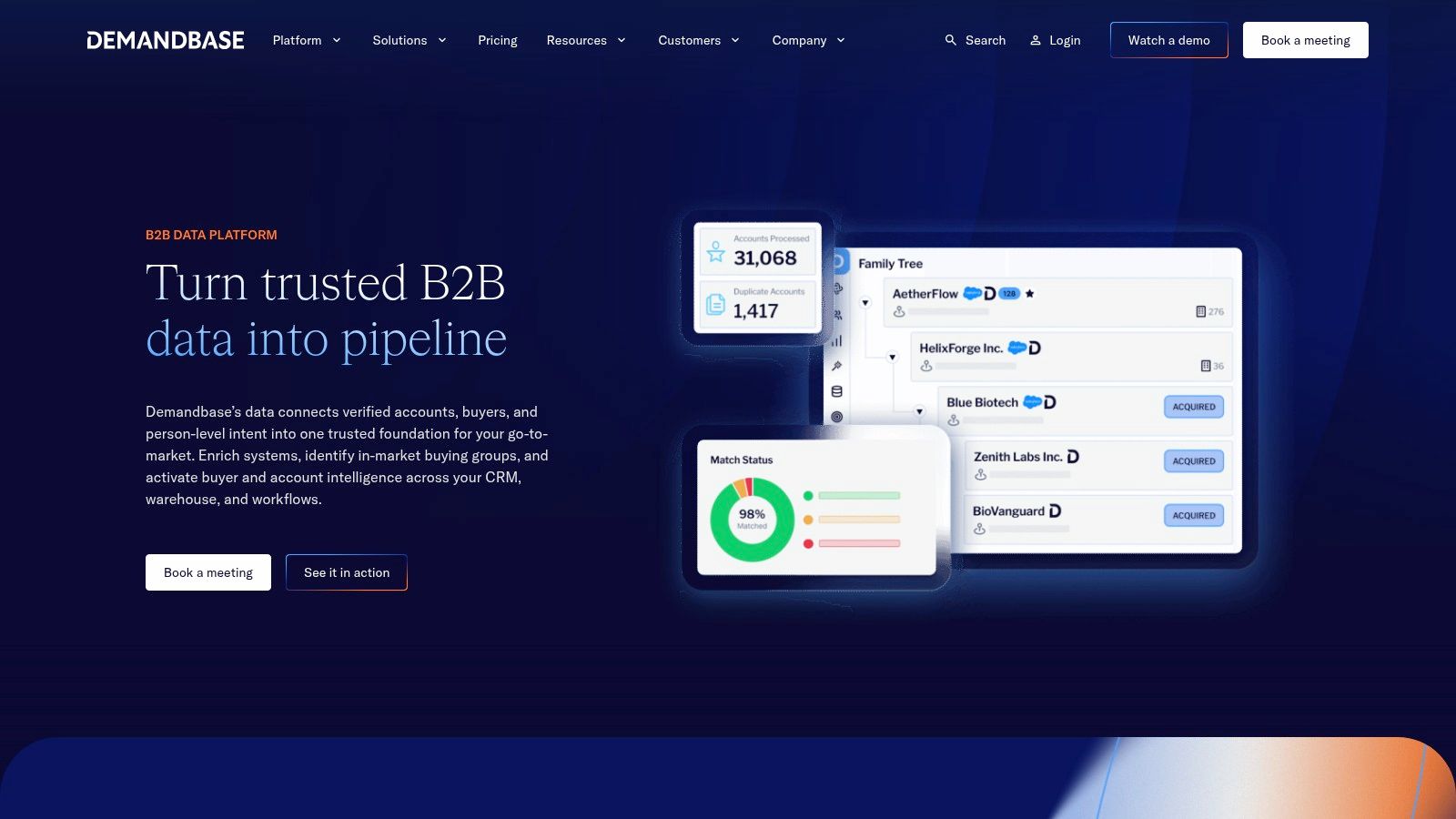
5. Demandbase Data Cloud
Demandbase Data Cloud makes the most sense when enrichment and ABM sit in the same operating model. It combines verified accounts, buyers, and person-level intent, then delivers data into cloud storage through Data Stream. For RevOps teams that want warehouse-native enrichment instead of one more app silo, that architecture is the selling point.
The non-US and multi-product angle matters here too. Demandbase explicitly notes that some GTM teams need custom datasets or coverage in non-English markets that automated databases miss Demandbase coverage guidance. That's a real buying criterion, not a side note. If your customer base spans regions or subsidiaries, the difference between a generic profile and a region-aware dataset shows up quickly in cross-sell and account prioritization.
Demandbase is strongest when intent and enrichment are used together, because it gives you more than a filled-in row. It gives you a prioritization layer. The drawback is that it earns its keep best inside the broader Demandbase ecosystem, so teams only shopping for basic firmographics can end up paying for more platform than they need.
Website: Demandbase Data Cloud
Internal resource: PitchSmart portfolio
6. Cognism
Cognism is a strong option when phone-led outbound depends on better international coverage, especially in EMEA. It positions itself around GDPR-first data, verified phone and email, and broad regional reach. That makes it attractive for SDR teams that can't tolerate the guesswork of weak mobile coverage.
The practical appeal is simple. If reps are calling into Europe, they need contact data that's built for that motion, not just repurposed from a US-heavy database. Cognism's enrichment API and scheduled CRM updates fit that use case well, and the compliance framing matters for teams that want fewer arguments with legal and ops.
The trade-off is predictability. Pricing is quote-based, API output can differ from the UI depending on entitlements or freshness, and niche regions may still require waterfalling. That doesn't make it bad. It just means the team has to know whether it's buying global phone coverage or trying to force one vendor to solve every market.
Website: Cognism
7. Apollo.io Enrichment
Apollo is the practical all-in-one choice for teams that want enrichment, prospecting, and engagement in one seat. It supports CSV enrichment, CRM auto-enrichment, API access on higher tiers, and waterfall-style workflows. The appeal is operational simplicity. A smaller outbound team can research, sequence, and track work without stitching together separate vendors on day one.
For many teams, Apollo's value is economic as much as functional. Credit usage and entitlement logic can get messy at scale, but the platform still gives a lot of utility per motion when compared with legacy enterprise stacks. The downside shows up when your data standards get stricter. Accuracy and mobile coverage can lag in some segments, and API access is reserved for higher plans, so the cleanest workflows sit behind the pricing line.
Apollo works best when the team wants enough enrichment to launch, but also wants the surrounding outbound stack in the same place. It's less compelling if your operating model depends on deep governance or product-anchored account research.
A rep-friendly stack matters, but so does field quality. If the data is broad and the process is sloppy, the sequence still sounds generic.
Internal resource: PitchSmart demo
Website: Apollo.io
8. Lusha
Lusha is the contact-first option that many SDRs reach for when they need direct dials and emails quickly. It gives you person and company lookup, browser extension access, CRM integrations, and a unified credit balance across platform, extension, and API. That simplicity is a real advantage when reps don't want to learn a heavier system.
The trade-off is depth. Lusha is handy for fast prospecting and mid-market contact work, but it's lighter on deep firmographic context than the bigger enterprise stacks. If the job is to find the person, it's useful. If the job is to explain why that person's account should get a specific product pitch, you'll need more context than Lusha usually provides on its own.
For teams that care about direct dial workflows, the biggest question is not whether Lusha can find contacts. It's whether those contacts are enough to support the actual message. That's where contact-first tools tend to stop.
Website: Lusha
9. People Data Labs PDL
People Data Labs is the raw data layer for teams that want to build their own enrichment logic. The API-first approach, transparent fields, and bulk delivery make sense for data teams, not casual users. If you've got engineering resources and a warehouse-centric process, PDL can become the substrate for custom research, matching, and internal scoring.
Its strength is flexibility. You can shape the pipeline the way you want instead of adapting your workflow to a prebuilt UI. The cost of that flexibility is implementation work. Match rates and coverage vary by persona and region, and teams often end up needing waterfalls or internal normalization to get the output into a usable state.
PDL is a good fit when the company wants to own the enrichment logic instead of renting it. It's less useful for a rep who needs a signal-backed opener before lunch.
Website: People Data Labs
10. Bombora
Bombora doesn't replace enrichment, it sharpens timing. Its Company Surge topics and interest intensity scores help teams prioritize accounts based on research behavior, which is why it shows up in ABM stacks rather than as a standalone data provider. On its own, it doesn't give you verified contacts. Layered onto account and contact enrichment, it tells you which accounts are warming up.
That distinction matters. Reps don't just need names. They need a reason to call now instead of next month. Bombora gives context for that timing layer, especially when integrated into tools like Demandbase or 6sense. It's most valuable when your GTM process is already ready to act on the signals rather than merely admire them.
The trade-off is implementation discipline. Intent data only pays off when marketing, RevOps, and SDRs agree on what to do with the signal. Without that handoff, you end up with a dashboard full of interesting accounts and not much outbound motion.
Website: Bombora
Top 10 Data Enrichment Tools, Feature Comparison
| Product | Core focus | 👥 Target | ✨ Unique selling point | ★ Quality | 💰 Price/value |
|---|---|---|---|---|---|
| PitchSmart 🏆 | Product-focused account research & outbound sequences | 👥 Rev enablement, expansion, SDR/BDR, RevOps, AEs | ✨ Custom product markers, traceable public-source signals, per-account openers | ★★★★★ | 💰Free trial + free tier; usage-friendly |
| ZoomInfo OperationsOS (Enrich) | Company/contact enrichment, MDM & hierarchies | 👥 Enterprise RevOps, sales ops, marketing ops | ✨ Enrich Premium waterfall; strong US coverage | ★★★★☆ | 💰Opaque, premium & credit model |
| Clearbit (HubSpot) | HubSpot-native enrichment & visitor reveal | 👥 HubSpot-centric teams, PLG | ✨ Tight native workflows; website visitor ID | ★★★★☆ | 💰Tied to HubSpot tiers/credits |
| Dun & Bradstreet Direct+ | Company identity, D‑U‑N‑S & hierarchies | 👥 MDM, data governance, enterprises | ✨ Authoritative corporate IDs & golden records | ★★★★☆ | 💰Premium; per-match/batch costs |
| Demandbase Data Cloud | ABM data + intent with warehouse delivery | 👥 ABM, RevOps & analytics teams | ✨ Warehouse-native streams + intent signals | ★★★★☆ | 💰Quote-based; best with full stack |
| Cognism | GDPR-first contact enrichment with phone verification | 👥 EMEA SDRs, phone-led outreach teams | ✨ Strong EMEA phone/email verification & compliance endpoints | ★★★★☆ | 💰Quote-based; compliance-focused |
| Apollo.io (Enrichment) | Enrichment + prospecting & engagement stack | 👥 SMB/scale GTM teams, SDR/AE | ✨ Integrated prospecting + lower-cost positioning | ★★★☆☆ | 💰Credit model; competitive mid-price |
| Lusha | Contact lookups, browser extension & direct dials | 👥 SDR/AE teams needing quick contact info | ✨ Extension + unified credits across tools | ★★★☆☆ | 💰Mid-market; phone credits can add up |
| People Data Labs (PDL) | API-first person/company data for warehouses | 👥 Data teams, engineers building custom pipelines | ✨ Transparent fields, high-volume delivery | ★★★★☆ | 💰Usage-based; scales with volume |
| Bombora | Company-level intent (Company Surge) | 👥 ABM, demand gen & analytics teams | ✨ Large topic taxonomy + Surge intent scoring | ★★★★☆ | 💰Enterprise/quote-based |
From Enriched Records to Actionable Research
A clean field list does not tell an outbound rep what to do next. The practical split is between data enrichment tools that complete records and research workflows that tell you which product to lead with, which signal supports that choice, and which opener is worth using.
For foundational company identity, D&B Direct+ is still a strong option. For enterprise-scale enrichment and hierarchy data, ZoomInfo belongs on the shortlist. If your team needs warehouse-native enrichment with ABM context, Demandbase fits that job better. If the motion is PLG or website-led, Clearbit by HubSpot is usually the more useful fit. For outbound teams that depend on phone coverage in EMEA, Cognism and Lusha both matter.
That lens helps because it forces a real trade-off. Choose the vendor that matches the data problem you already have, but do not expect completed fields to produce a usable rep action. A record with firmographics and contact data still leaves the hard questions open. Which product should go in front of this account, what signal supports that choice, and what should the rep say first?
The gap gets wider in multi-product B2B companies, especially after acquisition when one customer base maps to several offers. Generic enrichment can tell you the account exists and may show the tech stack. It will not reliably tell you whether the account is a cross-sell fit for Product A, a service-upgrade fit for Product B, or a poor use of rep time for both. That is the operational hole PitchSmart is built to close, by researching each account against what you sell and returning source-cited hooks a rep can use right away.
The stronger case for PitchSmart is workflow, not field count. It turns a list into product-specific research, so reps do not have to pull together signals, fit, and citations by hand before outreach. You can test that on one account with the free research tool, then use the no-credit-card trial to run a real list before committing. For teams that have outgrown generic enrichment and need product-anchored research, PitchSmart is worth a serious look.
PitchSmart gives outbound and RevOps teams product-anchored research instead of just more CRM fields. If you need to know which product to lead with, which signal matters, and what to say next, start with a real account on PitchSmart and see how the workflow holds up on your list.