A sales kickoff can be the most important revenue meeting of the year, or a costly interruption that changes nothing. A widely cited survey found that 74% of attendees said their company's sales kickoff did not deserve an A grade, while 29% rated it a C or below. That finding, reported in the State of Sales Kickoff Meetings survey, should change how revenue leaders judge the event. The question isn't whether the organization held an impressive gathering. It's whether sellers returned able to identify more expansion opportunities, research accounts faster, and start better conversations across the product portfolio.
That distinction matters most in B2B software and services companies assembled through acquisition. Leadership may own several products, while account executives, SDRs, and customer success managers still operate inside separate product lines. A sales kick off that celebrates the portfolio without giving teams a practical cross-sell motion creates awareness, not pipeline. It also leaves reps with the same manual research burden they had before the event. Salesforce research reports that reps spend 70% of their time on non-selling tasks and only 30% selling, as summarized by Everstage's sales productivity research.
Why Most Sales Kick Offs Fail to Change Behavior
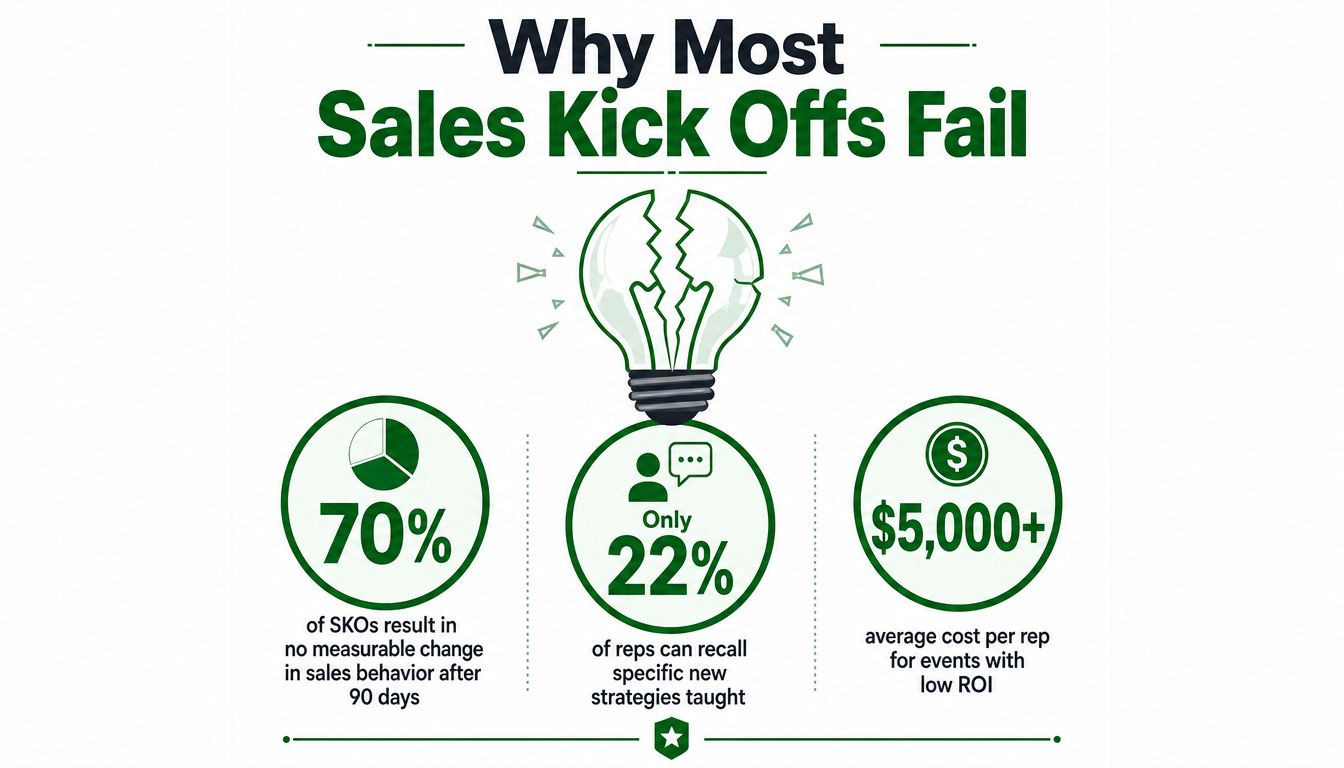
Only a portion of sales kickoffs produce sustained behavior change, according to sales kickoff research from RAIN Group. The standard SKO fails for a practical reason: leaders run it as an event to attend instead of a revenue program to operate.
A polished agenda cannot close the gap between what leadership announces and what a rep does in the next customer interaction. Another keynote may improve the mood for an afternoon. It will not show a seller which account to research, which buying signal matters, or how to connect a second product to an active customer problem.
The portfolio problem
Acquired organizations bring together multiple products, sales methodologies, customer segments, and definitions of a qualified opportunity. Leadership says “cross-sell,” while the rep hears a broad ambition without a target account, evidence, opening question, or manager coaching routine.
Product presentations create catalogue familiarity. They do not tell a seller which existing customer has a reason to consider another solution now, or how to carry that hypothesis into an outbound workflow. A useful SKO should make sellers work through real accounts, identify signals across the portfolio, and produce outreach that a manager can review.
Passive consumption remains the default format. Reps sit through product updates, strategy presentations, recognition ceremonies, and polished customer stories. They may leave with stronger company knowledge, yet still write generic outreach because nobody required them to research an account and turn a signal into a conversation plan.
Practical rule: If a session ends without a usable artifact, a practiced behavior, or a manager-owned follow-up, treat it as communication, not enablement.
Satisfaction isn't behavior change
A positive event survey can confirm that the venue worked, the speakers were engaging, and the team enjoyed seeing colleagues. It cannot prove that sellers changed how they qualify an expansion opportunity, prepare an outbound conversation, or position products from across the portfolio.
RAIN Group's research reports that only a portion of kickoffs create sustained behavior change, and only about one in five organizations with highly effective SKOs report very strong seller behavior impact. The same research says high-impact SKOs are 1.8x more likely to connect tightly to company strategy, 3.3x less likely to skip measurement, 2x more likely to emphasize bonding and morale, and 1.9x more likely to run twice per year. Morale has a place, but it supports a defined commercial motion rather than replacing one.
A useful diagnosis asks:
- What changed in the field: Can managers identify the new behavior in call reviews, account plans, or opportunity notes?
- What evidence exists: Did reps produce account-specific research, cross-sell hypotheses, or conversation plans during the event?
- What happens afterward: Does the frontline manager coach the behavior, or does the content disappear into a shared folder?
The SKO has moved beyond a simple annual meeting. A 2025 Sales Kickoff Industry Report found that 60% of respondents hold an SKO once per year, 46% had an in-person SKO, and 73% allow some participants to attend virtually. The leading expected benefit of in-person attendance was account planning tied to closed-won deals, cited by 51% of respondents.
That focus is commercially useful. The event should produce the account research, cross-sell hypotheses, and seller practice that leaders expect to see after everyone returns home.
Setting Measurable Goals Beyond Morale and Motivation
“Align the team” isn't a usable SKO objective. Neither is “build energy.” Those phrases describe an atmosphere, not a behavior a manager can observe and coach.
Start by choosing two to four target behaviors for the cycle after the event. The number matters because a kickoff can't install every new habit across a complex portfolio. A narrow set of behaviors gives enablement, managers, and RevOps something specific to inspect.
Choose behaviors before metrics
For a multi-product organization, strong targets might include:
- Cross-sell account selection. Each seller identifies existing accounts where a second product fits a documented business problem, customer profile, or recent signal.
- Research quality. Each outbound rep records the evidence behind an account hypothesis instead of relying on firmographics alone.
- Conversation planning. Each rep converts a relevant signal into an opening question, a reason to engage, and a next-step hypothesis.
- Manager coaching. Frontline leaders review and give feedback on the behavior using a shared rubric.
These are leading indicators. They tell you whether the new motion is being adopted before closed-won expansion revenue appears. Lagging indicators still matter, but they belong later in the measurement chain. Pipeline growth, opportunity progression, and expansion revenue can validate the commercial result, while research quality and practice completion show whether the event created the conditions for that result.
The 2025 research cited in this SKO impact summary found that 28% of companies remain unsure how to measure SKO impact, even though 65% focus on sales performance and 64% focus on revenue and pipeline growth. That gap is avoidable when teams define the behavior first and attach the business measure second.
Build the measurement loop
For each target behavior, write four fields:
| Field | Example |
|---|---|
| Behavior | Build a cross-sell hypothesis for a named account |
| Evidence | Source-backed signal, product fit, and conversation opener |
| Reviewer | Frontline manager or account team lead |
| Business connection | Qualified expansion conversation or opportunity |
Make the rubric simple enough for a manager to use during a normal pipeline review. A research plan either identifies a credible signal and links it to a product problem, or it doesn't. A conversation plan either gives the rep a specific reason to engage, or it falls back on generic messaging.
Use practice sessions to establish a baseline before the event closes. Have reps present one account hypothesis, challenge the evidence, and revise the opener. Give managers a short feedback form that measures the same behavior every time. The PitchSmart portfolio can support the account-research side of this workflow, but the operating decision remains with the enablement team: define what good looks like, assign ownership, and inspect it after the SKO.
Building an Agenda That Balances Strategy and Hands-On Practice
A strong two-day sales kick off has a narrative, but it doesn't confuse narrative with a sequence of presentations. Strategy should explain the commercial priority. Product sessions should clarify where each solution fits. Workshops should force sellers to apply that context to accounts they own.
Use large-group sessions for information that must be consistent across the organization. Keep application work in smaller groups where facilitators can challenge weak assumptions and hear the rep explain their reasoning.
A practical two-day structure
| Time Block | Session Type | Format | Primary Objective |
|---|---|---|---|
| Day 1, opening | Business strategy and portfolio direction | Large group with live questions | Connect the year's growth priorities to customer and product decisions |
| Day 1, mid-morning | Product and market updates | Product-line breakouts | Show the customer problems, buying signals, and cross-sell entry points for each solution |
| Day 1, afternoon | Account selection workshop | Role and segment breakouts | Select real accounts and identify portfolio whitespace |
| Day 1, late afternoon | Manager calibration | Manager cohort | Align leaders on the behavior rubric and coaching expectations |
| Day 2, opening | Customer and competitive context | Large group plus discussion | Translate market changes into discovery and outbound implications |
| Day 2, morning | Research sprint | Hands-on breakout | Produce source-backed account hypotheses and conversation hooks |
| Day 2, afternoon | Conversation practice | Small groups with peer feedback | Practice opening, discovery, objection handling, and product transitions |
| Day 2, closing | Commitments and operating review | Team sessions | Assign next actions, owners, and the first post-event checkpoint |
The order matters. Don't ask reps to draft outreach before they understand which portfolio problem they're trying to solve. Don't place a product launch after account planning if the new product changes the account-selection criteria. And don't schedule the manager session as an optional closing activity. Managers need to know what to inspect before reps return to their normal workflow.
Protect working time
Back-to-back keynotes create the appearance of importance while reducing the time available for practice. A product leader can explain positioning in a large room, but a rep needs to decide whether a specific customer has evidence of that problem and how to introduce it without forcing a cross-sell pitch.
Use transition points deliberately. After strategy, give teams a written account brief. After product updates, require a product-to-problem mapping exercise. After research, run a peer review. Each transition should convert information into an artifact that another person can evaluate.
A useful test is brutal but fair: remove every session that doesn't support a target behavior, a required artifact, or a decision the field must make. The agenda will get shorter, and the remaining sessions will become easier to facilitate well. If you're evaluating how a research workflow fits your kickoff, book a PitchSmart demo only after you've defined the account output you want the team to produce.
Designing Workshops That Force Real Account Research Practice
Generic role-play is comfortable because nobody's work is at risk. A rep can deliver a polished script against an invented buyer and still avoid the hard decisions that determine outbound quality: which account matters, what changed, why the signal is relevant, and which product belongs in the conversation.
Real-account workshops remove that escape route.
Start with the account set
Choose accounts before the event, using a mix of existing customers, named prospects, and stalled opportunities. For a post-acquisition organization, include accounts where one product is already adopted but another solution could address a related problem. Don't hand facilitators a list with no context. Give them the product definition, target customer profile, disqualifiers, and the signals that justify further research.
The workshop should mirror the actual outbound workflow:
- Segment the list. Group accounts by product fit, customer stage, region, industry, or observed buying signal.
- Research the account. Capture recent public evidence, business changes, strategic priorities, hiring patterns, product activity, or other relevant signals.
- Map the signal to a solution. State which product fits, what problem it addresses, and why the timing is credible.
- Draft the hook. Write an opening that refers to the signal without pretending to know more than the evidence supports.
- Build the sequence. Create a short email and LinkedIn progression that develops the same hypothesis rather than repeating a generic pitch.
For SDR and BDR teams, this is also the right setting to practice list segmentation and sequence drafting. Don't turn the exercise into a tour of every platform feature. The facilitator should ask why the rep selected the account and whether the evidence supports the proposed conversation.
Make peer review rigorous
Put three people around each account: the researcher, the reviewer, and the seller who must deliver the opener. The reviewer checks source quality and product fit. The seller challenges whether the message sounds relevant to a buyer. Then the researcher revises the plan.
Use a simple scorecard with questions such as:
- Evidence: Can the rep explain where the signal came from?
- Relevance: Does the signal connect to a problem the chosen product solves?
- Specificity: Could the opening apply to almost any account, or is it specifically account-based?
- Restraint: Does the message avoid claims the source doesn't support?
- Next step: Does the sequence create a sensible reason for a response?
Capture the final account brief, not just the workshop notes. Reps should leave with work they can use during their first week back, managers should have a clear coaching object, and enablement should know which signals produced confusion. Additional practical guidance on outbound research workflows is available in the PitchSmart blog.
Managing Hybrid and Remote Logistics Without Losing Engagement
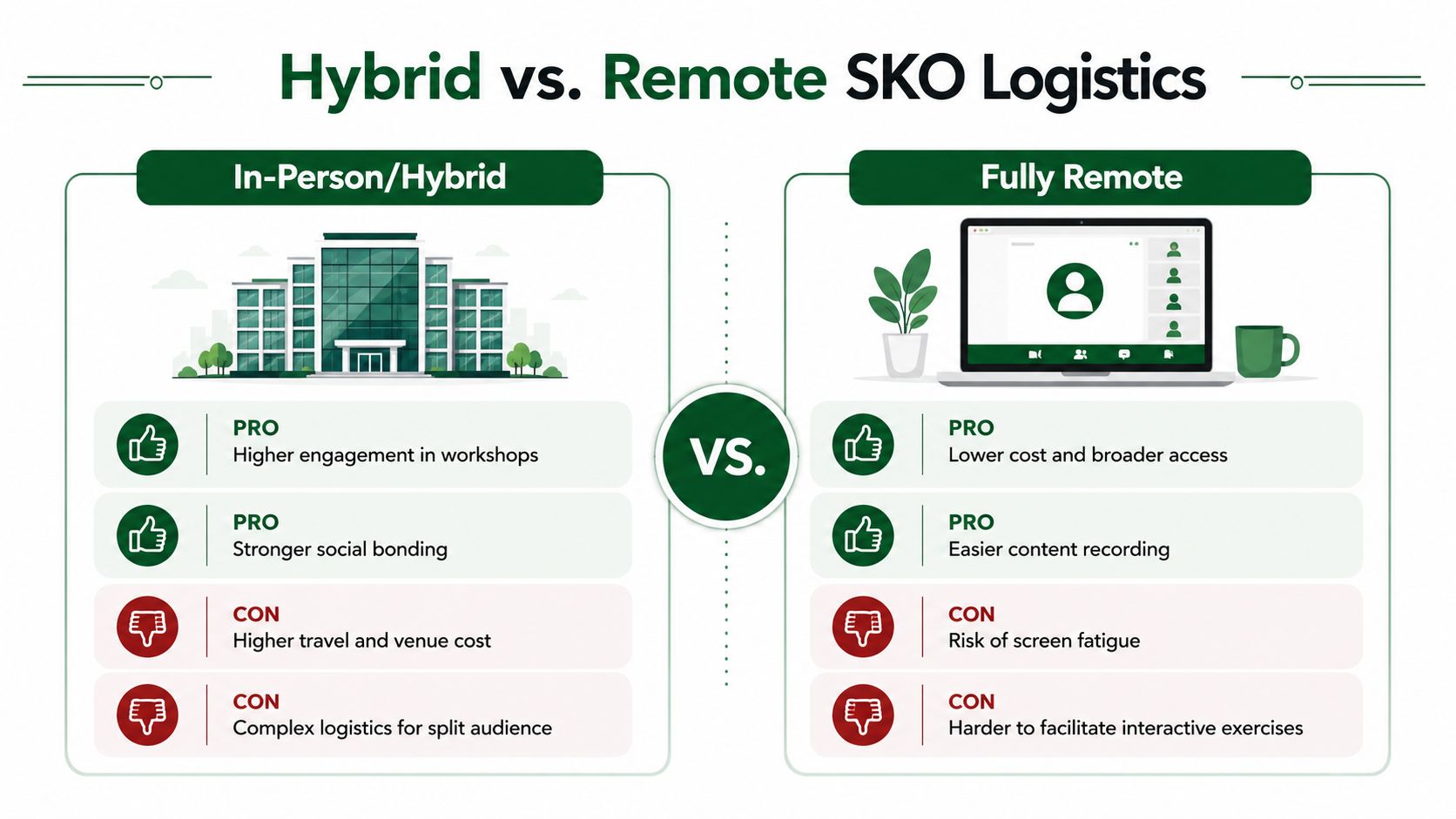
Format affects participation quality, but the operating design determines whether sellers do useful work. As noted in the 2025 industry report cited earlier, hybrid attendance is common. That access also creates a risk for research-heavy workshops: remote sellers can become spectators while the room completes the account work.
Choose the format by session
| Session need | In-person or hybrid | Fully remote |
|---|---|---|
| Strategy announcement | Strong for shared context and visible leadership | Effective when recording and written context are prepared |
| Product launch | Useful for questions and live demonstrations | Works when participants can test the workflow themselves |
| Account research | Strong only if remote participants have equal tooling and facilitation | Often efficient because every participant works in the same environment |
| Peer bonding | Easier through informal interaction | Requires deliberate small-group design |
| Manager calibration | Helpful for concentrated discussion | Practical when the rubric and examples are shared in advance |
Choose in-person delivery when the work depends on trust-building, portfolio integration, or difficult strategic decisions. The travel and venue effort can be justified when sellers must align on how products fit together in existing accounts.
Fully remote delivery works well when the output is individual research, account planning, or sequence drafting. Every participant can work in the same shared artifact, making the account hypothesis, product fit, and outbound next step easier for a manager to inspect.
Design for equal participation
Hybrid rooms need a remote-first operating rule. Give remote participants dedicated facilitators, visible working documents, and breakout groups that prevent room-side conversations from dominating. Every person should receive a named account, a timed work block, and a required output.
For global teams, publish asynchronous pre-work and rotate inconvenient session times where necessary. Record strategy content, not practice. A recording can replace a presentation, but it cannot replace feedback on a weak conversation hook or an unsupported cross-sell idea.
Keep work blocks short enough to sustain attention, then require a visible handoff. One person presents the account evidence, another explains the product fit, and a third challenges the opener. The final artifact should include the account signal, proposed message, sequence step, and owner, so managers can use it in outbound reviews after the SKO.
Engagement comes from responsibility and feedback, not from adding production value. If the room receives better tools or faster facilitator access, remote sellers will disengage before the workshop produces usable account research.
Creating a Reinforcement Plan That Extends Impact Beyond the Event
An SKO without reinforcement is a launch without distribution. The event may produce useful account plans, but managers and reps abandon them when the new behavior is disconnected from weekly work. As the RAIN Group research noted earlier, formal reinforcement remains uncommon, which helps explain why strong workshop outputs often disappear after the event.
Put managers in the operating rhythm
Frontline managers should leave the SKO with three tools: a target-behavior rubric, examples of acceptable work, and a scheduled coaching cadence. The first review should test whether reps used account evidence, identified a credible product fit, and connected that fit to an outbound next step. Later reviews can examine replies, discovery quality, opportunity movement, and expansion conversations.
Tie reinforcement to existing workflows instead of creating another reporting system. Add the account hypothesis to pipeline reviews, use call coaching to inspect the opener, and ask customer success leaders to review expansion actions during account planning. RevOps can confirm that required fields and activity records exist. Managers still assess whether the research, portfolio alignment, and message quality are strong enough to support a real conversation.
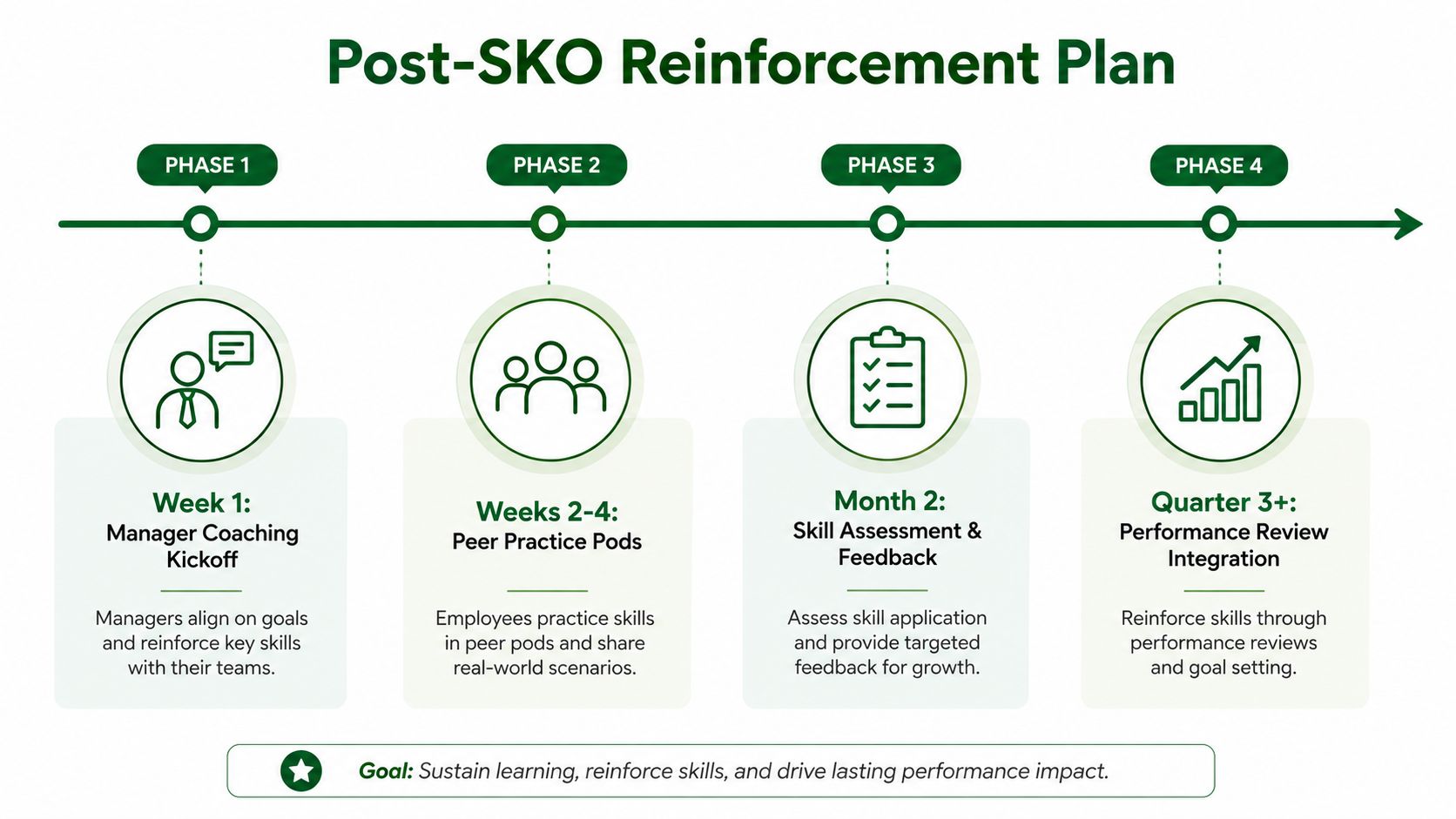
Use the first weeks to correct friction quickly. If reps cannot find research inputs, fix access. If they identify account signals but cannot connect them to the product portfolio, revise the product-to-problem guidance. If managers interpret the rubric differently, run another calibration session rather than blaming adoption.
The final measure is not event recall. It is visible behavior in account plans, outbound sequences, customer conversations, and expansion reviews. Those artifacts show whether the SKO changed cross-sell execution or created temporary enthusiasm.
Reinforcement works when the workflow makes the intended behavior easier to inspect, coach, and repeat. Managers should review the same evidence that reps use to choose an account, shape a message, and recommend the next product conversation.