The argument usually starts in a reorg meeting. A new CRO wants one owner for the onboarding program, the playbook in the CRM, and the rollout of the new call recording tool. Enablement says all three are about how reps learn to sell. Sales operations says all three live in systems it administers. Both are right, and the meeting ends with a shared slide that says the two teams will "partner closely", which settles nothing.
Most articles on this topic stop at the definitions: enablement is about people, operations is about process. That line is accurate and it is useless in a scope fight, because nearly every real artifact in a sales org has a people half and a process half. This piece splits the two functions a different way, by who holds the final decision and who owns each artifact, and names the handful of items that will be contested no matter how you draw the chart.
Why the usual split fails in a reorg
The common framing holds that enablement improves the seller and operations improves the system the seller works inside. Take onboarding as a test. Enablement builds the curriculum, the certifications and the ramp milestones. Operations provisions the CRM seat, sets up territory assignment, and builds the dashboard that shows ramp progress. Under the people versus process split, onboarding belongs to both, which means it belongs to neither when a new hire misses their first-quarter number and somebody has to explain why.
The same thing happens with tools. Operations selects and administers them. Enablement trains reps to use them. Adoption, the only thing leadership cares about, falls in the gap. That gap is expensive. Salesforce's State of Sales research, drawn from more than 4,000 sales professionals, reports that sellers use an average of eight tools to close deals, that 42% of reps feel overwhelmed by too many tools, and that reps spend 60% of their time on non-selling tasks. Every tool with two half-owners adds to that load.
Definitions describe what each function cares about. A reorg needs to know who decides. So split on that.
Split by decision rights
For each recurring decision, one function holds the final call and the other is consulted. A useful test: when the decision turns out wrong, whose job is it to reverse it? The table below is a starting position for a B2B sales org with both functions reporting into revenue leadership. Adjust the rows, keep the rule that every row has exactly one owner.
| Decision | Final call | Consulted |
|---|---|---|
| Territory design and account assignment | Sales operations | Sales leadership |
| Quota setting and capacity model | Sales operations | Finance |
| Compensation plan mechanics | Sales operations | Finance, HR |
| Pipeline stage definitions and forecast method | Sales operations | Enablement |
| Which tools are bought and how they are configured | Sales operations | Enablement |
| Onboarding curriculum and ramp milestones | Enablement | Sales operations |
| Sales methodology and talk tracks | Enablement | Product marketing |
| Certification: what a rep must show before selling a product | Enablement | Sales leadership |
| Coaching programs and what managers inspect | Enablement | Sales leadership |
| What a qualified account looks like for each product | Enablement | Sales operations |
Two rows surprise people. Stage definitions go to operations because the forecast depends on them, even though methodology shapes them. The qualified account definition goes to enablement because it is a statement about what reps should look for and say, even though operations will encode it. The pattern holds across the table: operations decides anything that feeds a number the business reports, enablement decides anything that changes what a rep does in front of a buyer.
If you want a deeper look at one of the operations rows, our guide to sales territory planning covers how territory design and account assignment interact with capacity.
Split by the artifacts each function owns
Decision rights settle arguments. Artifacts settle budgets and headcount, because an artifact needs someone to keep it current. List every document, system object and program your sales org depends on, and give each one a single maintainer.
Sales operations maintains
- The territory map and account assignment rules
- The quota and capacity model
- The compensation plan document and the calculation behind it
- CRM objects, fields, validation rules and stage definitions
- Lead and account routing logic
- The forecast and the pipeline dashboards
- The tool stack inventory, contracts and admin configuration
Sales enablement maintains
- The onboarding curriculum and the ramp plan (see our piece on onboarding new sales reps)
- Certifications per product and per role
- The sales playbook, talk tracks and objection handling
- Competitive battlecards, built with product marketing
- The coaching framework and call review rubric
- The content library reps pull from in deals
- The account research standard: what a rep checks before first contact
Forrester's work on the revenue enablement charter frames the charter as the document that states the function's mission, programs and performance goals. The artifact list above is the practical version of that charter. If enablement cannot name what it maintains, it will be assigned whatever nobody else wants, and the opposite happens to operations.
The four artifacts that will be contested anyway
Some items have a people half and a system half that cannot be separated. Do not pretend otherwise. Name them, pick the owner, and write down the consult step.
Stage exit criteria
Operations owns the stage. Enablement owns the behavior that gets a deal through it. The workable split: operations defines the fields that must be filled to advance, enablement writes what "filled correctly" means and trains to it. When forecast accuracy drops, both look at the same deals. Our breakdown of sales pipeline stages goes further into exit criteria.
Tool rollouts
Operations owns selection and configuration, enablement owns adoption. The failure is a tool that is configured, launched and then reported on by nobody. Put an adoption metric on enablement's scorecard with a date, and give operations a veto on any workflow enablement teaches that the configuration cannot support.
Win and loss findings
Operations can pull the data. Enablement has to turn the pattern into a change in what reps do. If you run a formal win loss analysis, assign the analysis to operations and the program response to enablement, with a single review meeting where both show up.
Buying signal definitions
This one gets the least attention and causes the most wasted rep time. Enablement decides which signals mean an account needs a given product now: a new sales leader, an open RevOps role, a funding round, a compliance deadline. Operations decides where those signals are stored, how they reach the rep, and whether they feed scoring. When nobody owns the definition, each rep invents their own, and the research behind a first call varies from thorough to nonexistent. Forrester's Peter Ostrow reported in 2024 that the average B2B seller spends only 26% of their time on customer-facing core selling activities, with 2.1 hours a week going to internal communication and email alone. An undefined research standard eats more of the remainder.
A worked example: one signal standard, two owners
Take a company selling a pipeline analytics product to mid-market sales teams. Enablement writes the standard for what makes an account worth a first call this quarter:
- A new sales leader was hired in the last six months.
- The account is actively hiring account executives.
- A funding round closed recently.
- A RevOps role is open or newly filled.
- Sales headcount grew this year.
Each line comes with the talk track that goes with it: why a new sales leader tends to rebuild the forecast process, what to say to a company scaling its AE team. That is enablement's artifact.
Operations then decides how the standard gets applied to every account on the list rather than whichever accounts a rep happens to research. It decides where the result lives in the CRM, which signals raise an account's priority, and how the rep sees the source behind each one. That is operations' artifact. Neither half works without the other, and neither team should be doing the other's half.
Applying the standard at list scale is the step PitchSmart handles. You define the buying signals for each product you sell, it researches every account against them, and each answer comes back with its source, so enablement's definition and operations' data live in the same place.
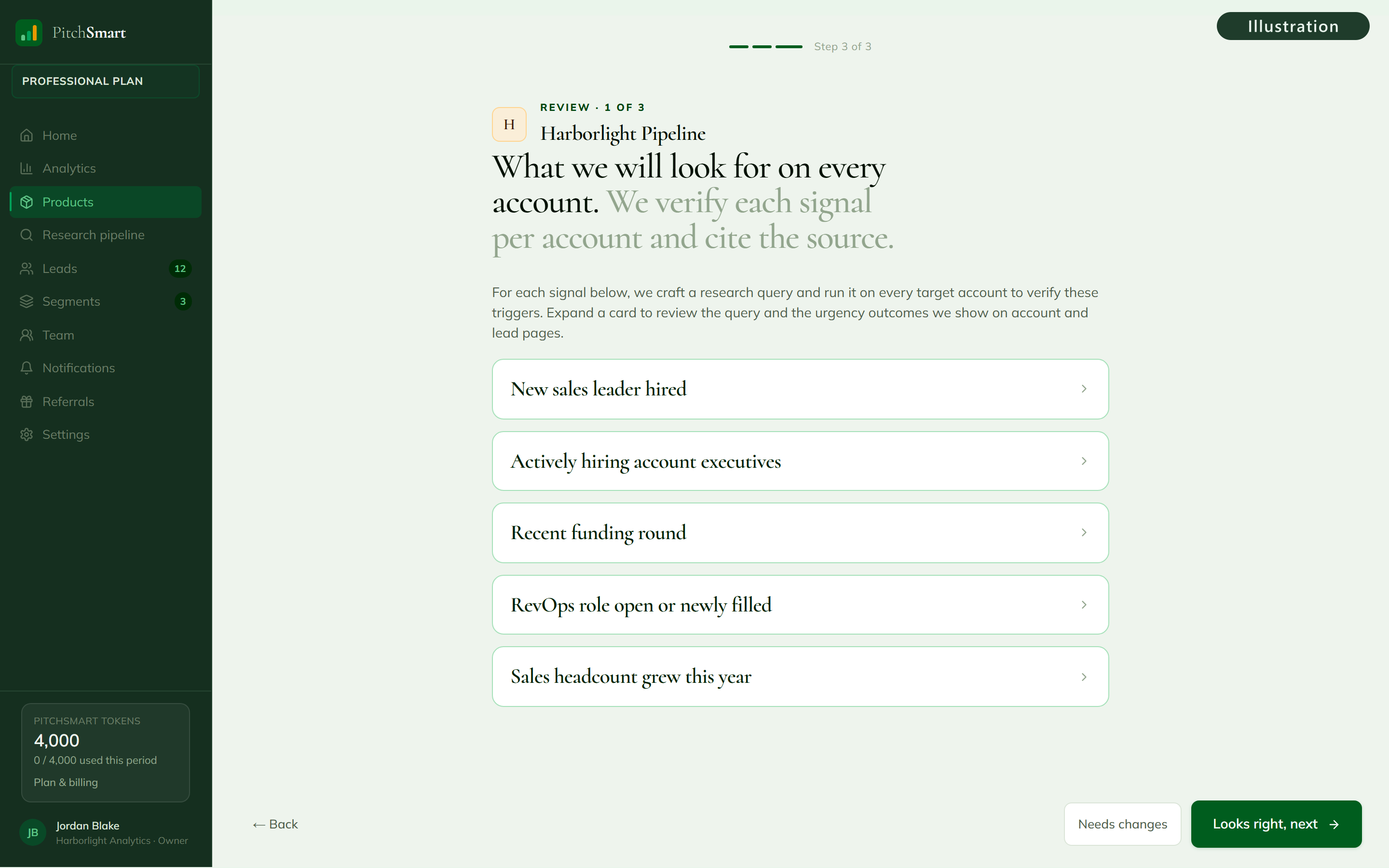
Illustration from a PitchSmart demo account. The company and person shown are invented. This is the review step for one product: each signal becomes a research query that runs on every target account, and the result is shown on account and lead pages with its source. To write your own signal standard and run it on your list, start a free trial.
Where enablement should report
The reorg question underneath all of this is usually whether enablement should sit inside revenue operations. There is no universal answer, but the tradeoff is well described. The Sales Enablement Collective's review of enablement reporting structures lists better access to data for measuring program impact as the main benefit of reporting into RevOps, and an overemphasis on processes, systems and data, at the expense of training, as the main risk, along with slower execution through extra approval layers.
That risk matches the decision rights table. If enablement reports into operations, the rows where enablement holds the final call tend to drift toward whatever is easiest to configure. Forrester's Ostrow describes enablement as a servant function that exists to help quota-bearers hit their numbers. A function in that position needs a direct line to sales leadership, whatever box it sits in.
A practical rule: keep enablement and operations as peers under the same revenue leader when the org sells more than one product, because the qualified account definition and the certification rules multiply with every product line and need an owner with authority over rep behavior. A single-product org with a small team can combine them under one leader, as long as the decision rights table still names an owner for every row.
A scope memo you can bring to the reorg meeting
Replace the "partner closely" slide with one page containing five parts:
- Decision rights table. Every recurring decision, one final owner, one consulted party.
- Artifact register. Every document, object and program, with a single maintainer and a review date.
- Contested items. Stage exit criteria, tool rollouts, win and loss findings, and buying signal definitions, each with its owner and a named consult step.
- Scorecards. Operations measured on forecast accuracy, data completeness and territory coverage. Enablement measured on ramp time, certification pass rates and adoption of what it trains.
- Escalation. The one person who breaks a tie, and the meeting where it happens.
The memo will not end the argument. It moves the argument from "whose job is this" to "is this row right", which is a conversation both leaders can finish. If account planning is next on the reorg list, our account planning template works well as the first shared artifact to run through the register.
Sales enablement and sales operations are not competing for the same work. They are two owners of different halves of the same artifacts. Write down which half is whose, and the partnership slide becomes unnecessary.