Your outbound team doesn't have a lead shortage. It has a prioritization problem.
Reps lose huge blocks of time to manual research, CRM cleanup, and chasing accounts that were never likely to buy in the first place. The result is familiar: generic sequences, weak personalization, slow follow-up, and a scoring model nobody trusts. Most lead scoring advice makes this worse because it's built for inbound forms and marketing automation, not for outbound teams working from owned prospect lists.
That's why a lot of outbound scoring projects fail. The model lives in a spreadsheet, the inputs go stale, and reps go back to gut feel. Meanwhile, the best opportunities sit buried in a list because nobody connected fit, timing, and real buying signals fast enough. If you're still scoring outbound prospects with static firmographics alone, you're not prioritizing. You're sorting.
The fix is to build lead scoring around how outbound works: list quality, account fit, recent signals, rep capacity, routing rules, and fast execution. When the scoring model is tied to automated research and source-backed signals, reps stop arguing with it and start using it.
1. Implement a Multi-Dimensional Scoring Model
Teams that score on a single dimension usually create one of two expensive problems. Reps either chase accounts that match the ICP but show no sign of change, or they burn time on active contacts inside accounts that were never likely to buy. Outbound scoring has to rank both fit and timing because your team is working owned lists, not waiting for hand-raisers.
A useful model answers three questions at once. Is this account a good match for the business? Is this contact someone who can influence a deal? Is there a credible reason to reach out now?
Score fit, timing, and workability separately
Keep the model short enough that a manager can audit it in a pipeline review. If scoring needs a spreadsheet and a RevOps translation layer, reps will ignore it.
Start with three buckets:
- Fit signals: industry, company size, geography, business model, team structure, tech stack, and whether the account matches your current ICP.
- Timing signals: hiring activity, funding, leadership changes, product launches, expansion moves, recent announcements, and any verified engagement with prior outreach.
- Workability signals: clean contact data, territory ownership, account status, open opportunity history, and whether the lead is usable by a rep right now.
This separation matters in outbound. A VP at a perfect-fit company with no visible trigger should not outrank a director at a slightly weaker-fit account that just opened ten relevant roles and replaced a key executive. The first lead may be strategic. The second is usually where meetings come from.
Weighting should come from closed-won patterns in your own CRM. A practical method is simple: calculate your overall lead-to-customer conversion rate, then compare each trait's conversion rate against that baseline. Traits that convert above baseline earn more points. Traits that consistently underperform should get fewer points or negative ones. That keeps the model tied to revenue instead of opinion.
Practical rule: If a rep cannot explain why a lead scored highly in one sentence, the model is too complex.
Manual research breaks this process fast. Scores decay when firmographics are stale, trigger events are missing, and reps are expected to verify every account by hand. Using automated prospect research from platforms like PitchSmart for outbound list enrichment and signal collection helps keep scores current across the lists you already own, which is what makes an outbound model usable at volume.
2. Establish Clear Sales-Marketing Alignment on Lead Definitions
Most lead scoring disputes aren't really about math. They're about definitions.
Sales says marketing passes junk. Marketing says sales ignores qualified leads. RevOps ends up trying to referee with a score threshold that nobody agreed on in the first place. In outbound, that friction gets worse because teams often source prospects from curated lists, partner data, events, and account research, not just inbound forms.

Write definitions people can actually use
A useful lead definition doesn't say "high intent" or "good fit." It says exactly what qualifies someone for outreach, handoff, recycle, or suppression. Reps need to know what to do with the lead, not just what bucket it sits in.
For outbound teams, define at least these stages:
- Research-ready: enough verified account and contact data exists to personalize outreach.
- Sequence-ready: the lead meets minimum fit criteria and has a usable hook.
- Rep-priority: score is high enough that the account deserves immediate attention.
- Recycle: fit is acceptable, but timing or contact quality is weak.
- Disqualified: wrong segment, wrong region, wrong account type, or blocked for compliance reasons.
The underexplained part of scoring is thresholding under real sales constraints. The harder question isn't whether to "set a threshold." It's what score should trigger handoff when rep capacity, territory rules, response-time expectations, and regional routing differ across teams. That's why data-driven guidance increasingly treats thresholding as an operational problem, using pipeline review, speed-to-lead monitoring, and recycle or leakage tracking instead of guesswork, as outlined in Reform's analysis of lead scoring thresholds.
Alignment breaks when teams define quality abstractly. It holds when each score band maps to a clear next action.
When definitions are concrete, reps stop treating scores as marketing decoration. They use them to decide who gets same-day outreach, who enters automation, and who shouldn't get touched at all.
3. Use Behavioral and Engagement Signals as Leading Indicators
Outbound teams often overvalue static fit because it's easy to store in CRM fields. But timing usually shows up in behavior first.
A company can match your ideal customer profile perfectly and still be a bad use of rep time this month. Another account might be slightly outside your sweet spot but clearly moving through a buying motion. If your model can't detect that difference, reps will keep sending polished emails to people who aren't paying attention.
Use recency rules, not permanent points
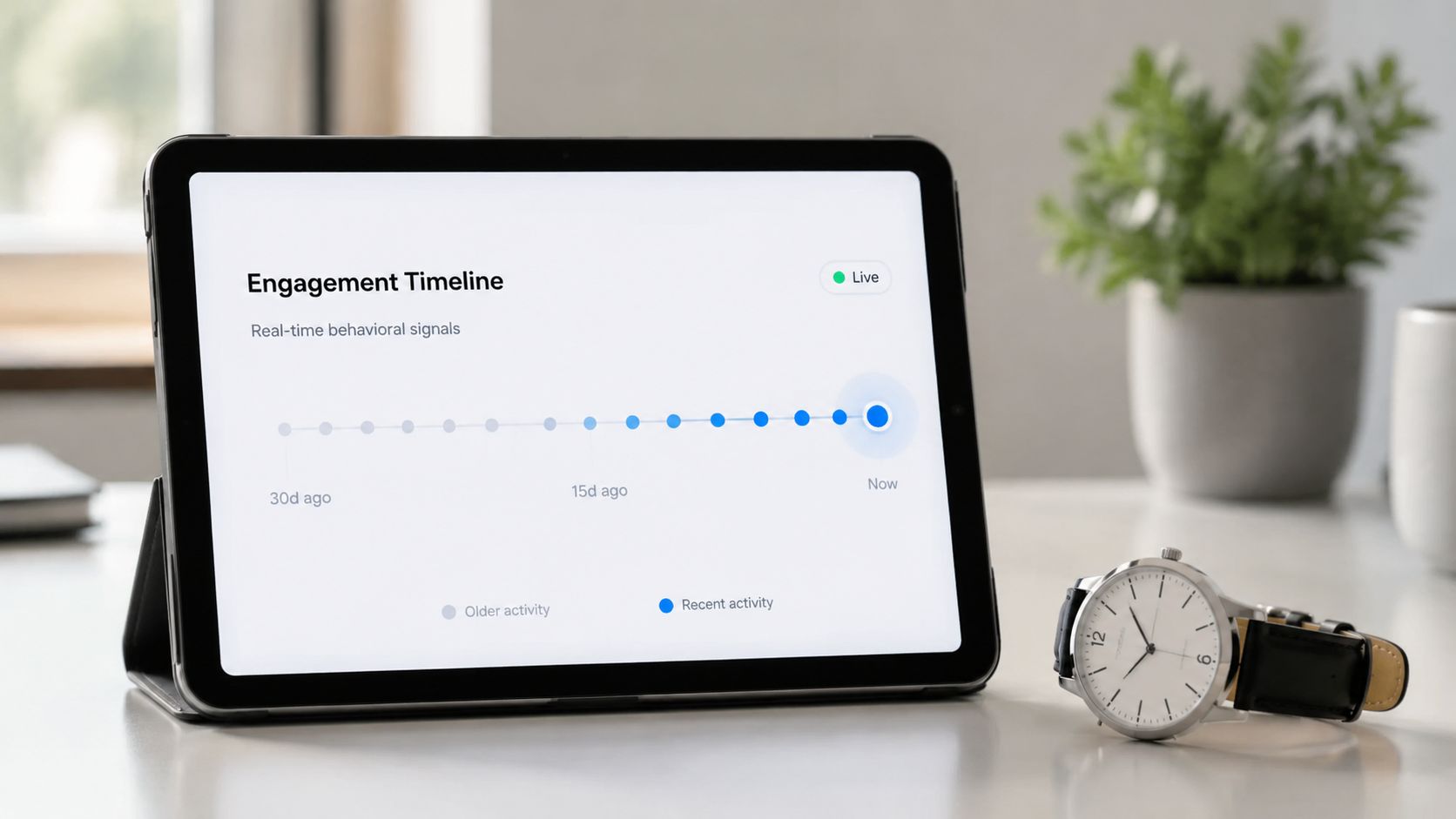
Behavioral scoring works best when signals are recent and specific. A prospect who opened an email months ago isn't hot. A company that just posted a relevant job opening, changed leadership, launched a new initiative, or clicked into your latest outreach sequence might be.
Good outbound behavioral scoring usually includes:
- Trigger events: hiring surges, team expansion, product launches, partnerships, leadership changes.
- Direct engagement: email replies, meaningful clicks, repeat visits, booked meetings, social interaction with clear buying relevance.
- Sequence interaction: which hooks got attention, which messages were ignored, and which persona engaged.
Don't award permanent credit for temporary behavior. Add decay rules so older actions matter less over time. Otherwise your model rewards stale interest and pushes reps toward accounts that had a moment of activity but no longer do.
This is also where generic cold email usually falls apart. Reps grab a broad list, send the same message to every contact, and then misread random engagement as real intent. What works better is linking behavioral signals to conversational hooks. If an account is hiring sales leadership, funding expansion, or restructuring a team, your first message should reflect that signal directly. PitchSmart's activity-based hooks and automated multistep outreach are useful here because the signal that lifts the score can also seed the opening line and follow-up sequence.
4. Continuously Test, Measure, and Refine Scoring Criteria
A scoring model that never gets revisited turns into list decoration. It may look disciplined in the CRM, but reps stop trusting it as soon as high-score accounts fail to reply and lower-score accounts keep booking meetings.
Treat the first model as a starting point. Then pressure-test it against outbound results you value: reply rate, meeting rate, opportunity creation, and progression by segment. For owned prospect lists, this matters more than it does in classic marketing automation, because your model is often scoring firms that have never touched your site. The score has to come from firmographic fit, contact fit, research signals, and sales outcomes, not just inbound behavior.
The benchmark approach works because it compares traits and signals against your real conversion baseline instead of internal opinion. If companies in one band consistently create pipeline and another band only generates opens or soft interest, adjust the weights. If a signal sounds persuasive but never changes outcomes, remove it.
A workable refinement process usually includes four checks:
- Review score bands against outcomes: compare scored tiers to meetings booked, qualified pipeline, and closed-won progression.
- Track sales feedback: give SDRs and AEs a simple way to flag false positives, missing signals, and accounts that were scored too low.
- Audit by segment: enterprise, mid-market, and SMB often convert on different patterns. The same is true across functions, regions, and sales motions.
- Cut weak variables: if a field or trigger does not improve prioritization, drop it before it adds noise.
Keep the review cadence tight. Monthly works for high-volume outbound teams. Quarterly is often too slow, especially if your team is adding new data sources, new territories, or new trigger signals.
PitchSmart's blog is a useful reference point for outbound teams working through list quality, personalization, and signal-based prospecting, especially when you're trying to connect scoring logic to actual outreach execution instead of keeping it trapped in RevOps documentation. Teams that want to operationalize that process faster can also evaluate PitchSmart pricing for automated research and outbound scoring workflows.
Field note: Strong scoring models usually get simpler over time. The best teams keep the few inputs that consistently improve prioritization and remove the rest.
Trust is the ultimate KPI here. If top reps still rebuild priority lists by hand, the model needs another pass.
5. Automate Research and Data Collection to Reduce Manual Effort
Manual research ruins lead scoring long before anyone notices.
A rep opens LinkedIn, checks the company site, scans recent news, updates CRM fields, writes a note, copies a hook into a sequence, and repeats the process account by account. By the time the list is scored, some of the signals are already stale. That's why many outbound teams know what they should score, but can't operationalize it consistently.

Automate before you optimize
Don't ask reps to become human enrichment engines. Automate collection first, then tune the model.
That means your system should pull and organize the signals your scoring model depends on:
- Account research: company context, segment data, public signals, relevant operational changes.
- Contact research: role, function, likely priorities, and whether the person fits the outreach motion.
- Conversation hooks: recent, source-backed details that give the rep a reason to reach out now.
- Routing inputs: owner, territory, sequence eligibility, and suppression status.
Automation also reduces a common scoring failure: inconsistency. One rep interprets a hiring signal as important. Another ignores it. One person logs a leadership change. Another never sees it. When bulk research runs across the full list, the model gets cleaner inputs and the team gets a more consistent priority queue.
PitchSmart fits cleanly into the workflow. Its bulk research, segmentation, and sequence generation help outbound teams move from "we should score this" to "the whole list is already researched, ranked, and ready to work." If you're evaluating rollout cost and volume, PitchSmart pricing is the page to review.
Automation doesn't eliminate rep judgment. It saves rep judgment for the moments that matter, like message angle, objection handling, and account strategy.
6. Implement Account-Based Scoring for Target Accounts
Lead scoring at the contact level alone creates a distorted view of value.
A single director at a strategically important account may deserve more attention than a senior executive at a company you'll never prioritize. Outbound leaders know this instinctively when they build target account lists. The problem is many scoring systems ignore it and rank contacts without enough account context.
Prioritize accounts, then contacts
Account-based scoring fixes that by scoring the company and the person separately, then combining the two. That's how you avoid flooding reps with individually strong contacts at low-priority accounts while missing coordinated buying activity inside the accounts that matter most.
In practice, score the account on factors like:
- Strategic fit: industry, business model, region, sales motion fit, contract potential.
- Current relevance: visible initiatives, team growth, leadership changes, market moves.
- Relationship context: existing customer status, prior conversations, open or closed opportunities.
- Coverage reality: whether the account sits in a strategic territory or named-account program.
Then score contacts within that account on role, influence, likely ownership of the problem, and engagement.
This matters even more for teams using advanced segmentation. If your platform can cluster accounts by buying signals, recent activity, and ICP fit, you can create separate outreach plays for different account types instead of forcing everything through one generic sequence. That's much closer to how strong outbound teams operate. They don't just ask, "Is this lead good?" They ask, "Is this account worth concentrated effort right now, and which contact gives us the best path in?"
When account scoring is done well, SDR prioritization, AE account planning, and manager inspection all get cleaner. The model starts to reflect revenue strategy, not just list hygiene.
7. Create Negative Disqualification Scoring to Eliminate Poor Fits Early
Often, teams spend too much time deciding who to pursue and not enough time deciding who to exclude.
That's expensive. Every low-fit prospect in a sequence steals time, attention, and deliverability from better opportunities. Good lead scoring best practices don't just reward positive signals. They actively penalize bad ones.
Protect rep time aggressively
Negative scoring should cover obvious disqualifiers and softer warning signs. Some leads shouldn't be worked at all. Others should stay in the database but drop below the line for active rep attention.
Useful negative scoring categories include:
- Hard disqualification: wrong geography, blocked industry, competitor, duplicate active opportunity, legal or compliance suppression.
- Role mismatch: student, consultant, junior title with no path to influence, generic inbox.
- Account mismatch: too small for your motion, wrong business type, no visible operational need.
- Signal conflict: recent layoffs, restructuring, or other context that makes your current offer poorly timed.
One mistake shows up a lot here. Teams build negative scoring so aggressively that they suppress every edge case. Don't do that. Outbound always has exceptions. A non-ideal company can still become a good opportunity if the timing is right, the problem is acute, or a strong champion appears. That's why soft penalties often work better than total removal unless the account clearly should never be touched.
Bad-fit leads don't just lower conversion. They also train reps to distrust the queue and go back to manual cherry-picking.
A clean disqualification layer makes the rest of the model stronger. Reps see fewer obvious misses, managers hear fewer complaints about lead quality, and the high-priority segment becomes more credible.
8. Build Transparent Source-Attributed Lead Scoring
Black-box scores create adoption problems.
If a rep sees a lead scored highly but can't tell why, they won't trust the rank. Even worse, they can't use the underlying signal in outreach. A score without explanation might help reporting, but it doesn't help a rep write a better first message.
Make every point explainable
Transparent scoring shows the logic behind the score and the source behind the signal. Instead of saying "priority score high," show that the account was prioritized because it matches your target segment, recently hired into a relevant function, and engaged with a specific message angle.
That changes rep behavior fast. The score stops being an abstract label and becomes a conversation starter.
A source-attributed model should expose:
- What raised the score: fit criteria, timing signals, engagement activity, account context.
- What lowered it: disqualifiers, stale signals, ownership conflicts, weak contact quality.
- Where the signal came from: company website, LinkedIn activity, public announcement, CRM history, outreach interaction.
- How recent it is: recent enough to use in messaging, or old enough that it should only influence routing.
PitchSmart is especially relevant here because its research workflow ties qualifiers and buying signals back to their original sources. For outbound teams, that's a big operational advantage. The same signal that drives the score can also be referenced in an email opener, a LinkedIn message, or a call prep note.
Transparent scoring also makes coaching easier. Managers can inspect whether reps are ignoring high-quality sourced signals, and RevOps can identify which sources correlate with useful conversations. That's how scoring becomes a working sales tool instead of a hidden formula.
8-Point Lead Scoring Best Practices Comparison
| Item | Implementation Complexity 🔄 | Resource Requirements ⚡ | Expected Outcomes 📊 | Key Advantages ⭐ | Ideal Use Cases / Tips 💡 |
|---|---|---|---|---|---|
| Implement a Multi-Dimensional Scoring Model (Explicit + Implicit Data) | High, multi-source integration, weighted params, real-time logic | Significant, firmographic + behavioral data, CRM integration, analytics, ops | More accurate prioritization, higher conversion and predictive deal signals | Balanced fit + intent scoring reduces false positives/negatives | Best for mid‑to‑large B2B with mature data; start with 5–7 criteria, baseline 50/50 weighting, recalibrate quarterly |
| Establish Clear Sales‑Marketing Alignment on Lead Definitions | Low–Medium, process, SLAs, documentation and governance | Low, meeting cadence, agreed definitions, CRM field standardization | Fewer handoff disputes, faster first contact, improved pipeline quality | Clear accountability, consistent handling, reduced lead attrition | Useful where sales and marketing are separate; use RACI, document criteria, set SLAs and kickback process |
| Use Behavioral & Engagement Signals with Time‑Decay Scoring | High, real‑time tracking, decay rules, multi-tool integration | High, intent providers, tracking tools, engineering, privacy compliance | Detects peak intent, higher response rates, faster deal velocity | Captures moment-of-interest for personalized outreach | Ideal for ABM and outbound; act within 24–48h, start with 30‑day decay, combine with firmographics |
| Continuously Test, Measure, and Refine Scoring Criteria (Win/Loss) | Medium, analytics pipelines, A/B tests, review cadence | Medium, analysts, CRM tagging, time for retrospectives | Improves predictive accuracy over time, reduces model drift | Data‑driven refinements identify truly predictive signals | Best when deal volume supports significance; run quarterly retrospectives, document hypotheses and changes |
| Automate Research and Data Collection to Reduce Manual Effort | Medium, connect enrichment tools and CRM, bulk processing setup | Medium, automation tools, subscriptions, integration and verification | Large time savings for SDRs, consistent data, scalable outreach | Eliminates manual errors, frees reps for conversations | Ideal for high‑volume prospecting; batch-process lists, integrate with CRM, spot-check data quality |
| Implement Account‑Based Scoring (ABM) for Target Accounts | High, account + contact models, aggregation logic, tiering | High, ABM platforms, coordinated account research, cross-team resources | Larger average deal size, focused resource allocation, faster multi-thread deals | Prioritizes strategic accounts and enables coordinated outreach | Best for enterprise/strategic sales; start with 100–500 curated accounts, score multiple contacts per account |
| Create Negative / Disqualification Scoring to Eliminate Poor Fits Early | Low–Medium, rule definition, suppression lists, automation | Low, exclusion lists, periodic review, policy owners | Fewer wasted touches, cleaner pipeline, improved rep efficiency | Quickly removes obvious non‑prospects and prevents brand risk | Use as an early filter; prefer soft disqualification first, review rules quarterly to avoid missing exceptions |
| Build Transparent, Source‑Attributed Lead Scoring (Signal Attribution) | Medium–High, track sources, show signal provenance, UI changes | Medium, multi-source integrations, audit trails, training | Higher trust and adoption by reps, better personalized outreach, auditability | Explainable scores, enables source performance analysis | Valuable where rep trust or compliance matters; show sources in CRM, tier source quality and validate signals |
From Scoring to Selling Put Your Model to Work
Lead scoring only matters if it changes rep behavior.
That's the ultimate test. Not whether the spreadsheet looks complex. Not whether the CRM field updates correctly. The test is whether your team reaches the right accounts faster, with better context, and with less wasted effort. If the answer is no, the model isn't helping revenue. It's just adding process.
The strongest outbound scoring systems share a few traits. They combine fit and timing. They use thresholds that reflect sales capacity and routing reality, not generic best-practice templates. They punish obvious bad fits. They get reviewed against actual outcomes. And, above all, they run on current, usable data instead of research that reps had to collect one account at a time.
This is often where the process falters. Manual research doesn't scale cleanly enough to support a serious scoring system. It slows prioritization, creates uneven data quality, and leaves reps writing outreach from half-complete context. By the time a lead is enriched, scored, and assigned, the best trigger might already be old.
For outbound teams, the path forward is straightforward. Automate the research layer. Pull explicit account and contact data in bulk. Surface recent activity signals that can act as both scoring inputs and messaging hooks. Segment lists by buying context, not just by title and industry. Then push those prioritized leads directly into sequences that reflect the reason each prospect was scored highly in the first place.
That's why platforms like PitchSmart are useful beyond simple enrichment. The product is built around the actual bottleneck: turning owned prospect lists into ranked, source-backed, conversation-ready outbound opportunities without forcing reps to do endless copy-paste research. Bulk research, activity-based hooks, list segmentation, and automated multistep sequences all support the same outcome. Faster prioritization and better outreach quality.
If you're rebuilding your lead scoring model, don't stop at the score. Build the workflow around it. The score should tell the team who to contact, why now, what signal matters, and what message angle to use. Otherwise you're still asking reps to do the hardest part manually.
Stop scoring stale records and hoping reps figure it out. Start with a model your team can trust, then feed it with research that's current enough to act on. That's how lead scoring best practices turn into actual pipeline.
PitchSmart helps outbound teams move from manual guessing to source-backed prioritization. Upload your list, let PitchSmart research accounts in bulk, score prospects using real signals, and generate conversation-ready outreach without the tab chaos.