Your rep opens the day with seven tabs, a CRM view that's already stale, and a spreadsheet full of half-qualified names. One tab is LinkedIn, another is Apollo, another is a notes doc, and every copy-paste adds another chance to miss a title, a trigger, or a buying signal. That's the bleeding neck in most outbound motions, not a lack of leads, but a workflow that burns time on research, admin, and data entry instead of selling.
That problem shows up fast in the numbers. In B2B, 53% of marketers spend at least half their budget on lead generation, and 45% of B2B businesses said generating enough leads was a significant challenge in 2024, which is why workflow efficiency matters so much in the first place. Outbound leads can cost 39% more than inbound leads, while inbound-marketing-dominated organizations see a 61% lower cost per lead Sopro lead generation statistics. The answer isn't to chase more volume, it's to qualify better, earlier, and with less manual work.
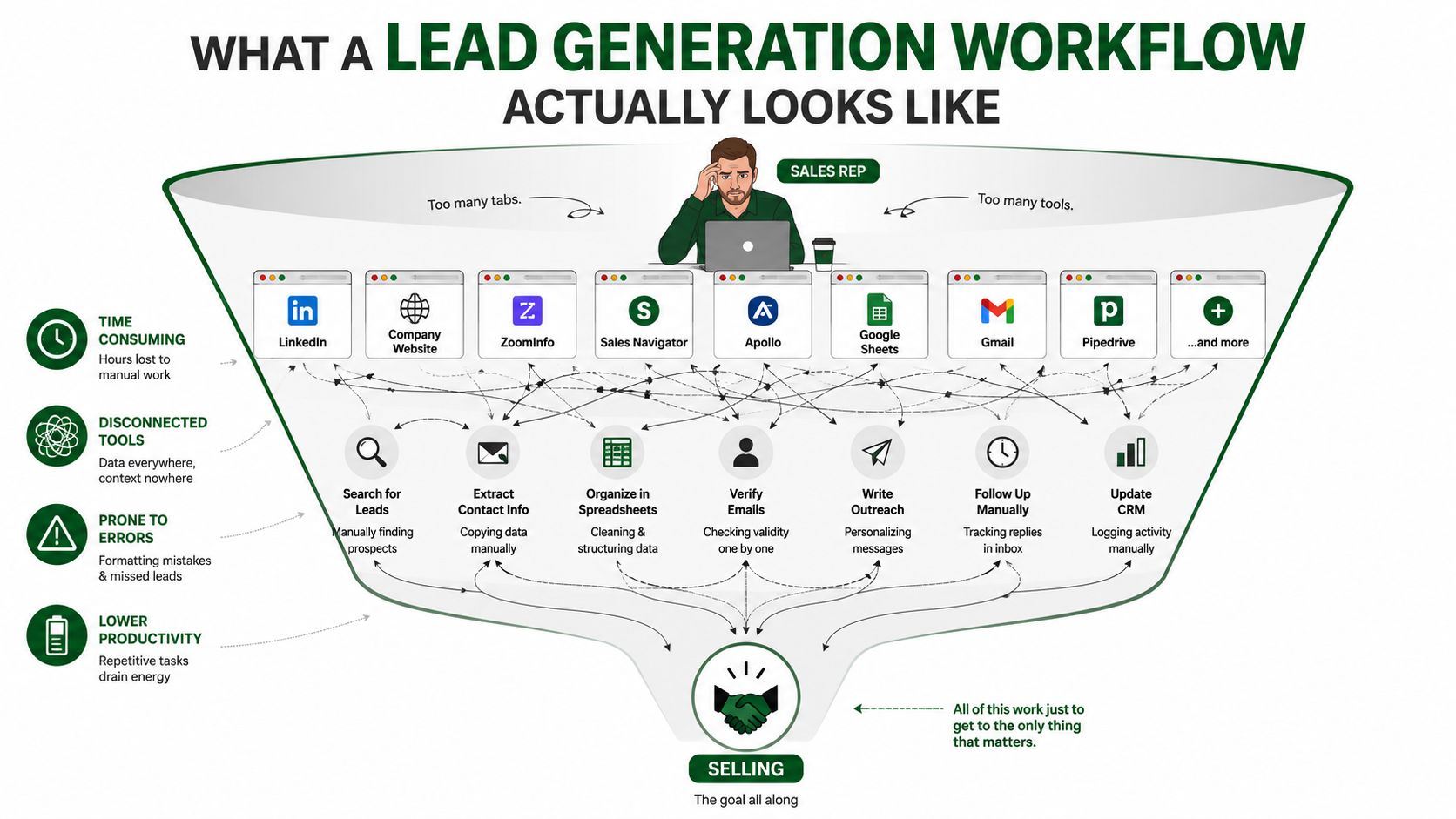
What a Lead Generation Workflow Actually Looks Like
A rep with too many tabs open is usually living inside a broken system, not a bad attitude. The work looks busy because every account gets handled as a one-off, so the day turns into browser juggling, spreadsheet cleanup, and manual note-taking while actual outreach gets squeezed into the margins. That is exactly why the old advice about “working harder” misses the point. The process is swallowing the selling time.
Practical rule: if a rep has to re-research the same company twice, the workflow is already leaking value.
A real lead generation workflow feels different because ownership, handoffs, and tooling are explicit. There's a clean entry point, a defined qualification gate, and a clear reason why a lead moves forward or stops. Instead of asking reps to improvise, the workflow tells them what happens next, who owns it, and what data has to exist before anyone starts sequencing.
That matters because the workflow is not a checklist of tactics. It's a system where each stage depends on the quality of the one before it, and the order matters more than the channel mix. A strong outbound motion can begin with a CSV, a CRM list, or an account plan, but it still has to move through the same gates: define the fit, enrich and verify the data, score the lead, outreach with context, nurture the not-ready ones, and measure what happened.
The fastest way to spot a mature motion is to ask one question. Can the team explain why a lead advanced, or did it just happen because someone had time to chase it? If the answer is unclear, the workflow isn't really a workflow yet. It's a pile of activities.
For teams trying to standardize this across outbound, PitchSmart fits the exact problem shape here because it starts from your own list and turns research into a repeatable sequence of steps instead of a manual hunt.
The Six Stages That Make Up a Modern Workflow
A workable lead generation workflow starts with sequence, not software. The six stages act like gates, and each one protects the next from bad data, weak fit, or random handoffs. If the order slips, the motion turns into expensive noise fast.
Define the ICP before anything else
The first stage is ICP definition. That is where you decide which company attributes and buyer traits matter, not the broad wish list many teams call targeting. If sales, marketing, and RevOps do not agree on the profile, scoring and outreach drift because they are built on a moving target.
Enrich and verify before scoring
The second stage is enrichment and verification. This is the point where many workflows break. If bad data enters the system, scoring becomes decorative and outreach turns into guesswork, because the workflow is now judging the wrong person, the wrong company, or a role that changed weeks ago. Verification comes before scoring for a reason.
Score, then route with a reason
The third stage is scoring. The fourth is outreach. The fifth is nurture. The sixth is measurement. Qualified leads convert to customers at roughly 10% to 30%, so this gate matters materially, because every poor-fit lead that gets through widens the gap at scale Prospeo lead generation workflow. When qualification is weak, sales spends time on accounts that never had enough fit or intent to justify the handoff.
A simple way to sketch the system is this:
- ICP definition decides who belongs on the list.
- Enrichment and verification confirms the row is real and usable.
- Scoring converts signals into priority.
- Outreach uses the score and the research to shape the message.
- Nurture keeps the not-ready leads warm.
- Measurement feeds the loop back into the ICP and the rules.
The workflow is only as strong as the earliest data gate. Once a bad record is scored and sequenced, the error gets more expensive at every later step.
A practical workflow also needs source-traceable scoring, so a rep can explain why one account moved forward and another stayed out. That means the score is not just a label. It carries the evidence behind it, which keeps the team honest when marketing, sales, and RevOps disagree on what qualifies. PitchSmart blog is one example of how teams can structure that kind of repeatable process around their own list and their own research rules.
Running Research in Parallel Across the Whole List
The biggest bottleneck in outbound is still the one-by-one prospecting habit. A rep opens a company, looks for a clue, writes a note, updates the sheet, then repeats the same motion for the next record. That pattern feels thorough, but it doesn't scale, and it makes the workflow fragile because every lead gets different treatment depending on how much time the rep had left.
Replace tab-hopping with bulk research
Parallel research fixes that by touching the whole list at once. A 500-account list pulled from the CRM can be researched in one pass, with each row enriched by the same categories of data, firmographics, recent activity, and conversation hooks drawn from online signals. The point isn't speed for its own sake, it's consistency. Every account gets the same research treatment, so the scoring model has comparable inputs across the full list.
That consistency is what makes the output auditable. A lead should not just carry a “high intent” label. It should carry the source behind that label, so a manager can see which buying signal triggered the score and why the row advanced. That traceability matters when sales asks why one account went to outreach and another stayed in nurture.
Log the evidence, not just the summary
A strong workflow records source-backed qualifiers at the row level. That might include a company detail, a recent product or hiring signal, a relevant page visit, or a public update that connects the account to your offer. Research from AI-based business prospecting shows that effective enrichment is built from structured, source-backed facts such as company name, location, industry, recent events, and why the company matches the profile, then condensed into a lead summary AI prospecting research. The important part is that the summary doesn't replace the evidence. It points back to it.
Practical rule: if the research can't be traced to a source, it shouldn't influence routing.
That's the gap most guides skip. They talk about enrich, qualify, and route, but they don't explain how to execute bulk research while keeping the evidence attached. For outbound teams, that's the core operational breakthrough, because it lets hundreds of rows move through the same standard instead of becoming a pile of inconsistent notes. A useful reference point for this style of execution is PitchSmart's workflow notes, since the process begins with your list and preserves source traceability as the list is researched.
The output should be simple enough to read in one screen. One row, one set of signals, one source trail, one next action. Anything more complicated is just another form of manual work wearing automation clothing.
Scoring, Prioritization, and the MQL-to-SQL Gate
Scoring is where raw research becomes a routing decision. If the workflow can't explain why a lead is sales-ready, the score is just a number sitting on top of a spreadsheet. Good scoring combines fit and intent, then makes the handoff defensible.
Fit and intent should never be the same thing
Fit asks whether the account belongs in your ICP. Intent asks whether the account is showing signs it's ready for a conversation. Those are different questions, and they need different weights. A perfect fit with no signal may belong in nurture, while a moderate fit with a strong trigger may deserve immediate attention from sales.
That distinction is why the MQL-to-SQL gate matters so much. A 2026 benchmark showed median MQL-to-SQL conversion at 9.8%, compared with 16.4% for the top quartile and 3.1% for the bottom quartile, while the full lead-to-closed-won rate sat at only 0.94% at the median Whitehat SEO B2B lead generation benchmark. The spread says the quiet part out loud, better scoring discipline changes routing quality, and routing quality changes pipeline.
Sample Signal Weights for a B2B SaaS Lead Score
| Signal | Type | Weight | Routing impact |
|---|---|---|---|
| ICP-matched industry and company size | Fit | High | Advances if other fit criteria are present |
| Recent hiring or growth event | Intent | Medium | Boosts priority for review |
| Pricing-page visit | Intent | High | Moves lead toward sales review |
| Webinar attendance | Intent | Medium | Sends to nurture or SDR follow-up depending on fit |
| Clear title match to buying role | Fit | High | Supports SQL handoff |
| Repeated engagement across channels | Intent | High | Raises urgency for outreach |
That table only works if every advanced lead carries a reason it advanced. A score without an explanation creates a black box, and black boxes are hard to defend when sales wants to know why one account got attention first. The routing rule should be readable in plain English. For example, “ICP fit plus a recent trigger plus a buying-role title” is useful. “Score 82” is not.
The best teams keep the model small enough to inspect and strict enough to trust. If the score can't be audited, it will eventually be ignored. If it can be audited, it becomes the backbone of the workflow.
Outreach Sequences That Use the Research
Research only matters when it changes the first message. Generic cold email fails because it treats every prospect like a template recipient, not a specific account with context. Once the lead is scored, the outreach should be built from the strongest hook the research surfaced, not from whichever opener happened to be in the sequence library.
Use a three-step cadence with a real signal
A tight 3-step email and LinkedIn sequence is enough when the targeting is solid. The first touch should name a recent signal, the second should translate that signal into a problem the prospect already understands, and the third should be a simple breakup that makes reply easy. When the list is clean, longer cadences often add repetition without adding relevance.
A hook-driven subject line is specific because it points to the signal. A generic one sounds like mass email because it could apply to anyone. Compare “Question about your expansion plan” with “Saw the new product hire” or “Quick follow-up on the hiring signal.” The second style works because it proves the sender did actual research.
A simple structure that sales can actually reuse
- Step 1, email: open with the strongest observed signal, then connect it to one business implication.
- Step 2, LinkedIn: mirror the same hook in a lighter tone, then add one sentence of context.
- Step 3, email: send a short breakup that names the original reason for reaching out and gives one clear next action.
The handoff should include the full research context, not just the message body. Sales does better when the signal trail is visible, because the rep knows which fact triggered the sequence and which angle to keep using on the call. Independent AI lead generation research describes the operational flow as discover, qualify, then engage at the right moment with personalized messaging AI lead generation workflow. That maps cleanly to a workflow where the sequence is seeded from the best hooks, not sent at random.
Practical rule: if the opening line could be reused for ten unrelated accounts, it's too generic.
The point is not to send more touches. It's to send fewer touches that sound like someone looked at the account.
Tooling, Integrations, and Where Automation Fits
Tool selection should follow the workflow, not the other way around. A lot of teams buy software before they have a documented process, then end up with a stack that looks busy but still leaks conversion at the handoff points. Over-automation is usually the problem. It hides bad inputs, unclear ownership, and weak qualification until the pipeline report shows the miss.
Match the tool to the stage
Start with list intake in the CRM or a CSV. Use a research platform that can run bulk enrichment with source-backed signals across the full list, because parallel research is what keeps a workflow from turning into a queue of half-finished accounts. Then send the scored rows into your sequencing tool, whether that is Outreach, Salesloft, or another sender the team already trusts. Keep routing and notifications in the CRM, because that system needs to remain the source of record for ownership and status.
A practical stack keeps each layer narrow. Research output should be structured, not buried in a paragraph that nobody can audit later. Sequences should be seeded from scored rows, not from a random list export, or reps will waste time on accounts that never should have entered outreach. Measurement should flow back into the ICP and the messaging rules instead of sitting in a monthly report that gets ignored after the meeting.
One workable choice in this category is PitchSmart, which imports CSVs or CRM lists, researches accounts in parallel, scores fit, and generates outbound sequences from the signals it finds. Its value comes from where it sits in the process, not from sitting above the rest of the workflow. Teams that want to review plans before they commit can also check the PitchSmart pricing page.
Integration checklist you can defend internally
- CRM as the source of truth: every status change and owner assignment lives there.
- Structured research output: every qualifier is attached to a source-backed field.
- Scored rows into sequencing: outreach only starts after the gate is passed.
- Closed-loop measurement: performance data feeds back into ICP and messaging rules.
A scalable workflow guide from Martal recommends mapping the current process, defining goals and KPIs, and establishing a baseline before adding automation Martal lead generation workflow. That order matters. If the team cannot describe the process on paper, another tool will not make it clearer.
The right stack makes the workflow visible. The wrong stack just makes the chaos look organized.
Metrics, Dashboards, and Common Failure Modes
Watch aggregate campaign numbers and miss the actual leak. That's a mistake because a lead generation workflow breaks at handoffs, not at the top line. The dashboard needs to show where the funnel is thinning, otherwise the team keeps optimizing the wrong stage.
Track the handoff, not just the outcome
The core checkpoints are Lead-to-MQL, MQL-to-SQL, and SQL-to-Closed. Each one answers a different question. If Lead-to-MQL is weak, the issue is usually targeting or capture quality. If MQL-to-SQL is weak, the problem is usually scoring or handoff quality. If SQL-to-Closed is weak, the issue is usually qualification, message match, or follow-up discipline.
That stage-by-stage view matters more than channel pride. Prospeo reports B2B SaaS funnel benchmarks including Lead-to-MQL at 39% and SQL-to-Closed at 37%, and it also notes a sharp channel spread in close rates, with SEO at 14.6% versus outbound at 1.7% Prospeo lead generation process. The point isn't that one channel is always better. The point is that workflow quality can't be judged by volume alone.
The recurring failure modes to look for
- Bad data entering scoring: if titles, companies, or signals are wrong, the score becomes noise.
- Premature automation: if ownership and rules aren't defined first, automation only hides the mistakes faster.
- Vanity metrics: opens and clicks can look healthy while the handoff is still broken.
Salesforce recommends A/B testing form fields, layout, and CTA language, and tracking conversion rate, cost per lead, lead quality, and ROI while passing qualified leads only after they meet predetermined criteria Salesforce lead generation guide. That's the right framing because it keeps the dashboard tied to decisions, not decoration.
If a dashboard can't tell you why a lead stopped moving, it's reporting activity, not performance.
A rollout that actually gets used
Week 1, map the current process, define the ICP, and set baseline KPIs. Week 2, stand up enrichment and verification with explicit rules. Week 3, launch scoring and push the first scored list into a 3-step sequence. Week 4, review the dashboard, tighten the model, and feed the learning back into the ICP and messaging rules.
After that, keep the cadence simple. Review stage metrics weekly, refresh scoring weights monthly, and audit the ICP quarterly. That rhythm is what turns the workflow into a system instead of a campaign.
If you're rebuilding outbound around parallel research, source-traceable scoring, and tighter sequencing, PitchSmart is built for that motion. It helps teams research whole lists in bulk, attach signals to their sources, and turn those signals into outbound sequences without the usual tab-hopping. Visit PitchSmart if you want to test that workflow on your own list and see how much manual research you can cut out.