You opened the CRM to a clean-looking list, but the list lied. Half the emails are stale, the job titles are off by one org change, and the reps still spend the morning cross-checking LinkedIn tabs before they can write a single line that doesn't sound like a mail merge. That's the cost of weak data enrichment techniques in outbound: wasted selling time, thin personalization, and sequences that arrive sounding generic because the team never had enough signal to begin with.
What usually gets called “research” is really a patchwork of manual lookups, partial appends, and duplicate records that drift across tools. PitchSmart's model is built for the opposite workflow, bulk research on your own list, source-backed qualifiers, and conversation plans seeded from recent signals, so the rep starts with usable context instead of a pile of tabs. That shift matters because enrichment is only useful when it turns raw records into actions a rep can take the same day.
The Hidden Tax on Every Outbound Rep
Tuesday morning usually starts the same way. Eleven tabs are open, LinkedIn in one, the CRM in another, a company website, a funding database, a job board, a tech lookup tool, and a spreadsheet somebody swore was “the source of truth.” By the time the rep has checked a few titles, confirmed a domain, and copied a line into the sequence builder, lunch is already close and the actual selling part of the day hasn't started.
That's why manual research feels like a tax, not a task. PitchSmart's own framing is blunt about the productivity hit, because repetitive research, admin, and data entry consume roughly 70% of a rep's day in the workflow it's trying to replace. When a rep has to research accounts one by one, every additional record lowers throughput, and the first thing to slip is the opener quality, which is how you end up with generic emails that read like a merge field accident.
Parallel research changes the unit of work
The difference isn't “better data” in the abstract. It's the fact that a CSV can be uploaded once and researched in parallel, so a 200-account list doesn't demand 200 separate manual digressions before the first sequence goes out. That changes the unit of work from “find something interesting on this one prospect” to “generate a usable signal across the whole list.”
Practical rule: if your rep has to open multiple tabs to write the first line, the enrichment process is still too manual.
That's where bulk research and signal-backed hooks matter for outbound teams. Instead of enriching a record just so it looks fuller, the workflow should surface a trigger, a hiring move, a tech change, a recent announcement, something the rep can reference that afternoon in a first line that doesn't sound scraped. PitchSmart fits that model by researching owned lists in parallel and turning those qualifiers into outreach inputs, so the list comes back closer to send-ready instead of merely cleaner.
What Data Enrichment Means for Outbound
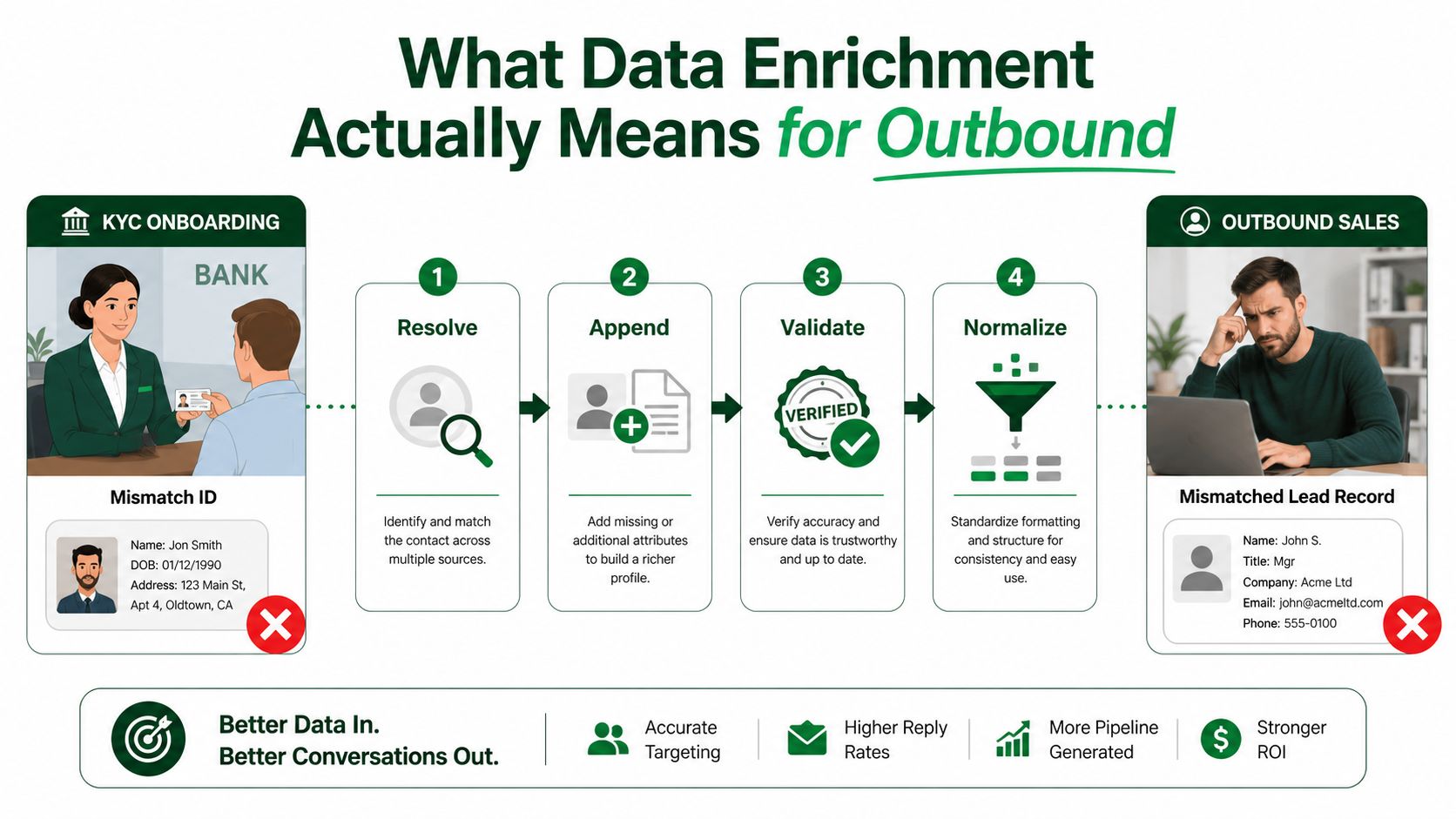
In outbound, data enrichment is a sequence, not a single append. It starts with entity resolution, then moves to attribute augmentation, then validation, then normalization, so the record you write against is the right one. IBM's framing makes the structure clear, enrichment starts with cleaning, then source selection, then adding data through integration tools, not the other way around. IBM's overview of data enrichment is useful because it treats enrichment as workflow, not magic.
Why resolve comes before append
If a bank onboarding team mismatches an identity, the account can't safely move forward. Sales has the same problem. A rep can't personalize a sequence against an unresolved company record and expect routing, scoring, and segmentation to stay intact, because appends will attach to the wrong entity if the identity layer is messy.
The order matters. First, resolve duplicate or conflicting identities with deterministic rules or fuzzy matching where needed. Then append useful fields, things like firmographics, lifecycle metadata, or geocodes. After that, validate the values against source quality and normalize the formats so “NYC” and “New York City” don't live as separate realities in the CRM.
Enrichment is bigger than cleaning alone
Cleaning alone removes noise. Appending alone adds fields. Enrichment combines both and makes the output operational. A team that skips resolution usually does not notice the failure immediately, because the CRM still looks fuller, but routing breaks, scores drift, and the wrong rep gets the wrong account.
A fuller record isn't the same thing as a better record.
The strongest enrichment setup sits between raw inputs and downstream execution. PitchSmart's lead research workflow fits that layer because it works from your existing list, ties qualifiers back to source, and gives reps something they can use immediately instead of forcing them to clean and personalize in separate tools.
The Six Core Data Enrichment Techniques
The vendor market loves to present data enrichment techniques as if they're all interchangeable. They're not. The right method depends on the question you need answered, the speed you need it answered at, and how much trust you can place in the match. CUFinder's breakdown is useful here because it treats firmographic, technographic, contact, intent, behavioral, and reverse-ETL sync as distinct methods, not one giant bucket. CUFinder's technique guide is a good reference point for the taxonomy.
The practical read on each technique
Firmographic enrichment adds company context like industry, size, and location. Use it when you need to segment lists, prioritize ICP fit, or route accounts to the right owner. It's how a rep notices that two companies look similar on paper, but only one fits the segment the team sells into.
Technographic enrichment adds the stack behind the account. Use it when displacement, integration fit, or tool overlap matters. A tech-stack mismatch can surface an upgrade or replacement conversation instead of a generic pitch.
Contact enrichment fills in role, title, email, or phone details. Use it for direct outreach and routing, but treat freshness carefully because titles and contact data move fast.
Intent enrichment adds buying-signal context. Use it when timing matters more than breadth, since those signals help you pick which accounts deserve the next touch.
Behavioral enrichment captures observed actions across web, content, or product interactions. Use it when you want a message that reflects engagement history rather than static company facts.
Reverse-ETL sync pushes enriched fields back into CRM and sequencers. Use it when the enrichment only matters if sales can act on it.
Comparison table
| Technique | Typical Match Rate | Refresh Cadence | Best Use Case |
|---|---|---|---|
| API-based enhancement | 70–95% | Instant | Real-time lead capture and fast routing |
| Third-party integration | 60–85% | Monthly or quarterly | Bulk account enrichment |
| Web scraping | 40–70% | Weekly or monthly | Broad coverage when other sources are thin |
| Intent data integration | 40–80% | Daily | Timing-sensitive prioritization |
Those technique-level ranges come from a 2025 industry overview, and they matter because they show why one method rarely solves every outbound problem. Higher-confidence API and partner-data methods are better when a rep needs dependable context fast, while broader methods like scraping are noisier and should be treated as a fallback. The technique benchmarks make the trade-off obvious, coverage rises as precision and freshness vary.
PitchSmart's blog is relevant here because the useful question isn't “which enrichment vendor is loudest,” it's “which signal helps the rep write a better first line today.” That's the level at which technique choice matters.
Sources, Matching, and the Waterfall Decision
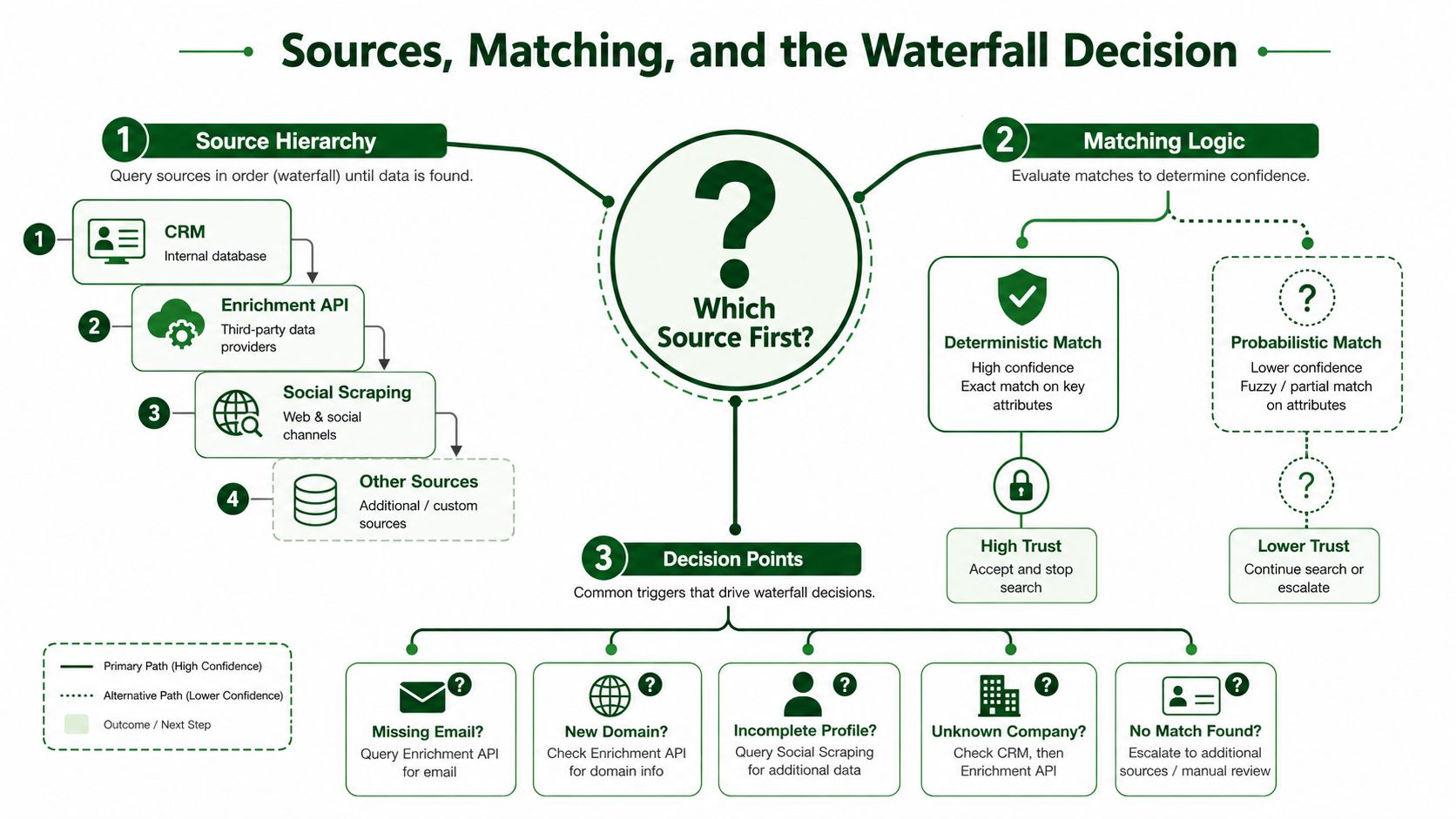
Source order decides whether enrichment helps or hurts. Query the weakest source first, and you spend time cleaning up junk while still risking the wrong values on the wrong account. A better setup uses a waterfall, first-party CRM data first, then contracted partner data, then API enrichment, and scraping only when nothing better is available.
Match quality is a gating step, not a nice-to-have
Deterministic matching works when the identifiers are strong enough to trust, like a clean domain or a stable account key. Probabilistic matching has a place when the record is incomplete, but it needs caution because fuzzy logic can merge identities that only look similar. Upstream cleanup, especially canonicalization, prevents that mess. If one system says “NYC” and another says “New York City,” the join should treat those as the same value before the record reaches scoring.
Operational truth: most enrichment failures aren't data failures, they're match failures.
That is why source hierarchy matters in practice. First-party CRM records should anchor the identity. Contracted partner data should fill what the CRM lacks. API lookups then add speed where freshness matters. Scraping belongs at the edge because it can widen coverage, but it also adds more uncertainty and more compliance risk.
Decision logic by trigger
A missing email should send the record down a contact-enrichment path. A new domain or merged account should trigger identity review before any append. A suspiciously old title should trigger revalidation instead of blind reuse. These are not abstract rules, they are the branch points that keep a sequencer from sending good copy to a bad record.
A strong outbound stack combines batch and real-time for different reasons. Batch is easier for deduping, backfills, and scheduled CRM refreshes. Real-time works better for new inbound leads, account activity, or any trigger where the first touch needs fresh context before the rep starts typing.
From Raw Record to Ready-to-Send Opener
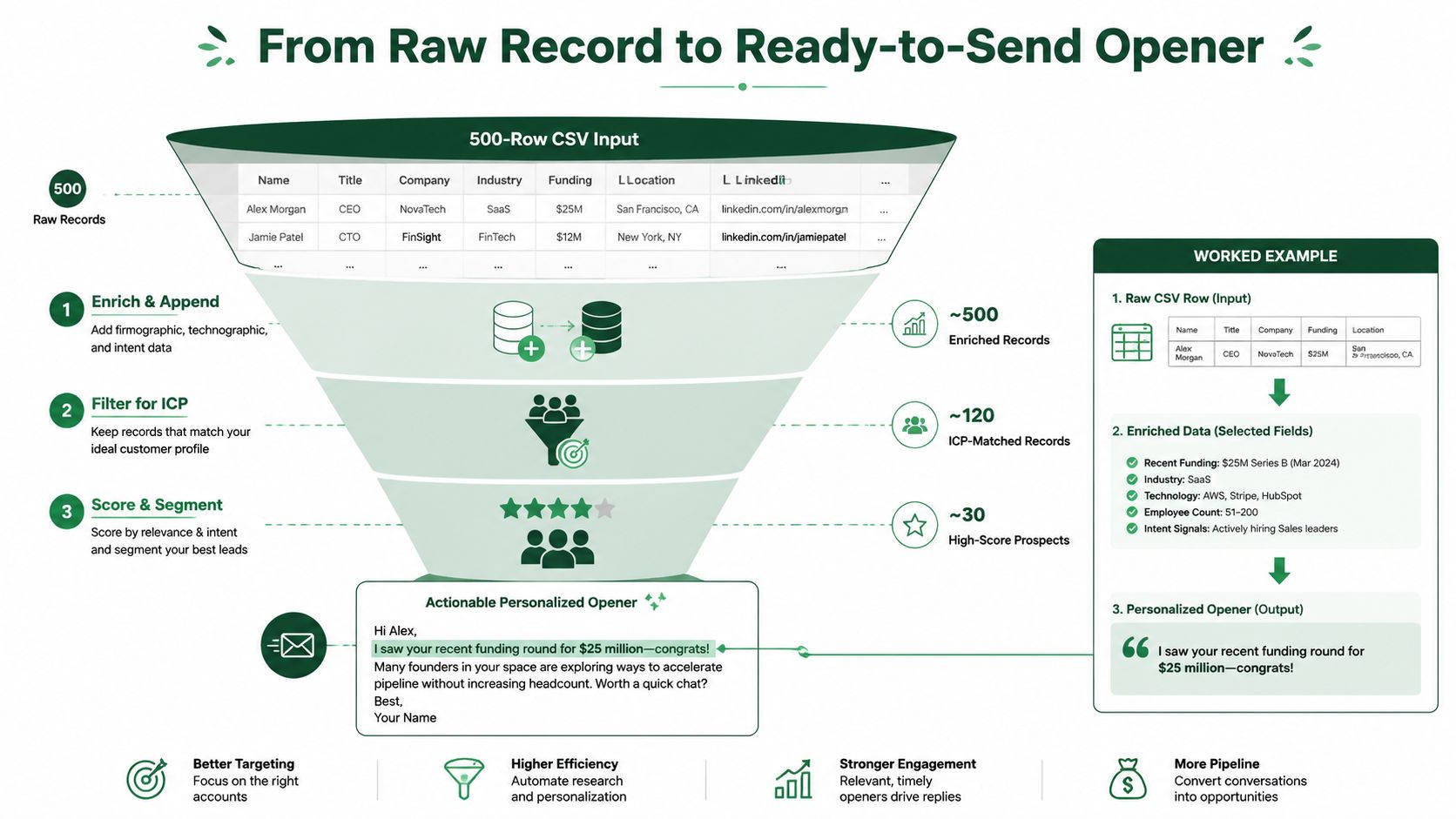
A 500-row CSV is where theory meets the dashboard. If the list comes in raw, the right sequence isn't “enrich everything and hope it helps.” It's resolve the identities, enrich only the fields that matter, score the rows against a few rules, then split them into sequences that each have a different conversation trigger.
A simple scoring model that a rep can actually use
Start with three rules. Give seniority fit one point if the contact is in the buying committee. Give tech-stack overlap one point if the current stack suggests compatibility or displacement. Give recent trigger one point if there's a hiring post, funding round, or tool migration worth mentioning. A row that scores three gets a direct opener, a row that scores two gets a softer hook, and a row that scores one gets put into a lower-priority nurture sequence.
That structure keeps the enrichments tied to execution. A hiring post becomes a staffing and scale conversation. A funding round becomes a growth and timing conversation. A tool migration becomes a switch-cost or integration conversation. The opener isn't invented from nowhere, it's pulled from the signal that was already appended.
What the rep sends that afternoon
- Hiring post trigger: lead gets a line like, “I noticed your team is hiring into the function I work with most.”
- Funding trigger: lead gets a line like, “I saw the recent funding announcement and thought the timing might be right for this.”
- Tool migration trigger: lead gets a line like, “Looks like your stack is changing, which usually creates a short window to tighten the workflow.”
Those openers work because each one maps to a concrete reason for contact. They don't need cleverness, they need accuracy and relevance. A cleaned, enriched row should end with a clear next action, not just a prettier CRM entry.
If the appended field doesn't change the opener, it probably shouldn't have been enriched in the first place.
That's also where PitchSmart belongs operationally. Its bulk research, source-backed qualifiers, and automated 3-step email and LinkedIn sequences are most useful when the team wants signal-driven openers without manually stitching every row together.
Freshness, Decay, and the Refresh Cadence Problem
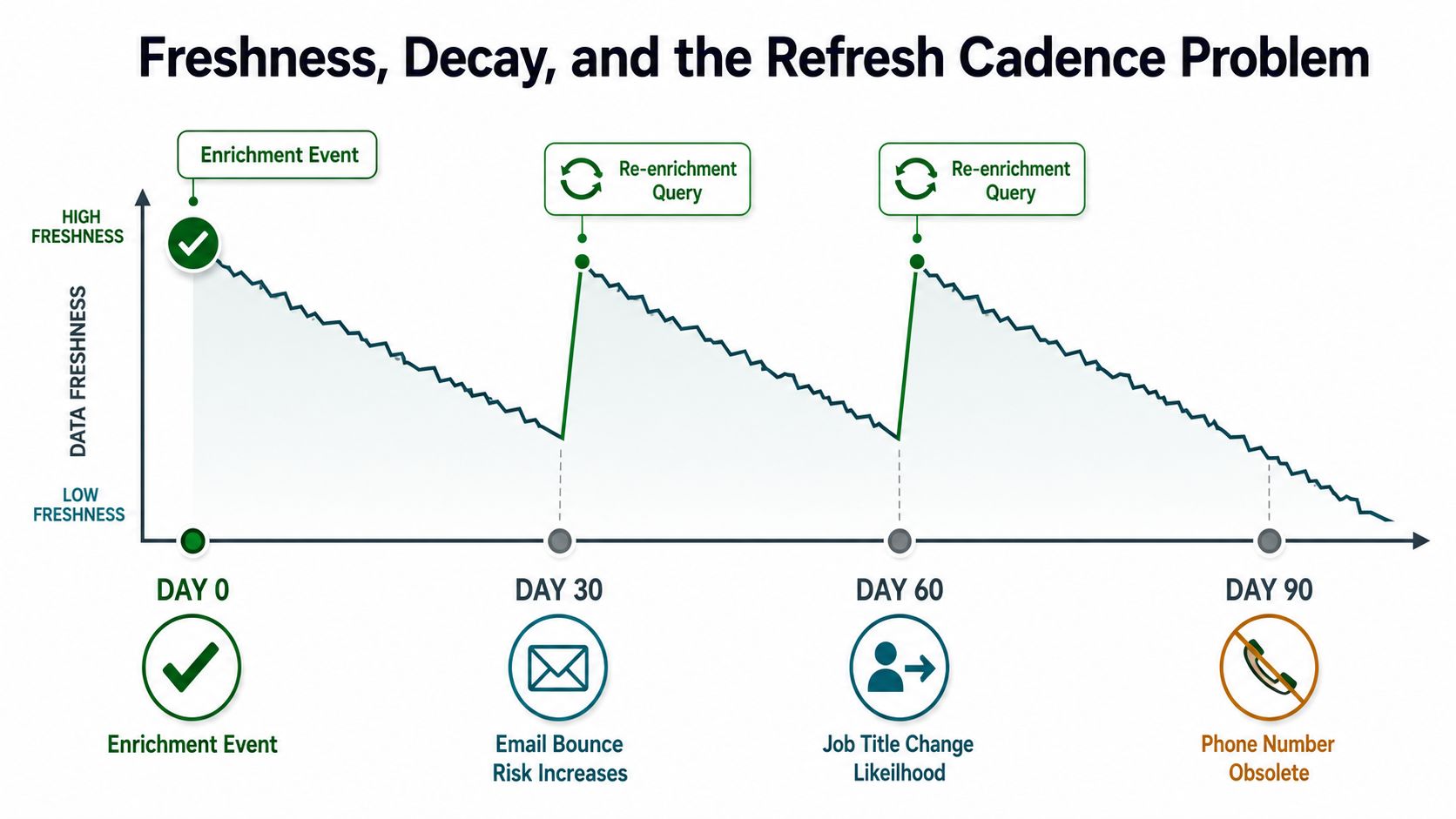
The hardest part of enrichment is not getting the data once. It is keeping it useful. A record that looked clean last quarter can already be misleading if the contact changed jobs, the account reorganized, or the signal that drove the sequence has expired. HubSpot's guidance notes that titles and phone numbers may need monthly or quarterly refresh, while firmographics can refresh annually, which is the right way to think about the problem, by attribute type, not as a single blanket policy. HubSpot's enrichment guidance makes the decay issue explicit.
Each attribute needs its own heartbeat
Contact data decays fastest because people move. Trigger data decays quickly because buying signals have a short shelf life. Firmographics change more slowly, so they can sit on a longer cadence. If the whole CRM is refreshed on the same schedule, the team either wastes effort on stable fields or lets important fields go stale.
The better setup is to assign a refresh owner for each class of data. Sales ops can own contact and routing fields. RevOps can own dedupe and normalization. Marketing ops can own trigger syncs into sequencing. That keeps the enrichment workflow active instead of treating it like a one-time import.
Continuous pipelines beat one-off cleanups
Cloud-based workflows matter because enrichment is no longer a quarterly cleanup task. The broader market coverage points to that shift, with cloud deployments holding 56% market share in 2023 and projected to grow at 12.7% CAGR through 2030, while the overall data enrichment market was put at $2.37 billion in 2023 and $4.58 billion by 2030. Market coverage on enrichment growth points to the same operational conclusion, enrichment is becoming a continuous layer, not a one-off project.
That cadence should pull the decay line back up before the CRM drifts into irrelevance. A rep does not need every field perfect forever. A rep needs the right fields fresh enough to support the next send, the next route, or the next follow-up.
PitchSmart's privacy controls sit in the same operational bucket, because refresh logic and compliance logic should be managed together, not as separate afterthoughts.
Privacy, Compliance, and the Operational Guardrails
Outbound teams don't get to treat compliance as a legal footnote. If the source is sloppy, the domain takes the hit, the suppression list gets out of sync, and the team ends up enriching contacts it can't safely mail. That's why GDPR, CCPA, and CAN-SPAM should be handled as workflow guardrails, not a disclaimer bolted onto the end of a project plan.
Three controls that keep the workflow sane
First, confirm lawful basis for processing B2B contact data in the jurisdictions you work in. Second, keep suppression lists synced between the enrichment layer and the sequencer so opt-outs don't re-enter the flow. Third, check vendor provenance before you trust a source, because if a provider won't explain where the data came from, you're inheriting that uncertainty.
A high-risk source usually shows the same signs. No published provenance. No clear opt-out mechanism. Scraping public profiles without a consent story. Those are the kinds of shortcuts that create operational drag later, even when the first import looks successful.
Checklist for RevOps: source provenance, opt-out path, suppression sync, retention policy, and a named owner for refresh cadence.
PitchSmart's privacy controls fit this same operational standard because compliant enrichment should reduce risk, not create a new review queue. The point is simple, disciplined enrichment keeps deliverability cleaner and gives the team a list it can work from.
Rolling Out an Enrichment Workflow in 30 Days
The fastest way to ship this is to treat it like a workflow rollout, not a software install. Week one is a data audit, where you find the fields that drive routing, segmentation, and opens. Week two is choosing 3 to 5 priority fields, because Zapier's guidance to narrow enrichment to the fields that matter most is the right instinct here, not a nice-to-have. Zapier's enrichment advice is practical because it forces focus.
A realistic rollout plan
Week three is a parallel pilot on a 1,000-row list. Run the old process and the new process side by side, then compare research time per account and the quality of the generated hooks. Week four is where scoring and sequencing get wired together so enriched fields trigger routing, personalization, and assignment instead of sitting in a database.
The dashboard should stay small. Track research time per account, sequence reply rate, and qualified meetings per 100 researched accounts. Those are the numbers that tell you whether enrichment is making outbound faster and better, not just larger.
PitchSmart fits this rollout because it works from bulk list uploads, keeps source attribution attached to the qualifier, and turns research into a signal-backed conversation plan instead of another manual step. That makes it easier to replace repetitive prospecting work with a repeatable enrichment workflow that reps can trust.
If you're rebuilding outbound and tired of watching reps burn hours on tab-hopping, PitchSmart gives you a way to research your own lists in bulk, keep every qualifier tied to its source, and turn enrichment into outreach that's ready to send. Upload a CSV, see the signals come back in parallel, and use them to build cleaner segments, sharper openers, and sequences your team can launch the same day.