You can feel when a prospect list has gone bad. Reps stop trusting it, managers stop believing the numbers in the dashboard, and everyone starts doing the same thing, copying old accounts into new sequences and hoping the message holds up. In a multi-solution company, that gets ugly fast, because one account can be a fit for one product line and a dead end for another, and nobody wants to spend half the week manually figuring out which is which.
That's the bleeding neck, not the CRM, not the spreadsheet, not the sequence. The problem is that manual research eats selling time, generic lists age badly, and buyers now do their homework long before a rep gets a reply, with 96% researching on their own before speaking to sales, 88% already knowing about the company, services, and competition at first outreach, and the average sales process involving five decision-makers (Cognism). If the list isn't current, product-specific, and routed with intent, reps are just burning cycles on accounts that were never going to move.

The fix is to treat prospect list management as an operating system, not a contact dump. That means defining fit by product, enriching only the fields that matter, scoring by signal strength, routing by motion, and keeping the list fresh enough that reps aren't working stale records. Teams that want a tool built around that workflow can start at PitchSmart, where research starts from what you sell rather than a generic firmographic filter.
Why Your Prospect List Feels Like a Burden Right Now
The burden usually shows up in the same place every quarter. An SDR opens a list, recognizes half the accounts from three previous campaigns, then spends the afternoon checking LinkedIn, a company blog, and a CRM note field that hasn't been touched since the last acquisition. By the time outreach goes out, the hook is either generic or outdated, and the rep already knows the reply rate won't justify the effort.
The market is noisier than many organizations acknowledge. Buyers are doing research before they talk, they already have a view of your company, and there are multiple decision-makers in the deal from the start (Cognism). That means a broad list built from industry, size, and title is often too blunt to support useful outreach, especially when the same account needs a different motion depending on which product you're selling.
Practical rule: if a rep can't tell why an account is on the list in under ten seconds, the list is too loose.
The old habit is to treat the list as a static asset. The better habit is to treat it as a live queue, where fit, timing, and product relevance change as signals change. That shift matters most for companies assembled through acquisition, because the same customer base often needs to be sliced by product line, not just by account ownership.
A cleaned-up list still won't save weak outreach. But a properly managed list gives reps a fighting chance, because it narrows the work to accounts with a believable reason to engage right now.
Starting from Your Products Instead of Generic ICP Filters
Begin by asking, “Who fits our ICP?” That's the wrong first question when you sell multiple solutions. The better question is, “What does each product solve, and what signals suggest an account is ready for that specific offer?” If you skip that step, the same company ends up on every outbound list, even when it's only relevant to one motion.
Product definition comes before firmographics
A generic ICP gives you a market shape. It doesn't tell you whether the account belongs in a new-logo sequence, an expansion motion, or a nurture track. In a multi-solution company, that distinction matters more than a neat-looking filter set, because a customer can be a weak fit for one product line and a strong fit for another.
That's why product-centric list management works better. Start with the solution, define the problems it solves, then set the account and contact signals that prove the fit. After that, the rest of the workflow gets simpler, because research, scoring, and routing all point back to a real use case instead of a vague profile.
If the product definition is fuzzy, the list will be fuzzy too.
What to define for each solution
Keep the definition practical, not academic. You do not need a strategy deck that says the same thing five different ways. You need a working map that tells a rep where to look and what to ignore.
- Primary use case: what the product solves in the customer's world.
- Account shape: the company characteristics that usually show up when the product fits.
- Buying signals: the events that make outreach timely.
- Exclusion rules: the signs that the account belongs in another motion.
That framework is what keeps acquisition-assembled portfolios from collapsing into one generic motion. It also gives customer success and revenue operations a common language for deciding when an account should stay in outbound, move to expansion, or sit in nurture until the signal is stronger.
Sourcing Lists and Enriching Only What Matters
Once the fit definition is clear, list building turns into a filtering problem, not a scavenger hunt. The mistake many teams make is pulling everything that looks remotely relevant and planning to clean it later. That creates bloated sheets full of duplicates, bad emails, and accounts that should never have been researched in the first place. A tighter workflow starts with strict product fit, then enriches only the fields that help someone route or act on the record.
Build the list like a routing layer
The minimum useful record is straightforward. Use company name, size, industry, location, contact name, job title, verified business email, direct-dial phone, LinkedIn URL, and signal tags such as intent, funding, or hiring. In practice, that means deduplicating against the CRM before upload, assigning ownership by territory, and deciding whether the contact belongs in outbound, cross-sell, or nurture before a sequence ever starts, as outlined in ZoomInfo.
The point is simple. Incomplete or unverified records create wasted outreach, and every bad record adds manual work downstream. If the list is acting like a scored routing layer instead of a static spreadsheet, the team has to be disciplined about what gets in and what stays out.
Keep the sourcing inputs close to your own motion
The strongest source lists usually come from your own operating history, not a rented universe. CRM history, outbound notes, event follow-up lists, and expansion signals already tied to customer accounts usually tell you more than broad database pulls. External data can still help, but only after it is validated and mapped into the product definition you already built.
A lot of teams skip that step and end up paying to enrich the wrong accounts. That wastes budget, but the bigger issue is operational noise. Reps start trusting the list less, and once that happens, the whole motion gets harder to manage. For a practical breakdown of those traps, see our prospecting guide.
Here's the order that holds up under pressure.
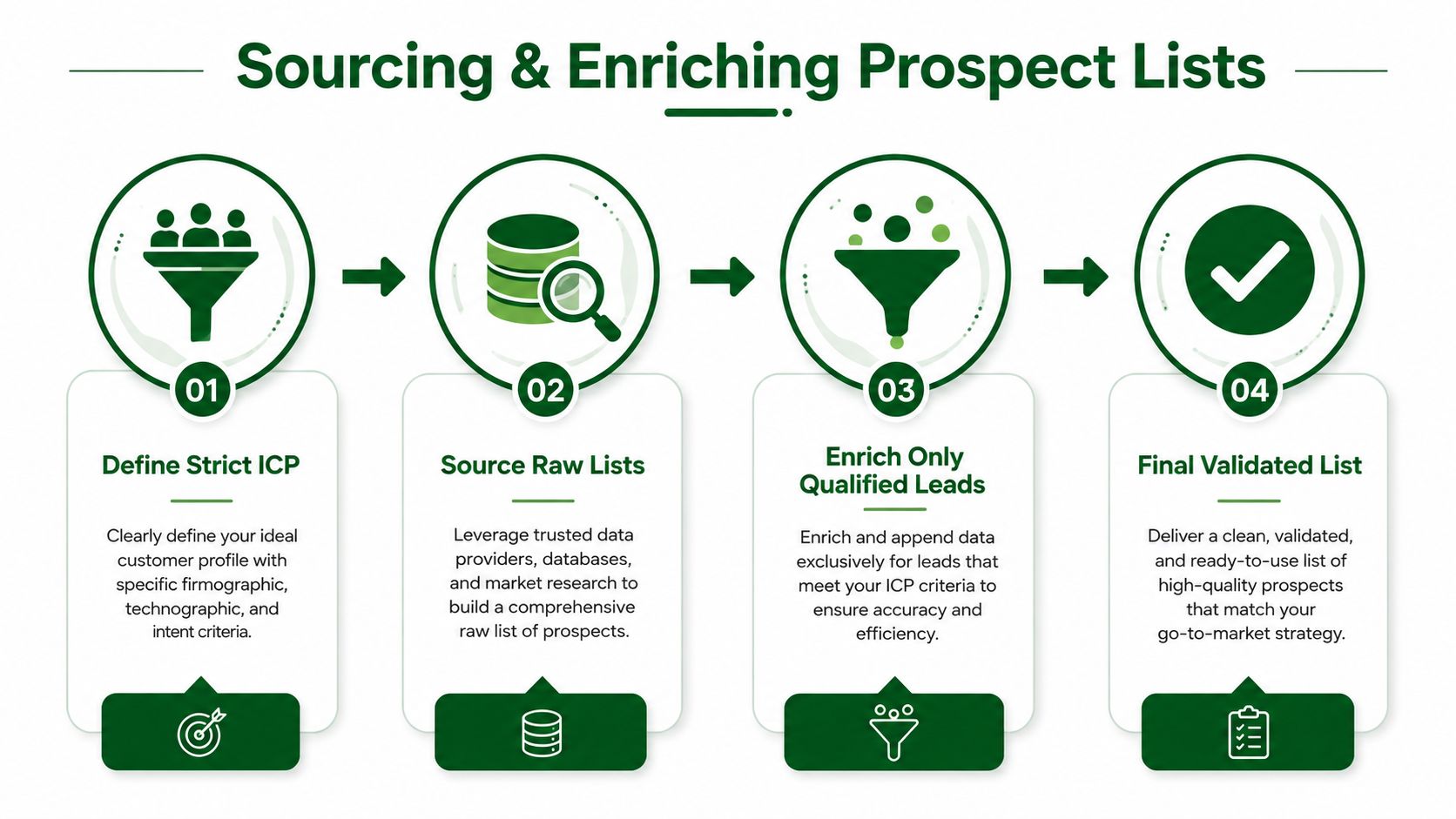
- Define the strict ICP: anchor the list to one product or one motion.
- Source raw rows: pull from your own CRM, campaigns, events, and approved external research.
- Enrich only qualified leads: add the fields that support routing and sequencing.
- Validate before upload: dedupe, verify, and assign ownership before the list touches the sequencer.
That is the difference between a list that creates work and a list that removes it. Internal discipline matters more than database size, especially when the same account may need to be handled differently depending on which product line is in play.
Scoring Accounts by Product Fit and Signal Strength
Scoring is where the list stops being a pile of contacts and starts becoming a decision system. A lot of teams still score too much on static firmographics, then wonder why reps are chasing accounts that look good on paper but have no reason to engage now. Product fit should come first, and timing signals should move a record up or down the queue based on what's happening in the account.
Rank for motion, not just resemblance
A new-logo outbound account should be scored differently from an expansion account, even if both sit in the same industry and size band. The outbound list should care more about urgency and visible change. The expansion list should care more about customer state, product adjacency, and whether the account is showing signs that another line could solve a problem they already feel.
That's where signal strength matters. Hiring trends, funding, tech-stack change, and public announcements are useful because they tell you something is moving. Static fit without a signal is often just a future maybe.
Automation pays when the scoring rules are consistent
The operational payoff comes from making the ranking repeatable. Research on lead nurturing and follow-up discipline says companies that excel at lead nurturing generate **50% more sales-ready leads at a 33% lower cost, while organizations that automate lead management see at least a 10% revenue increase within 6 to 9 months (SalesGenie). Those figures don't mean every score should be automated blindly. They do mean the scoring rules need to be stable enough that automation can help, instead of amplifying bad judgment.
Use a simple tiering logic and keep it product-specific.
| Signal Type | New-Logo Outbound Weight | Expansion Cross-Sell Weight |
|---|---|---|
| Recent public trigger | High | Medium |
| Intent around the problem the product solves | High | High |
| Hiring or team build-out | Medium | Medium |
| Existing customer relationship | Low | High |
| Tech-stack change | High | Medium |
The table is not a rigid formula. It's a way to keep reps from treating every signal the same. A strong fit without timing belongs in nurture, not in the front of the sequence queue.
Routing Accounts Differently Based on Product Fit
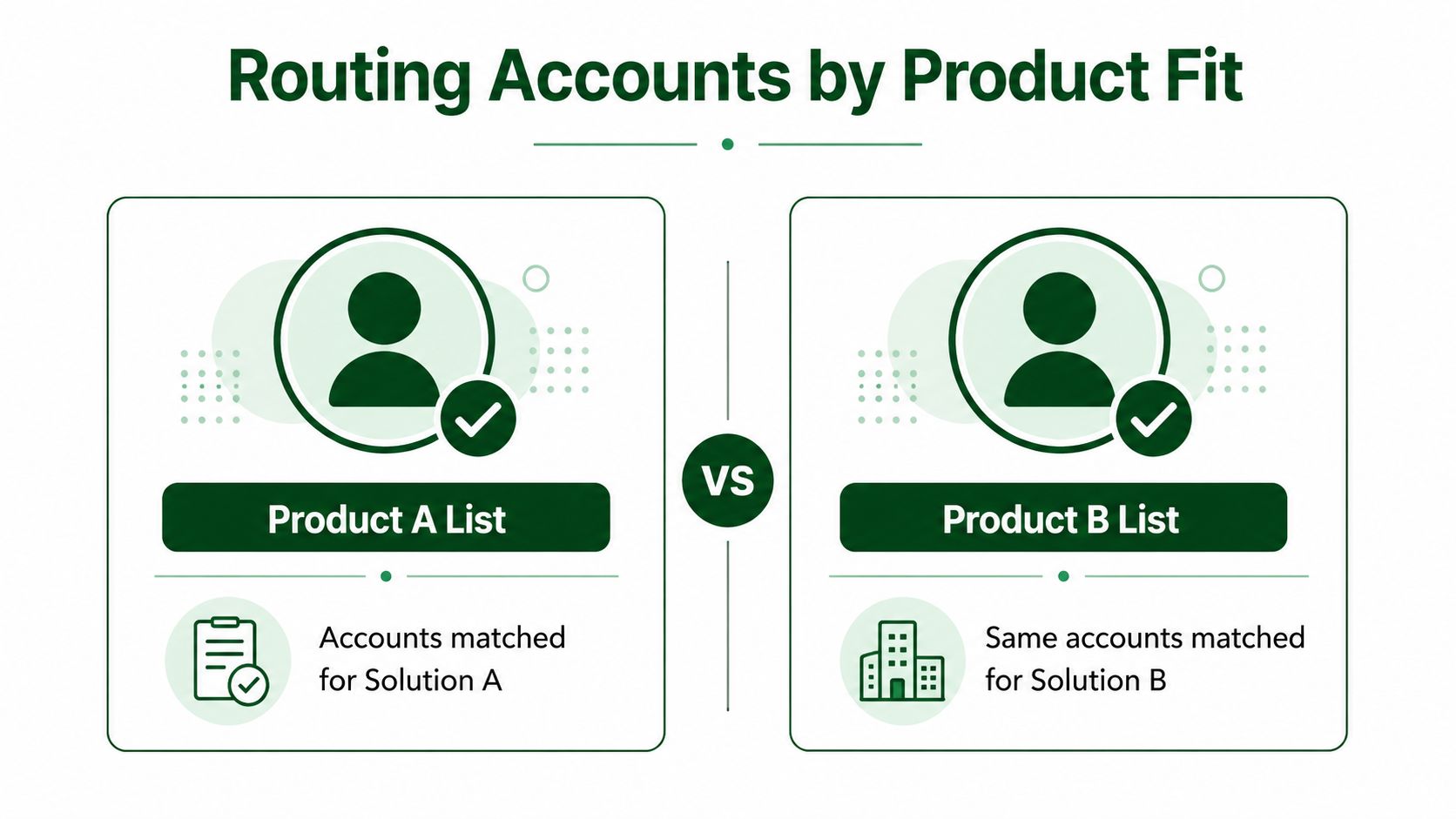
The same account can belong in more than one list inside a multi-solution company. The problem starts when the team gives it the same treatment every time. If Product A solves one pain and Product B solves another, the same account may be a fit for outbound in one motion and a fit for expansion in another.
One account, different actions
A prospect account with strong timing for Product A should go to outbound. That is the cleanest path when there is a visible trigger and the account is not already a customer for that line. If the fit is only moderate and the signal is thin, the account belongs in nurture until something changes. If it is already a customer and Product B fits the next need, the right owner is usually the account manager, not an SDR sending a cold sequence.
That distinction cuts duplicate effort and keeps reps from stepping on each other. It also gives RevOps cleaner ownership rules, because routing can reflect the actual motion instead of forcing one generic rule across the portfolio.
Operational rule: duplicate accounts across product lists are fine, duplicate motions are what create chaos.
PitchSmart can support that routing by researching accounts against the product definition you pick, then sorting them into product-specific buckets and producing an opener or sequence from the best fit. That matters when the same account base needs different treatment for outbound, expansion, and cross-sell, because the rep should not have to work out the routing logic by hand.
The routing rule should match the motion
The easiest way to reduce confusion is to make the next action obvious in the record itself. If the account is new-logo and high-fit, assign it to outbound. If it is a customer with adjacent fit, assign it to account management or customer success. If the signal is weak, park it and revisit later instead of forcing it into a sequence just to keep activity flowing.
That is the part many teams miss. Routing is not admin work. It is how you protect rep attention from bad prioritization.
Syncing Lists to Your CRM and Automating Sequences
A list loses value fast if it does not move cleanly into the system reps use. The handoff needs to be plain and predictable. If ownership breaks, tags disappear, or the signal score gets stripped out on import, the workflow is already leaking value before the first email goes out. The sync step should preserve the research instead of flattening it.
Keep the fields that drive action
Before the upload, confirm that each record still carries the product-fit score, signal tags, ownership, routing outcome, and the fields your team uses to decide what happens next. Then push it into the CRM or sequencer the team already works in, whether that is HubSpot, Outreach, Apollo, or another platform. Once it is inside the system, the account should be ready for a sequence without a rep retyping the research notes by hand.
The automation should handle the repeatable parts. It should not make judgment calls for you. When an account needs a human decision because the context is messy, keep that decision in the rep or manager workflow.
A clean sync also depends on field discipline. If your CRM only keeps a generic lead status, the product-specific work you did upstream will disappear as soon as the record lands. Keep the fields that tell a rep what to do, what to ignore, and what to revisit later. That is the part that keeps multi-solution accounts usable after the first pass.
Seed the sequence from the best hook
The best outreach usually starts from one specific signal, not a paragraph of account trivia. The point of automation is to seed a short sequence from the research that matters, then let the rep adjust if a reply comes back with new context. That is a better use of time than asking every rep to rebuild the same message structure from scratch.
PitchSmart supports that handoff by turning the research into sequence-ready output once the account is sorted. If you want a practical look at how that product-first workflow syncs to your CRM, use a walkthrough of the product-first workflow. The value is not another layer of software. It is keeping the research, CRM fields, and sequence creation tied together so reps are not redoing the same work in three places.
Track the post-sync handoff with a few practical measures.
| Metric | What It Measures | Target Benchmark |
|---|---|---|
| Ownership accuracy | Whether the right rep got the account | No misroutes at upload |
| Signal retention | Whether tags survive sync | All priority signals preserved |
| Sequence attachment | Whether the right motion started | 100% of routed records entered the correct path |
| Duplicate suppression | Whether the same account is blocked from repeat entry | No duplicate routing |
| Research freshness | Whether the record still reflects current context | Updated before launch |
Monitoring List Health and Maintaining Quality Over Time
The list doesn't stop decaying because you've pushed it into the CRM. B2B data goes stale fast, and every stale record drains rep time, damages trust in the list, and makes managers second-guess the forecast. The fix is a maintenance rhythm, not a one-time cleanup.
Build a cadence around freshness
Good list hygiene starts with simple rules. Re-verify dormant contacts every six months, remove hard bounces immediately, and audit data at least quarterly because B2B data decays quickly (Fundraise Insider). One industry source cites annual data decay of 70.3%, which is enough to explain why old lists become liabilities if nobody touches them (Fundraise Insider).
The same source also recommends smaller, signal-qualified campaigns of 200 to 500 verified contacts instead of 5,000+ scraped emails (Fundraise Insider). That's not about playing small. It's about respecting the difference between volume and usable attention.
Refresh by signal, not by calendar alone
Quarterly review is the minimum. In practice, high-value accounts should be re-ranked whenever a meaningful signal changes, such as leadership changes, product launches, hiring, or ownership shifts. If the fit score no longer matches the current reality, retire the account from active outreach until it earns its place back.
A useful operating question is whether the account still belongs in the motion it was assigned to. If the answer is no, the record needs a new route, not another template. That's especially important in multi-solution companies, because a customer can move from outbound target to cross-sell opportunity without ever leaving the account base.
Keep the maintenance questions short and practical
Should lists refresh monthly or quarterly? Quarterly is the baseline, with faster review on live opportunities and any account tied to a major trigger. How many signals are enough before outreach? Enough to explain why the rep should act now, not enough to make the record look busy.
What happens when the same account appears in multiple product lists? Keep the duplicate if the motion is different, but assign it to the right owner and sequence for each product. How do privacy and compliance fit in? Use the data you're allowed to use, keep source traceability, and don't assume a contact belongs in every region just because the company is a fit somewhere else.
Practical takeaway: a list is healthy only when it still supports the motion you want a rep to take today.
That's the maintenance loop many teams miss. They build once, launch once, and then wonder why performance drifts. The teams that keep winning are the ones that keep re-scoring, re-routing, and retiring records before stale data starts dictating the quarter.
If your team is dealing with multi-product routing, stale research, and reps who waste too much time figuring out who belongs on which list, use PitchSmart to research accounts against each product definition instead of a generic ICP. Visit PitchSmart to see how it handles bulk account research, signal-based segmentation, and sequence-ready outputs for outbound and expansion teams.