You probably know the feeling, the pipeline looks busy, but your reps are buried in tabs, CRMs, LinkedIn, and half-finished personalization. The problem isn't effort. It's that manual prospect research turns outbound into a clerical job, and once that happens, team productivity improvement stops meaning more selling and starts meaning more copy-paste.
Outbound teams don't usually lose the day in one dramatic collapse. They lose it in small, repeatable drags, one stale account at a time, one generic opener at a time, one CRM update at a time. That's why the fix has to be structural, not motivational. If the workflow still asks every rep to research leads one by one, then the team is paying a hidden productivity tax before the first email even goes out.
Why Outbound Teams Lose 70 Percent of Their Day
Most outbound orgs treat research as a small setup task. It isn't. When reps spend their mornings scraping LinkedIn, checking a company site, hunting for recent activity, then rewriting the same opener six different ways, the workday gets swallowed by non-selling motion long before outreach begins. PitchSmart's publisher notes that repetitive research, admin, and data entry can consume roughly 70% of a rep's day, which matches what many managers already see in practice, a lot of motion, not enough live selling.
The deeper issue is that the loss isn't evenly distributed. One rep may get trapped in list cleanup, another in finding buying signals, another in copy-pasting notes into a CRM. The team looks active, but the activity is fragmented, and fragmented work is exactly where productivity leaks hide.
The real bottleneck is workflow design
Gallup's engagement research is useful here because it shows how output changes when the work environment changes. Engaged employees are 18% more productive than disengaged employees, and a 1% increase in employee engagement correlates with a 0.6% increase in productivity in the same research stream, according to the productivity statistics summary from ActivTrak's referenced source page. That doesn't mean morale alone fixes outbound. It means the system matters, because reps can't stay engaged when the process keeps forcing them into repetitive, low-value tasks. ActivTrak's productivity statistics summary
A manager can tell a rep to “personalize more,” but if personalization requires ten tabs and twenty minutes per account, the process is already broken. The fix is to move the work upstream and do research in parallel, not serially. That's where productivity gains come from, reclaiming selling time without adding headcount.
Practical rule: If a rep has to touch the same lead information more than once before sending, the workflow is probably too manual.
The best outbound teams stop asking, “How do we push reps to do more?” and start asking, “Which parts of research can we remove entirely?” Once that question is on the table, the productivity conversation gets much sharper. You're no longer optimizing effort, you're redesigning the day.
Diagnosing Your Current Productivity Blockers
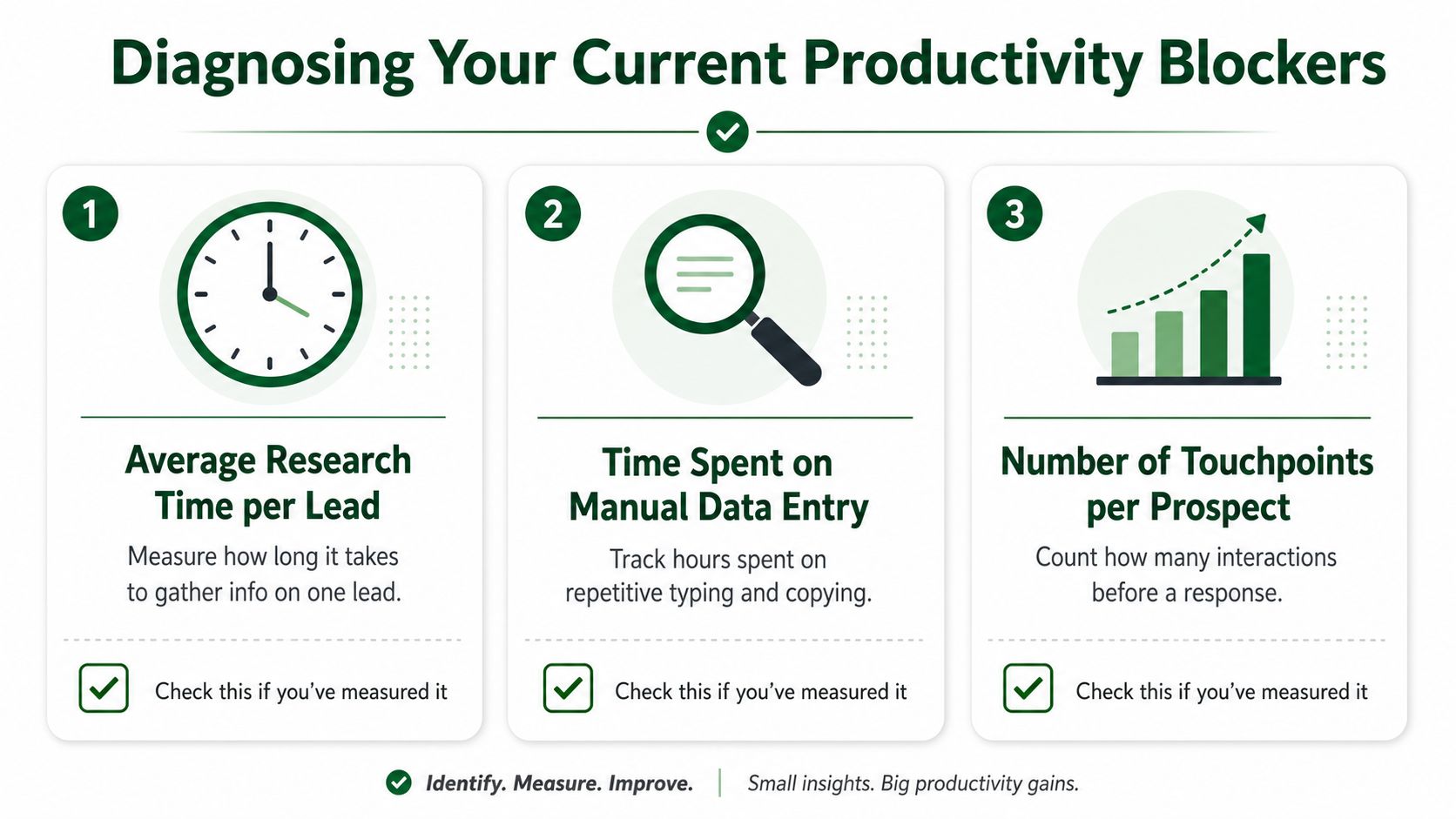
Before changing the workflow, get a baseline that shows where time is leaking. In outbound, the usual pressure points are average research time per lead, share of sequences using generic versus signal-backed hooks, and the ratio of planned outreach to reactive admin work. Those measures are blunt, but they show which part of the motion is slowing reps down first.
Run the audit without surveillance theater
A two-week audit does not require invasive monitoring. Ask reps to log start and stop times for research blocks, then compare those notes with CRM timestamps and sequence launches. If the timestamps show long gaps between list import, enrichment, and send time, the process is dragging. If the notes show constant switching between data sources, context switching is burning time.
The point is to separate a bad list from a weak message and a slow process. Low reply rates often come from generic hooks or stale data. High bounce rates usually point to list quality and weak validation. Burnout usually shows up when reps spend too much of the day on reactive cleanup instead of planned outreach. For a closer look at how these workflow issues show up in practice, see PitchSmart's blog on diagnosing outbound workflow bottlenecks.
| Symptom | Likely root cause | What to check first |
|---|---|---|
| Low reply rates | Generic messaging or weak signal use | Are hooks tied to recent account activity |
| High bounce rates | Stale or incomplete list data | Are records current and segmented correctly |
| Rep burnout | Too much manual research and admin | How many tools and tabs each lead requires |
A useful benchmark for the broader productivity conversation is that workers spend roughly 60% of their workday productive on average, leaving room for improvement through better coordination and task design, as summarized in the WorkTime productivity statistics page. WorkTime's employee productivity statistics
Start with the leads that take the longest to research, not the leads that are easiest to send.
One detail matters a lot. If a sequence underperforms because reps are choosing the wrong accounts, you have a targeting problem. If it underperforms because every opener sounds interchangeable, you have a research problem. If it underperforms because reps cannot keep up with list prep, you have a workflow problem. Fix the layer that is creating the drag.
Prioritize by the first bottleneck
The fastest teams do not try to fix everything at once. They pick the largest blocker, remove it, then measure again. If research time per lead is the worst offender, the next move is automation. If messaging is the issue, the next move is signal quality. If the admin burden is crushing cadence, the next move is consolidation.
For teams that want a practical example of the tooling and rollout side, PitchSmart's main site shows a bulk-research workflow built for teams that want to work from their own lists rather than a rented database. The point is not the logo. It is the operating model, one pass across the whole list instead of one rep at a time.
Replacing Manual Research with Bulk Signal Workflows
Manual research fails because it asks every rep to repeat the same hidden labor. Bulk research works because it turns that labor into a shared system, and the system does the heavy lifting once. Upload the list, run parallel research, score the accounts, and convert the output into hooks and sequence drafts that are already tied to evidence.
Build the workflow around the list you already own
Start with a CSV or pull prospects from your CRM. Keep the list hygiene tight, because bulk research amplifies whatever is in the input. If your records are mixed by segment, territory, or deal stage, fix that before launch. The workflow should start from your owned list, not from a rep improvising in the browser.
Then run research in parallel. PitchSmart is built to research accounts at once, tie qualifiers and buying signals back to their original source, score prospects, and assemble a signal-backed conversation plan. That matters because it removes the need to reconstruct the account story manually every time. Reps can work from the output instead of piecing the story together themselves.
Turn signals into hooks, then hooks into sequences
Once the account signals are in place, the next job is hook selection. Activity-based conversational hooks drawn from recent online signals beat generic openers because they give the rep a concrete reason to reach out now. The message changes from “just checking in” to a specific, current observation the buyer can recognize.
That's also where sequence creation gets easier. PitchSmart's workflow supports automated 3-step email and LinkedIn sequences seeded from the best hooks, which reduces the amount of blank-page writing reps need to do. The sequence still needs judgment, but the starting point is far better than asking a rep to invent relevance from scratch.
The gain shows up in segmentation. Advanced list segmentation based on buying signals lets teams prioritize accounts showing intent instead of flattening the whole list into one generic cadence. That's especially useful for outbound teams that manage multiple territories or product lines, because the list can be sorted by readiness instead of just firmographic fit.
If a signal can't be traced back to a source, it shouldn't make it into the opener.
A bulk workflow should also support rep-friendly reuse. Reps should be able to reference any lead on demand and copy insights into the tools they already use. If the system forces them into another long detour, you've only moved the friction around.
Keep the cadence short and evidence-led
The goal is not to add more steps. It's to collapse the research, scoring, and drafting cycle into one pass so outreach can begin faster. In a healthy workflow, the list tells you who matters, the signal tells you why now, and the sequence gives the rep a starting point they can use.
When teams do this well, the value isn't just speed. It's consistency. One rep no longer writes a brilliant email while another sends a generic one, because the system standardizes the research quality before the first send.
Role Level Playbooks for SDRs BDRs and Managers
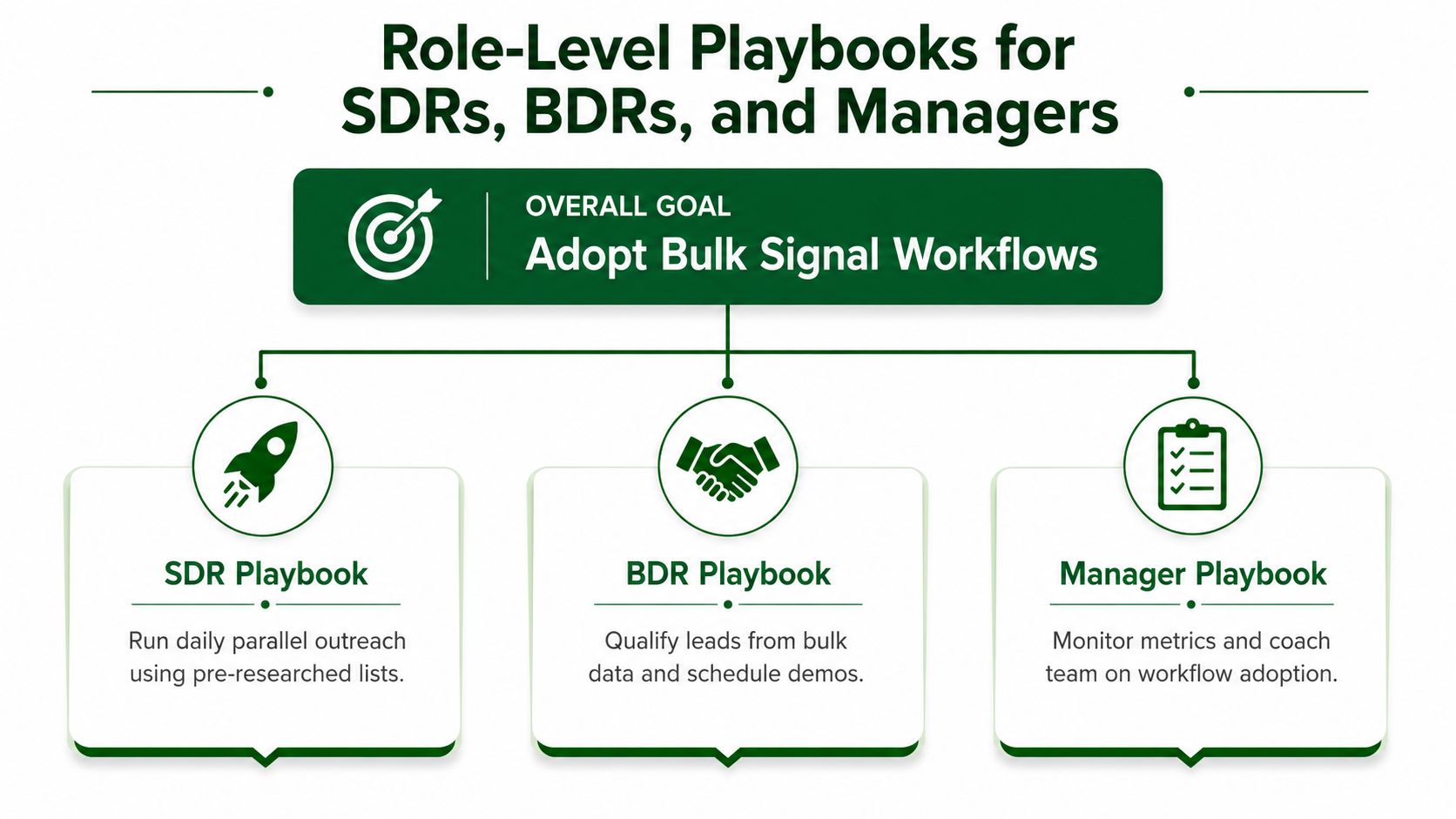
A workflow only sticks when each role knows what changes on Monday morning. SDRs need a fast path from signal to send. BDRs need account-level prioritization. Managers need a coaching rhythm that checks quality, not just activity.
SDRs should protect signal to sequence velocity
SDRs live or die by throughput, but throughput only matters if the message stays relevant. The daily block should be simple, research the assigned list in bulk, review the top signals, launch the sequence, then log exceptions. If a lead needs deeper investigation, park it instead of letting one account eat the entire hour.
Working rule: SDRs should never start the day by writing from a blank page.
That rule keeps the reps from falling back into research drag. The handoff between research and outreach should be clean, with only one checkpoint, does the hook match the signal and does the sequence reflect the segment. If yes, send. If not, revise the hook or move the lead into a different queue.
BDRs should prioritize account tiers, not just names
BDRs usually handle larger, messier lists, so their job is less about speed and more about ranking. The workflow should separate accounts into tiers based on buying signals, then assign the stronger accounts to more personalized outreach and the weaker ones to lighter touches or later follow-up. That reduces wasted effort on accounts that aren't ready.
The key handoff rule is simple. Research should decide the tier, and the tier should decide the cadence. If the team keeps using the same sequence for all accounts, segmentation is decorative, not operational.
Managers should coach the quality of the workflow
Managers need a weekly review rhythm tied to research quality scores, reply quality, and pipeline movement. The most useful question is not “How many touches did the rep send?” It's “Did the rep work the highest-value accounts with the right level of evidence?” That keeps coaching focused on pipeline value instead of motion.
| Role | Daily focus | Quality check | Escalation trigger |
|---|---|---|---|
| SDR | Signal to sequence speed | Hook matches account activity | Generic opens keep showing up |
| BDR | Account-tier prioritization | Tier matches buying signal strength | High-value accounts are underworked |
| Manager | Workflow adoption and coaching | Research quality score trends | Reps revert to manual prep |
If the data quality drops, the manager should fix the list source or segmentation rules before blaming the rep. If sequence performance drops, the manager should inspect hooks and timing, not pile on more activity. If adoption stalls, shorten the workflow and make the output easier to use.
KPIs and Measurement That Reward Pipeline Value
Most outbound teams measure the easy stuff because it's visible. That usually means calls, emails, and tasks completed. Those numbers aren't useless, but they can reward busywork while hiding whether the team is creating pipeline.
Build an indexed score, not a vanity dashboard
A better approach is a measurement-and-feedback system with five to ten output-quality indicators. The indicators should include things like signal-to-meeting conversion rate, research-backed reply rate, task completion rate, cycle time, error rates or revision requests, and the share of work hours spent on planned versus reactive work, which aligns with the measurement guidance from HR Cloud. HR Cloud's team efficiency and productivity guidance
The mechanics matter. Weight each indicator by business value, then roll them into a single indexed score that managers review in a recurring cadence. That keeps the team from optimizing one number at the expense of everything else. A rep who sends fast but creates rework should not score better than a rep who sends slightly slower but produces cleaner pipeline.
| KPI | Definition | Frequency | Target Benchmark |
|---|---|---|---|
| Signal-to-meeting conversion rate | Share of signal-backed outreach that becomes meetings | Weekly | Improve steadily over time |
| Research-backed reply rate | Replies to outreach that uses verified account signals | Weekly | Beat the baseline for generic sequences |
| Task completion rate | Share of planned outreach tasks finished on time | Daily | Stay consistently high |
| Cycle time | Time from list import to first send | Weekly | Keep shrinking as the workflow matures |
| Quality revisions | Number of rewrites or corrections per sequence | Weekly | Keep low and trending down |
| Planned versus reactive work | Time spent on scheduled outreach compared with cleanup | Weekly | Tilt toward planned work |
Use measurement to prevent metric gaming
The danger is overfitting to one KPI, usually task count. That can inflate output while hiding defects, rework, or bad targeting. The safer structure is a balanced scorecard that tracks volume and quality together, because productivity improvement should show up in both.
That logic lines up with the broader evidence on measurement design. The ProMES review on productivity measurement found that structured systems can produce large productivity improvements, with effects that can last for years and transfer across countries, organizations, work types, and worker groups. The same review also warns that weak indicator design can reduce impact, which is exactly what happens when teams chase activity instead of value. ProMES review in PubMed
Measure the work that creates revenue, not just the work that looks busy.
The practical takeaway is plain. If the scorecard doesn't tell managers whether research quality is improving, the scorecard isn't finished. If it can't distinguish clean pipeline from noisy activity, it's not helping.
Change Management Without Burning Out Your Team
The hardest part of team productivity improvement is usually not the workflow itself. It's getting reps to trust that the new system will save time instead of adding another layer of tracking. The human side matters because work design and job conditions influence output, not just monitoring, as the HBR-linked research on well-being and firm performance argues. HBS research on well-being and performance
Roll it out as time reclamation
Start with a voluntary pilot and let the early adopters show the rest of the team what changed. Don't sell the pilot as a compliance exercise. Sell it as time returned to selling. That framing matters because reps are already wary of tools that feel like surveillance, especially if previous “productivity” projects only added more reporting.
Protect deep work blocks during the rollout. If managers keep scheduling check-ins on top of check-ins, the team will blame the new workflow for the overload. A cleaner pattern is one short weekly review, one feedback channel for friction, and one place where the rep can flag bad data without waiting for a meeting.
Reduce tool fatigue by collapsing the stack
The fastest way to lose adoption is to make reps bounce between research tools, sequencing tools, and spreadsheets. PitchSmart's model consolidates research, scoring, and sequence creation into one workflow, which means the rep isn't forced to translate the same account story three different times. PitchSmart pricing
That consolidation matters more than people admit. If a tool saves five minutes but adds friction elsewhere, the team won't stick with it. The change has to feel like less work, not just different work.
“Show them the time they get back, then let the numbers settle the argument.”
A good communication template is short. State the problem, name the manual work the team is removing, explain how the new process works, and tell reps where to report friction. That keeps the rollout grounded in operational reality instead of abstract change language.
Your 30 Day Implementation Roadmap
The cleanest rollout starts with diagnosis, not software. Week one should be a time audit and blocker review. Week two should run a first bulk research pilot with a volunteer cohort. Week three should introduce the role playbooks and KPI scorecard. Week four should expand to the full team with feedback loops already in place.
A practical month for a 10 person outbound team
One 10-person outbound team I've seen work with followed a version of this pattern. They were spending about four hours a day on manual research, list cleanup, and rewriting openers. After shifting to bulk research and signal-driven sequencing, they were generating outreach in under 45 minutes because the research was done in parallel and the hook selection was already surfaced for them. The change didn't happen because they hired more people. It happened because they stopped making reps do work a system could do once.
You need a few prerequisites before launch. CRM access has to be clean, the list has to be segmented, and the team has to agree on what counts as a signal worth using. Without that, the pilot will still work technically, but the output will be noisy.
Watch for these rollout failures
- Dirty inputs: If the CSV or CRM export is messy, clean it before the pilot.
- Loose ownership: If nobody owns signal review, sequence quality slips fast.
- Too many metrics: If the scorecard gets crowded, reps stop using it.
- No feedback loop: If rep friction doesn't get surfaced quickly, adoption stalls.
The decision rule is straightforward. If the pilot shows better signal use, shorter research cycles, and cleaner outreach, expand it. If it only increases activity without improving quality, tighten the workflow first. The goal is not to produce more send volume, it's to create more pipeline value per hour.
If your outbound team is still spending half the day stitching together research by hand, it's time to stop paying for that hidden tax. PitchSmart gives you bulk lead research, signal-backed hooks, and automated outreach sequences from the list you already own, so your reps can spend their time on conversations instead of tab-hopping. Visit PitchSmart and use it to turn manual prospecting into a workflow your team can scale.