Most win loss analysis programs fail for the same reason generic cold outreach fails, they document activity instead of changing what reps do on the next call. Teams spend weeks on buyer interviews, CRM reviews, and slide decks, then wonder why the same objections keep showing up in the same deals. In multi-product companies, that gap gets worse fast, because the core question isn't just why a deal was won or lost, it's which account is ready for which solution and which signal should change the next touch.
If you're still treating win loss analysis as a quarterly postmortem, you're probably missing the part that matters most to outbound and expansion teams. The discipline has become a standing GTM function in many organizations, not a one-off research project, and that shift matters because the output has to reach the people writing sequences, prioritizing accounts, and coaching reps every day. A useful program doesn't just explain outcomes, it changes the next sequence, the next account list, and the next conversation.
Why Most Win Loss Programs Fail to Change Outcomes
Most win loss analysis programs don't fail because the team lacked effort. They fail because the program stops at the insight layer and never touches the work reps do. A deck can be accurate and still be useless if it never changes the sequence, the talk track, or the account research workflow.
The budget signals tell the story. In a 2023 State of Win-Loss Analysis report, 94% of respondents said their organization was maintaining or increasing win-loss budget, and among enterprise organizations with 1,001+ employees, 36% were investing more than $50,000 annually in win-loss Klue's summary of win-loss statistics. That's evidence that the function is getting institutionalized, but institutionalization doesn't automatically mean operational impact.
The common failure is a disconnected handoff
Buyer interviews often produce clean themes, then those themes sit with product marketing or RevOps while outbound keeps running the same plays. Reps don't need another retrospective, they need the specific message that works against a specific competitor, the account signal that should trigger a different sequence, and the reason a product line wins in one segment but not another. In a multi-product company, generic themes like “price” or “product fit” are too blunt to guide account-level action.
Practical rule: if a win loss program can't change a sequence, a talk track, or a target account list, it's not finished.
That's why programs built around slide decks stall. Teams present the top reasons buyers chose a competitor, but they don't translate that into the work system. No one owns the handoff from finding to behavior, so the same insight gets rediscovered quarter after quarter.
The wrong assumption is that buyer feedback is enough
It isn't. Buyers remember the last few moments of the process more clearly than the full path, and internal notes are often just as biased. Corporate Visions reports that 53% of buyers say a losing vendor could have won if not for a fixable misstep during the sales process, and Elevated Signal cites disagreement between reps and buyers on deal-loss reasons 50% to 70% of the time across more than 100,000 purchase decisions Corporate Visions. That gap is exactly why a useful program has to connect buyer voice with observed behavior.
The strongest programs don't ask, “What happened?” They ask, “What changed because we learned it?” That distinction is what separates a research artifact from a revenue system.
Defining Scope and Selecting the Right Deals to Analyze
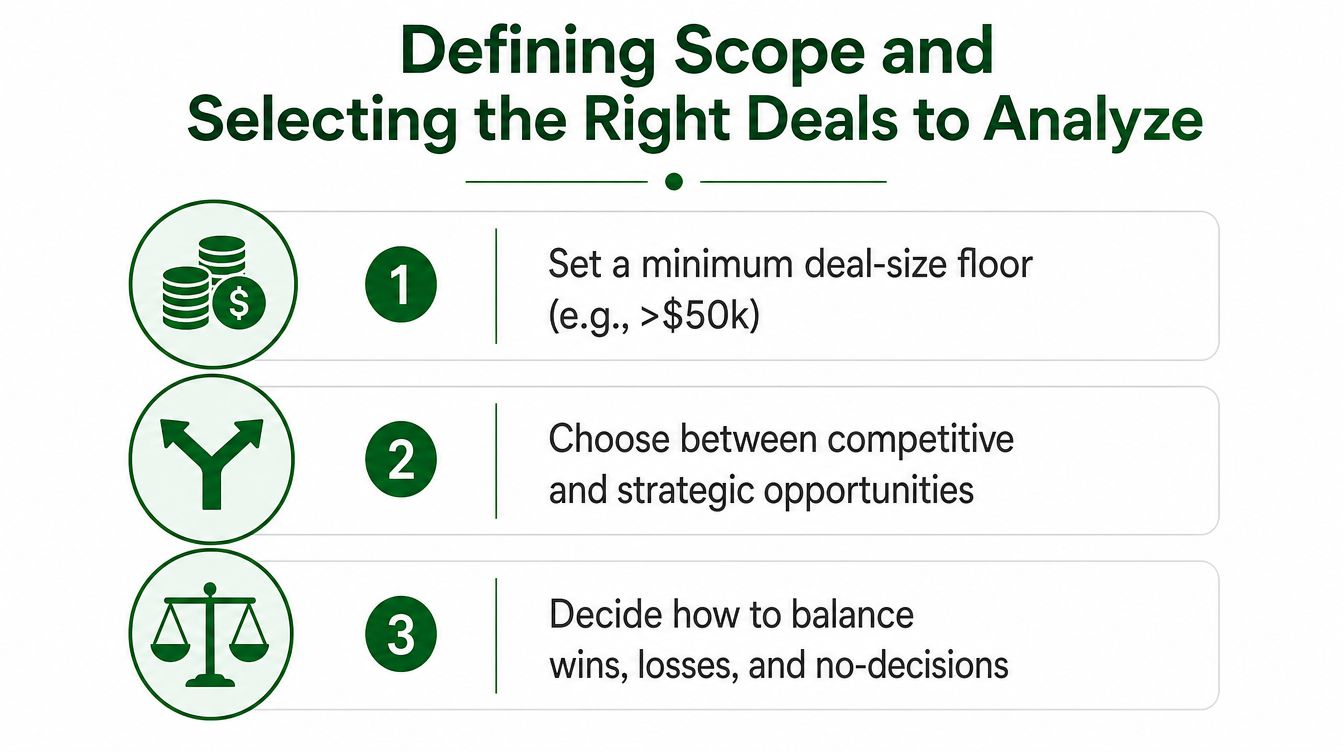
A strong program starts by narrowing the field on purpose. Trying to analyze every opportunity creates noise, while a selective sample gives you enough depth to see repeatable patterns. Elevated Signal recommends a deal-size floor, a focus on competitive or strategic opportunities, inclusion of no-decisions, and roughly balanced wins and losses, with at least 20 interviews as a baseline and interviews completed within 3 months of the decision Elevated Signal.
Start with a hypothesis, not a dump from CRM
The question comes first. If you want to know whether a product line loses on pricing, you don't need every closed deal from the quarter. You need the deals where pricing was in play, plus enough wins and no-decisions to compare. If you want to know whether an expansion motion is working, focus on existing accounts that had a cross-sell opportunity, not every customer renewal.
That's the part teams miss when they pull a full export and hope the pattern appears. A hypothesis changes the sample. A sample without a hypothesis just creates more work.
Balance strategic importance with consistency
A deal-size floor matters because tiny opportunities can distort the picture and waste interview time. Competitive deals matter because they surface why you lost when a buyer had a real alternative. No-decision deals matter because stalled buying often hides the actual bottleneck, and modern guidance treats no-decision as part of the analysis rather than a cleanup bucket Corporate Visions.
If the sample includes only obvious wins and obvious losses, you'll miss the deals that were actually winnable.
The best sample design is boring on purpose. It's specific, repeatable, and narrow enough that the team can finish it on time.
Keep the operating question tied to the deal type
For multi-product companies, the analysis starts to diverge from classic new-logo win-loss work. You're not only testing why one opportunity closed. You're testing which solution matched which account state, which competitor showed up, and which signals were visible before the buyer moved. That means scope should reflect product line, segment, competitor, and stage, not just close status.
A selective design saves time later because it keeps the dataset coherent. Once the program starts mixing every motion into one bucket, the resulting conclusions become too vague to use.
Collecting Data from CRM Records and Buyer Interviews
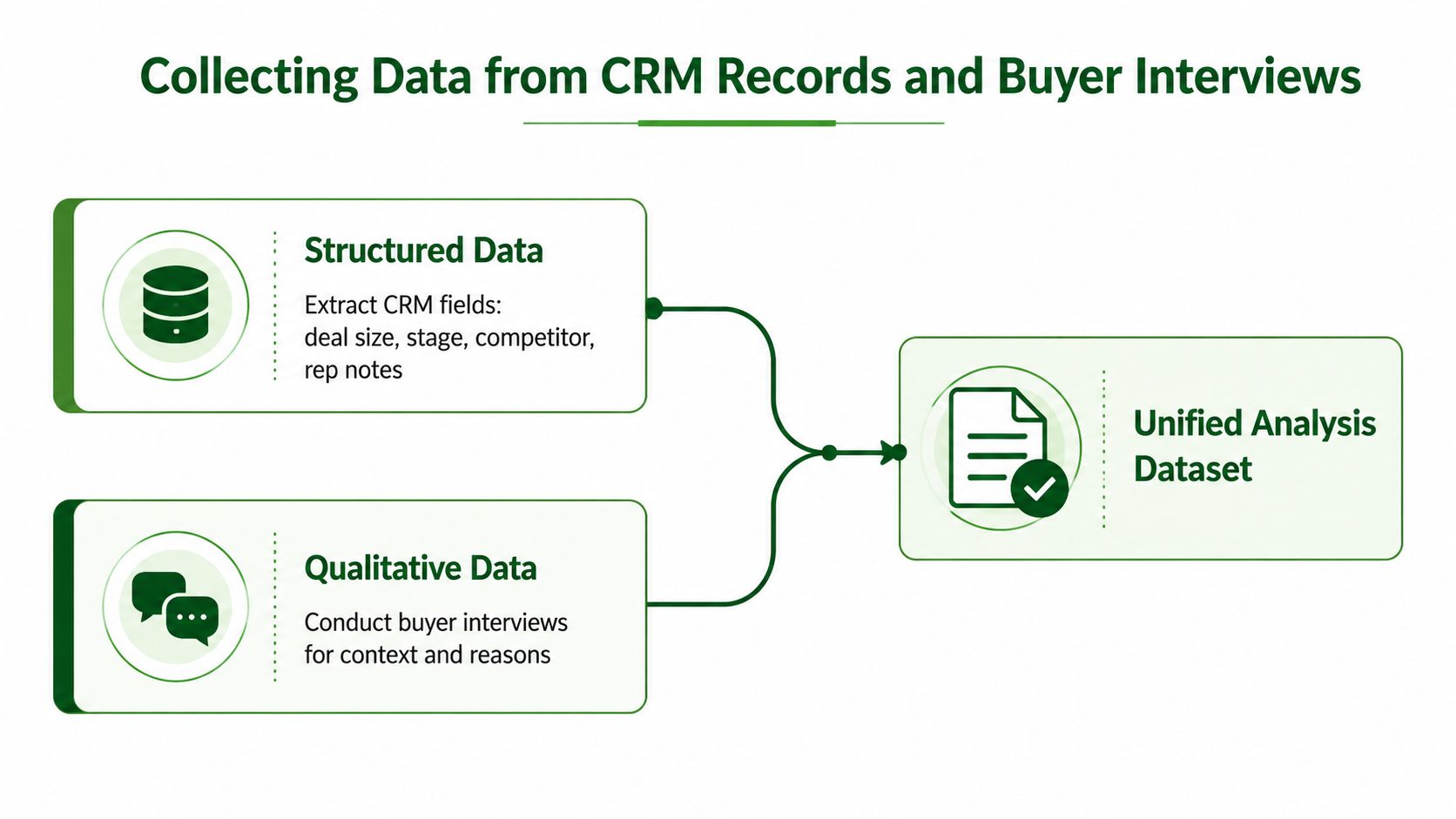
A good win loss program needs two data layers, structured records and buyer voice. If one is missing, the conclusions get shaky fast. Structured fields show the shape of the deal, while interviews expose the reason behind the outcome.
The CRM side should capture the basics that let you segment intelligently, deal size, competitor named, stage at loss, time in pipeline, product line involved, and rep. Outreach and call-record data should also be pulled where possible, because sequence variant, reply behavior, and meeting conversion often show whether a message is landing. For a practical overview of how this kind of data becomes reusable, the PitchSmart blog is a useful reference point for account research workflows tied to outbound execution.
Build the record before you start the interview
Buyer conversations are richer when you already know the deal path. Without timestamps, competitor names, and stage data, interview feedback becomes untethered opinion. The point is to avoid treating a buyer's memory as the whole truth.
That's also why structured data should include the rep view, but not depend on it. Reps are close to the deal, which helps, but they're also incentivized to simplify the reason a deal was lost. If the call log, CRM timestamps, and buyer comments all point to the same issue, you've got something worth acting on. If they diverge, the gap is usually the insight.
Keep the interview neutral and short
The interview isn't a courtroom cross-examination. It's a structured conversation that should let the buyer explain their decision in their own words. The interviewer should talk very little and spend most of the time probing for detail, because the first answer is usually the surface reason, not the operating reason.
Practical rule: don't ask a buyer to validate your theory. Ask them to walk through the decision as it unfolded.
Timing matters too. Guides often recommend interviewing losers quickly and winners within a few weeks, but the bigger point is that memory decays fast and the last interaction gets overweighted. That's why the interview has to be triangulated against call recordings and CRM timestamps, not treated as the only signal.
Use the same structure every time
Standard questions make comparisons possible. Ask what changed in the buying process, what alternatives were considered, what blocked progress, and what triggered the final decision. Then store the answers in a consistent format so they can be coded later.
The win loss program gets stronger when the data layers are built to compare, not just collect. That's the difference between a few interesting anecdotes and a dataset a revenue team can use.
Building a Coded Taxonomy to Quantify Patterns
Qualitative themes do not drive change until you can see how often they show up and how much revenue they touch. That is why the next step is coding. A consistent taxonomy gives RevOps and enablement a way to compare deals across reps, products, and segments without turning every debrief into a debate.
A useful starting point is a taxonomy that covers product/features, pricing and commercial terms, sales execution, implementation/support expectations, competitive positioning, and timing and process dynamics, then ranks fixes by frequency × revenue impact × addressability Liminal's guide to win-loss analysis. That structure matters because it keeps one loud anecdote from driving a company-wide change.
Keep the taxonomy broad enough to compare, narrow enough to use
If the categories are too broad, “fit” becomes a junk drawer. If they are too narrow, no one can apply them consistently. The useful middle ground is a set of codes that reflect how deals get decided and where revenue teams can intervene.
| Category | Example Codes | What It Reveals |
|---|---|---|
| Product and features | Missing integration, weak workflow support, feature parity gap | Whether the product itself blocked the deal |
| Pricing and commercial terms | Budget mismatch, discount pressure, contract terms | Whether economics or packaging changed the outcome |
| Sales execution | Poor discovery, weak follow-up, single-threaded deal | Whether the rep process created avoidable risk |
| Implementation expectations | Rollout risk, support concern, time to value | Whether the buyer feared adoption failure |
| Competitive positioning | Lost to incumbent, stronger alternative, differentiator unclear | Which competitor message won in market |
| Timing and process dynamics | No decision, delayed buy, internal change | Whether the deal stalled for reasons outside the pitch |
Code for comparison, not for ceremony
The code needs to be applied the same way across deals, or the analysis drifts. That means deciding early what qualifies as a pricing loss versus a packaging issue, or a product fit issue versus an implementation concern. Once those rules are set, the dataset can be segmented by loss reason, rep, deal size, industry, competitor, and product line.
The point of a coded taxonomy is a common language. Instead of saying “we keep losing on price,” the team can say, “pricing pressure is concentrated in one segment, against one competitor, in deals where implementation risk is also high.” That gives the team a very different action list.
Prioritize by what can change
Not every pattern deserves the same amount of attention. A problem that appears often but is hard to fix may need a different response than a smaller issue that can be addressed quickly. The frequency and revenue lens keeps the team from chasing isolated noise.
For multi-product B2B companies, that lens needs one more layer. The primary question is not only which deals were won or lost, but which accounts are ready for which solution and which signals predict cross-sell success. A code set that captures product fit, buying urgency, and expansion intent gives analysts at PitchSmart portfolio a cleaner way to separate one-off wins from accounts that can grow.
The result is a ranked list of changes, not a pile of observations. That is what makes the analysis useful to RevOps, enablement, and the people building the outbound motion.
Turning Findings into Outreach and Enablement Changes
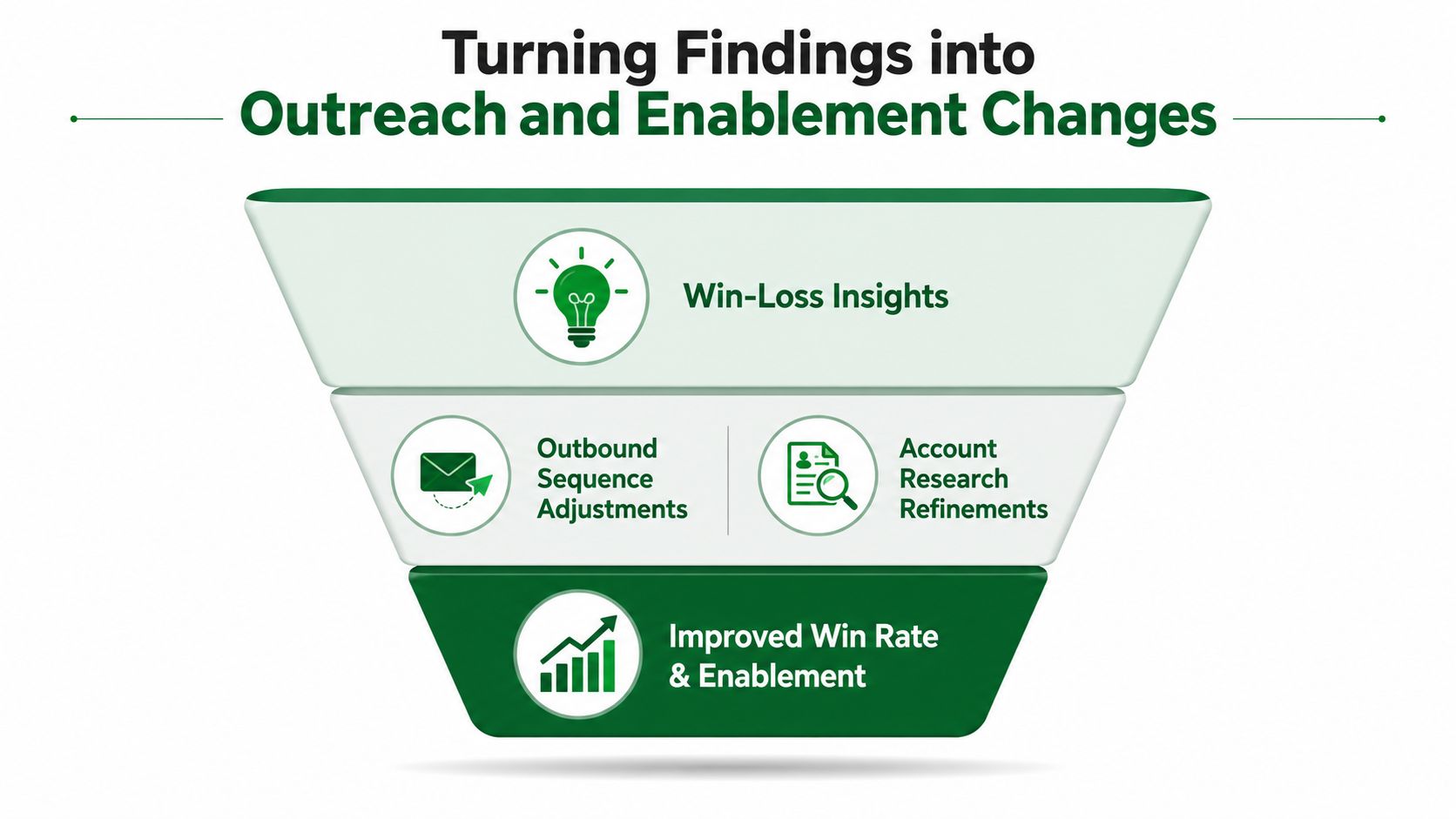
Win loss analysis proves its value when it changes the next outbound motion. If the findings don't alter account selection, sequence design, or talk tracks, the program has become reporting, not enablement. The same is true in multi-product environments, where the task is often to decide which existing account is ready for which solution.
The cleanest move is to map each coded pattern to a specific operational change. If wins cluster around one segment that wasn't in the original ICP, update the ICP. If a particular buyer signal keeps showing up in closed-won deals, build that signal into account research and seed it into the opener. For multi-product companies, create per-account cross-sell actions that tie one solution to one signal and one opener.
Turn each pattern into one owned change
A finding without an owner dies quickly. The practical move is to assign the update to the team that can change the artifact, not the team that merely notices the problem. If implementation risk shows up repeatedly, enablement should change the proof points and pre-call prep, not just log the issue.
The same applies to competitive positioning. If one competitor keeps winning a specific segment, the response shouldn't be a vague battlecard refresh. It should be a new opener, a clearer counterpoint, and a list of account signals that indicate that competitor is in play.
Use the signal that showed up, not a generic persona note
The best account research is tied to something that happened recently. Buyer behavior, site activity, content engagement, or a public trigger can all shape a better first touch than a stale persona paragraph. That's the bridge from analysis to execution, the signal from win loss should feed the account research workflow, not stay trapped in a report.
For teams already doing expansion motions, the program becomes especially useful. If one product line wins when a specific condition is present, that condition should become a cross-sell trigger. If another solution loses because the buyer can't see implementation value, the outreach shouldn't lead with the feature list.
Keep the output small enough to use
Outbound teams don't need a 40-point enablement plan. They need a few changes they can act on this week, a better opener, a tighter list, a revised sequence, and a reason to prioritize one account over another. The PitchSmart portfolio page is a relevant example of how account-level actions can be structured around the signals that matter, not just broad account descriptions.
The goal is not more content. The goal is better decisions before the rep sends the first message.
Common Pitfalls That Stall Win Loss Programs
The quickest way to stall a win loss program is to let rep self-report become the record of truth. Reps are valuable inputs, but they are not neutral observers, and they often compress a messy loss into the easiest explanation. That is how “lost on price” becomes a catch-all for implementation fear, weak discovery, poor multi-threading, or the wrong product fit for the account.
Timing is another failure point. Buyers forget details fast, and the later the interview happens, the more the answer leans toward the final conversation instead of the full buying journey. Scope is the third trap, because teams try to analyze every opportunity and end up with a broad sample that does not answer a specific question.
The multi-product trap is the quietest failure
I've seen teams roll findings together across product lines because the dashboard looks cleaner. It also erases the specificity needed to fix positioning and expansion strategy. A solution that loses in one segment for one reason can look healthy in the aggregate, which means the wrong team gets the wrong fix.
Keep product lines separate long enough to see the pattern. Compare them only after the coding is stable. In a multi-product business, that distinction matters because the core question is not just why a deal was won or lost, it is which account was ready for which solution, and which signals pointed to a cross-sell path that the team missed. If the team skips that step, it ends up optimizing for the average customer, which is usually no one.
Too much analysis can be as damaging as too little
A full-CRM retrospective feels thorough, but it often buries the signal in noise. The team spends more time reconciling records than deciding what to change, and the output starts to feel detached from the field. That is why a focused pilot beats a sprawling, all-deals review when the program is still young.
Start small, code consistently, and only broaden the sample when the first pattern is clear.
The same rule applies to recommendations. If the analysis produces a dozen changes, ownership gets thin and execution slows. One or two sharp adjustments are enough to prove the system works, especially when they map to the account types, buying signals, or solution fits that show up in the data.
The key correction is operational discipline
Every stalled program I've seen had one thing in common, the insight never reached the workflow where reps make decisions. Once the team tightens the cadence, narrows the sample, separates product-level patterns, and routes the findings into account research, the program starts to look less like a research project and more like part of the revenue machine. For teams that want a practical next step, a structured win loss analysis demo can help turn those findings into a repeatable operating rhythm.
That is the standard to hold. Anything less is just documentation.
Running Win Loss Analysis as a Recurring Revenue System
The best win loss analysis programs aren't quarterly projects. They're recurring operating rhythms that keep feeding coaching, messaging, and product conversations with fresh evidence. In markets where buyer expectations move and competitors change their pitch, old findings go stale fast.
The cadence matters because the program should produce a new hypothesis as soon as the last one is tested. A quarterly recap can't keep up with a portfolio business that sells multiple solutions into the same base. If the goal is account expansion and better outbound execution, the system has to stay connected to the live workflow.
Assign ownership by function, not by hope
RevOps should own the data integrity, because the program lives or dies on clean records and consistent segmentation. Enablement should own the behavioral change, because reps only improve when the output reaches their talk tracks and sequences. Customer success can add expansion context, especially when the question is which account is ready for which solution.
That division keeps the work from drifting into collective ownership, which usually means no ownership at all. It also makes the review meeting practical, because each function knows what it's responsible for changing.
Make the review rhythm short and repetitive
The point of a recurring system isn't to produce a giant retrospective. It's to spot movement in reasons, competitors, and deal patterns before the rest of the team feels it in missed quota. A short standing review works better than a sprawling quarterly presentation because it keeps the team close to the latest signal.
For teams trying to connect analysis to execution quickly, the PitchSmart demo is a useful way to think about how account research and buying signals should feed the next action, not the next report.
Measure whether the program is actually being used
If no one changes a sequence, no one updates an account list, and no one references the findings in pipeline reviews, the program isn't working. The test isn't how polished the report looks. The test is whether the next opportunity in the same pattern gets handled differently.
Practical rule: a win loss program is healthy when it creates fewer repeat mistakes.
That's the operating standard for multi-product B2B teams. The analysis should tell you which offer fits which account, which signal predicts cross-sell readiness, and what message gives the rep a better shot on the next call. If it doesn't do that, it's too abstract to matter.
If you want to turn win loss analysis into actual outbound and expansion work, visit PitchSmart and see how your account research can be tied to the solutions you really sell. PitchSmart is built for teams that need better account-level signals, cleaner segmentation, and draft outreach that starts from the right hook. If your reps need to know which account is ready for which solution, it's worth a look.