Sales reps spend only 28 to 30% of their week on actual selling, while 70 to 72% disappears into admin work, prospecting, and data entry, according to SalesMotion's review of rep time allocation. That's the essential context for any conversation about a sales engagement platform.
Often, teams don't have an outreach problem. They have a research and execution quality problem. They buy a platform to automate cadence steps, then feed it stale contacts, weak segmentation, and generic copy. The result is predictable. Activity goes up. Relevance doesn't.
A good sales engagement platform can absolutely help. But if you treat it like a volume machine instead of a workflow system for intelligent engagement, you'll just send bad outreach faster.
The Hidden Drain on Your Sales Team
The biggest drain on a sales team isn't always poor closing. It's the hours lost before a rep ever reaches a buyer.
When reps spend most of their week bouncing between spreadsheets, LinkedIn tabs, CRM cleanup, list building, and note entry, pipeline suffers upstream. The cost isn't abstract. Reps delay first touches, managers get noisy activity reports, and prospects receive generic emails because nobody had time to do the research properly.
That's why the usual advice to “increase activity” falls short. If the outreach is based on thin data and weak context, more volume just creates more ignored emails and more wasted follow-up tasks.
Practical rule: If a rep has to manually figure out who to contact, why now, and what to say for every account, your outbound motion won't scale cleanly.
A new sales manager usually sees this in a few places first:
- Bloated prospecting time that eats the morning before any live outreach happens
- One-size-fits-all messaging because personalization takes too long to do manually
- Inconsistent follow-up when reps manage tasks across too many tools
- Low confidence in lists because nobody trusts the contact data enough to move fast
A sales engagement platform matters because it can centralize execution. It gives reps one place to run email, calls, tasks, and follow-ups instead of rebuilding their day from scratch.
But that only helps if the platform is paired with a better outbound process. If your team automates bad targeting, stale data, or generic messaging, the platform won't save them. It will only make the weakness harder to ignore.
What Is a Sales Engagement Platform
A sales engagement platform is the operating layer reps use to execute outreach across email, calls, and other touchpoints in a structured way. If the CRM is the flight recorder, the SEP is the cockpit.
The CRM stores account history, contact records, and pipeline data. The SEP helps a rep decide what to do next, in what order, on which channel, and with what message. That distinction matters because many teams expect a CRM to drive rep behavior when it was really built to record it.

A strong SEP usually does four things well:
- Organizes rep workflow so daily execution isn't scattered across browser tabs
- Automates sequences across channels without losing track of follow-up
- Captures engagement data that managers can use for coaching and optimization
- Syncs with the CRM so work completed in the SEP updates the system of record
That role is becoming more important, not less. The global sales engagement platform market is projected to grow from US$9 billion in 2024 to US$25 billion by 2031, with a 17.2% CAGR, according to this market projection from GlobeNewswire. That growth reflects a simple reality. Sales teams need structured, data-driven execution, especially when work is distributed and buyer attention is fragmented.
The cockpit versus flight recorder model
The easiest way to explain SEP value to a new manager is this:
| System | Primary role | What reps use it for |
|---|---|---|
| SEP | System of action | Run sequences, complete tasks, follow up, prioritize outreach |
| CRM | System of record | Track contacts, opportunities, notes, stages, account history |
This is why teams get frustrated when they try to force CRM workflows to do SEP work. Reps need a live execution environment, not just a database with activity logs.
A sales engagement platform should reduce decision friction for the rep. If it still feels easier to work from sticky notes and inbox folders, the rollout failed.
The catch is that a cockpit still needs good instruments. If the underlying account data is weak, or if the team has no idea what message belongs to which buyer signal, the platform becomes a cleaner interface for bad decisions.
Core Features That Drive Productivity
Most feature lists for a sales engagement platform are too shallow. They name the parts, but they don't explain which ones remove friction from a rep's day.
This is the better way to evaluate an SEP. Ask whether each feature improves speed, context, or consistency. If it doesn't improve one of those, it's probably shelfware.
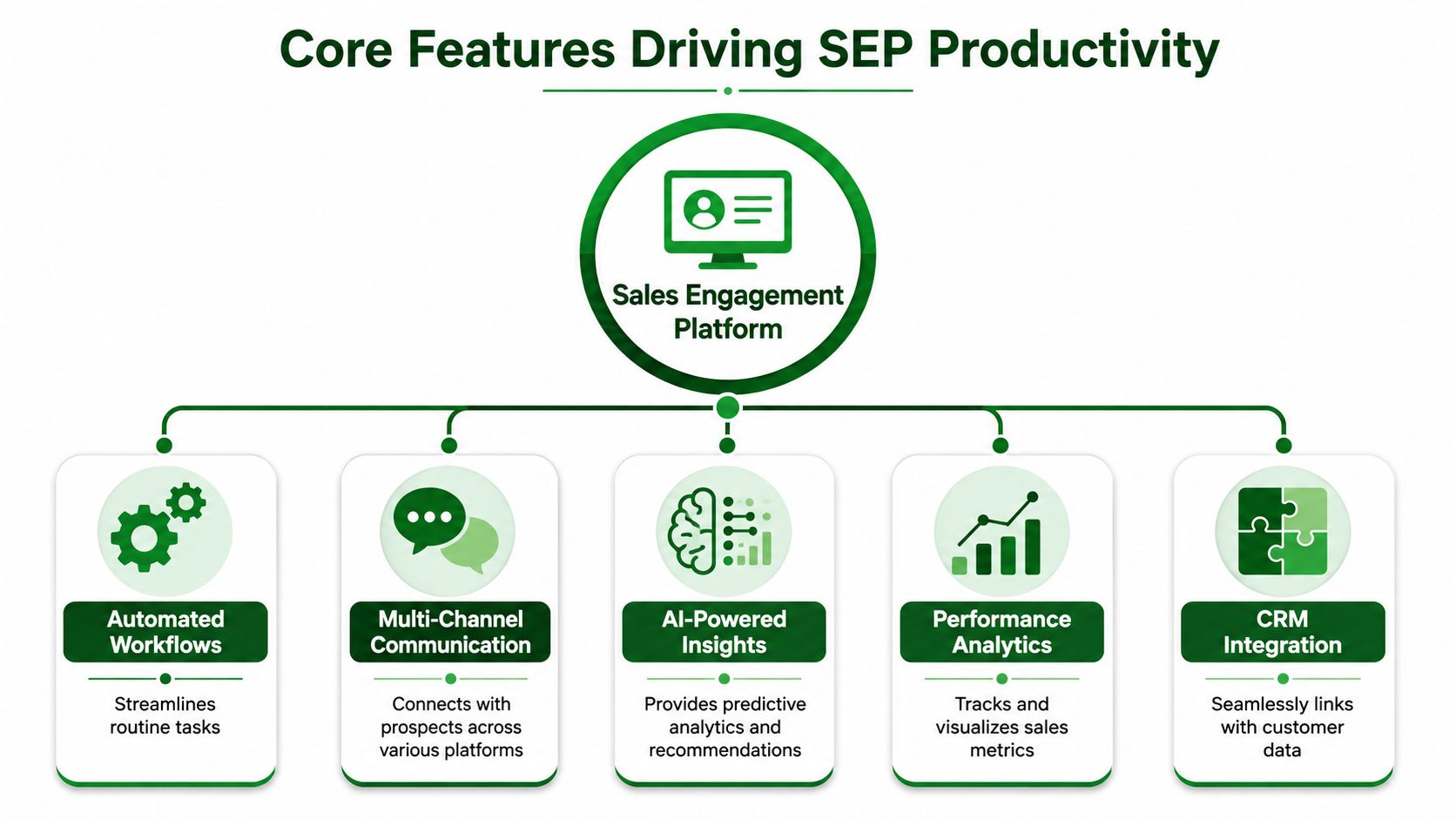
Sequence automation that reduces task sprawl
Sequence automation is the core SEP capability. It schedules follow-ups, controls channel order, and keeps reps from dropping prospects after the first attempt.
The important question isn't whether the platform supports sequences. Every serious tool does. The question is whether the sequence logic matches how your team sells.
Good sequence automation should support:
- Different paths by segment so enterprise accounts don't get the same motion as SMB
- Clear task queues that tell reps what matters now
- Flexible branching when a buyer replies, opens repeatedly, or goes cold
- Simple editing so managers can refine messaging without rebuilding everything
Bad implementations create busywork. Reps end up clearing tasks instead of thinking about account progression.
Communication tools that keep reps in flow
A rep loses time every time they jump from SEP to inbox to dialer to LinkedIn to CRM. The best platforms reduce that handoff friction.
Core communication functionality usually includes email execution, call tasks, templates, snippets, and activity capture. What matters in practice is whether the rep can move through a block of outreach without rebuilding context each time.
If your workflow still requires manual copying of notes, manual task creation, or manual logging after every touch, the SEP hasn't removed much.
Analytics that improve decisions, not just reporting
Most sales teams already have enough dashboards. What they lack is useful interpretation.
SEP analytics should help managers answer practical questions:
| Question | Useful SEP signal |
|---|---|
| Are reps following the intended motion? | Sequence adherence and task completion patterns |
| Is messaging resonating by segment? | Reply patterns and meeting creation by campaign or cohort |
| Where does outreach stall? | Drop-off by step, channel, or audience |
| Which reps need coaching? | Execution consistency, not just raw volume |
That's more valuable than staring at aggregate activity counts. A report that says reps sent many emails doesn't help anyone fix a weak motion.
AI that finds reasons to reach out
Many platforms frequently underdeliver. They offer writing assistance, subject line ideas, or generic prompt-based copy. That's useful at the margins, but it's not the primary bottleneck.
The harder problem is finding why this account should hear from you now.
The best use of AI in outbound isn't polishing bland outreach. It's uncovering prospect intelligence. That means recent online activity, business changes, role-specific pain clues, buying signals, and conversation hooks a rep can use.
For teams trying to improve that first mile of outbound research, tools built around signal-backed research workflows, including platforms like PitchSmart for outbound lead research and sequencing support, fit better than generic AI writing layers.
Relevance doesn't start with better wording. It starts with better reasons.
CRM integration that preserves context
CRM integration shouldn't be treated as a checkbox. It's what keeps your sales engagement platform from becoming another disconnected app.
A clean integration should make sure contact updates, activity history, and sequence outcomes map back into the CRM without creating duplicate records or forcing reps to clean up data manually later.
If integration is weak, managers lose visibility, reps stop trusting the systems, and RevOps inherits another cleanup problem.
SEP vs CRM vs Sales Enablement
Confusion around these categories causes bad buying decisions. Teams expect one platform to do the job of three, then blame the tool when adoption drops.
The cleanest way to think about it is by operational role. A CRM manages customer data. A sales enablement platform supports rep knowledge and readiness. A sales engagement platform drives daily action.
That distinction matters more now because tool overload is already hurting rep productivity. 50% of sales reps are overwhelmed by the number of platforms they're required to use, according to the Gartner statistic cited by Everstage. If each platform adds another login without simplifying workflow, the stack becomes part of the problem.
SEP vs CRM vs Sales Enablement
| Category | Sales Engagement Platform (SEP) | Customer Relationship Management (CRM) | Sales Enablement Platform |
|---|---|---|---|
| Primary purpose | Execute outreach and follow-up | Store and manage account, contact, and pipeline data | Train reps and organize content, guidance, and coaching |
| System type | System of action | System of record | System of knowledge |
| Primary user behavior | Send, call, task, sequence, prioritize | Update, review, forecast, inspect | Learn, prepare, access messaging and collateral |
| Best use case | Daily outbound workflow | Opportunity management and reporting | Rep readiness and message consistency |
| Failure mode | Automates low-quality outreach | Becomes a static database | Becomes a content graveyard |
How they should work together
The best setup is complementary, not competitive.
- CRM holds history: Accounts, contacts, ownership, opportunity stages, and reporting live here.
- Sales enablement supports execution: Reps get playbooks, messaging guidance, objection handling, and content.
- SEP runs the motion: Reps work their queue, complete touches, and move prospects through a defined cadence.
A new sales manager should ask one practical question: Where does the rep spend the day? If the answer is “everywhere,” productivity falls apart.
Tool consolidation only works when the chosen platform becomes the rep's default workspace, not just another tab they ignore.
An SEP earns its place when it reduces context switching, clarifies next actions, and turns scattered prospecting work into one repeatable operating motion.
The Critical Mistake That Makes SEPs Fail
The most common SEP mistake is assuming automation fixes strategy.
It doesn't. It amplifies whatever is already in the system. If your contact data is stale, your targeting is loose, and your messaging has no real trigger behind it, the SEP will execute all of that very efficiently.

Bad data breaks good automation
The simplest truth in this category is also the one teams ignore most. A platform is only as effective as the contact data feeding it, as noted in ZoomInfo's discussion of sales engagement platforms and data quality.
That sounds obvious, but look at what usually happens in a rollout:
- RevOps connects the SEP to the CRM
- Sales ops imports lists from several sources
- Managers load sequence templates
- Reps start sending outreach before anyone audits data quality
Then the failure pattern starts. Messages go to outdated contacts. Roles don't match the pain point in the copy. Geographic coverage is uneven. Ownership is messy. Sequence reporting gets polluted by bad records, and leaders think the messaging is the issue when the list was weak from day one.
More touches do not fix a bad motion
The second mistake is treating activity volume as proof of progress.
A platform can tell you that reps sent the email, completed the call task, and advanced the cadence. It cannot tell you whether the account was worth touching in the first place, whether the trigger was real, or whether the message addressed an active problem.
That's why many SEP deployments feel productive without becoming effective. The workflow becomes cleaner, but the underlying outbound logic stays shallow.
When the research step is weak, every later step gets more expensive.
Generic, unresearched cold emails are the clearest symptom. Teams know they're underperforming, so they add more templates, more follow-up steps, and more channels. But the first message still lacks a reason to exist.
What to audit before rollout
Before expanding SEP usage, audit the inputs behind it.
| Audit area | What to check |
|---|---|
| Contact quality | Is the right person, role, and company information present and current enough to trust? |
| Segmentation logic | Are lists grouped by actual buying context or only by broad firmographics? |
| Message triggers | Does each sequence have a credible reason for outreach? |
| Field hygiene | Are reps inheriting duplicate, missing, or conflicting records? |
| Research workflow | Is relevance created upstream, or is each rep improvising manually? |
It's often found that the SEP wasn't the primary bottleneck. The first mile was. Manual research took too long, so reps skipped it. Once that happens, the platform becomes a distribution engine for low-context outreach.
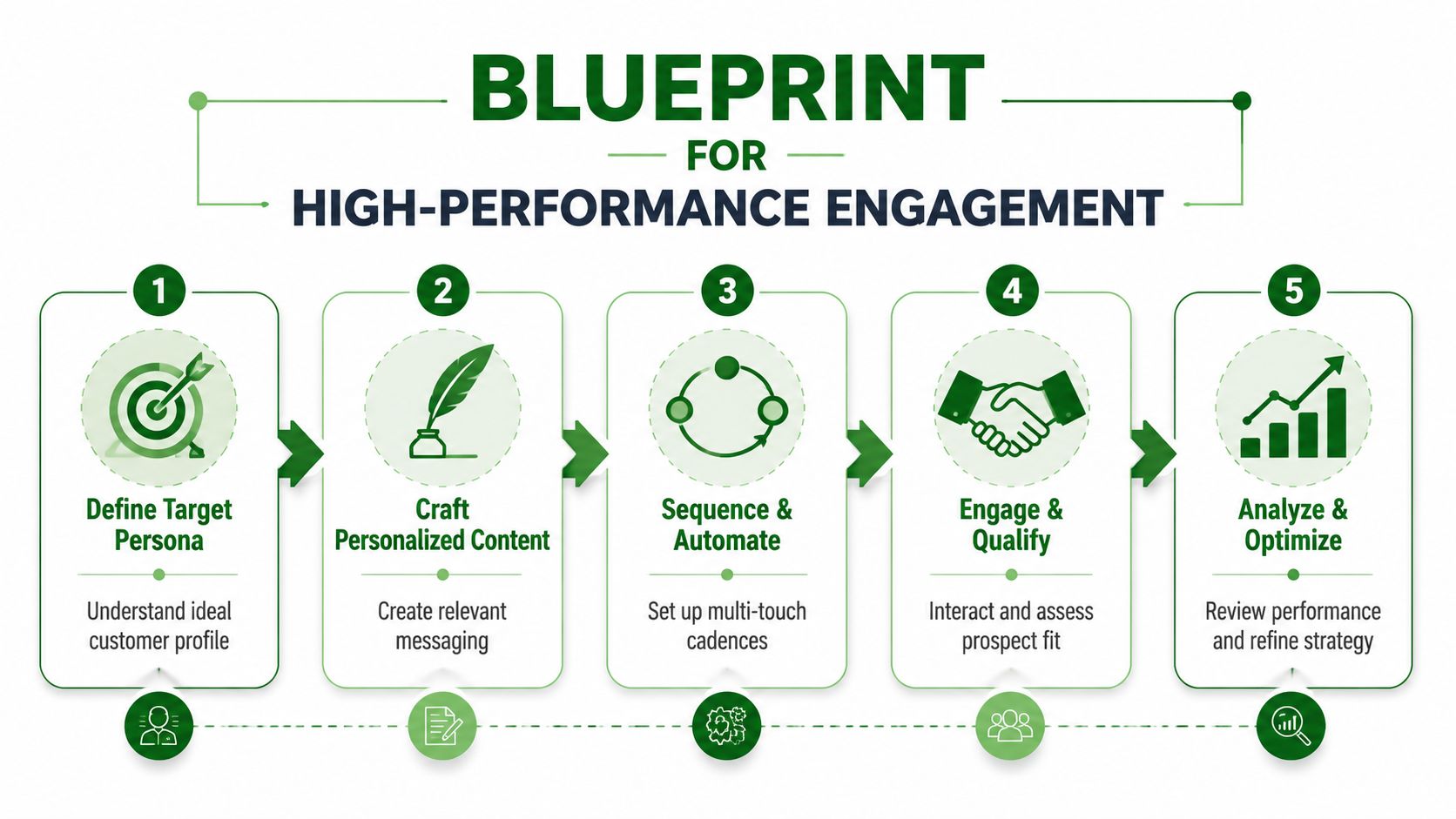
A Blueprint for High-Performance Engagement
A high-performing sales engagement platform workflow starts before the first sequence step. The platform should execute outreach, not invent the strategy behind it.
The practical model is simple. Put intelligence first, then automate.
Start with signals, not static lists
Most outbound lists are built from firmographics and job titles. That's a start, not a strategy.
Higher-quality engagement starts when teams segment based on buying signals, qualifiers, and timing clues. That could mean changes in role scope, recent activity, clear pain indicators, or account-level events that create a reason to talk now.
Static lists age badly. Signal-led lists give reps a reason to lead with relevance.
Research at scale before writing a sequence
This is the step too many teams leave to individual reps.
Instead of asking each SDR to open tabs and manually assemble account context one lead at a time, standardize bulk research across the target list. Pull the qualifiers, identify recent signals, and extract usable conversation hooks before any email copy gets drafted.
That changes the quality of the whole motion. It also creates better handoffs between RevOps, managers, and reps because everyone is working from the same evidence base. Teams that want examples of this shift toward research-first outbound can find related ideas in the PitchSmart blog on outbound workflows and signal-based prospecting.
Build short sequences around one real idea
Once the research exists, sequence design gets easier.
A good three-step motion usually works better when each step reinforces one concrete reason for outreach instead of stacking generic value props. The sequence can span email and LinkedIn, but it should stay anchored to the same trigger.
Try this structure:
- Opening touch: Lead with the most credible signal or hook, not a generic company intro.
- Follow-up: Add a sharper angle or qualifying question tied to the same business context.
- Final step: Close with a direct, low-friction prompt that makes sense if the signal is real.
Automation helps. It ensures consistency after the thinking has been done upstream.
Measure business outcomes, not vanity activity
SEPs are good at counting tasks. Leaders need to be careful not to inherit the platform's worldview.
As Supered's analysis of SEP performance notes, SEPs reliably increase activity but only conditionally improve outcomes because they count swings without verifying whether reps qualified the deal or advanced the buyer's position. That's the right warning.
Track outcomes such as:
- Meetings booked by signal type
- Qualified conversations by segment
- Sequence performance by reason for outreach
- Pipeline progression after first response
Better outreach comes from matching the message to the moment, then measuring whether that moment produced a real sales conversation.
If you only optimize for sends, tasks completed, or cadence volume, the team will get better at being busy.
Choose Your Approach Before You Choose Your Tool
A sales engagement platform is useful. It is not magic.
The teams that get value from an SEP usually make one decision early. They fix the quality of inputs before they try to optimize the quantity of outputs. They clean up contact data, define meaningful segments, standardize research, and give reps real reasons to reach out.
That approach also helps with tool selection. Once you know how your outbound motion should work, it becomes easier to judge whether Outreach, Salesloft, Yesware, Groove, or another platform fits the process. Without that clarity, buyers tend to choose based on feature demos and end up automating the wrong behavior.
If you're evaluating SEP ROI, start one step earlier. Audit how your team creates lists, how it validates contacts, how it finds buying signals, and how it turns research into messaging. That work determines whether the platform becomes a productivity engine or just a faster way to send forgettable email.
For teams comparing workflow options and rollout costs, PitchSmart pricing is one place to review a research-first model before layering on more outbound automation.
If your reps are still doing prospect research one account at a time, that's the first bottleneck to remove. PitchSmart helps outbound teams research leads in bulk, surface signal-backed conversation hooks, segment lists around buying signals, and turn those insights into automated 3-step email and LinkedIn sequences. If you want your sales engagement platform to drive quality instead of just more activity, start there.