Sales teams usually ask how to increase volume of sales. The sharper question is why the engine producing that volume is underperforming in the first place. Sales representatives spend 72% of their time on non-selling activities such as administrative tasks, prospecting, and data entry, leaving only 28% for actual revenue-generating conversations, according to the Forrester Activity Study summary covering 3,031 reps.
That statistic changes the conversation. If reps spend most of the week buried in tabs, spreadsheets, CRM cleanup, and one-by-one research, low sales volume isn't primarily a closing problem. It's an operating model problem. Teams keep staring at closed-won counts, booked revenue, and quarter-end output, even though those are lagging indicators. The controllable levers sit earlier in the workflow: research speed, list quality, segmentation, messaging relevance, and how consistently reps can execute outreach without drowning in admin.
In outbound B2B, volume of sales doesn't rise because leadership says “prospect harder.” It rises when the team removes friction from the top of funnel, improves message-market fit, and gives reps enough selling time to create more qualified conversations.
Why Your Sales Volume Has Stalled and What to Do About It
A sales volume problem is often misdiagnosed as a rep performance problem. The rep gets blamed for low meetings, weak pipeline creation, or uneven closes. In practice, the stall often starts much earlier. The team built an outbound process that asks humans to do slow, repetitive work at scale.

If a rep has to research every account manually, hunt for a usable angle, verify titles, cross-check firmographics, update the CRM, then write a custom first touch from scratch, throughput collapses. You don't have a motivation gap. You have a workflow bottleneck. That's why many teams see busy calendars and weak pipeline at the same time.
Lagging metrics hide the real failure
Closed deals tell you what already happened. They don't tell you why the outcome was weak. Volume of sales is useful, but only after you pair it with leading indicators such as:
- Research throughput: How many target accounts can a rep qualify without sacrificing quality.
- Signal quality: Whether outreach uses current, specific reasons to contact the buyer.
- Segmentation discipline: Whether the list is grouped by relevant pain, buying trigger, or market pattern.
- Execution consistency: Whether reps complete the required touches across channels.
Practical rule: If sales volume is down, start by auditing rep time, list quality, and message relevance before you touch compensation plans.
A lot of “personalization” fails because it isn't research-backed. Reps grab a generic line from a homepage, mention a funding announcement from months ago, or send the same template to completely different personas. Buyers recognize that immediately. Generic cold emails don't just underperform. They waste the little selling time reps still have.
What to do instead
The better move is to treat volume of sales as an outcome of system design. That means removing manual research from the critical path, defining a tighter qualification model, and measuring prospecting inputs with the same rigor used for forecast calls.
For teams that want more tactical thinking on outbound operations, the PitchSmart sales blog is a useful reference point for modern research and sequencing workflows.
Defining Volume of Sales for B2B Outbound Teams
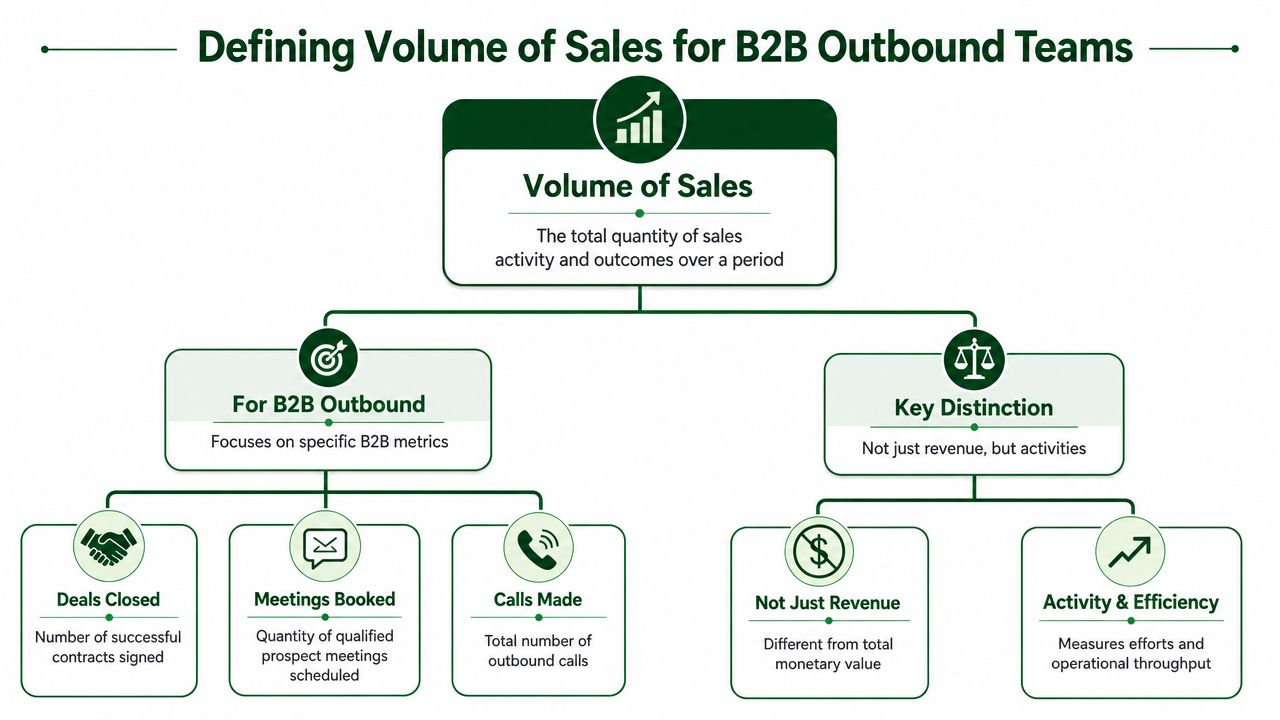
In B2B outbound, volume of sales means the quantity of sales output over a set period. Depending on your motion, that can mean deals closed, subscriptions sold, pilots launched, meetings booked that convert downstream, or another count-based outcome that reflects commercial throughput. The key distinction is simple. Volume measures how many, not how much money.
That sounds obvious, but teams blur it constantly. In SaaS, especially, revenue dashboards often dominate the conversation. A manager says pipeline is growing or bookings are soft, but nobody defines whether the problem is count, deal size, conversion, or cycle time. When that happens, volume of sales becomes a vague phrase instead of a usable operating metric.
Quantity is the point
Think of a simple retail example. If a store sells more units this month, sales volume increased even if discounts lowered revenue per unit. B2B works the same way, just with different units of measurement. For an outbound team, the count may be:
- Closed deals
- Qualified meetings that enter pipeline
- Activated paid subscriptions
- Signed contracts within a named segment
The unit has to match the stage your team can influence. SDR leaders often track meetings and opportunities created. AE leaders usually care more about opportunities converted and deals won. RevOps should define both, then keep them separate.
Volume of sales is a throughput metric. It tells you whether the machine is producing enough count-based output to support growth.
Why it matters more in large B2B markets
The addressable commercial surface in B2B is massive. For instance, the B2B e-commerce sector alone is valued at $36.16 trillion as of 2026, with an anticipated CAGR of 14.5% through 2030, according to the U.S. International Trade Administration forecast. Even if your company sells through a narrower SaaS motion than marketplace commerce, the lesson holds. Scale belongs to teams that can process markets efficiently, segment precisely, and convert activity into repeatable output.
A common mistake is to define volume too low in the funnel. If you only count signed customers, you get a clean number but a slow feedback loop. If you count every email sent, you get activity but not commercial value. Strong teams choose a unit that sits close enough to revenue to matter, yet early enough in the process to be managed week by week.
That usually means using two definitions at once: one for sales activity volume and one for commercial output volume. Without both, you either optimize busyness or stare at outcomes you can't change quickly.
Sales Volume vs Sales Value and Other Key Metrics
Teams get into trouble when they use one metric to answer every question. Sales volume doesn't tell you whether you sold the right deals. Sales value doesn't tell you whether your engine can produce enough opportunities consistently. You need both, plus a few supporting measures, or you'll optimize for the wrong behavior.
A simple comparison that prevents bad decisions
| Metric | What It Measures | Business Question It Answers | Example |
|---|---|---|---|
| Sales Volume | Number of units, deals, subscriptions, or opportunities produced in a period | Are we generating enough count-based output? | 20 new contracts signed this quarter |
| Sales Value | Monetary value of those sales | Are we creating enough revenue? | The quarter included several high-value contracts |
| Average Deal Size | Typical revenue per closed deal | Are we moving upmarket or downmarket? | Fewer deals can still produce strong revenue if deal size rises |
| Sales Velocity | How quickly opportunities move through the funnel | How fast does pipeline convert into revenue? | A team with steady movement can support more predictable forecasting |
| Conversion Rate | Share of leads or opportunities that progress to the next stage | Is the process efficient at each stage? | Better qualification usually improves downstream conversion |
A team can increase volume of sales while weakening the business. That happens when reps close a lot of small, poor-fit deals that churn quickly, consume support time, or distract the product roadmap. The opposite is also true. A company can post strong revenue from a handful of large accounts while hiding a weak outbound engine that isn't producing enough pipeline depth.
The supporting metrics that make volume useful
Sales volume becomes meaningful when you read it alongside adjacent metrics.
- Sales value shows quality in monetary terms. If volume rises but value stalls, you may be discounting too hard or moving into a lower-fit segment.
- Average deal size reveals mix shifts. This matters when leadership celebrates count growth that was due to smaller contracts.
- Sales velocity exposes process drag. You may be creating enough opportunities, but if they sit in stage too long, the team feels productive without generating timely outcomes.
- Conversion rate identifies leakage. If meetings are up and wins aren't, the issue may be targeting, qualification, or handoff quality.
A healthy outbound system doesn't ask reps to choose between volume and relevance. It builds enough research quality upstream that the team can scale both.
This is why vanity metrics are dangerous. Total dials, total emails, and raw activity counts can look impressive in a board slide, but they don't answer the operational question that matters: did the team create enough qualified movement toward revenue? If the answer is no, then more undifferentiated activity won't fix it.
A better scorecard starts with count-based output, layers in monetary value, then checks the process metrics that connect the two. That approach lets RevOps diagnose whether the problem sits in targeting, execution, handoff, or close quality, instead of treating “pipeline is light” as one undifferentiated issue.
How to Calculate and Benchmark Sales Volume
The calculation itself is simple. The hard part is deciding what counts, keeping the data clean, and choosing benchmarks that mean something in your specific motion.
Start with a clean counting rule
At its core, volume of sales is:
Sales volume = total number of completed sales units in a period
In SaaS, the “sales unit” might be closed-won deals, new subscriptions, or activated customers. For an SDR function, it may be accepted meetings or qualified opportunities created. The formula isn't where teams fail. They fail when one report counts meetings booked, another counts meetings held, and a third counts anything with a calendar invite.
Use one counting rule and document it. Keep it boring. Boring definitions are easier to govern.
A practical setup looks like this:
- Choose one primary unit. Closed-won deals for AE reporting, qualified opportunities for SDR reporting.
- Set the reporting window. Weekly for operating reviews, monthly and quarterly for trend analysis.
- Define exclusions. Duplicate records, canceled meetings, recycled opportunities, or renewals if you're measuring new logo output.
- Lock ownership rules. Shared credit models create noise unless everyone agrees how attribution works.
Benchmark against your own operating reality
External benchmarking sounds attractive, but it often produces bad decisions in B2B outbound. Different ACVs, sales cycles, territories, ICP definitions, and handoff rules make direct comparisons messy. Internal benchmarking is far more useful. Compare current output against your own prior periods, segments, and rep cohorts.
For smaller teams, this matters even more. Bain & Company says selling to small businesses is a “huge untapped market” because providers often fail to adapt segmentation and scale strategies for this segment, resulting in poor measurement of true sales volume, as outlined in Bain's analysis of underserved SMB selling. That's exactly what shows up in RevOps audits. SMB teams often have fragmented lists, partial CRM hygiene, and informal qualification rules. They aren't short on effort. They're short on measurement discipline.
Use benchmarks that reflect that reality:
- Period-over-period trend: Compare this month to the last several periods using the same counting rule.
- Segment comparison: Break output by industry, persona, region, or company size to see where volume originates.
- Source comparison: Separate outbound, inbound assist, partner, and expansion activity.
- Rep workflow comparison: Look at how different research and sequencing habits affect output quality.
If your systems are messy, start with one clean report before you build a dashboard empire. For teams tightening prospecting operations, the PitchSmart platform reflects the kind of workflow discipline that's useful here: structured inputs, transparent sourcing, and a repeatable way to move from account list to usable outreach.
The Outbound Engine How to Systematically Increase Sales Volume
The fastest way to kill volume is to force reps into one-by-one research while asking them to hit scale targets. That's where most outbound programs break. The list exists. The market exists. The team is willing to execute. But the workflow between “target account” and “first relevant touch” is so manual that output never compounds.
There's another layer of drag. Gartner reports that 50% of sellers are overwhelmed by the number of platforms they must use, which creates context-switch fatigue and reduces decision-making speed, according to this sales productivity summary citing Gartner. In practice, that means reps jump between CRM, LinkedIn, company sites, enrichment tools, note docs, and sequencing software before they send one message that might still sound generic.
Fix research before you fix messaging
A common approach to improving output involves rewriting templates. That's not where I'd start. If the underlying account research is weak, better copy only makes irrelevance sound more polished.
What works is a process that gives reps usable context at list level, not account-by-account drudgery. The core inputs should be:
- Bulk lead research with custom qualifiers. Research has to run across the whole list so reps can prioritize instead of starting from zero on every account.
- Clear source traceability. If a signal can't be verified, reps won't trust it and managers can't coach it.
- Segment-ready outputs. Accounts should cluster by pain point, trigger, market type, or buying signal, not just industry code.
What doesn't work is dumping a giant lead list into the team and calling it pipeline coverage. Coverage without relevance creates noise. Reps compensate by sending generic sequences. Response quality drops. Managers then ask for more volume, and the team responds with more low-context activity.
Operator's note: If research quality is inconsistent, the team can't standardize messaging, and volume never scales cleanly.
Build hooks from live signals, not assumptions
The best cold outreach starts from a reason to contact the buyer now. That reason usually comes from observable activity. Hiring patterns. Market moves. Website changes. Product direction. Messaging shifts. Expansion cues. Public signals don't guarantee intent, but they do give the rep a credible opening.
That changes the structure of outbound. Instead of “we help companies like yours,” the rep can anchor outreach to a current business context. Instead of one broad sequence for a whole segment, the team can create variations seeded from signal-backed hooks.
This is the part many teams still do by hand. A rep checks company pages, skims recent posts, copies notes into the CRM, then drafts a custom opener. Done once, that looks thoughtful. Done across a real target list, it becomes a throughput killer.
A better operating model combines:
- Activity-based conversational hooks pulled from recent online signals.
- List segmentation based on buying signals so messages match what buyers are likely dealing with.
- A small set of tested narrative paths aligned to common triggers instead of bespoke writing every time.
Here's a quick product walkthrough worth watching because it shows how modern teams reduce research friction before outreach begins.
Standardize the sequence so quality scales
Once research and hooks are in place, the next job is standardization. With standardization, teams either gain an advantage or fall back into artisanal outbound.
Good systems don't ask reps to invent a new sequence for every account. They give reps a repeatable structure. In practice, that often means an automated 3-step email and LinkedIn sequence seeded from the strongest hook, with room for human edits where the account justifies it.
The trade-off is important. Fully manual outreach protects quality but destroys throughput. Fully generic automation protects throughput but destroys relevance. The workable middle is structured automation fed by better research inputs.
That model usually has four traits:
- The first touch uses the strongest verified hook.
- The follow-up adds context or a different angle, not a nag.
- The LinkedIn step reinforces familiarity instead of copying the email.
- The sequence rules stay consistent enough that managers can coach them.
When teams want to operationalize that balance, they should look at whether their current stack reduces work or just spreads it across more tools. If you're evaluating structured outbound workflows, the PitchSmart pricing page gives a concrete view of a platform designed around bulk research, signal-backed hooks, segmentation, and automated sequencing rather than another generic database layer.
Putting It All Together From Research to Revenue
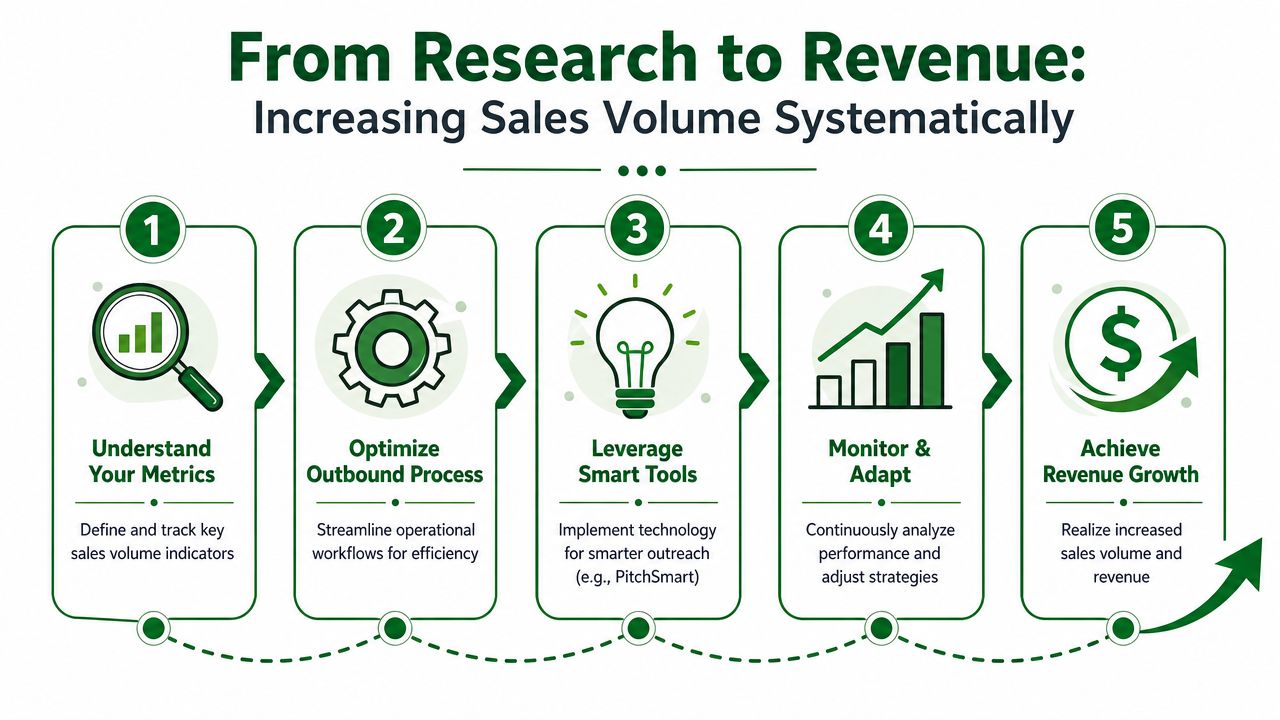
Sales volume improves when the team stops treating it like a scoreboard and starts treating it like the downstream effect of better operations. The sequence is straightforward. Better research creates better segmentation. Better segmentation creates more relevant outreach. More relevant outreach creates more qualified conversations. Those conversations create the conditions for higher volume of sales.
What good teams do differently
Strong outbound teams don't confuse motion with progress. They design around throughput and message quality at the same time.
That usually shows up in a few habits:
- They define one primary sales unit clearly. Everyone knows what counts and what doesn't.
- They remove repetitive research from the rep's day. Reps spend more time in conversations and less time proving basic facts.
- They segment lists before launching sequences. One sequence doesn't try to serve every account.
- They build outreach around real signals. Messaging starts from business context, not generic value props.
- They review leading indicators every week. Pipeline is inspected early enough to change the outcome.
Sales volume is rarely capped by market demand alone. More often, it's capped by the team's ability to research, prioritize, and communicate at scale.
The operating takeaway
If you're a RevOps leader, the practical shift is this: stop asking only how many deals closed and start asking what conditions made those deals possible. Audit the handoffs. Audit the research load. Audit how many tools a rep touches before first contact. Audit whether segmentation is real or just cosmetic.
Most stalled teams don't need more hustle. They need fewer manual steps, tighter inputs, and a repeatable system for turning account intelligence into outreach that buyers will read.
Volume is one of three things that can move a revenue number. Price volume mix analysis separates the three, so a quarter that grew on discounting does not get read as a volume win.
PitchSmart helps outbound teams fix the part of the process that usually breaks first: manual research. If you want a faster path from account list to signal-backed outreach, try PitchSmart to run bulk lead research, segment prospects by buying signals, and generate outreach sequences without the usual tab-sprawl and copy-paste.