Intent data reveals which prospects are actively researching solutions like yours right now, so sales teams can prioritize outreach based on timing instead of guesswork. Sales reps spend only 28 to 30% of their week on direct selling activities, while 70 to 72% disappears into non-selling work like research, admin, and CRM updates, which is exactly why bad prospecting habits keep killing pipeline.
This is the core issue behind most cold outreach failure. It's not that reps can't write. It's not that the market is impossible. It's that teams are still asking the wrong question. They ask who fits the ICP, then blast a list. They should be asking who is showing buying behavior now.
When you understand what intent data is, outbound stops being a volume game and starts becoming a timing game. That matters for SDRs more than anyone, because the difference between a relevant message and a wasted touch usually comes down to whether the account is actively researching the problem you solve.
The Real Reason Your Cold Outreach Is Failing
Sales reps spend only 28 to 30% of their week on direct selling activities, according to Salesforce's 2025 State of Sales, as cited in this analysis of rep time allocation. The rest goes to research, admin, updates, and internal work. That is the core outbound problem. Reps are burning limited selling time on the wrong accounts.
Poor prioritization kills outreach before messaging even gets a chance.
A rep can build a clean list, personalize five emails, and still get nothing because the account is not in market. I see this constantly. SDRs are told to research harder, add more personalization, and send more volume, when the actual miss is timing. If the buyer has no active problem to solve, the best opener in the world still lands cold.
Manual research creates fake productivity
Manual prospecting feels productive because it looks busy. Tabs are open. Notes are filled in. Contacts are enriched. None of that creates pipeline if the account has no active buying motion.
What reps need is a way to decide where to spend the next hour, not a bigger pile of accounts.
That is why intent data matters at the rep level. It helps SDRs stop treating every good-fit account the same and start focusing on the accounts showing current interest. Then the job becomes practical. Find the right people inside that account, match the outreach to the topic they care about, and get to the meeting faster. If your team needs more examples of that workflow, the PitchSmart sales prospecting blog covers the tactical side.
Static lists don't tell you who deserves attention now
Firmographics still matter. They tell you whether an account belongs in your market. They do not tell an SDR what to do this morning.
That gap is where teams lose quota.
A clean ICP list gives you names. It does not tell you which account is researching your category, which topic is heating up, or which contact is most likely to respond right now. Without that layer, reps fall back on guesswork. They overwork the obvious accounts, ignore smaller ones with active demand, and waste strong messaging on bad timing.
A useful outbound workflow is stricter than that:
- Prioritize active accounts: Work the companies showing current research behavior first.
- Reduce research drag: Stop spending the same amount of time on every account.
- Anchor outreach to a topic: Contact-level messaging should reflect the problem the account is signaling, not a generic persona template.
- Move fast: Fresh signals lose value quickly, so routing and action have to happen fast.
This is the shift that matters for SDRs. Intent is not just a better targeting input for managers. It is a practical way for reps to translate account-level interest into contact-level outreach that books meetings. Without that translation, intent stays theory. With it, reps stop guessing and start working accounts that can convert.
What Exactly Is B2B Intent Data
Intent data is behavioral information that shows what a buyer or account is researching before they fill out a form, reply to an email, or ask for a demo, as explained in Foundry's definition of intent data.
For SDRs, that changes the job. The goal is not to push every good-fit account into a conversation. The goal is to spot active research early, map it to the right people, and reach out with a message tied to the problem they are already spending time on.

It answers when, not just who
Most prospecting systems are good at defining market fit. They can tell you whether a company matches your target profile based on industry, size, geography, technology, or hiring activity.
Intent data adds timing. It helps reps separate accounts that could buy someday from accounts that are showing signs of active evaluation now. That distinction matters because timing is usually what kills cold outreach. Good messaging sent to the wrong account at the wrong moment still gets ignored.
A rep with intent data does not have to start from a blank page. They already have a working angle. If an account is researching pipeline visibility, call coaching, or outbound efficiency, outreach can start there instead of opening with a generic value proposition. For more examples of that workflow in practice, the PitchSmart sales prospecting blog breaks down research-driven outbound in detail.
Intent data is a record of live research behavior
SDRs often hear about intent data as a score in a dashboard. That framing is part of the problem. A score by itself does not book meetings. What matters is the behavior behind it and whether a rep can turn that behavior into a useful hypothesis about who to contact and what to say.
In practice, intent data is a trail of digital breadcrumbs. Those signals can include:
- Research activity: Reading content tied to a category, pain point, or solution area
- Content engagement: Downloads, repeat visits, or interactions that suggest evaluation is getting more serious
- Search and discovery behavior: Topic exploration that points to an active problem
- Social and community activity: Public engagement around relevant business issues
Intent data does not confirm a deal. It gives reps evidence that an account has moved beyond passive fit and into active research.
That is the practical value. SDRs can stop treating every account in a territory the same and start translating account-level interest into contact-level outreach. PitchSmart helps make that jump. It turns noisy signals into clear actions, so reps know which contacts to work, which angle to use, and how to get from abstract intent to booked meetings.
The Different Types of Intent Data Signals
Not all intent data is created the same way. If you don't understand the source, you won't know what to trust, what to prioritize, or where the blind spots are.
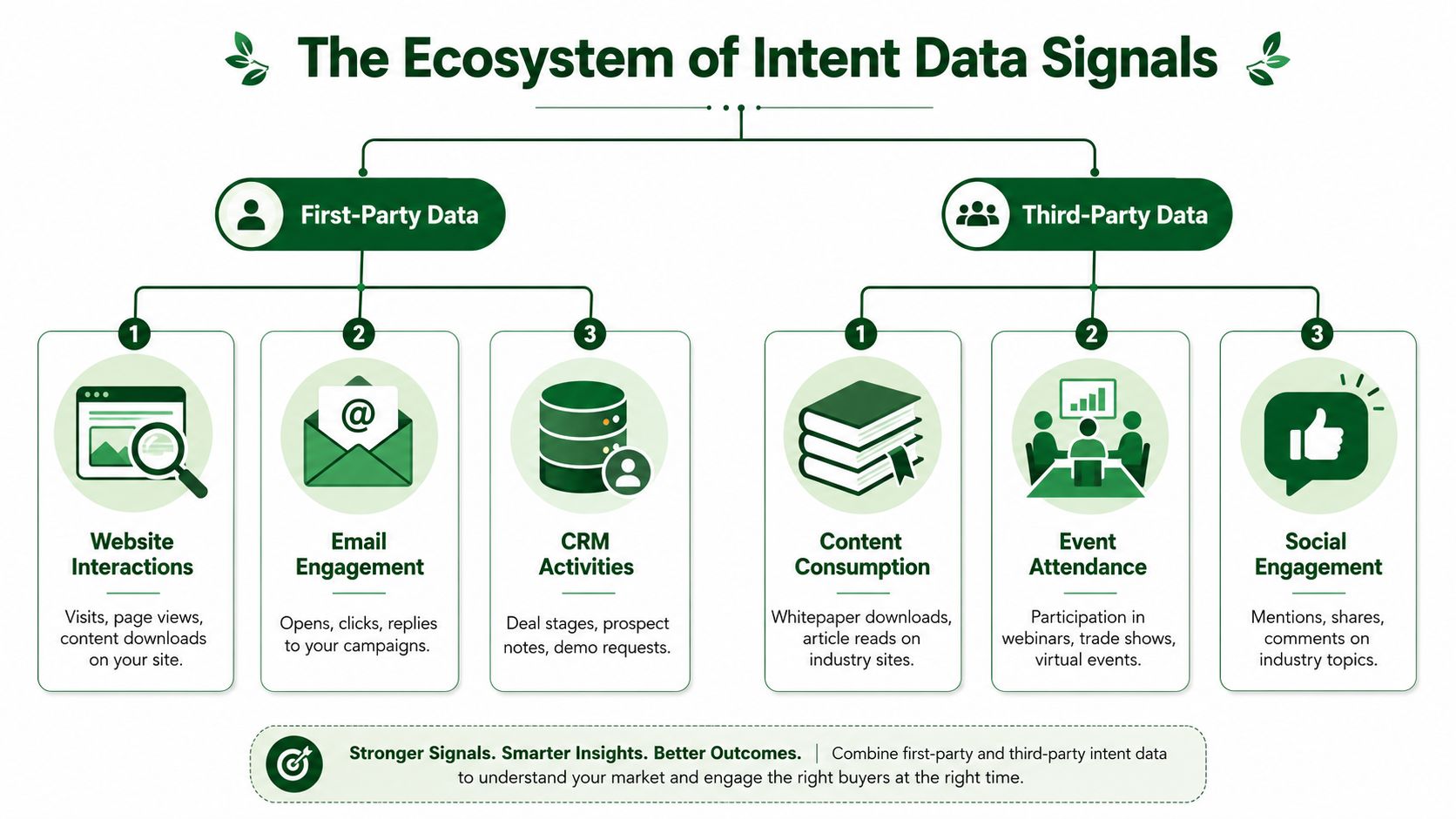
The core split is straightforward. Infuse's glossary on intent data explains that first-party intent data comes from your own digital properties, while third-party intent data comes from external providers tracking research behavior across broader partner networks. It also notes the trade-off clearly. First-party signals are the most reliable, while third-party data gives you the scale to identify net-new accounts.
What each signal source gives you
There's also second-party data through direct partnerships, but for most SDR workflows the practical comparison starts with the two ends of the spectrum.
| Attribute | First-Party Intent Data | Third-Party Intent Data |
|---|---|---|
| Source | Your website, email, CRM, owned channels | External publisher and partner networks |
| Reliability | High, because it comes from direct interaction with your brand | Broader and earlier, but more indirect |
| Coverage | Limited to accounts already touching your ecosystem | Useful for finding net-new accounts |
| Best use | Prioritizing known interest in your company | Spotting category research before prospects raise their hand |
| Main weakness | Misses buyers who haven't visited you yet | Can feel too broad without added qualification |
Here's the operational reality. If someone from a target account visits your site, engages with your emails, or requests something from your team, that's a strong signal. But it only tells you about buyers who are already entering your orbit.
Third-party signals widen the aperture. They help you see category-level research before the buyer lands on your domain. That's valuable for outbound because you can catch accounts earlier.
Why blended coverage wins
The mistake is treating one source as enough.
If you use only first-party intent, you'll miss buyers who haven't found you yet. If you use only third-party intent, reps may chase accounts with broad topic activity but weak brand engagement. The strongest workflow combines both, then adds fit and contact mapping.
To consider this from a practical viewpoint:
- Use first-party for confirmation: It tells you the account is engaging with you specifically.
- Use third-party for discovery: It helps uncover demand outside your owned channels.
- Use second-party when available: Partner ecosystems can add context you won't get alone.
- Use firmographic fit as a filter: Interest matters most when the account can buy.
The goal isn't more signals. It's fewer false positives.
That's why mature teams don't dump raw intent feeds directly onto reps. They combine source type, topic relevance, account fit, and actual contact access before an SDR ever writes the first line.
How Intent Signals Are Collected And Scored
Intent vendors are doing two jobs at once. First, they collect behavior from places buyers research. Then they try to turn that messy activity into something a sales team can act on without wasting half the day chasing noise.
Apollo's explanation of intent data for prospecting lays out the basic mechanics. Providers aggregate signals like web visits, content consumption, and search activity, then use identity resolution to map those behaviors back to business accounts. That account view is useful, but SDRs should be clear on the limitation. An account-level surge is not a contact strategy.
That distinction matters more than vendors admit.
How providers turn behavior into account scores
Providers collect activity across publisher networks, review sites, ad ecosystems, owned properties, and other environments where business research happens. They classify that activity by topic, compare it against a baseline, and assign scores based on strength, frequency, and timing.
What lands in the rep workflow usually sounds like this:
- an account is researching a topic more than usual
- interest in a category is rising at a company
- a cluster of behaviors suggests active evaluation
Useful signal, incomplete instruction.
The score tells you where to look. It rarely tells you who on the buying committee is driving the research, whether that person can buy, or what message will earn a reply. That is exactly why SDRs get stuck. They receive an account with a heat score and still have to figure out the right function, the right contact, and the right angle before the signal cools off.
Teams that skip that translation step burn time fast.
If you are operationalizing these workflows, review PitchSmart's privacy and data handling practices before you push intent into outbound sequences.
How scoring works in practice
Scoring models vary by provider, but the inputs are usually the same:
- Behavior collected: page visits, content downloads, review-site activity, search behavior, ad engagement.
- Topic classification: the system groups that behavior into themes such as sales engagement, CRM migration, or hiring software.
- Identity resolution: anonymous activity gets mapped to a company based on IP, cookies, device graphs, or other matching methods.
- Weighting: recent, repeated, topic-specific actions get more weight than scattered older activity.
- Prioritization: the platform ranks accounts so reps work the best current opportunities first.
The trade-off is coverage versus precision. Broader networks produce more signal volume, but they can also create more false positives. Tighter scoring reduces noise, but it can miss early-stage research that has not crossed the provider's threshold yet. Good RevOps teams know the model is directional, not perfect.
Why recency usually beats raw volume
A high score from last week can already be dead.
Apollo notes that ignoring signals older than 72 hours cuts noise by approximately 80% while retaining high-intensity buying signals (source). That lines up with what happens in the field. SDRs do not lose meetings because they lacked another dashboard. They lose meetings because they reached out after the account had already moved on, narrowed its shortlist, or handed the project to someone the rep never contacted.
So treat scoring as a time-sensitive priority cue, not a permanent badge that says "hot account."
For an SDR, the practical question is simple. What do I do with this score today? The answer is not "blast five contacts." The answer is to use the signal to narrow the problem, identify the likely stakeholders tied to that problem, and write outreach that reflects the topic the account is researching. That is the gap PitchSmart closes. It turns account-level intent into contact-level action so reps can stop guessing who to email and start booking meetings from real buying motion.
Old intent is usually a stale lead dressed up as insight.
Strong teams do not celebrate huge intent lists. They work short, current lists with clear topic relevance, mapped contacts, and a fast path to outreach.
From Theory To Quota How To Use Intent Data In Sales
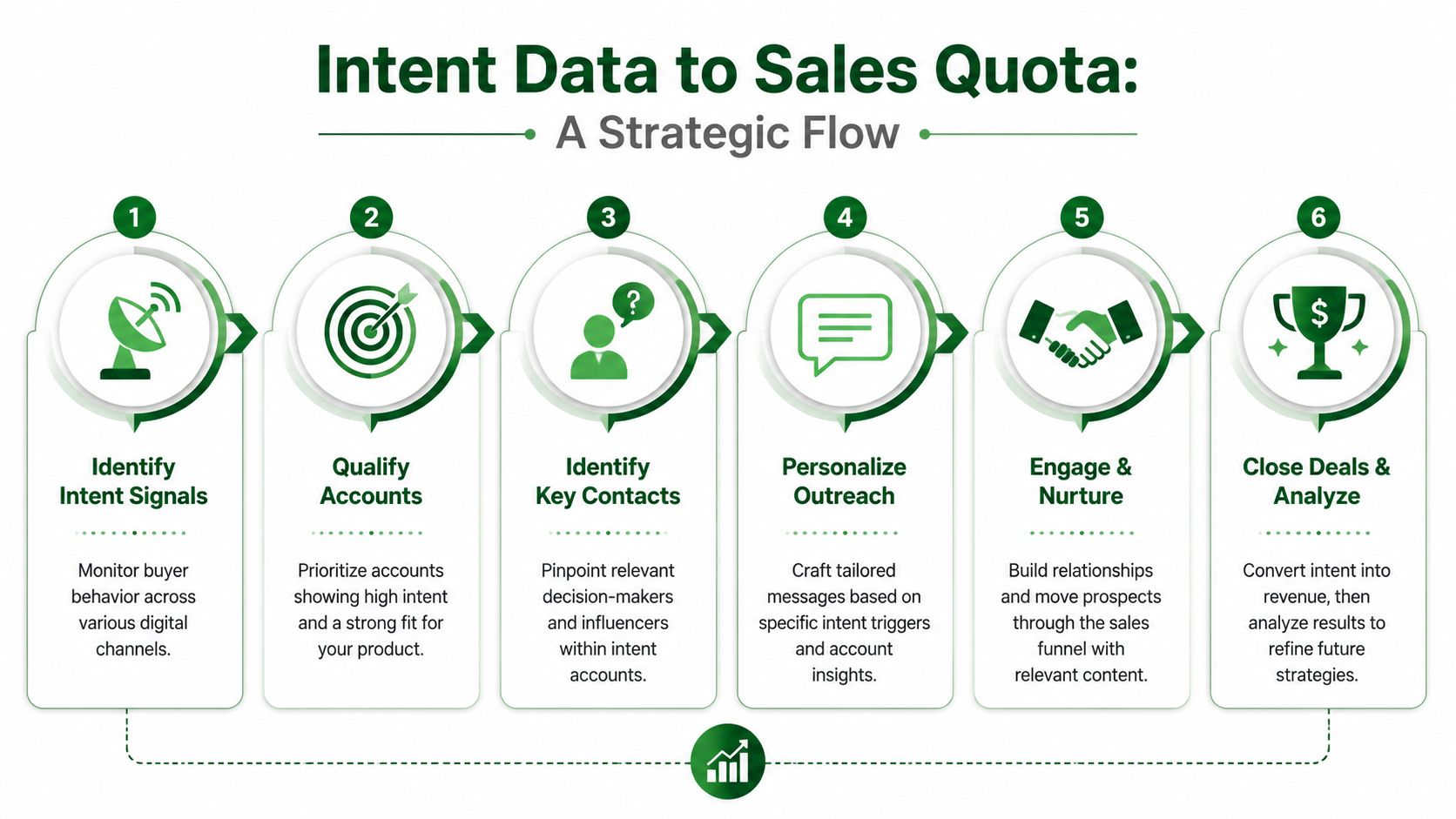
A common challenge arises when organizations identify an account researching something. They still don't know who to contact, what to say, or how to move before the signal goes stale.
That gap is real. Vector's article on what to do with intent data makes the point directly: most content treats intent as account-level only, but the most useful intent is first-party, contact-level, and high-frequency. It also surfaces the practical question SDRs run into every day: How do I map topic intent to the right person in the buying group? Without that step, teams engage the company but miss the decision-maker.
The gap between account intent and contact action
Take two SDRs working the same territory.
The first SDR uses a static list. They see that a company matches the ICP, pull a few titles, and send a generic sequence about productivity, efficiency, or whatever message is on-brand this quarter. There's no evidence behind the timing. There's barely evidence behind the angle.
The second SDR starts with intent. The account is researching a topic tied to a live business problem. Instead of emailing every VP-level contact at random, the rep narrows the likely buying group based on the topic, current org structure, and recent visible activity from specific contacts.
That second workflow is what turns theory into meetings.
What an SDR should actually do next
When an account-level intent signal appears, the next move isn't “send sequence.” It's qualification.
Use this checklist:
- Check topic relevance: Is the account researching a problem your product solves?
- Check fit: Does the company still match your ICP, or are you forcing it?
- Check likely owners: Which functions would care most about that topic?
- Check contact evidence: Which individuals show the closest connection to the issue?
- Check timing: Is the signal still fresh enough to act on?
From there, your outreach should stop sounding like a pitch and start sounding like a well-timed observation. If the account appears to be researching workflow automation, don't send broad “helping teams save time” copy to a generic operations list. Contact the function most likely to own that pain, and reference the problem category with restraint.
The best intent-driven email doesn't say “I know what you did.” It says “Your team may be working through this problem right now.”
That's also where modern outbound tooling matters. You need a workflow that can research an account list in bulk, identify likely buying-committee contacts, surface recent online signals that can become conversational hooks, segment lists by buying behavior, and seed those hooks into a usable email and LinkedIn sequence. Otherwise your reps still end up doing manual stitching across tabs.
For teams evaluating workflow cost, PitchSmart pricing gives a clear view of what it takes to operationalize research-backed outbound without turning SDRs into part-time data entry staff.
Building Your Intent-Driven Sales Playbook
Intent data only pays off when you turn it into a repeatable operating system. One rep can improvise. A team needs rules.
The playbook starts with signal intake and ends with outreach execution. In the middle, RevOps has to define how accounts are prioritized, how contacts are selected, and what kind of messaging gets launched for each signal type.
Set rules before reps start clicking
If you don't standardize action, intent data turns into another noisy dashboard.
A clean sales playbook should define:
- Priority routing: Which signals deserve same-day follow-up and which go to nurture
- Contact selection: Which roles are default first touches for each topic cluster
- Message boundaries: What reps can reference directly and what should stay broad
- Sequence choice: Which outreach pattern gets used for each kind of buying signal
The point isn't bureaucracy. It's speed with consistency. Reps shouldn't have to reinvent logic every time a new account surges on a relevant topic.
Build sequences around topics, not templates
Most outbound sequences fail because they're built around a company pitch instead of a buyer problem.
A better structure is topic-led. If the signal points to evaluation around a category, the first touch should frame the problem. The second touch can add a sharper operational angle. The third can move to a short call ask or LinkedIn follow-up. That sequence should exist before the rep starts working the list.
Here's the pattern that usually holds up:
- Touch one uses the hook: Reference the problem area in plain language.
- Touch two adds context: Tie the issue to a role-specific consequence.
- Touch three lowers friction: Ask for a quick conversation or offer a relevant resource.
A short product walkthrough helps show what this kind of system looks like in practice.
What makes this operationally useful is automation around the painful parts. Teams need a way to run bulk lead research across a list, pull out source-backed qualifiers and buying signals, segment by likely readiness, and generate an initial three-step email and LinkedIn sequence without making every SDR rebuild the wheel manually.
Good playbooks reduce choices at the moment of action.
That's the difference between “we have intent data” and “our reps know what to do with it.”
Stop Guessing Start Selling With Intent
Blind outreach still exists because it's easy to start, not because it works well. Pull a list, load a sequence, hope somebody replies. That's not a strategy. It's a labor-intensive way to hide weak prioritization.
Intent data changes the workflow in the place that matters most. The rep no longer has to guess which account deserves attention today. They can work from evidence. They can route time toward accounts showing live research behavior. They can write messages around the problem the buyer appears to care about, not the generic value prop marketing approved three months ago.
Used responsibly, intent data also doesn't require reckless data practices. Stick with reputable providers, use clear governance, and make sure your workflow respects privacy and sourcing standards. The point is better timing and better relevance, not creepier outreach.
For SDRs, managers, and RevOps teams, the practical takeaway is simple. If your outbound process still depends on manual research and static lists, you're wasting selling time you don't have. If you can translate intent into contact-level action fast, you give your team a real shot at more meetings with less noise.
Try PitchSmart if you want to turn intent-driven prospecting into an actual outbound workflow. Upload a list, run bulk research across the whole account set, surface source-backed buying signals and conversation hooks, segment by likely readiness, and generate outreach your reps can use immediately without spending their week buried in tabs.