Your quarter is slipping, your pipeline is thin, and your reps are still buried in tabs. They're clicking through team pages, guessing who owns the budget, copying names into spreadsheets, and trying to turn a public website into a prospect list. That's the moment when scraping emails from websites starts to look smart.
It isn't.
It looks like a shortcut because the pain is real. Reps are under pressure to build lists fast, launch outreach fast, and somehow still personalize enough to get replies. When the CRM is light and leadership wants meetings, a bot that pulls addresses off company sites feels like a practical answer.
But scraping solves the wrong problem. It gives you raw contact strings when what you need is relevance, context, and a reason for the buyer to respond. In modern B2B outbound, a scraped address without a signal is just a faster way to send ignored emails.
The Sales Rep's Desperate Search for Leads
Late in the quarter, bad list-building habits spread fast. One rep pulls a few addresses from a company contact page. Another grabs names from a team directory and tries to infer the pattern. Soon the team is treating scraping emails from websites like a normal part of outbound instead of what it really is: a symptom of broken prospecting operations.

The pressure is easy to understand. Sales representatives spend only 28–30% of their work week on direct selling activities, while the remaining 70–72% goes to non-revenue work like research, CRM updates, email triage, and internal meetings, according to this breakdown of sales time allocation. When reps spend most of the week not selling, they start reaching for anything that looks faster than manual research.
Quota pressure creates bad process
A rep doesn't wake up wanting to scrape websites. They usually get there after a sequence of operational failures:
- Weak territory coverage: The named accounts are there, but the contacts are missing.
- Manual research overload: Every prospect requires another round of searching LinkedIn, company sites, and press pages.
- No signal prioritization: The team can't tell which accounts are active, so they default to volume.
- Sequence pressure: Leadership wants campaigns launched now, not after a week of research.
That combination creates the fantasy. If a crawler can grab enough emails by lunch, maybe the rep can still hit activity targets by end of day.
Practical rule: If your reps are scraping websites to make up for missing process, your list-building system is failing them.
The real problem isn't missing emails
Most sales teams frame this as a contact acquisition issue. It isn't. The problem is that reps are doing one-by-one research in a market that rewards speed and relevance. They need a repeatable way to identify the right accounts, the right people, and the right reason to reach out.
Scraping only addresses the thinnest slice of that workflow. It might produce strings that look like contacts, but it doesn't tell the rep whether the person is active, relevant, reachable, or likely to care. That gap is why teams can spend hours “building list volume” and still have nothing useful to send.
The temptation is understandable. The logic is flawed. Scraping emails from websites feels like a productivity hack when you're staring at an empty sequence queue. In practice, it's usually just manual prospecting with extra risk layered on top.
The Technical Illusion of Easy Email Scraping
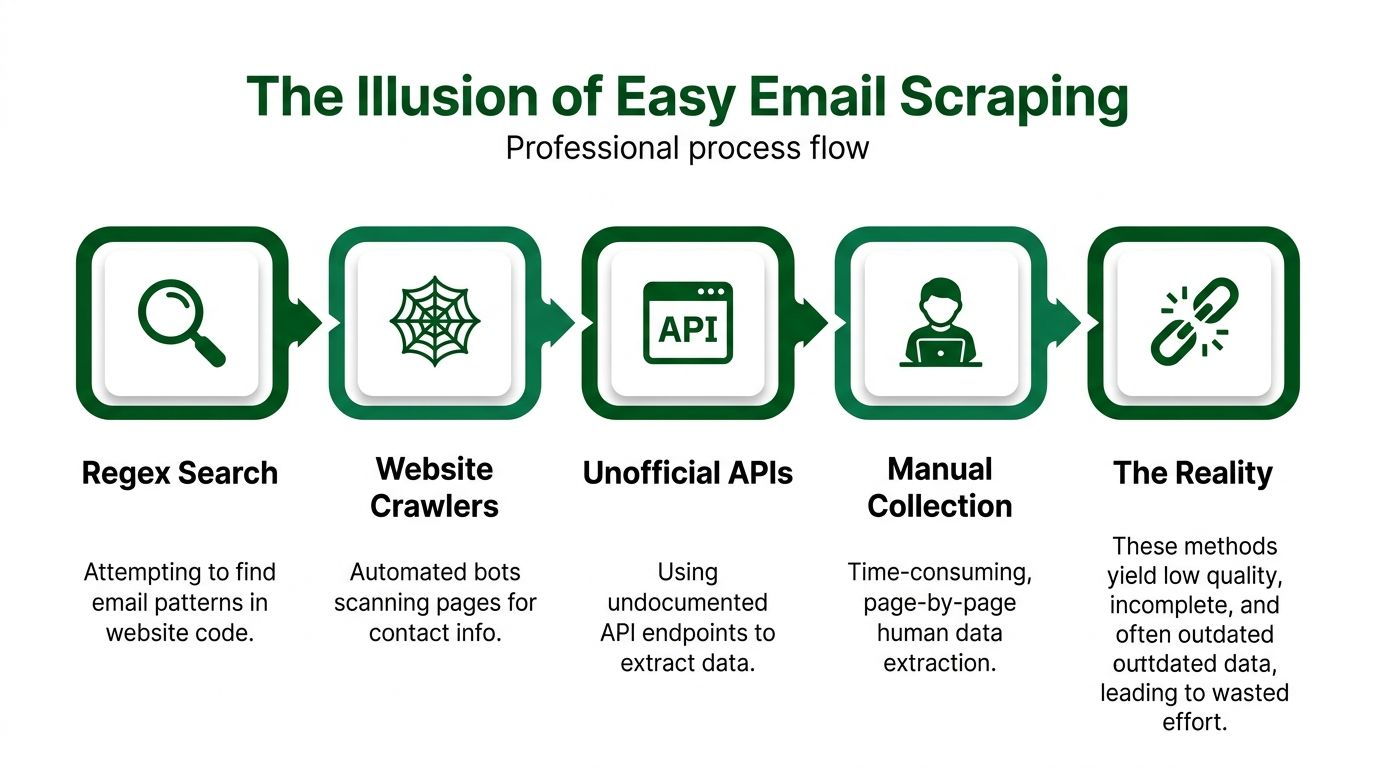
The technical story around scraping is badly oversold. People talk about regex, crawlers, browser automation, and extraction tools as if this is a clean pipeline. It isn't. The minute you move beyond a static contact page, the process gets messy.
Why scraping looks simple from the outside
At a high level, the playbook is familiar. A scraper loads pages, searches for patterns that resemble an email address, and stores whatever matches. More advanced setups use headless browsers to render JavaScript and rotating proxies to avoid basic blocking. That sounds efficient until you look at the output quality.
According to ScrapingBee's discussion of email scraping workflows, expert-level scraping requires a two-phase architecture, and the extraction step alone yields only 40–60% accuracy without post-processing validation. That means the “easy part” isn't even reliable before cleanup begins.
Why the data quality breaks down immediately
The web isn't built to help scrapers. Sites hide addresses in scripts, encode them, split them across page elements, or replace them with forms. Some pages load contact details only after JavaScript runs. Others place junk patterns in the source to catch bots.
ScrapingBee also notes that failing to handle obfuscated encoding causes up to 30% of bot attempts to miss valid addresses. So even if your system is technically functional, it still misses a meaningful chunk of what you were trying to collect.
Here's what usually goes wrong:
| Method | Why teams try it | Where it fails |
|---|---|---|
| Regex search | Fast pattern matching across page content | Captures noise and misses hidden or dynamic emails |
| Website crawlers | Broad site coverage | Pulls role accounts, stale pages, and irrelevant contacts |
| Headless browsers | Handles JavaScript-rendered content | Higher complexity, more cost, more maintenance |
| Manual collection | Better judgment on each page | Slow, inconsistent, impossible to scale |
The technical win condition is misleading. You can successfully scrape a page and still fail at prospecting.
A rep doesn't care whether the script completed. They care whether the resulting contact is usable in a live sequence. That's the part technical scraping advocates skip. They celebrate extraction volume and ignore downstream quality.
The engineering effort doesn't create sales leverage
If your team has to render pages, rotate infrastructure, decode obfuscation, filter role accounts, and validate the list after extraction, you haven't built a shortcut. You've built a side project.
And the output still lacks context. You don't know why that company matters today. You don't know whether the person changed roles, hired a new team, launched a product, or showed any sign of interest. You only know that a string resembling an email appeared on a page.
That's not a prospecting advantage. That's technical labor disguised as pipeline generation.
The Hidden Costs and Poor ROI of Scraped Lists
Let's assume your scrape works. You rendered the pages, avoided the obvious traps, cleaned the list, and loaded the contacts into a sequencer. You still haven't solved the core problem. You've just moved it downstream into deliverability, reputation, and wasted rep effort.
The problem starts after the scrape
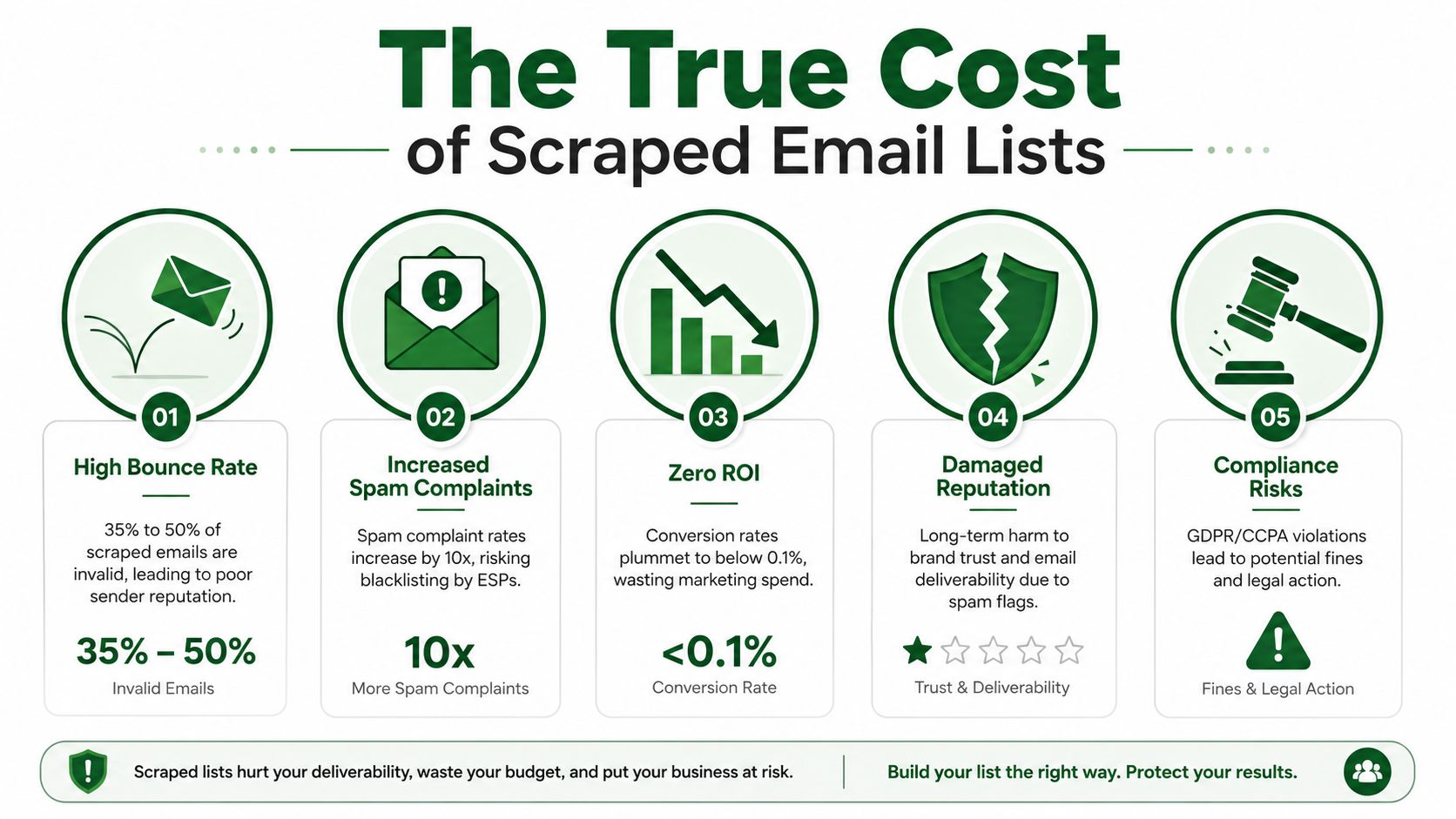
Scraped lists perform poorly where it matters most: inbox placement and engagement. According to Campaign Cleaner's guide on email extraction and list quality, scraped addresses generate bounce rates exceeding 25% and engagement rates often below 5%, while verified prospects typically achieve 15–25% open rates.
Those numbers should end the debate for any serious outbound team.
If your starting list bounces heavily and barely engages, every follow-up becomes more expensive. Reps spend time writing, QA checks take longer, deliverability gets worse, and the domain carries the damage long after the campaign ends.
Free data becomes expensive fast
“Free” is the most expensive word in scraped outbound. You pay for it in places teams often ignore:
- Sender reputation damage: High bounce volume tells inbox providers your list hygiene is weak.
- Sequence waste: Reps end up personalizing messages for dead inboxes and generic aliases.
- Tool friction: ESPs and outreach platforms treat scraped lists as risky behavior.
- Management noise: Leaders chase activity metrics that never convert into meetings.
The operational cost is bigger than the line item cost. A bad list poisons performance reviews, forecast confidence, and sequence testing. When list quality is poor, teams misread everything. They blame copy when targeting is broken. They blame timing when the contact was never viable.
Revenue reality: A scraped list doesn't fail cheaply. It fails across deliverability, rep time, and reporting quality at the same time.
Scraped volume is not pipeline
Sales teams sometimes defend scraping by saying they only need “enough at-bats.” That logic belongs in a lower-trust era of outbound. Modern outbound rewards precision. If the list is weak, volume amplifies the weakness.
There's also a false comfort in partial validation. Cleaning helps, but it doesn't create intent, context, or fit. A cleaned list of irrelevant contacts is still an irrelevant list. A technically reachable person who has no reason to care is still a dead end.
The ROI question is simple: would you rather have more addresses or more conversations? Teams that optimize for raw volume usually get the first and miss the second.
Navigating the Legal and Compliance Nightmare
A lot of sales teams talk about scraping as if the only downside is bad deliverability. That's incomplete. The bigger issue for a legitimate business is compliance exposure. Once you start collecting and using scraped addresses for commercial outreach, this stops being a scrappy growth tactic and becomes a governance problem.
Public doesn't mean permissionless
The most common bad assumption is that public availability equals safe usage. It doesn't. A business email published on a team page may still be personal data under privacy law, and your right to see it isn't the same as your right to use it for outbound sales.
The risk is especially severe in regulated markets. GDPR treats personal data seriously, and scraped email addresses can fall under that umbrella. The verified data here is unambiguous: under GDPR, fines can reach up to 4% of global annual revenue or €20 million, whichever is higher. That alone should remove scraping from any serious RevOps playbook.
In the United States, the risk is also concrete. The FTC has issued warnings that scraping and using email addresses for commercial purposes without consent may violate the CAN-SPAM Act, with penalties of up to $50,095 per violation, as described in this summary of email scraping compliance risks.
RevOps owns the risk whether sales admits it or not
If a rep scrapes a list and launches outreach, the liability doesn't stay with the rep. Operations inherits it. Legal inherits it. Leadership inherits it. Your company domain, brand, and compliance posture all get tied to behavior that was never reviewed properly.
That's why this isn't just a “sales judgment” issue. It's a process design issue. If your team needs guidance on how customer data should be handled, reviewed, and protected, your standards should look more like a documented privacy program than a growth hack. A good reference point is a clearly stated privacy framework like this one.
Here's the practical compliance test I use with sales teams:
- Can you explain where the data came from? If sourcing is murky, stop.
- Can you justify the outreach basis? If the only answer is “it was on their website,” stop.
- Can you defend the workflow internally? If legal or ops would be surprised, stop.
If your outbound motion depends on explaining away how the contact data was obtained, the motion is already broken.
Scraping emails from websites doesn't just create campaign risk. It creates organizational risk. That's the kind of problem that shows up after the send button is pressed, when fixing it is slower and more expensive.
The Pivot From Raw Data to Actionable Intelligence
The core failure of scraping isn't only technical or legal. It's strategic. Scraping gives you destinations, not opportunities. A contact record without context doesn't help a rep open a conversation that feels timely, relevant, and credible.
An email address is not a buying signal
Most outbound programs often lose the plot. They celebrate contact acquisition and ignore message relevance. That's backwards.
According to Lindy's analysis of scraped outreach performance, 60-70% of scraped emails are technically valid after cleaning, but campaigns using only scraped addresses without buying signals or behavioral data see reply rates under 1%. Campaigns that integrate source-backed signals such as recent job changes or content engagement achieve 3-5%.
This is the comparison that matters. Not “can we extract emails,” but “can we create replies.”
What a better workflow looks like
A modern outbound engine starts with your target list, not the public web. You define accounts that fit your ICP, identify the right people, and then enrich those records with evidence that something changed, something shipped, or something in the market gives you a relevant opening.
That shift changes the entire workflow:
- Start with owned targeting. Use your CRM, account list, or uploaded CSV as the source of truth.
- Research in bulk. Don't ask reps to investigate one company at a time across dozens of tabs.
- Prioritize by signal. Sort accounts by activity, change, and relevance instead of list size.
- Write from evidence. Build email and LinkedIn messaging from specific, recent signals.
- Automate the sequence shell. Use a structured 3-step sequence, but seed it with the best hooks.
The strongest systems now use bulk, customizable lead research with proprietary data points, activity-based conversational hooks drawn from recent online signals, automated 3-step email and LinkedIn sequences seeded from the best hooks, and advanced list segmentation based on buying signals. That's the opposite of scraping. It's a move from extraction to intelligence.
If you want to study how modern outbound teams think about scalable research and signal-backed messaging, the broader conversation is happening in places like the PitchSmart blog on outbound research workflows.
Better outbound starts when you stop asking, “How do we find more emails?” and start asking, “Why should this buyer reply now?”
Building a Modern Outbound Engine Without Scraping
The answer isn't to make scraping safer. The answer is to stop treating scraping as a prospecting strategy at all. High-performing teams build systems that reduce manual research, improve targeting quality, and give reps real conversation starters instead of anonymous addresses.
The operating model that actually works
Here's the model I recommend for RevOps and sales leaders:
- Use your own lists: Pull target accounts from CRM, intent sources, inbound hand-raisers, partner ecosystems, or tightly defined ICP lists.
- Run parallel research: Research every account at once instead of assigning reps to tab-hopping work.
- Segment before outreach: Group accounts by role, trigger, industry, and urgency.
- Standardize hooks: Give reps a bank of source-backed conversation starters, not generic personalization.
- Automate sequence execution: Launch coordinated email and LinkedIn touches without forcing reps to rebuild the message every time.
This is how you reclaim the time that manual prospecting destroys. It also fixes the original bleeding-neck problem. Reps stop spending their day collecting junk and start spending their day talking to qualified prospects.
What to change this quarter
If your team is still scraping emails from websites, make these changes now:
- Ban website scraping as a list-building default: Don't leave this to rep discretion.
- Audit current outbound sources: Know exactly which lists came from where.
- Shift KPIs away from raw volume: Reward qualified conversations, not just contacts added.
- Invest in research automation: Your reps shouldn't be doing repetitive account research by hand.
- Build around signals: Recent activity beats static contact data every time.
The sales team doesn't need a better scraper. It needs a better operating system for outbound.
If you're evaluating tools to replace manual prospecting and build a cleaner research-to-sequence workflow, start with the PitchSmart pricing page and compare the cost of signal-backed research against the cost of wasted rep hours, bad data, and low-yield outreach.
PitchSmart helps outbound teams replace manual prospecting and risky list-building with bulk lead research, source-backed buying signals, advanced segmentation, and automated 3-step email and LinkedIn sequences built from real conversational hooks. If you want a faster, cleaner way to turn your own prospect lists into pipeline, try PitchSmart.