Your reps already know the feeling. They pull a list from a database, open LinkedIn, scan the company site, check for recent news, hunt for a reason to reach out, then send a message that still sounds generic. By noon, they've touched a handful of accounts and advanced none of them.
That isn't a list problem alone. It's an operating model problem. Manual research turns outbound into a slow, expensive guessing game, and generic outreach wastes the little attention prospects still give cold messages.
High-performing teams don't treat prospect lists as one-time exports. They build dynamic prospecting systems that identify fit, detect signals, validate assumptions, and activate outreach while the information is still useful.
The Hidden Cost of Bad Prospect Lists
Bad prospect lists don't just lower reply rates. They force SDRs and BDRs into work they should never be doing by hand in the first place.
A weak list creates a chain reaction. Reps spend hours validating job titles, checking whether an account is still relevant, looking for signs of urgency, and rewriting intros because the list itself gives them no context. Then leadership wonders why activity is high but meetings are low.
The old workflow breaks before the first email
The firmographics-only approach is the main culprit. A list filtered by industry, employee count, and geography might look clean in a spreadsheet, but it tells a rep almost nothing about whether the account is researching solutions, changing priorities, or even worth contacting right now.
What usually follows is familiar:
- Tab overload: A rep opens LinkedIn, the company site, job boards, recent press, and the CRM just to decide if one account deserves an email.
- Shallow personalization: The message references a title or company name, but not a real business trigger.
- Poor prioritization: High-potential accounts sit next to dead accounts because the list has no scoring logic.
- Lost selling time: The rep's calendar fills with research and admin instead of conversations.
Bad prospect lists don't just produce bad outreach. They train reps to spend their best hours doing analyst work.
Static lists create stale decisions
The deeper problem is that most prospect lists are built as snapshots. Markets don't work that way. Hiring plans change. New leaders join. Accounts start evaluating tools. Priorities move faster than the spreadsheet does.
That recency issue shows up in other forms of prospect ranking too. In baseball coverage, prospect lists often diverge because evaluators weight risk, development stage, and tools differently, and FanGraphs notes that different outlets can rank the same player very differently for exactly that reason in its Angels prospect analysis. B2B outbound has a similar problem. Teams argue over whether an account belongs on a list when the more useful question is how confident they are in the signal and what changed recently.
The fix is a system, not a bigger spreadsheet
Strong outbound teams build prospecting around continuous validation. They define target accounts clearly, enrich them with live signals, score them, route them into the right sequence, and keep adjusting based on outcomes.
That shift matters because the talent behind this kind of work is becoming more central, not less. The U.S. Bureau of Labor Statistics reports that data scientists earned a median annual wage of $112,590 in May 2024, with employment projected to grow 34% from 2024 to 2034 and about 23,400 openings per year on average in the occupation, according to the BLS data scientist outlook. Outbound list-building is following the same path. The teams that win are using data discipline, not brute-force effort.
Define Your True North Not Just Your ICP
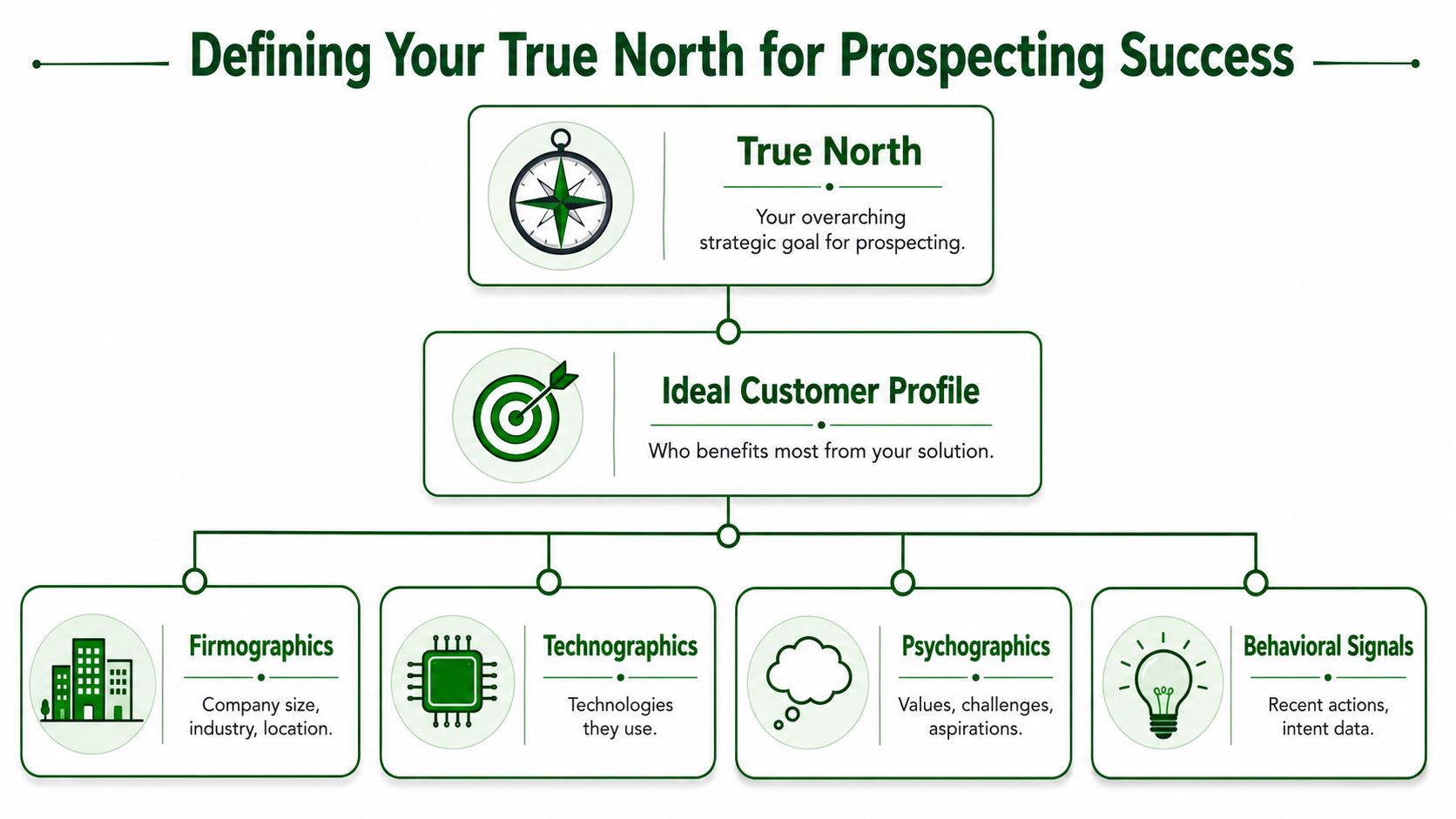
Organizations often claim to have an ICP when their definition is merely a rough filter. Industry. Headcount. Region. Maybe a title set. That's enough to build a list, but not enough to build pipeline.
A real targeting model needs to answer a harder question. Who is a fit, showing intent, and reachable at the right moment? If your model can't answer that, the list will stay bloated and your reps will still have to guess.
Why firmographics alone break down
Firmographics are only the first cut. They help you remove obvious non-fits, but they don't tell you whether the account is worth immediate attention.
A stronger model layers multiple signal types:
- Fit: Core firmographics, sub-industry, business model, team structure, and relevant technographics.
- Intent: Evidence the account is researching, engaging, or showing category-adjacent behavior.
- Timing: Events that make change more likely, such as hiring, funding, leadership moves, or new initiatives.
- Relationship depth: Any path to credibility, including shared affiliations, prior contact, customer adjacency, or mutual connections.
Cheap, static list vendors flatten all of this into contact volume. That's the false economy. You pay less upfront, then spend far more in wasted rep time, lower relevance, and preventable misses.
Use a scoring model before you source names
Scoring should come before sourcing at scale. Otherwise, every record enters the workflow as if it deserves equal effort.
Apollo's recommended weighting is a useful starting point for modern lead scoring: fit criteria (40%), intent signals (30%), timing factors (20%), and relationship depth (10%), as outlined in Apollo's guide to building a sales prospecting list. That framework is practical because it forces teams to stop overvaluing static fit.
A simple operating model looks like this:
| Signal layer | What to ask |
|---|---|
| Fit | Does this account look like customers who succeed with us? |
| Intent | Is there evidence they're actively exploring a related problem? |
| Timing | Did something recently happen that changes urgency? |
| Relationship | Do we have a warm angle or credibility bridge? |
Practical rule: If a prospect list can't tell a rep why an account matters now, it isn't ready for outreach.
The point isn't to make scoring academically perfect. The point is to make prioritization consistent enough that reps stop working the list top to bottom and start working the best opportunities first.
Source Contacts You Actually Want to Talk To
The fastest way to poison outbound is to treat every available contact record as usable. Teams typically don't need more names. They need better entry points into the right accounts.
That starts by rejecting the idea that bought lists are the foundation. They aren't. They're a raw input at best, and often a distraction.

What rented data gets wrong
Static vendors optimize for coverage. Outbound teams need relevance.
Here's the trade-off in plain terms:
| Approach | What you get | What usually goes wrong |
|---|---|---|
| Large third-party export | Fast volume | Stale titles, weak context, unclear source quality |
| Manual one-by-one research | Better judgment | Too slow to scale across a real book of accounts |
| Owned list plus enrichment | Better control | Requires process discipline and tooling |
A rep can manually inspect every account and often make better decisions than a generic vendor record. The problem is throughput. One-by-one research doesn't scale across a serious outbound motion.
That leaves the durable option. Build from sources you trust, then enrich aggressively.
Where strong prospect lists really come from
The best prospect lists usually start from assets your team already owns or can verify directly:
- CRM data: Closed-lost accounts, dormant opportunities, and past inbound often hide strong reactivation targets.
- Website conversions: Demo requests, content signups, webinar registrants, and abandoned hand-raisers.
- LinkedIn Sales Navigator searches: Useful for company and persona discovery when guided by a disciplined targeting model.
- Event and community lists: Speakers, attendees, sponsors, and association member lists often surface concentrated buying groups.
- Customer adjacency: Partners, competitors of customers, and peer accounts with similar operating conditions.
This is why the right tooling should enrich your list, not replace your thinking. Platforms like PitchSmart for outbound research workflows make more sense when they operate on lists you already trust, instead of pushing you toward another opaque database.
Good sourcing isn't about finding anyone who could buy. It's about finding people you can justify contacting with a relevant point of view.
The practical test is simple. If a rep can't explain why a contact is in the sequence without opening five tabs, the sourcing stage wasn't finished.
From Raw Data to Actionable Sales Intelligence
Raw prospect data isn't useful until it changes rep behavior. A CSV with names, titles, and company domains might satisfy a list quota, but it doesn't help someone write a strong opener or choose who to contact today.
The gap between data and action is where most outbound engines stall.
What manual research actually looks like
Manual prospect research sounds manageable until you watch it happen. A rep starts with a company and asks basic questions. Are they growing? Did they hire into a relevant function? Has a new executive joined? Are they posting about an initiative that maps to our product? Is this the right persona or just the nearest one?
Then the process repeats for every account.
That approach breaks because each account becomes a mini research project. Even when the rep is skilled, the workflow is inconsistent. One rep checks hiring pages. Another looks at LinkedIn posts. Another relies on gut feel and sends the email anyway.
Manual vs automated prospect research
The contrast is less about quality than about repeatability and speed.
| Metric | Manual Research (Per Rep) | Automated Research (with PitchSmart) |
|---|---|---|
| Account review | One account at a time | Entire list processed in parallel |
| Signal capture | Depends on rep habits | Standardized across accounts |
| Prioritization | Often subjective | Scored consistently from defined rules |
| Outreach prep | Copy-paste from multiple tabs | Research packaged into usable talking points |
| CRM hygiene | Usually delayed | Easier to standardize and update |
For teams trying to operationalize outbound, that's the key advantage. Automation doesn't replace judgment. It gives judgment a structured input.
The most useful systems enrich prospect lists with signals that a rep can act on. Examples include recent hiring patterns, leadership changes, technology adoption, account activity, and relationship clues that change the opening line from generic to timely.
A broader recency lesson shows up in sports prospecting as well. MLB's Angels prospect coverage updates as players emerge and rankings shift, which is exactly why static snapshots age poorly, as seen on the MLB Angels prospects page. B2B lists age the same way. The value is often in what changed recently, not just who matched the filter last quarter.
Turn signals into sales action
The workflow that works is straightforward:
- Start with the ICP-derived account set. Don't ask enrichment to rescue a bad target list.
- Append decision-maker and influencer contacts. Include enough context to know who should receive which message.
- Enrich with current signals. Pull in business changes, role changes, and account-level activity that affect timing.
- Tag the best conversation hooks. Convert raw facts into reasons to reach out.
- Segment before launch. Separate high-priority, warm-angle, and monitor-later accounts.
- Push clean data into sequencers and CRM. Reps shouldn't have to rebuild the record downstream.
A useful reference point for more operational guidance is the PitchSmart blog on outbound execution, especially if you're standardizing workflows across SDR, BDR, and RevOps teams.
The job of prospect research isn't to collect interesting facts. It's to give the rep a better decision about who to contact, when to contact them, and what to say first.
Once teams understand that, prospect lists stop being static assets and start functioning like decision systems.
Activate Your List with Signal-Based Outreach
Even a well-enriched list does nothing on its own. Pipeline comes from activation, and most outbound teams still activate prospect lists with messaging that ignores the very signals they spent time collecting.
That's where performance breaks down. The data is specific, but the sequence is generic.
Lead with the signal not the pitch
A strong opener doesn't summarize your company. It anchors on a current, credible reason for contact.
That might be a leadership hire, a hiring pattern, an initiative implied by the tech stack, or a relationship-based angle. Relevance matters because prospects are 70% more likely to accept a meeting when outreach is based on a mutual connection, according to Salesgenie's prospecting statistics. The lesson isn't limited to referrals alone. It shows why social proof, adjacency, and contextual relevance should influence list design and outreach strategy from the start.
That changes how sequences should be written:
- Email one: Reference the strongest timely signal and tie it to a business problem.
- LinkedIn touch: Reinforce the context, not the whole pitch.
- Follow-up email: Add a second angle or consequence, ideally linked to the same signal cluster.
What doesn't work is stuffing three personalization tokens into a template and calling it relevant. Buyers can tell when the "personalization" was added after the sequence was written.
Relevance has to shape the message before the first sentence is drafted. It can't be sprinkled on afterward.
Build sequences around timing
The best outreach systems group accounts by trigger type, not just persona. A company hiring into revenue operations needs a different opener from a company with a newly hired CTO. Same market, different timing story.
That means your activation workflow should segment prospect lists into buckets such as:
- Immediate priority: Accounts with strong fit and fresh triggers
- Warm relationship angle: Accounts where a mutual connection, shared background, or customer adjacency can open the conversation
- Monitor and nurture: Good fit, but weak timing
- Recycle later: Contacts or accounts that aren't ready for sequence pressure
After that segmentation, the sequence can be semi-automated without becoming generic. A three-step email and LinkedIn flow works well when each draft is seeded by the highest-confidence hook for that account.
Here's a good product walkthrough to study if you're thinking about how research and outreach should connect in practice:
The operational goal is simple. Reps shouldn't be writing from a blank page. They should be editing from a research-backed conversation plan.
Maintain Your Prospecting System for Peak Performance
Monday morning, the team pulls a "proven" list back into sequence. By Tuesday, half the context is stale. Two contacts changed jobs, one account froze hiring, three emails bounce, and a rep is working an opportunity that should have been suppressed because an AE already opened a thread. That is what happens when prospecting is treated as a static asset instead of an operating system.
Static lists decay fast. Titles change. Team structures shift. Buying priorities move. Good accounts can go cold for six months, then become high priority because funding landed, a leader was hired, or a strategic initiative changed.
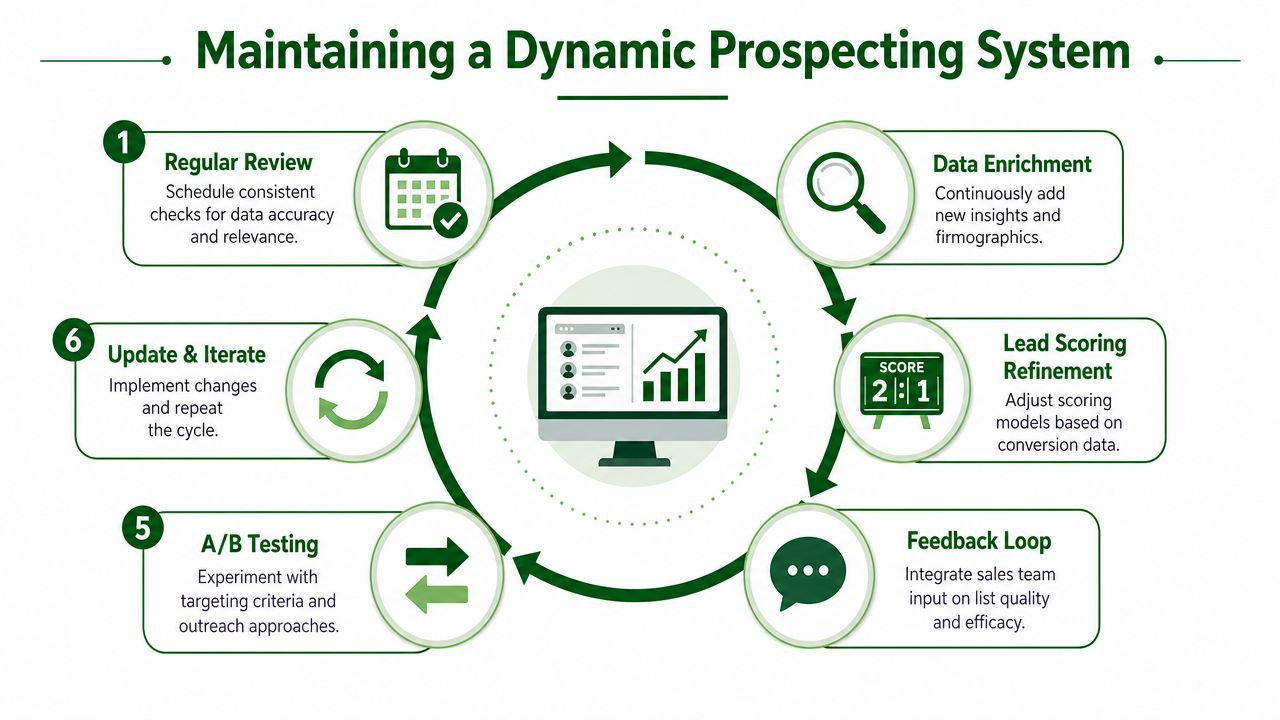
The fix is a maintenance loop. Clean the records, refresh the signals, capture rep feedback, and push the learnings back into targeting rules. Teams that do this well are not "maintaining a list." They are continuously validating a prospecting system.
Protect list quality before you scale
A lot of outbound teams scale a segment because it sounds reasonable in a planning doc. That is expensive. Rep time gets burned on accounts that looked right on paper but do not convert in market.
Use a recurring quality-control process:
- Deduplicate records: Keep one clear source of truth for each account and contact.
- Verify contact data: Recheck deliverability, role, and account ownership on a schedule.
- Refresh enrichment: Update firmographic data and recent signals so priority reflects current conditions.
- Capture field feedback: Pull objections, disposition notes, and meeting outcomes from SDRs and AEs into the model.
- Suppress bad fits quickly: Remove segments that produce noise before they absorb more volume.
Watch meeting-booked rate closely. A weak rate is usually a targeting problem, a timing problem, or a message-to-segment mismatch. Sending more volume into a weak segment rarely fixes any of the three.
Use testing rules that keep you honest
Random changes are not testing. They are drift.
For a new segment, start small and hold the variables steady long enough to learn something. Outreach.io recommends structuring sales experiments around a defined hypothesis, a controlled change, and a clear success metric so teams can separate signal from noise in outbound performance data, as outlined in its guide to running better sales experiments.
That discipline matters because prospecting systems fail subtly. Teams change targeting, copy, and channel mix at the same time, then cannot explain why results moved.
A practical review cadence looks like this:
| Review area | What to check |
|---|---|
| Segment performance | Which account groups produce replies and meetings |
| Signal quality | Which triggers correlate with real conversations |
| Persona accuracy | Whether the selected contacts had influence or just proximity |
| Sequence fit | Whether the message matched the trigger that put the account into the system |
One more rule. Do not let stale segments linger because they worked last quarter.
Strong outbound programs run on closed-loop maintenance. Every bounce, reply, meeting, and disqualification should sharpen the next pass. Over time, that is how prospecting gets cheaper, faster, and harder to copy.
Stop Building Lists and Start Building Pipeline
Prospect lists are useful only when they operate as part of a living system. The winning motion is clear. Define a real target model, source contacts you can defend, enrich with current signals, activate with relevant outreach, and keep validating the results.
Manual list-building traps reps in research loops. A signal-driven system gives them better accounts, better reasons to reach out, and more time to sell. If you're evaluating tools, start with the PitchSmart pricing page and look for the workflow that removes manual research without turning your team into template spammers.
If you want to see what this looks like in practice, try PitchSmart. Upload a list from your CRM or a CSV, run bulk research across the entire file, and turn raw prospect lists into signal-backed outreach your reps can effectively use.