Sales teams don't have a value proposition problem first. They have an execution problem.
Reps still burn most of the day on research, admin, and data entry instead of customer conversations. Sales representatives spend 70% of their time on non-selling tasks such as research, admin, and data entry, leaving only 30% of their workweek for actual revenue generation, according to Salesforce's State of Sales report summary. When that's the operating reality, messaging gets built in a rush, personalization turns into surface-level token edits, and cold outreach collapses into generic copy.
That's why most value proposition development fails in outbound. The issue usually isn't that the team lacks a slide, a positioning doc, or a one-line pitch. The issue is that the message never gets translated into a repeatable system reps can use against live accounts, live triggers, and live objections. A static statement might work in a brand deck. It rarely survives the pressure of daily prospecting.
For outbound teams, a value proposition has to do more than sound clear. It has to help a rep decide what to say to this buyer, at this company, right now.
The Real Reason Your Cold Outreach Is Failing
A typical rep day goes sideways before the first email goes out.
The morning starts with a list that looks decent on paper. Then the rep opens LinkedIn, the company site, a news tab, a CRM record, maybe a funding database, maybe a job board. An hour later, they've assembled just enough context to send a message that still sounds like everyone else's. By noon, they've personalized a handful of accounts and updated fields in three systems. By late afternoon, they're behind on activity and tempted to ship generic copy just to catch up.
That's not a discipline issue. It's an operating model issue.
When reps only get a fraction of the day for real selling, outreach quality drops. The first thing that gets sacrificed is message relevance. The second is follow-up quality. The third is confidence. Reps stop leading with a sharp buyer problem and start leading with product descriptions, broad claims, or awkward personalization that doesn't connect to business pain.
Generic outbound usually isn't generic because the rep is lazy. It's generic because the workflow forces speed without giving the rep usable context.
The result is predictable. Prospects ignore emails that read like they were written for a list, not a company. They ignore openers based on stale firmographics. They ignore value claims that don't connect to a current priority.
A strong value proposition fixes that, but only if it's built for outbound use. In practice, that means three things:
- It names a real buyer problem: not a broad market challenge, but a concrete operational pain the prospect already recognizes.
- It links your offer to that pain: not through feature dumping, but through a clear before-and-after.
- It gives the rep a reason to reach out now: not someday, but based on timing, context, or a visible trigger.
Often, teams work on the second point and neglect the first and third. That's why their messaging sounds polished in internal reviews and flat in real inboxes.
From Static Slogans to Dynamic Sales Tools
A lot of companies think they've already handled value proposition development because they have a sentence on the homepage or a slide in the sales deck. That's not enough.
Only 2.2% of companies possess a useful value proposition, despite 64% of businesses claiming to have an established one, according to Invesp's analysis of value proposition effectiveness. That gap tells you exactly what happens inside most revenue teams. They have messaging. They don't have messaging that helps a rep win attention in a live outbound motion.

What a static value proposition looks like
Static value props usually share the same flaws:
- They're too broad: “We help teams work smarter” tells the buyer nothing.
- They're feature-led: the message starts with platform capabilities instead of buyer stakes.
- They ignore context: the same copy gets sent to every account regardless of trigger, segment, or role.
- They live in documents, not workflows: marketing writes them, leadership approves them, reps forget them.
A static value proposition is mostly a slogan. It can describe the company, but it can't guide a rep through account selection, message creation, or objection handling.
What a dynamic value proposition does differently
A dynamic value proposition is built for use, not admiration.
It changes based on segment, role, and account context. It gives the rep a practical angle for outreach. It also forces the team to define what matters operationally: which pain to lead with, which signal changes the message, which proof point belongs with which buyer.
That's the difference between positioning and execution.
For outbound teams, the best test is simple. Can a rep look at an account, match it to a buyer problem, and produce a relevant first-touch message without rewriting everything from scratch? If the answer is no, the value proposition still isn't doing its job.
Teams that want that level of precision need to stop treating value proposition development like a branding exercise and start treating it like a system design problem. That's where process matters, and where tools like PitchSmart fit into the workflow. The message has to be usable at the list level, not just the whiteboard level.
Operational test: if your value proposition can't survive list segmentation, rep handoff, and sequence execution, it isn't finished.
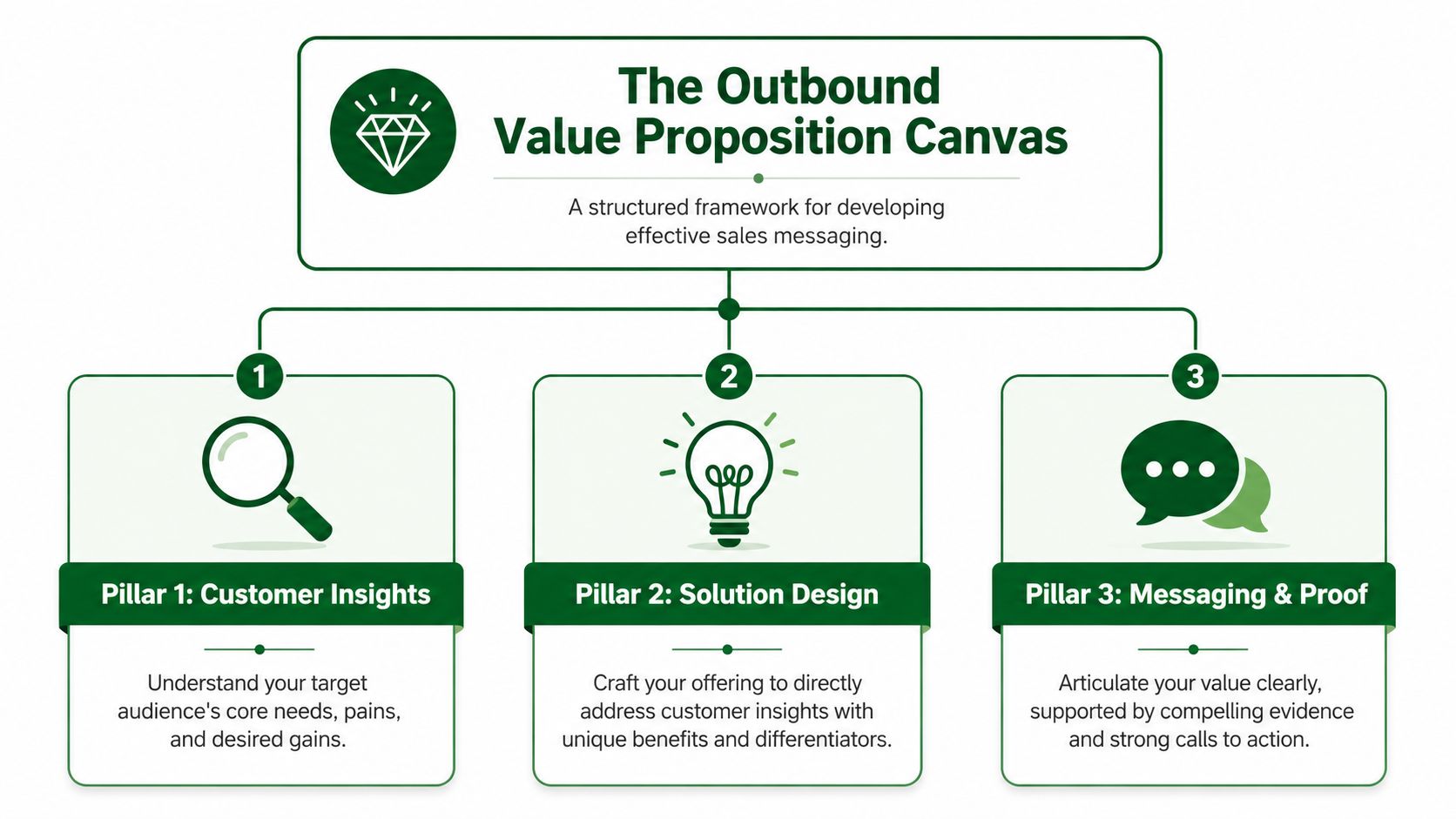
The Outbound Value Proposition Canvas
A usable outbound value proposition needs structure. The cleanest operating model is a three-phase approach: Customer Discovery, Mapping, and Testing, as outlined in Six Paths Consulting's value proposition design framework.
For outbound teams, I like to turn those phases into an execution canvas. Keep it simple enough for SDRs and BDRs to use, but strict enough that it doesn't degrade into vague messaging.
Start with the buyer's actual job
Many groups skip this and jump straight to product language. That's backwards.
The buyer's job isn't “buy software.” It's usually something operational and messy. A head of sales might need cleaner pipeline visibility. A RevOps lead might need process consistency across reps. An SDR manager might need better message relevance without adding more manual work.
Capture the buyer view in three buckets:
| Buyer lens | What to document | Bad example | Better example |
|---|---|---|---|
| Job | What the buyer is trying to accomplish | Improve outreach | Create a repeatable outbound motion across segmented account lists |
| Pain | What gets in the way today | Prospecting is hard | Reps spend too much time researching accounts one by one and still send weak first touches |
| Gain | What good looks like | More meetings | Faster prep, clearer messaging, and stronger first-touch relevance |
This part has to come from the field. Pull it from lost call notes, discovery calls, onboarding conversations, reply patterns, and rep feedback. If your wording sounds like marketing copy, it's probably too abstract.
Map your offer to pains and gains
Once the buyer job is clear, map the offer with discipline. Not every feature deserves equal weight. The point is to identify which parts of your product relieve the buyer's pain or create a meaningful gain.
Use this pattern:
- Pain reliever: Which capability reduces friction the buyer already feels?
- Gain creator: Which outcome improves speed, confidence, or control?
- Proof path: What evidence, workflow change, or visible result makes the claim believable?
Here's a practical outbound example.
- Buyer pain: Reps waste time researching accounts manually and still miss relevant context.
- Product capability: Bulk lead research with account-level qualifiers and source-backed signals.
- Pain reliever: Reps stop bouncing between tabs to gather basic outreach context.
- Gain creator: The team can move from list to personalized messaging faster and with more consistency.
- Proof path: The message references a current company event, role change, or buying signal instead of a generic opener.
Map features only when they remove a pain the buyer already cares about. Feature lists without pain alignment create bloated messaging.
A lot of value proposition development breaks here because teams get sentimental about features. Buyers don't care that a capability took months to build. They care whether it removes a costly bottleneck.
Turn the map into testable messaging
The final step is hypothesis formulation. At this point, the canvas becomes rep-ready.
Don't write one master statement and call it done. Write a set of message hypotheses tied to segments and triggers. Each one should answer four things:
- Who is this for
- What pain are we leading with
- Why now
- What change do we claim
A simple template works well:
For [role] at [company type], we help solve [specific pain] by [mechanism], so the team can [desired gain].
That's the internal version. The outbound version should sound more natural and more specific.
Examples:
- For a RevOps leader: “Noticed the team is hiring into outbound. That usually creates inconsistency fast if research and messaging stay manual.”
- For a sales manager: “Saw the rep team is expanding. Teams often hit a wall when personalization depends on each rep doing one-by-one account prep.”
- For an agency owner: “If your team is delivering outbound for multiple clients, research consistency usually breaks before sequence quality does.”
Keep each hypothesis narrow. One message per pain. One trigger per opener. One audience per variant. Outbound falls apart when teams try to fit too much into a single sentence.
Validating Your Claims with Outbound Experiments
A value proposition is still a guess until buyers react to it.
A lot of teams waste time. They debate wording internally, run messaging reviews, and tweak slides. Then they launch outreach without a real test plan. Outbound gives you a faster path. You can validate message-market fit with small, controlled experiments in email and LinkedIn, then keep only what earns replies and meetings.
There's a strong business reason to take testing seriously. Kaizenko's guide to the Value Proposition Canvas notes that profits can increase by more than 40 percent per year when companies maximize value propositions through a structured approach. The inverse matters too. Teams that skip validation often invest in messaging that never lands.
What to test first
Start with variables that change buyer interpretation, not cosmetic edits.
Good outbound experiments usually test one of these:
- Problem framing: lead with wasted rep time versus lead with poor personalization quality.
- Trigger choice: lead with hiring activity versus lead with role change or market move.
- Mechanism language: lead with research automation versus lead with signal-based prioritization.
- CTA style: ask for a short conversation versus ask whether the issue is on their radar.
Bad tests compare two emails that are different in five ways. When subject line, opener, body, CTA, and audience all change at once, you don't know what caused the result.
A cleaner setup looks like this:
| Test element | Version A | Version B |
|---|---|---|
| Segment | Same | Same |
| Core pain | Manual research slows reps | Generic messaging lowers relevance |
| CTA | Same | Same |
| Sequence length | Same | Same |
That gives you signal you can use.
How to read the results without fooling yourself
Open rates can be directionally useful, but they don't tell you whether the value proposition resonated. Outbound teams should care more about reply quality, positive response patterns, meetings booked, and what prospects repeat back in calls.
Watch for these patterns:
- High opens, weak replies: the subject line worked, the message didn't.
- Replies asking “how are you different?”: your pain statement landed, your differentiation didn't.
- Polite interest with no meeting: the claim sounds fine, but it doesn't feel urgent.
- Fast positive replies from one segment only: your value proposition is probably segment-specific, which is useful.
The goal of testing isn't to prove your original message was right. It's to learn which buyer problem creates motion.
A disciplined team keeps a message log. Every variant should tie back to a hypothesis, a segment, and an observed outcome. Over time, that becomes a real messaging asset, not a pile of one-off copy experiments.
If your team wants examples of how outbound operators document and refine these tests, the PitchSmart blog is a useful place to study workflow-oriented ideas. The key is to keep validation close to execution. Don't outsource learning to quarterly positioning work.
Powering Your Value Prop with Live Buying Signals
The biggest gap in value proposition development isn't initial design. It's failure to update the message as accounts change.
That's the practical problem highlighted in Cognosis's take on modern value proposition development. Teams build a message once, approve it, and keep shipping it after the buyer context has moved on. By then, the pain may be different, the priority may have shifted, and the old angle no longer fits.
Why static messaging expires fast
Outbound happens account by account. Timing matters more than teams admit.
A company that just hired a new sales leader needs a different message than one consolidating tools. A firm that recently expanded headcount creates different friction than one tightening operations. A prospect using a certain stack may care more about workflow fit than about abstract efficiency claims.
Static messaging misses these shifts because it assumes the same value claim travels cleanly across all accounts. It doesn't.
The rep feels that breakdown first. They read the approved messaging doc, look at the account, and know the copy doesn't quite fit. Then they either send it anyway or rewrite it manually. Both options are expensive.
Which signals actually change the message
Not every data point deserves to shape outreach. The useful signals are the ones that change what the buyer likely cares about right now.
For most outbound teams, those include:
- Role changes: a new leader often re-evaluates process, tools, and team consistency.
- Hiring patterns: growth in SDR, BDR, RevOps, or AE roles often signals workflow strain.
- Funding and expansion events: these can shift urgency around scale and execution.
- Tech stack clues: they help frame the message around process fit and operational friction.
- Recent online activity: this can give you a timely conversation hook that isn't manufactured.
A signal isn't the message itself. It's the trigger that tells the rep which value angle to use.
Good signal use doesn't mean cramming a fact into the opener. It means choosing the right problem statement because the account context changed.
What this looks like in practice
A dynamic outbound system takes a base value proposition and routes it through account signals.
For example, if the account is hiring outbound reps, the message can center on research consistency and rep ramp quality. If the signal is a new RevOps leader, the message can shift toward process control, standardization, and visibility. If the company shows active go-to-market expansion, the message can focus on preserving message quality while activity volume increases.
Later in the workflow, this kind of signal-led messaging becomes much easier to operationalize with automation and structured research.
Here's a product walkthrough that shows the general idea in action:
The important part isn't the format. It's the operating principle. Your value proposition should behave like a decision system, not a sentence.
Embedding Dynamic Messaging into Your Daily Workflow
Teams don't typically fail for a lack of a message. They fail because the message never makes it into the rep's daily routine in a usable way.
That's where workflow design matters. Dynamic messaging has to show up in list building, account prioritization, sequence creation, and call prep. If it lives only in training decks, reps will default back to manual research and ad hoc writing.
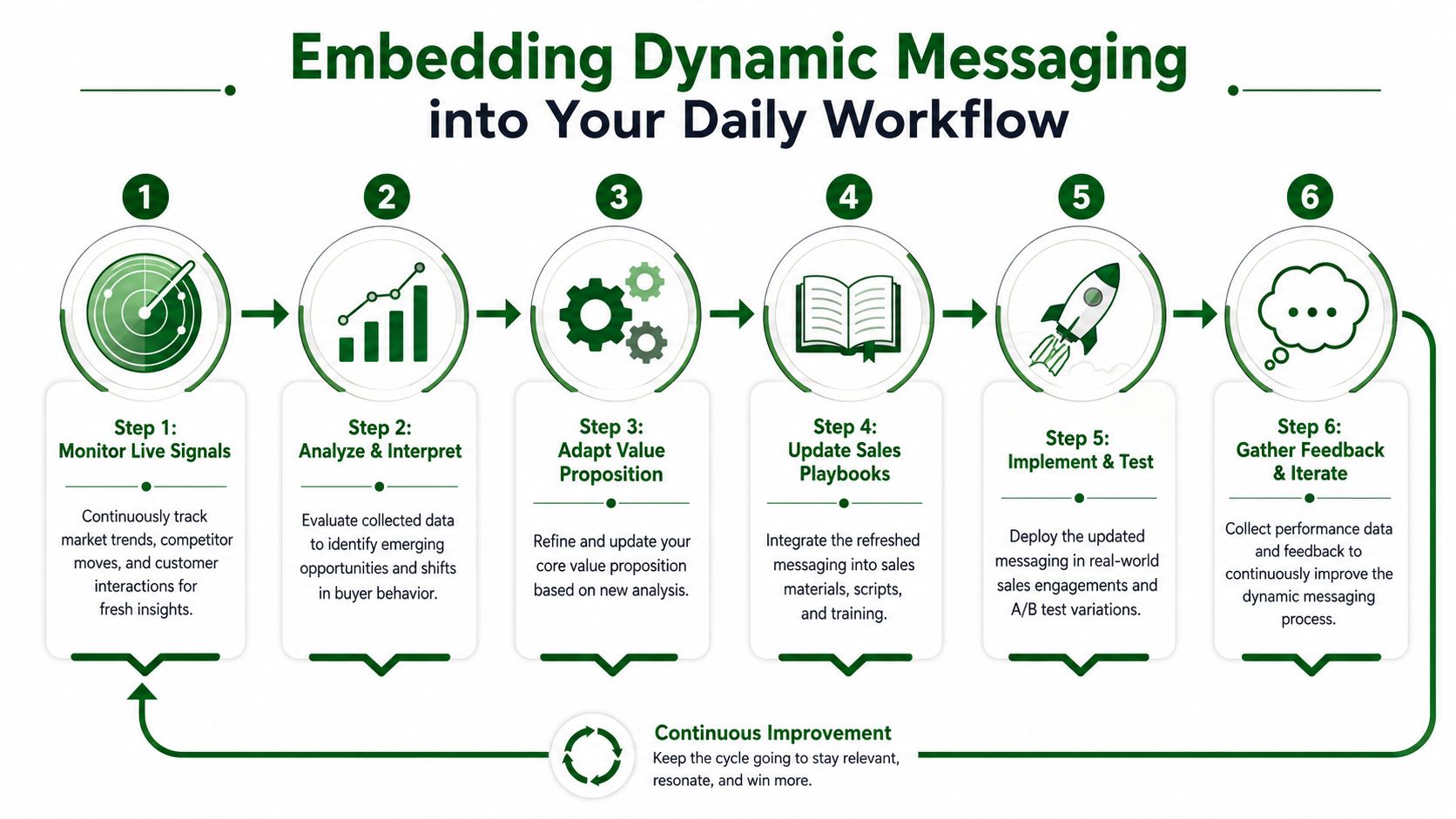
A daily operating model for SDR and BDR teams
A workable motion looks like this:
- Segment the list by signal
Don't hand reps one large queue. Break accounts into groups based on visible buying signals, role context, or operational similarities. Message quality begins with this approach.
Assign one value angle per segment
Each segment should get a primary pain statement and a supporting claim. That keeps outreach coherent and makes performance easier to interpret.
Build a three-step sequence around that angle
Email one should lead with the strongest signal-backed hook. Follow-up should deepen the pain or add a different proof path. The third touch can shift channels, often with LinkedIn, while keeping the same underlying value proposition.
Arm reps with centralized research
Before calls or manual follow-up, reps should be able to see the account context in one place. They shouldn't need to reconstruct the story from scattered tabs.
Capture reply language
When prospects respond, log the actual words they use. That language sharpens the next round of message variants better than internal brainstorming ever will.
Refresh segments as new signals appear
The workflow has to update. Accounts move, priorities change, and the message has to move with them.
Here's the trade-off. The more freedom you give every rep to personalize from scratch, the slower and less consistent the system becomes. The more you standardize around segments and triggers, the easier it is to scale quality.
Where teams usually break the process
The common failure points are operational, not strategic:
- Too many segments: reps can't remember which message goes with which account set.
- Too many claims per sequence: the message loses focus.
- No source-backed context: reps stop trusting the research and revert to manual checking.
- No feedback loop: good objections and useful replies never make it back into the system.
A better rule is to keep the workflow narrow and repeatable. One segment. One pain. One proof path. One sequence. Then improve from real outcomes.
For teams ready to standardize this at scale, PitchSmart pricing is worth reviewing alongside your current research and sequencing stack. The right tooling should reduce manual account prep, support advanced segmentation, and make it easy to seed automated email and LinkedIn sequences from the strongest conversation hooks.
Teams get better results when they stop asking reps to invent relevance account by account and start giving them a system that surfaces it.
The best outbound teams don't treat value proposition development as a messaging exercise that ends when the doc is approved. They treat it as an operating discipline. The message gets built from buyer pain, tested in market, updated with fresh signals, and embedded into the rep workflow until relevance becomes the default.
PitchSmart helps outbound teams turn static messaging into a working system. Upload your list, uncover source-backed buying signals in bulk, build sharper segments, and generate automated 3-step outreach seeded with real conversation hooks instead of generic personalization. If your reps are still doing one-by-one research, explore PitchSmart and see how much faster value proposition development gets when the research and execution layer are built for outbound.