Many teams asking what is outbound sales are really asking a more urgent question: why does outbound feel like so much work for so little return?
A new SDR opens the laptop at 8:30, then disappears into a swamp of tabs. LinkedIn. Company site. Recent posts. Hiring page. Funding news. CRM cleanup. Spreadsheet checks. A few half-personalized emails go out by lunch. A call block starts in the afternoon. Almost nobody replies. By the end of the day, the rep has “done outbound” without doing much actual selling.
That's the failure pattern. Companies hire people to start conversations and create pipeline, then bury them in manual research and generic sequencing. When that happens, outbound turns into a labor problem before it becomes a messaging problem.
The Hidden Cost of Traditional Outbound Sales
Traditional outbound usually fails long before the first cold email lands. It fails in the operating model.
A rep gets handed a territory, a loose ICP, and a quota. Then leadership expects precision outreach from a workflow built on copy-paste research. The rep manually checks each account, tries to find something relevant, writes a custom opener, logs activity, and repeats. After enough repetitions, the “personalization” becomes fake. It looks customized on the surface, but it's built from shallow signals and rushed judgment.

The market punishes that fast. One outbound benchmark report says only 0.4% to 0.6% of outbound sales emails receive positive responses, and it also notes that a 10% or lower call-to-conversation rate signals a major issue in the outbound calling process, according to Tendril's outbound metrics benchmarks.
The real cost isn't just low replies
Low reply rates are only the visible symptom. The deeper problem is wasted selling capacity.
Manual outbound creates four forms of drag:
- Research drag means reps spend prime hours gathering facts instead of using them.
- Messaging drag shows up when every opener sounds “personalized” but still reads like a template.
- Process drag appears when follow-up depends on rep memory instead of a clean system.
- Burnout drag hits when strong reps feel busy all day and still can't point to quality pipeline.
Practical rule: If your outbound process requires a rep to open a dozen tabs before sending a first message, the system is too expensive to scale.
Why old-school volume breaks down
Spray-and-pray outbound worked better when inboxes were less crowded and buyers were easier to reach. That environment is gone. Buyers can tell when a rep skimmed the homepage and guessed at a pain point. They ignore the message, and the rep learns the wrong lesson: send more.
That's backward. When outbound underperforms, the answer usually isn't more activity. It's better account selection, sharper timing, and a workflow that doesn't depend on every rep being a part-time researcher.
Outbound Sales vs Inbound Sales A Fundamental Split
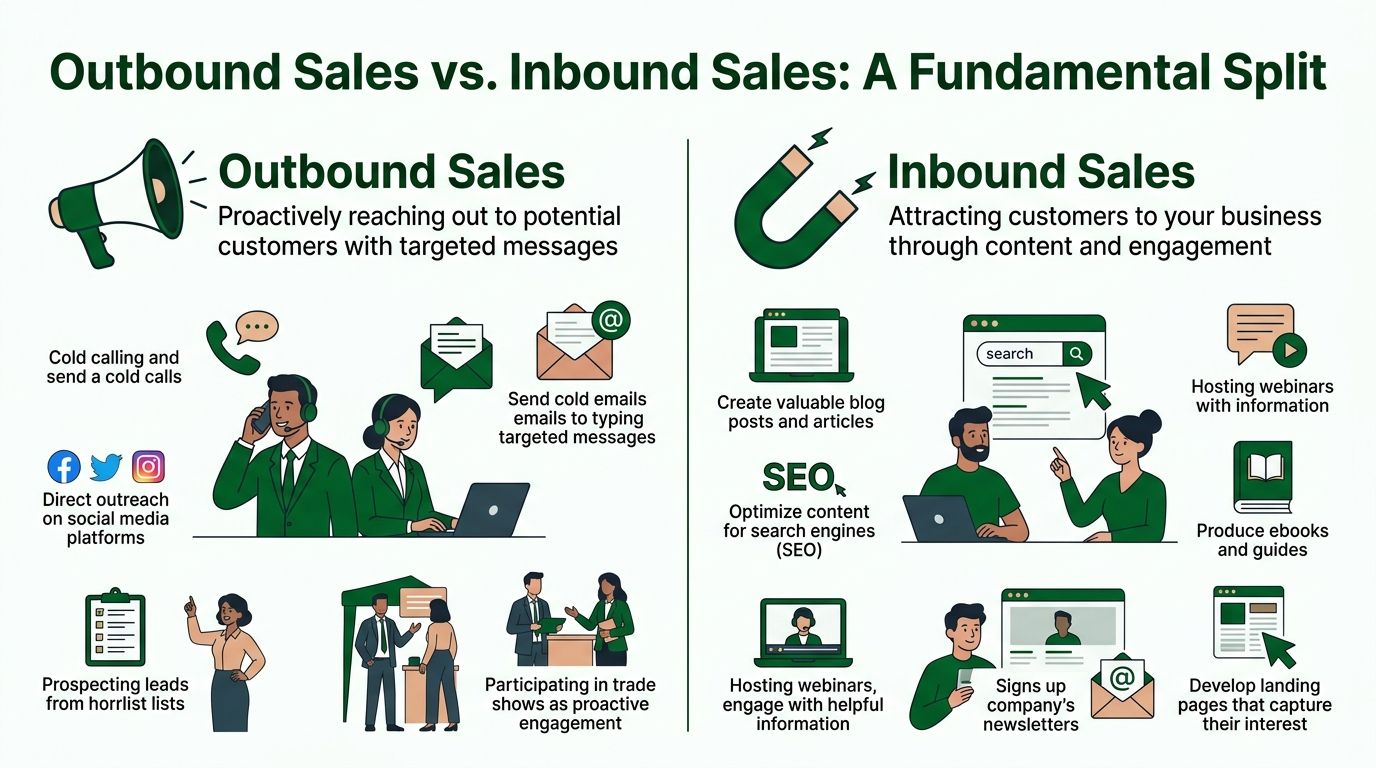
The simplest definition is still useful. Outbound sales is when the seller starts the conversation. Inbound sales is when the buyer raises a hand first.
But that basic definition misses the strategic split. Outbound is a hunting motion. Inbound is a farming motion. One starts with account selection and targeted initiation. The other starts with attraction and demand capture.
Who starts the motion
Operationally, outbound is a proactive pipeline-creation system. Reps identify an ICP-fit account, research it, then initiate contact across email, phone, and social touchpoints instead of waiting for demand to arrive. Strong teams formalize that work into prospecting, multichannel outreach, qualification, and closing, while managing it with metrics like meetings booked, lead-to-deal conversion rate, sales cycle length, and CAC, as described in Salesmotion's explanation of outbound sales.
Inbound runs differently. Marketing and brand do more of the early lifting. The prospect already knows the category, has some level of intent, and is usually easier to route into discovery.
A quick visual helps:
A practical comparison
| Attribute | Outbound Sales (Hunting) | Inbound Sales (Farming) |
|---|---|---|
| Initiation | Seller starts the conversation | Buyer starts the conversation |
| Targeting | Built around named accounts and role selection | Built around content, channels, and capture |
| Speed to test | Fast to launch with a clear list and message | Slower to build because demand creation takes time |
| Control | Sales controls who gets contacted and when | Marketing and market response shape flow more heavily |
| Personalization need | High from the first touch | Often grows later in the cycle |
| Failure mode | Bad targeting and generic outreach | Weak demand generation or poor lead qualification |
Outbound gives teams more control, but it also demands more discipline. If you choose the wrong accounts, outreach quality won't save you. If you choose the right accounts but execute with weak research, you still lose.
That's why a lot of teams compare outbound platforms by their ability to structure work, not just send messages. A useful example is this breakdown of PitchSmart vs HubSpot Sales Hub, especially for teams deciding whether they need workflow management, research support, or both.
Outbound works best when you know exactly who you want to reach and why now is the right time to reach them.
The Modern Outbound Sales Workflow
Modern outbound isn't a string of random cold emails. It's a system with dependencies. If the first stage is sloppy, everything downstream gets more expensive.
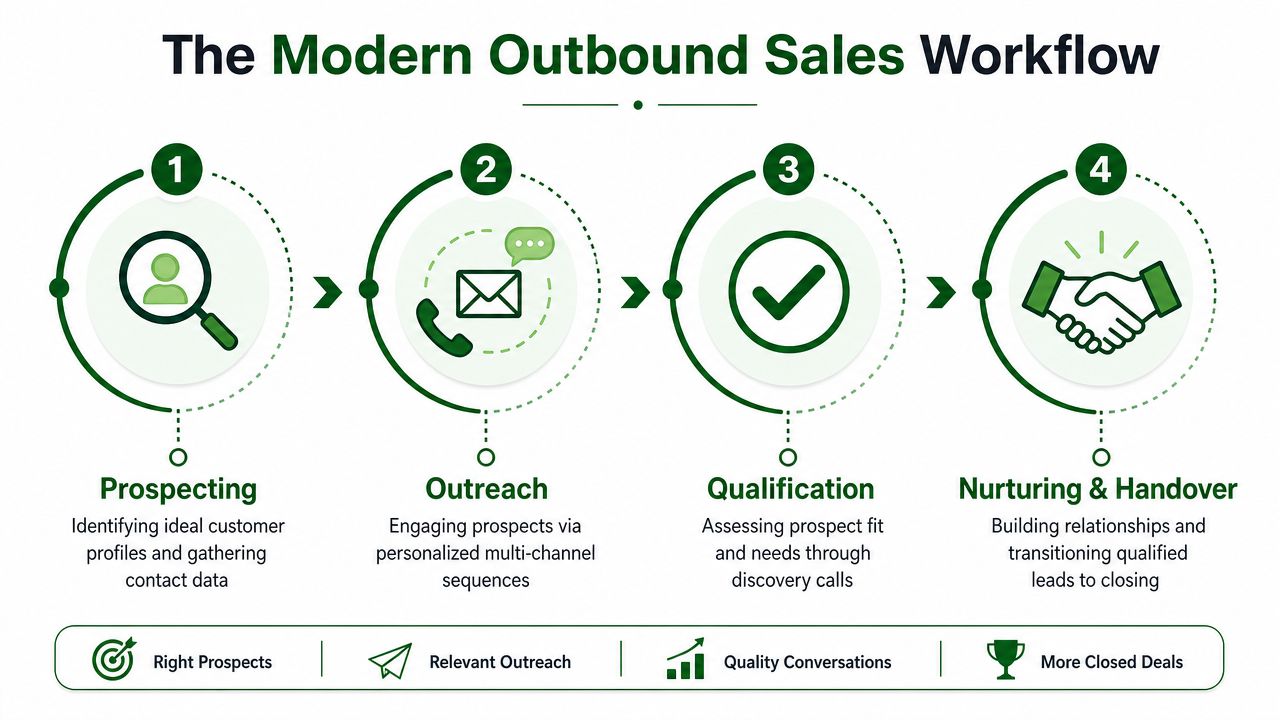
Stage one through three
1. ICP and TAM definition
Start tighter than you think you should. Outbound breaks when teams target “mid-market SaaS” or “operations leaders” and call that strategy. A usable ICP includes business model, company profile, relevant environment, likely pain, and the people who feel that pain.
2. List building and segmentation
Once the ICP is clear, build lists around segments that can support different messaging. Don't dump every account into one master sequence. Segment by fit, likely use case, urgency, or visible buying context. If your list logic is weak, every rep improvises.
3. Account and prospect research
Under these conditions, manual outbound gets crushed. Reps hunt for context one account at a time, then try to turn scraps into a strong opener. The better approach is to standardize what counts as relevant research: role context, company changes, recent activity, strategic initiatives, and anything that sharpens a hypothesis.
For teams trying to remove that bottleneck, this guide on how to automate lead research is useful because it reframes research as an operational step, not a rep-by-rep art project.
Stage four and five
4. Multichannel outreach cadence
A sequence is not a pile of touches. It's a timed argument. Each step should add context, reduce ambiguity, or change the format of the ask. Email, phone, and LinkedIn work better together than alone because they create familiarity and multiple chances to connect.
Follow-up matters more than most new teams expect. One sales statistics roundup reports that 80% of sales require at least five follow-up calls, while 44% of salespeople stop after one follow-up, according to Outplay's sales statistics roundup. That gap is exactly why structured cadences outperform one-off effort.
5. Qualification and handoff
The SDR's job isn't to trick a prospect into a meeting. It's to surface a real opportunity. Good qualification protects everyone downstream, especially AEs who inherit the meeting. If the prospect doesn't fit, doesn't care, or can't tie the issue to a real initiative, force-fitting a handoff only pollutes pipeline.
A messy handoff is usually a research problem in disguise. The AE gets a meeting, but not a usable point of view.
The workflow is simple on paper. It gets hard when every stage depends on manual effort and inconsistent judgment. That's why process design matters as much as rep skill.
Key Roles and Critical Metrics in Outbound Teams
Outbound teams underperform when responsibilities blur. SDRs chase bad accounts. AEs redo discovery from scratch. RevOps cleans up reporting after the fact. The fix is clarity.
Who owns what
SDRs and BDRs create pipeline. They own prospecting, first-touch messaging, follow-up execution, and early qualification. Their job is to turn a cold account into a credible sales conversation.
AEs convert qualified interest into a real opportunity. They run discovery, shape the deal, manage stakeholders, and close. In a healthy system, AEs don't spend half the call figuring out why the account was contacted in the first place.
RevOps builds the machine. That means routing logic, sequencing rules, list hygiene, stage definitions, data quality, and the dashboard the team uses to diagnose performance. RevOps also protects the team from fake productivity. More activity isn't success if the activity creates weak pipeline.
What leaders actually watch
The best dashboards don't stop at activity counts. They track whether effort is turning into qualified movement.
A practical outbound scorecard usually includes:
- Meetings booked: Useful only if the meetings are relevant.
- Show rate: Tells you whether prospects understood the value of taking the call.
- Lead-to-opportunity conversion: Exposes qualification quality.
- Sales cycle length: Helps test whether the team is creating urgent, high-fit opportunities.
- CAC and pipeline efficiency: Show whether the motion is economically sustainable.
There's also a strategic shift leaders need to understand. The strongest outbound programs are increasingly signal-driven and data-enriched, not volume-driven. Teams use firmographic, technographic, and intent data to prioritize accounts and time outreach around signals like funding rounds, executive hires, or strategic initiatives. The effect is better timing and relevance, which Demand Gen Report's coverage of data-driven outbound prospecting associates with higher conversion quality and healthier pipeline efficiency.
If your dashboard tells you how many emails were sent but not whether the right accounts were contacted at the right time, you don't have an outbound dashboard. You have an activity log.
The role structure and the metrics have to reinforce the same principle: outbound is a precision system, not a brute-force contest.
From Manual Grind to Scalable Sales Engine
The old model assumes you can scale outbound by hiring more reps and asking each of them to work harder. That's the wrong unit of analysis. The constraint usually isn't rep effort. It's research throughput and message relevance.
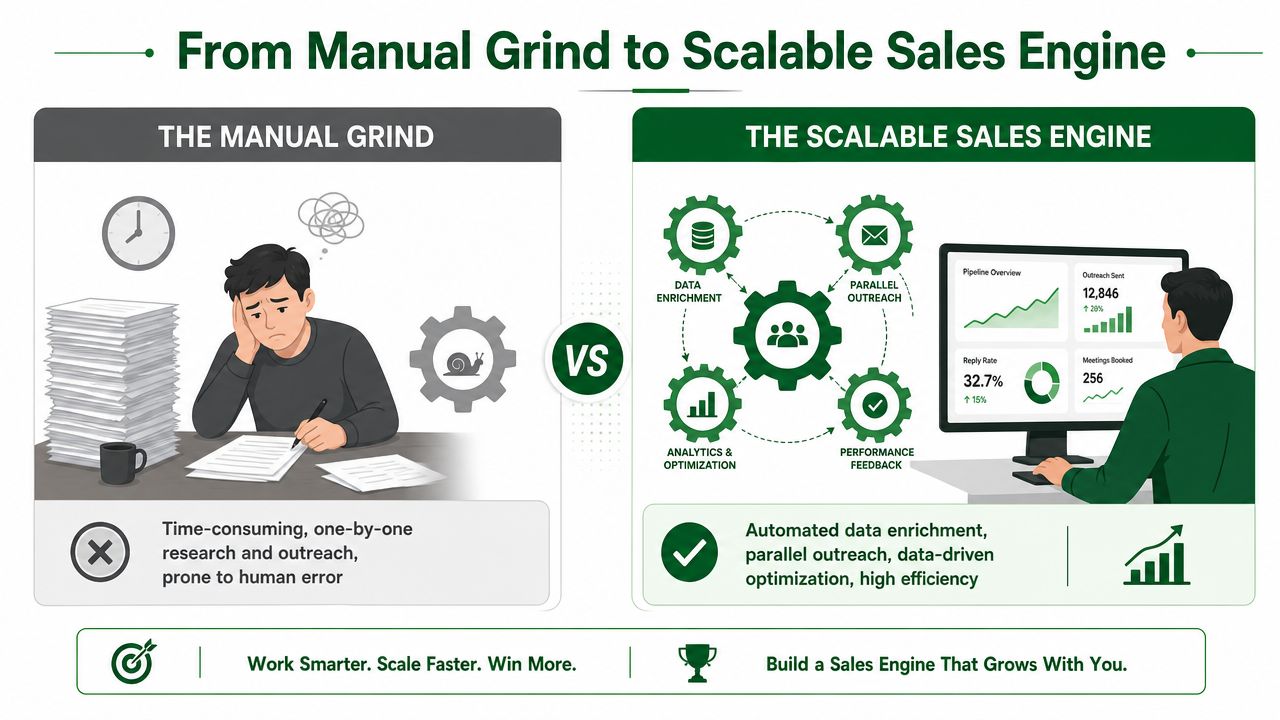
Where manual outbound breaks
Manual outbound tends to fail in the same places:
- List quality degrades because teams pull broad contact sets and hope messaging will sort it out.
- Research becomes shallow because no rep has time to investigate every account properly.
- Personalization gets faked with generic first lines and interchangeable “pain points.”
- Follow-up slips because reps remember some prospects and lose others.
- Management reacts with more volume instead of fixing fit and timing.
This is why the most useful contrarian view of outbound is also the most practical one. Outbound is not a universal growth lever. It's a fit-dependent operating model that works better when teams can identify high-fit accounts, assess timing, and personalize at scale. It also becomes inefficient when the resource cost outruns pipeline quality, as argued in ZoomInfo's discussion of when outbound fits and when it doesn't.
When outbound is worth the investment
Outbound deserves investment when your team can answer four questions clearly:
| Question | Healthy answer |
|---|---|
| Can we identify high-fit accounts? | Yes, with enough specificity to build targeted segments |
| Can we spot useful timing signals? | Yes, with research that goes beyond static contact data |
| Can we personalize without slowing to a crawl? | Yes, through a repeatable research and messaging workflow |
| Can we maintain follow-up discipline? | Yes, through structured sequences and clear ownership |
If those answers are weak, adding more send volume usually makes the economics worse.
That's also where teams start comparing categories of tools instead of buying another point solution. They need list segmentation, buying-signal context, research support, and sequence execution tied together. If you're evaluating that stack, this comparison of PitchSmart vs Outreach and Salesloft is a useful lens because it separates engagement tooling from the research layer that makes engagement worthwhile.
The scalable version of outbound looks different from the manual one. Reps work from prioritized lists. Research is standardized. hooks come from real account context. Sequences are seeded with actual reasons to reach out. Managers optimize the system instead of pushing for more random activity.
Your First Steps to Building a Modern Outbound Motion
What's needed isn't a bigger outbound strategy document, but a tighter starting point.
A clean starting checklist
Define a narrow ICP first.
Pick one segment where the pain is clear, the buyer is identifiable, and the use case is easy to explain. Broad targeting hides weak thinking.
Build a small test list.
Start with a focused set of accounts you'd want to close. A smaller, cleaner list teaches more than a giant list full of edge cases.
Standardize what research matters.
Don't let every rep decide what “personalization” means. Agree on the signals that deserve mention, the qualifiers that indicate fit, and the situations that justify outreach now.
Design sequences around message progression.
Each touch should do a different job. One message introduces the hypothesis. Another adds context. Another changes the call to action. Repetition without progression feels lazy.
Protect the handoff.
Define what counts as qualified before meetings start flowing. Otherwise SDRs optimize for calendar acceptance while AEs inherit confusion.
Choose tech that removes manual work, not tech that records it.
A lot of sales tools help teams manage outbound after the work is already messy. The stronger stack improves account selection, research quality, segmentation, and sequencing before reps lose hours to admin.
If your team gets those basics right, outbound becomes measurable and fixable. If you skip them, every problem shows up later as “low reply rates,” even though the actual cause sits upstream in targeting, research, and execution discipline.
PitchSmart helps outbound teams replace one-by-one prospecting with a faster research layer built for scale. Upload a list or pull from your CRM, segment leads by buying signals, generate source-backed account research in bulk, surface activity-based conversational hooks, and launch automated 3-step email and LinkedIn sequences seeded from the strongest angles. If your reps are still spending most of their day stitching together context by hand, try PitchSmart and build the research system before the outbound engine breaks.
Enhanced by the Outrank app