Sales teams don't usually have an appointment setting problem. They have a research and workflow problem.
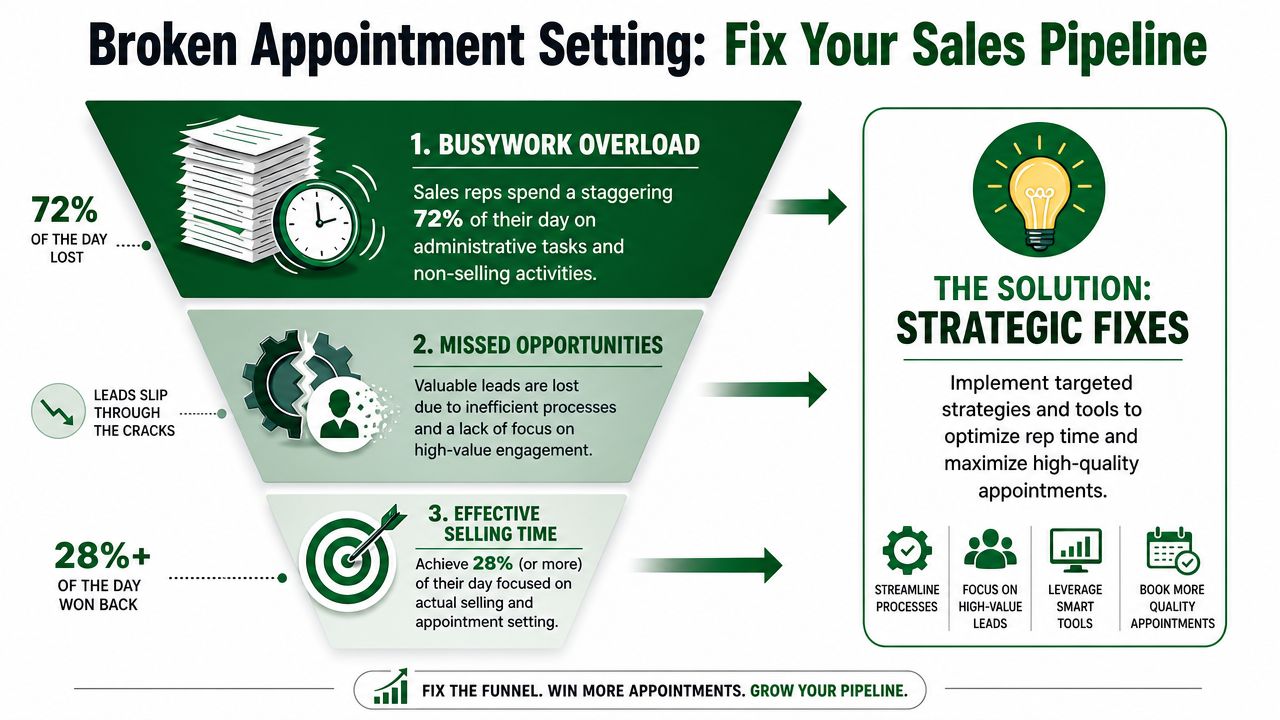
The number that should bother every sales leader is this: sales representatives spend only 28% of their time actively selling, while the remaining 72% goes to low-impact administrative work such as CRM updates, internal meetings, and hunting for decks, according to DocuSign's summary of Salesforce State of Sales data and Gartner validation. That's the bleeding neck. Not call reluctance. Not “lazy SDRs.” Not a weak template.
If your reps are manually researching accounts one by one, stitching together context from LinkedIn, company sites, hiring pages, and CRM notes, you've built a system where busywork beats pipeline. Then leaders respond the wrong way. They ask for more dials, more emails, more touches. That only scales irrelevance.
Strong B2B appointment setting works differently. It starts with tighter qualification, then uses real signals to guide outreach, then protects meetings with disciplined follow-up and nurturing. The teams that win aren't doing more random activity. They're making fewer, smarter touches to prospects that fit.
Why Your Appointment Setting Is Broken and How to Fix It
Poor appointment setting usually starts with a design problem, not a rep effort problem.
Teams ask SDRs to prospect, research, write, qualify, chase replies, clean CRM records, and book meetings inside the same block of time. The result is predictable. Research gets rushed, messaging turns generic, and qualification happens after the meeting is already on the calendar.
We see three failure modes again and again:
- Bad targeting: Reps contact accounts that match a list filter but show no credible reason to evaluate a solution now.
- Generic messaging: Outreach sounds polished, but it lacks a real trigger, business pain, or stakeholder relevance.
- Weak handoff discipline: Meetings reach AEs with thin notes, no clear buying signal, and no shared definition of what made the account worth booking.
Practical rule: If a rep needs ten tabs open to prepare one email, your system is too manual to scale well.
The fix is operational. Put research upstream. Make qualification visible before the first touch. Give reps context they can use, not raw records they have to interpret from scratch.
High-performing teams do not win by forcing more activity into the day. They win by narrowing effort to the accounts that show fit and movement, then using automation to assemble the context. That is how you get from 100 forgettable touches to 10 informed ones that can start a real conversation.
What a working system looks like
A healthy B2B appointment setting program runs on clear inputs and clean handoffs.
| Area | Broken program | Working program |
|---|---|---|
| Targeting | Static lead lists | Accounts grouped by fit and live signals |
| Messaging | Templates with surface-level merge tags | Outreach built on specific account context |
| Cadence | Volume-first sequencing | Multi-touch outreach with a reason behind each step |
| Handoff | Calendar filled at any cost | Meetings booked with notes, qualification, and agenda |
| Management | Activity policing | Review of bottlenecks, reply quality, and conversion points |
The goal is not to remove human judgment. The goal is to reserve it for work that matters. Reps should spend time on message quality, objection handling, and live conversations. They should not spend most of the day stitching together basic context from scattered tools.
At PitchSmart, we build around that principle. Smarter research creates better outreach, better outreach creates better meetings, and better meetings create pipeline your AEs trust.
Laying the Foundation with Your ICP and Qualification
Teams often define their ICP too loosely. They stop at industry, employee count, and maybe geography. That gives you a list. It doesn't give you a market.
A working ICP for B2B appointment setting has to answer a harder question: which accounts are both a fit and plausibly in motion right now? If you can't answer that, your reps end up filling sequences with companies that look fine in Salesforce but have no buying reason, no active initiative, or no reachable stakeholder.

That's why strong teams separate fit signals from timing signals.
Fit tells you who belongs in the market
Fit is the baseline. If the account doesn't match your solution profile, no amount of copywriting will save the campaign.
Start with the obvious filters, then sharpen from there:
- Firmographic fit: Industry, company size, region, and sales model.
- Operating model fit: Team structure, complexity of workflow, stakeholder count.
- Environment fit: Relevant tools already in use, likely process maturity, signs they've outgrown the status quo.
- Buyer fit: Titles that influence the problem you solve, not just names that sound senior.
The reason this matters is simple. A realistic B2B appointment setting conversion rate typically falls between 2-5% across most industries, while high-performing professional services firms can reach up to 7% when they execute precise ideal customer profiling and multi-touch sequencing well, according to Instantly's guide to B2B sales appointment setting. Precision isn't a nice-to-have. It's the difference between acceptable and top-tier performance.
Timing tells you who deserves attention now
Most outbound teams often get lazy. They build static lists and run the same message at every account. That produces activity, not relevance.
Useful timing signals are often operational:
- Recent hiring: New leadership or active hiring in the function tied to your product.
- Tech change: A new integration, migration, or platform adoption that changes workflow.
- Public activity: Executive posts, launch announcements, partner activity, product messaging shifts.
- Organizational movement: New territories, new team structure, or new go-to-market language.
Good qualification asks two questions at once. Is this account a fit, and is there a reason to talk now?
That means qualification criteria should live inside the campaign build itself, not as an afterthought after replies arrive.
Build a qualification framework your SDRs can actually use
Most SDR teams fail ICP execution because the rules are too abstract. “Target mid-market SaaS companies with growth pain” sounds smart in a planning doc. It's useless in the queue.
Use a practical review grid:
Account fit
Does this company match the profile we consistently close?Trigger presence
Is there any observable signal that justifies outreach now?Stakeholder access
Can we identify a decision-maker or strong influencer tied to the problem?Message angle
Do we already know the likely pain point, or are we guessing?
If the rep can't answer all four, the account isn't sequence-ready.
This is also where manual research breaks down. Reviewing a handful of named accounts by hand is manageable. Reviewing an entire outbound segment that way isn't. The quality drop usually starts when volume pressure hits. Reps stop checking job posts, stop validating titles, stop reading the executive's recent activity, and fall back to generic copy.
That's the hidden reason so many appointment setting programs underperform. The issue isn't usually effort. It's that the qualification standard is impossible to maintain manually at scale.
Designing Your High-Signal Outreach Sequence
Sequence design gets too much credit. Messaging quality gets too little.
A lot of teams obsess over whether the second touch should be email or LinkedIn, whether the voicemail should happen on day four or day five, whether six touches are better than seven. Those decisions matter, but they're secondary. If the outreach is generic, the cadence just delivers irrelevance more efficiently.
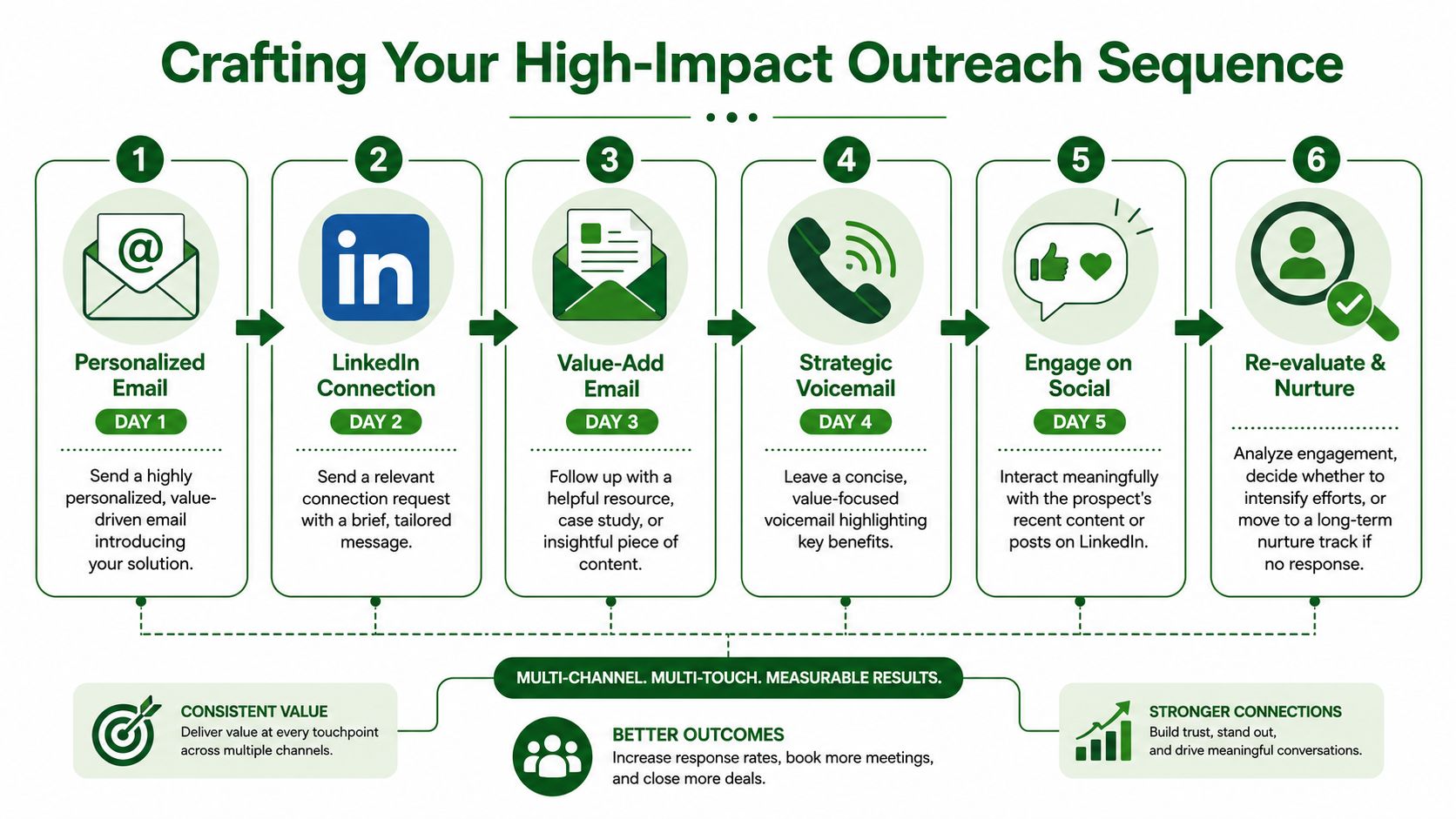
Here's a visual model for how a sequence should flow across channels:
Why generic sequencing fails
Most weak outbound emails share the same problems. They lead with the sender, not the buyer. They make broad claims. They ask for time before earning interest.
A bad opener sounds like this:
Hi Sarah, I help B2B companies streamline their outbound process and improve pipeline generation. We work with teams like yours to drive more meetings. Open to a quick call next week?
There's nothing offensive about it. There's also no reason to reply.
A stronger opener uses a signal that proves the rep understands why this account might care:
Hi Sarah, noticed your team is hiring into demand generation while expanding partner content. That usually creates handoff friction between campaign execution and outbound follow-up. Reaching out because teams in that spot often need tighter prospect prioritization and cleaner messaging by segment.
The second version works better because it has three things the first one lacks:
- A reason now
- A plausible business problem
- Evidence that the rep did the homework
That's the standard your sequence needs to enforce.
A simple sequence that earns replies
The sequence itself doesn't need to be exotic. It needs to feel coherent across channels.
A practical structure looks like this:
| Touch | Channel | Job to do |
|---|---|---|
| 1 | Open with a real trigger and clear problem framing | |
| 2 | Add familiarity, not a second pitch | |
| 3 | Expand on the operational issue or cost of inaction | |
| 4 | Phone or voicemail | Put a human voice behind the outreach |
| 5 | Social engagement | Interact where the buyer is already active |
| 6 | Breakup or nurture decision | Move out, or reroute into a monitored list |
This short video is useful if you want a field-level view of sequence mechanics in action:
The important part is how each touch changes the conversation. Don't repeat the same ask six times. Don't send “just bumping this up” to a prospect who never had a compelling first reason to care.
A few rules improve sequence quality fast:
- Lead with context: Open on something observable, not a broad market statement.
- Stay problem-first: The buyer cares about friction in their workflow, not your platform menu.
- Use LinkedIn as air cover: A profile view, relevant connection request, or post engagement can support the email. It shouldn't duplicate it.
- Let voicemail do one thing: Confirm relevance and familiarity. Don't cram a pitch into it.
- Decide the route deliberately: After the final touch, either recycle the account into nurture or remove it. Don't leave it in limbo.
A sequence is a delivery system. If the insight is weak, the cadence just repeats weak messaging on schedule.
The teams that consistently book stronger meetings usually maintain a library of hooks by segment. They know which signals matter for VP Marketing versus Head of Sales Development versus RevOps. They don't ask each rep to invent fresh relevance from scratch every morning.
If you want a broader view of how outbound teams are evolving their workflows, the articles in the PitchSmart blog resource center are worth reviewing. The useful takeaway isn't that every team needs more automation. It's that automation should support relevance, not replace it.
Mastering Objections and Nurturing Future Pipeline
Most outbound objections aren't rejections. They're status updates.
That distinction matters because the wrong rep hears “not interested” and tries to overcome it. A disciplined rep hears “not interested” and asks what kind of no it is. No budget. No timing. No priority. No authority. No perceived problem. Each one needs a different next step.
Treat objections as routing data
When a prospect pushes back, your job is to classify the response and preserve future value.
Three common categories show up constantly:
Bad timing
This usually means the prospect understands the problem but doesn't have the initiative active yet. Don't press for a meeting they won't respect. Capture what changed recently, when they expect the issue to resurface, and what signal would justify reconnecting.Happy with current vendor
Don't default to competitive combat. Ask what they like, what they wish worked better, and whether there's an upcoming renewal, team change, or workflow gap. That gives you positioning data and a future re-entry point.No budget or no project
Budget objections often mask prioritization issues. Probe lightly. Find out whether the pain is real but unfunded, or absent altogether. Those are different nurture tracks.
A simple rep response sounds like this:
Makes sense. Usually when someone says timing's off, it's either because the initiative isn't live yet or the current process is good enough for now. Which is closer to your situation?
That question lowers resistance and gives you usable CRM intelligence.
Protect the meeting after it's booked
Booking the meeting isn't the finish line. Held meetings matter more than calendar screenshots.
Industry average show rates for B2B appointments range between 50% and 65%, and well-managed programs that use automated confirmations and pre-meeting nurturing can see up to 30% higher meeting success rates, according to Touchstone BPO's overview of appointment setting. Teams lose too many booked meetings because they treat scheduling like an admin task instead of part of qualification.
That means you need a meeting protection process:
Set the agenda immediately
The invite should tell the buyer what the conversation is for, who should attend, and what decision or outcome makes the call useful.Confirm with context
A reminder that references their stated challenge performs better than a sterile calendar notice.Use a clean reminder rhythm
A note a few days ahead and another the day before reduces avoidable no-shows.Make rescheduling easy
Don't punish missed meetings. Give the prospect a simple path back into the calendar while the context is still fresh.
Objection handling should create better segmentation. If it doesn't improve your next action, it was just improvisation.
The best nurture systems create buckets that are operational, not vague. “Follow up later” is not a category. “Revisit after hiring closes,” “check after renewal window,” and “watch for new RevOps leader” are categories. That's how future pipeline gets built without spamming the same account every month.
Building Your Unfair Advantage with a Modern Tech Stack
Most outbound stacks aren't missing tools. They're missing orchestration.
Sales teams usually buy a CRM, add a sequencing platform, connect a dialer, layer in calendar software, then wonder why reps still spend their day buried in admin and browser tabs. The answer is straightforward. The stack records activity and sends activity, but it doesn't produce enough usable intelligence before the rep starts working.
The stack most teams build wrong
A weak setup looks like this:
- CRM stores incomplete records
- Data vendor provides names and emails
- Sales engagement tool sends sequences
- Reps manually fill the gap with research, notes, and copywriting
That sounds manageable until volume rises. Then the entire system depends on whether each rep has time to validate accounts, inspect recent signals, choose the right persona, and write something relevant. Most won't. Not because they don't care, but because the stack asks them to do too much pre-work before they can create pipeline.
That wasted effort is expensive. Sellers who actively partner with AI sales tools are 3.7 times more likely to meet quota, according to Salesforce sales statistics, because AI handles heavy operational work like prospecting support and call summaries, leaving reps more time to focus on actual customer interaction.
What the stack should actually do
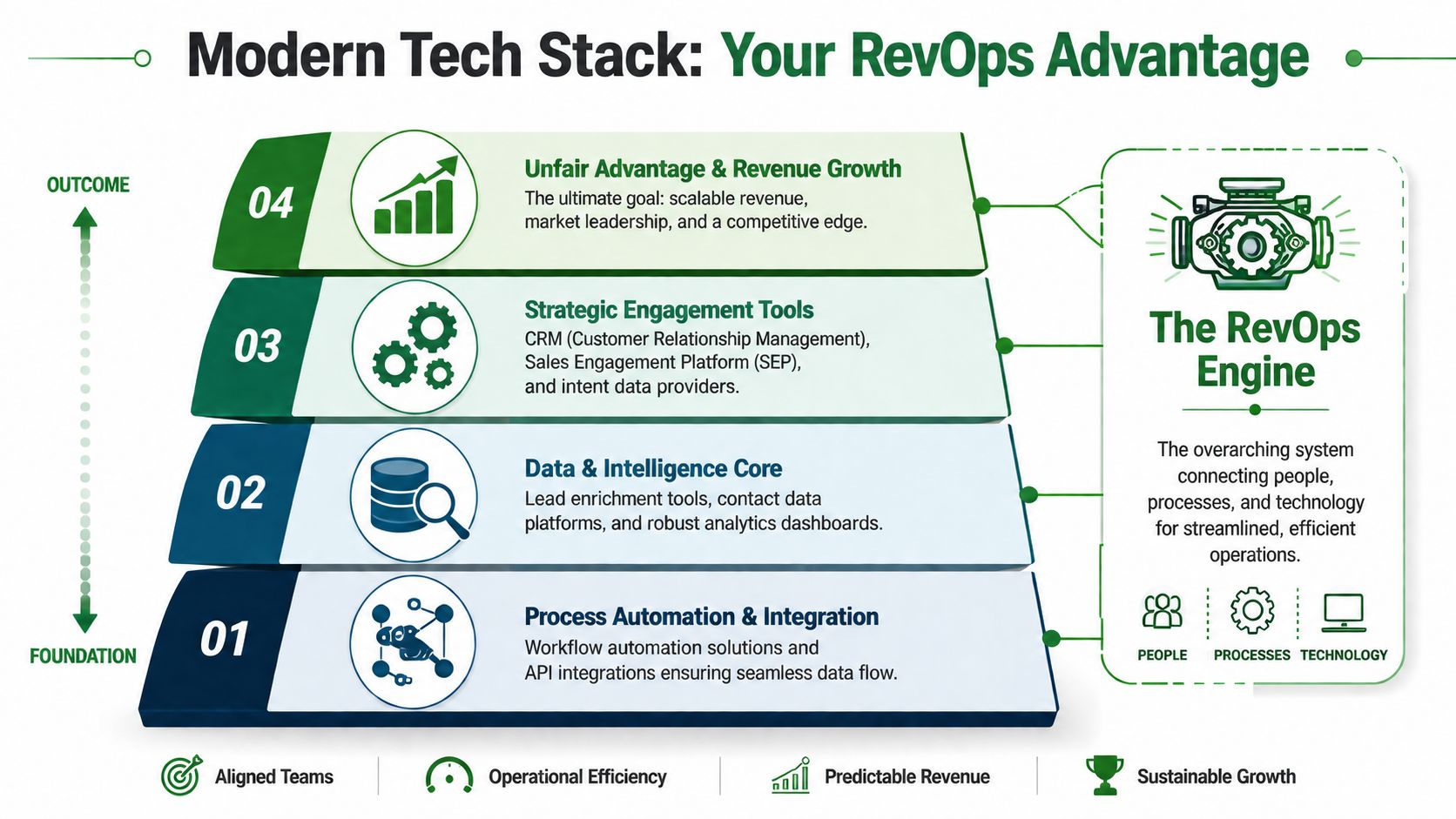
A modern outbound system should have four layers working together:
| Layer | Purpose | What good looks like |
|---|---|---|
| Foundation | Automation and integration | Data flows without manual re-entry |
| Intelligence core | Research and enrichment | Accounts are qualified before outreach |
| Engagement layer | Sequence execution | Messaging matches segment and signal |
| Outcome layer | Revenue visibility | Managers can trace meetings to quality inputs |
The missing layer for many teams is the intelligence core. That's the layer that turns a raw list into a prioritized market. Without it, every downstream tool is underfed.
A strong stack should help your team do five things well:
- Segment by buying context: Not just title and industry, but observable reason-to-engage signals.
- Push structured context into outreach: Reps shouldn't retype or reinvent what the system already knows.
- Keep CRM hygiene tight: Qualification status, objections, and next steps should update consistently.
- Support rep judgment: Automation should prepare the work, not flatten it into robotic messaging.
- Expose bottlenecks clearly: You need to see where meetings break down, not just how many emails went out.
The best tech stack doesn't replace reps. It removes the manual prep work that prevents reps from behaving like good sellers.
Sales leaders secure an unfair advantage. While one team is still asking reps to research every account by hand, another is running coordinated outreach from cleaner segments, better signals, and tighter handoff data. One side creates activity. The other creates conversations.
If you want to see how that kind of workflow fits together operationally, PitchSmart's platform overview shows the model clearly. The important point is broader than any one tool. Research has to become a system layer, not a side task.
From Activity to Outcomes How to Measure and Scale Your Program
Many appointment setting dashboards are built to track labor output instead of sales quality.
They count dials, emails sent, task volume, and sequence enrollments. That helps you see whether reps are active. It does not tell you whether your program is producing qualified conversations with the right accounts. We see this often in outbound teams that chase volume. Activity rises, reply quality drops, AEs lose trust in booked meetings, and the team mistakes motion for progress.
For this reason, the industry needs a stronger shift away from volume-first reporting. As Beyond Codes argues in its B2B appointment setting strategy discussion, teams need to move from activity-based reporting toward intent-based measurement. That means looking at conversation quality, stakeholder relevance, and whether meetings create real deal movement.
Stop rewarding raw volume
Manage appointment setting like a pipeline creation function.
The metrics should reflect quality, fit, and downstream conversion:
- Connection quality: Did the rep reach a real decision-maker or strong influencer?
- Qualification rate: Of booked meetings, how many matched your agreed ICP and buying criteria?
- Show rate: Did the prospect attend, and did the meeting happen with the right stakeholder?
- Opportunity progression: Did the held meeting create a next step, pipeline, or disqualification with a clear reason?
- Reason-coded objections: What patterns show up by segment, persona, and trigger?
These metrics change rep behavior fast. Reps stop stuffing calendars with low-fit meetings. Managers stop rewarding list burning. Sales and marketing can see which segments deserve more coverage and which ones should be cut.
A useful review cadence should inspect both execution and market response.
| Review level | Key question |
|---|---|
| Sequence | Which hooks, signals, and touch patterns create qualified conversations? |
| Persona | Are we reaching people who can drive a buying process? |
| Rep | Does this rep generate meetings that convert, or calendar fills that stall? |
| Segment | Which account groups justify more investment, and which ones waste coverage? |
Scale only what's repeatable
Teams usually break here. They hire more reps before they have stable targeting, signal rules, messaging, and qualification discipline. More headcount on top of a loose process gives you more inconsistency, not more pipeline.
Scale when these three conditions are true:
- Your ICP rules are clear enough for another rep to follow
- Your sequence library reflects what works by segment, signal, and persona
- Your handoff and nurture rules are documented inside the workflow
When those conditions are in place, onboarding gets easier and quality holds. New reps are not guessing who to target or how to frame outreach. They inherit a system built on research, clear triggers, and examples of meetings worth taking.
This is also the right point to invest more in tooling and workflow design. If you are pressure-testing whether your current process can support the next stage, PitchSmart pricing for research-driven outbound teams gives you a practical benchmark for what modern research-backed outbound infrastructure looks like.
If you cannot explain why a booked meeting deserved calendar space, you do not have a scalable appointment setting program. You have activity with a meeting link.
Strong B2B appointment setting does not come from asking reps to make 100 generic touches. It comes from giving them enough context to make 10 high-signal touches that start real conversations. That is the shift. Measure the quality of research, signals, stakeholder selection, and conversion to pipeline. Then scale the parts of the system that keep producing those outcomes.