Your reps are already paying for bad research with their time. They're bouncing between CRM tabs, LinkedIn, spreadsheets, and stale notes just to write one opener, while the day disappears into admin and internal cleanup. In a lot of teams, that means the same people who should be creating pipeline are stuck hunting for enough context to avoid sounding generic.
That's the problem with account based prospecting when it's done manually. The strategy is sound, but the execution gets crushed by research debt, and the fallout shows up fast in weak outreach, stalled cross-sell motions, and reps who've stopped trusting their own lists. For multi-solution B2B companies, that friction is expensive because every account already has more expansion potential than a one-product seller, but only if someone can find the right signal quickly.
Why Manual Research Drains Sales Productivity
A weekly outbound meeting usually tells the same story. One rep has three tabs open trying to confirm the right contact, another is copying and pasting notes from LinkedIn, and a third is rewriting the same email because the first draft sounds like it was written for a stranger. Nobody is short on effort. They're short on clean, relevant inputs.
That's exactly where the process starts leaking. Salesforce's 2026 State of Sales says reps spend 60% of their time on non-selling tasks like hunting for sales materials, manual CRM entry, and approvals, according to Salesforce's 2026 sales statistics. Another 2026 summary cites Salesforce data showing teams spend 70% of their time on non-selling tasks and only 30% selling, with research and preparation among the recurring time sinks, from Everstage's sales productivity analysis. That's not just inefficiency, it's quota math working against you.
Practical rule: if a rep has to research the same account twice, the process is already broken.
The damage is worse in cross-sell motions. Existing customers should be the easiest accounts to expand, but manual research turns them into another pile of tabs, notes, and guesswork. Reps fall back to broad messaging because they don't have time to verify which product, which problem, and which recent trigger matters.
That's why generic cold email keeps underperforming. When the opener isn't grounded in an account's current situation, it reads like a volume play, not a reason to reply. If your team is feeling that drag right now, a faster workflow matters more than another debate about messaging. A practical place to see what this looks like in action is PitchSmart's demo, because the core bottleneck isn't creativity, it's research time.
Understanding Account Based Prospecting Fundamentals
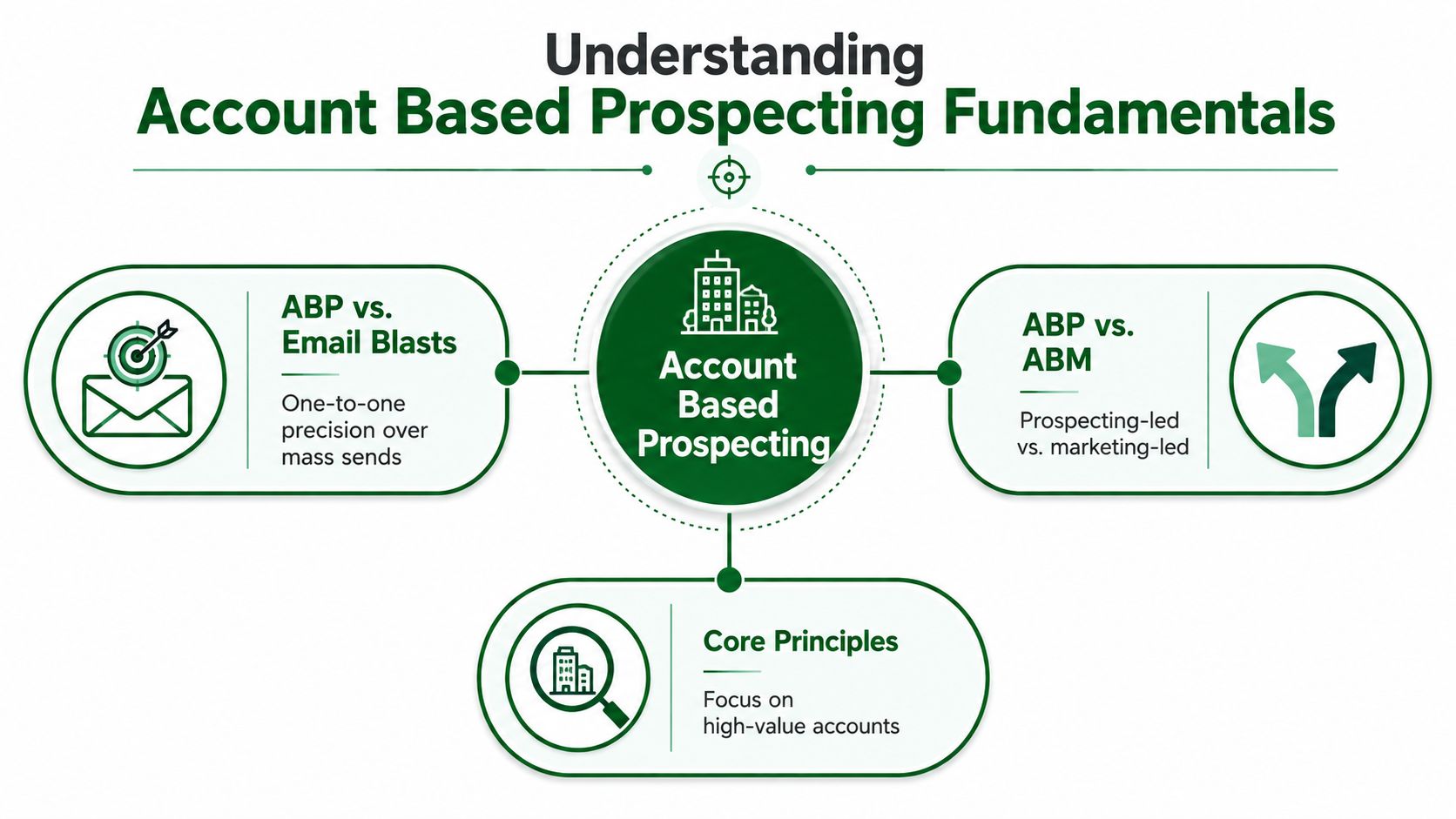
Account based prospecting is not a prettier version of lead blasting. It starts with specific accounts, then works backward to the people, signals, and product context that justify outreach. That's different from one-to-many email, where the list comes first and the message stays mostly the same, and it's different from marketing-led ABM, where campaign orchestration usually leads the motion.
By 2020, 61% of companies surveyed had a full ABM program or were in a pilot, and 27% planned to start within six months, according to UserGems' ABM statistics. That matters here because it shows the market had already moved toward account-level prioritization. Account based prospecting lives inside that shift, but it's the sales and RevOps side of the motion, where the question is not just which accounts matter, but which accounts deserve outreach this week and why.
What Changes In A Multi-Solution Company
For a single-product company, account research can be broad. For a multi-solution business, it has to be product-specific. A finance software company might sell one product into FP&A, another into close management, and another into planning workflows. The same account can be a fit for all three, but the buying signals won't be the same, and neither will the opener.
That's where most generic ABP advice gets thin. It stops at persona mapping and leaves out the harder part, which is tying a solution to the exact problem the account is trying to solve. A hiring surge in FP&A roles says something different from a company evaluating budgeting tools, and a rep needs to know which signal maps to which line of business.
Practical rule: the account is only half the unit of research. The other half is the specific product motion you're selling into that account.
The strongest ABP programs treat fit and signal as separate filters, then combine them before outreach. Fit says the account belongs in the list. Signal says it belongs in today's queue. That distinction is what keeps teams from burning hours on accounts that look good on paper but aren't moving.
PitchSmart's account research guide is useful context for teams standardizing that process, especially when multiple solution lines need different qualification logic.
Crafting Your Account Based Prospecting Playbook
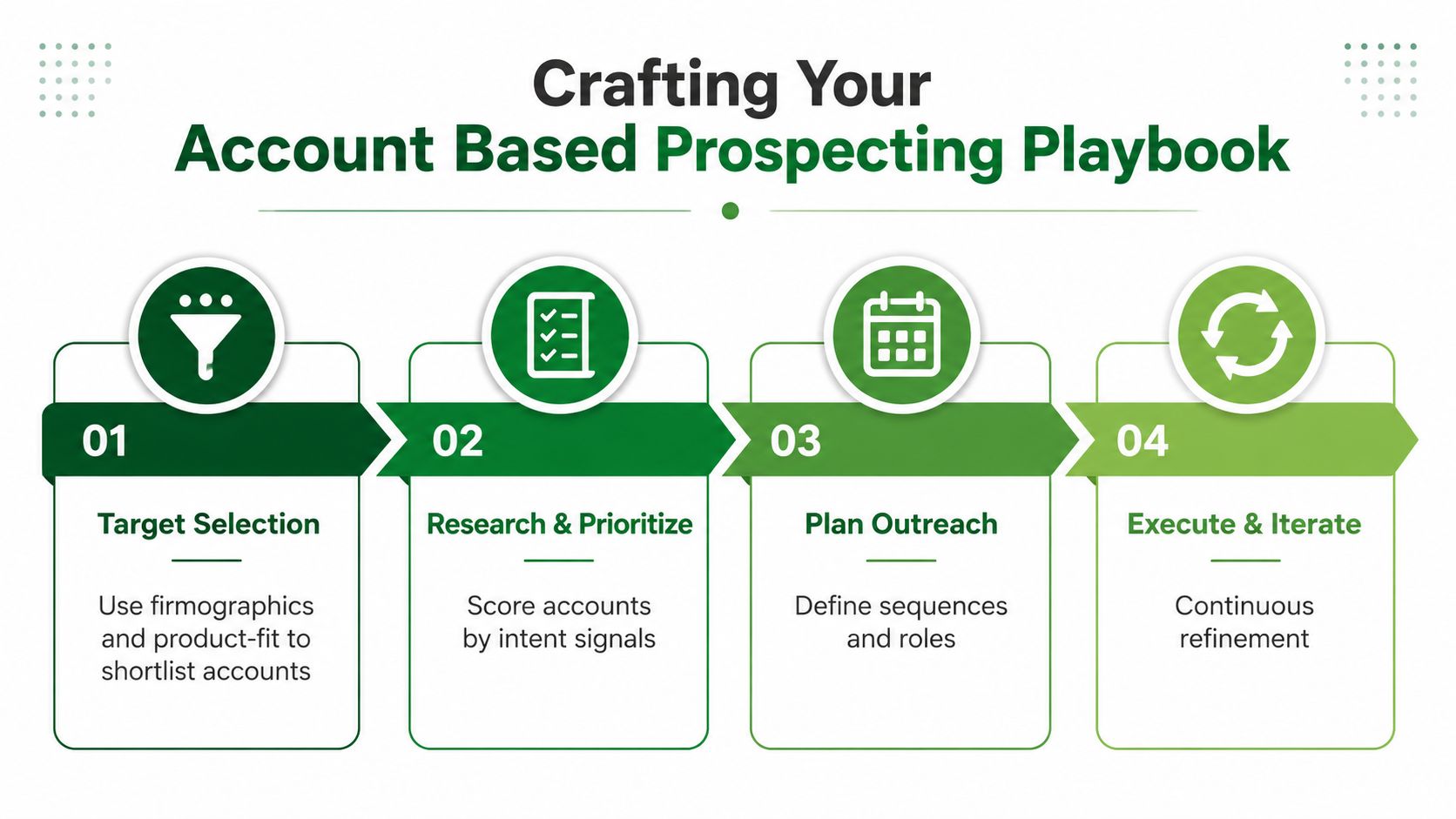
A useful playbook starts with list construction, not messaging. If the account list is noisy, no amount of personalization will save the sequence, because the rep will keep writing to the wrong problem. The goal is to build a queue of accounts that are both a fit and currently showing some sign of movement.
Start With Product Fit, Not Just Firmographics
Firmographics still matter, but they're too blunt on their own. A good target list should reflect the account's industry, size, and structure, then narrow further based on the product you're selling and the problem that product solves. That's especially important for companies that grew through acquisition, where one customer base may need different products surfaced at different times.
For outbound teams, this means uploading or syncing the list you already own, then checking it against the motion you care about. For revenue enablement and expansion leaders, it means ranking the installed base by which account has a plausible cross-sell path, not just which account has spend.
Layer Signals Before You Rank Accounts
Single signals are noisy. Multiple aligned signals are where the work gets interesting. Industry guidance on account-based signals points to five core categories, website engagement, competitive activity, tech stack changes, hiring signals, and recency-weighted CRM interactions, according to 6sense's 2024 benchmark guidance. That mix matters because one signal can be a coincidence, while several together usually mean an account is active.
For a finance software seller, a hiring surge in FP&A roles plus a budgeting-tool evaluation is a much cleaner trigger than either one alone. For a service business, a new executive hire plus recent website research might be enough to move the account up the queue. The point is to rank accounts weekly, not to treat every signal as a finished conclusion.
A simple working sequence looks like this:
- Filter for fit first. Keep only accounts that match the product motion you're selling.
- Score the signals second. Weight concurrent activity more heavily than a single event.
- Separate outreach queues. Keep cross-sell, upsell, and net-new motions distinct.
- Use source-backed notes. Reps need to know where the signal came from so they can write a real opener.
Research In Parallel, Not One Account At A Time
Bulk research changes the economics of the process. Instead of one rep manually researching one account at a time, the team can run the full list through a parallel workflow, then review only the accounts that clear the threshold. That's where tools built for account-level research matter, because the bottleneck stops being data collection and starts being judgment.
Practical rule: if research can't be done in batches, it won't survive contact with a real outbound team.
A structured playbook should end with a prioritized list, a reason for priority, and a next action. If it stops at “interesting accounts,” the team will still waste time deciding what to do next. The stronger workflow is simple, repeatable, and tied to one product motion at a time.
PitchSmart's solution to account research fits this kind of operating model because it starts from what you sell, then researches the account against that definition rather than a generic profile.
Scaling Personalization and Outreach Cadence
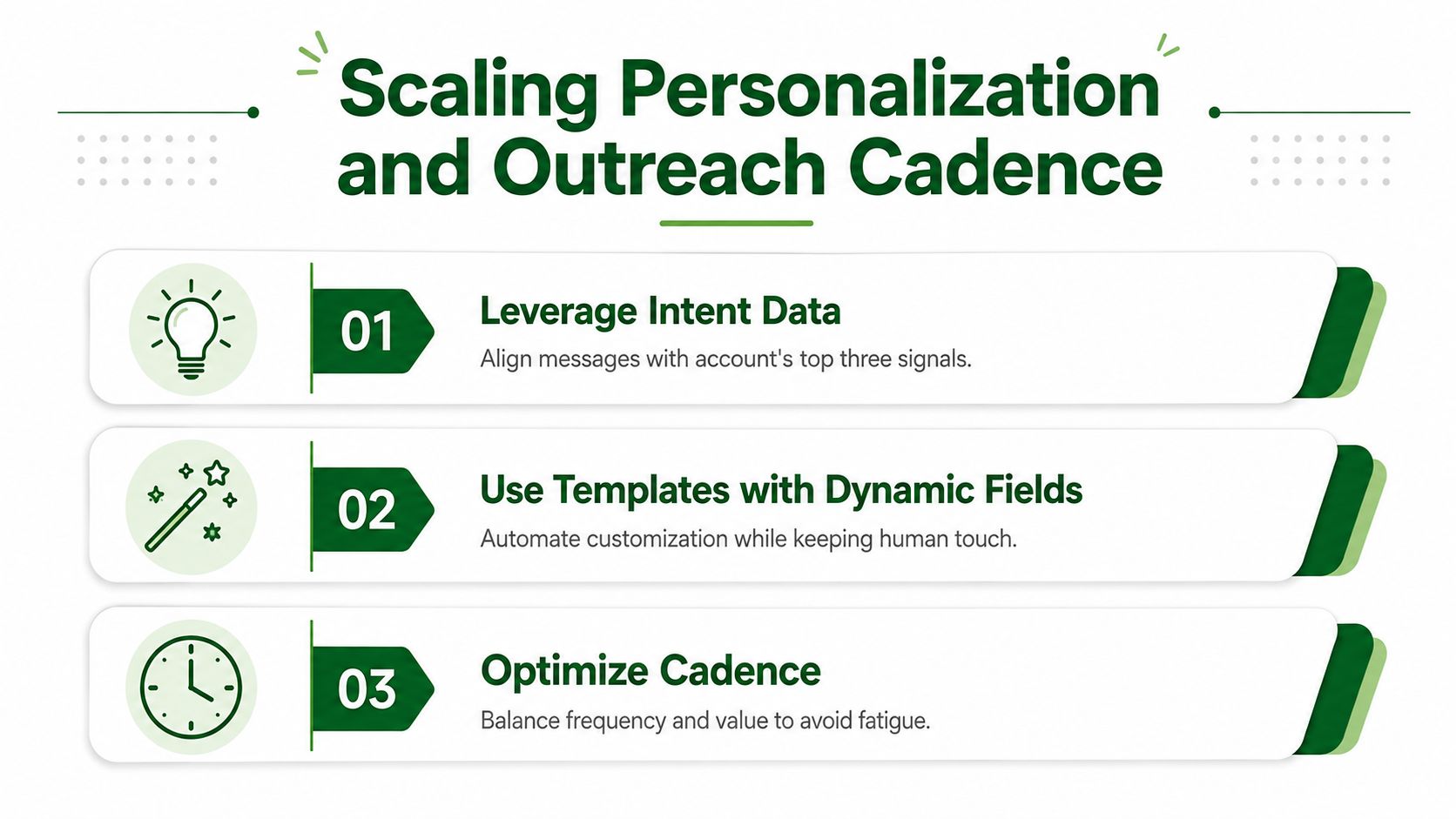
The biggest mistake in personalization is treating the first line like the whole job. A first line can mention a job change, a product review, or a recent technology shift, but it still needs to connect to a real business reason for contacting the account. Without that connection, the message reads like a clever opening glued to a weak pitch.
Build Hooks From Recent Signals
The best hooks come from the account's current activity, not from a token inserted into a template. If an executive was just hired, say why that role matters to the product motion. If the company posted for a finance or operations role, connect that hiring need to the problem your solution solves. If the account has been researching competitors, use that as the opener only if the problem you solve is the one they're likely comparing.
That logic works because it respects timing. A signal that happened weeks ago may still matter, but a recent one usually deserves priority. When you're working from bulk research outputs, each account should surface a short list of usable hooks, not a pile of raw notes.
Use A Three-Touch Sequence With Different Jobs
A three-touch sequence works best when each touch has a distinct purpose. The first touch opens the conversation, the second adds context, and the third gives the prospect a low-friction reason to answer. That can happen across email and LinkedIn without turning the cadence into spam.
A simple structure looks like this:
- First touch, lead with the signal. Open with the activity you found, then connect it to the specific product problem.
- Second touch, add a second angle. Bring in another relevant signal or a different stakeholder perspective.
- Third touch, ask a narrow question. Keep it easy to answer, and keep it tied to the exact motion.
The point is not to sound handcrafted in a dramatic way. The point is to sound informed enough that the recipient can tell you did the work.
Replace Token Personalization With Activity-Driven Copy
Token-based personalization often creates false confidence. A rep swaps in a company name, maybe a title, and the email technically looks customized, but it still doesn't explain why the account should care now. Activity-driven copy does the opposite. It starts from what the account did, then writes the message around that event.
A 2026 cold-email study covering 25,000 campaigns found reply rates rose from 2.1% with no personalization to 11.7% with fully custom messages, according to Warmy Sender's personalization study. The useful lesson isn't to chase perfect prose. It's that each added layer of relevance earns the right to keep the conversation going.
If you're building this at scale, automation should draft the sequence from the best hooks, while the rep decides whether the account deserves a human tweak. That's the only way to keep volume and relevance in the same motion. One practical option in that workflow is PitchSmart, which researches accounts in bulk, surfaces conversational hooks from recent activity, and drafts a three-email sequence from those findings.
Measuring Account Based Prospecting Success
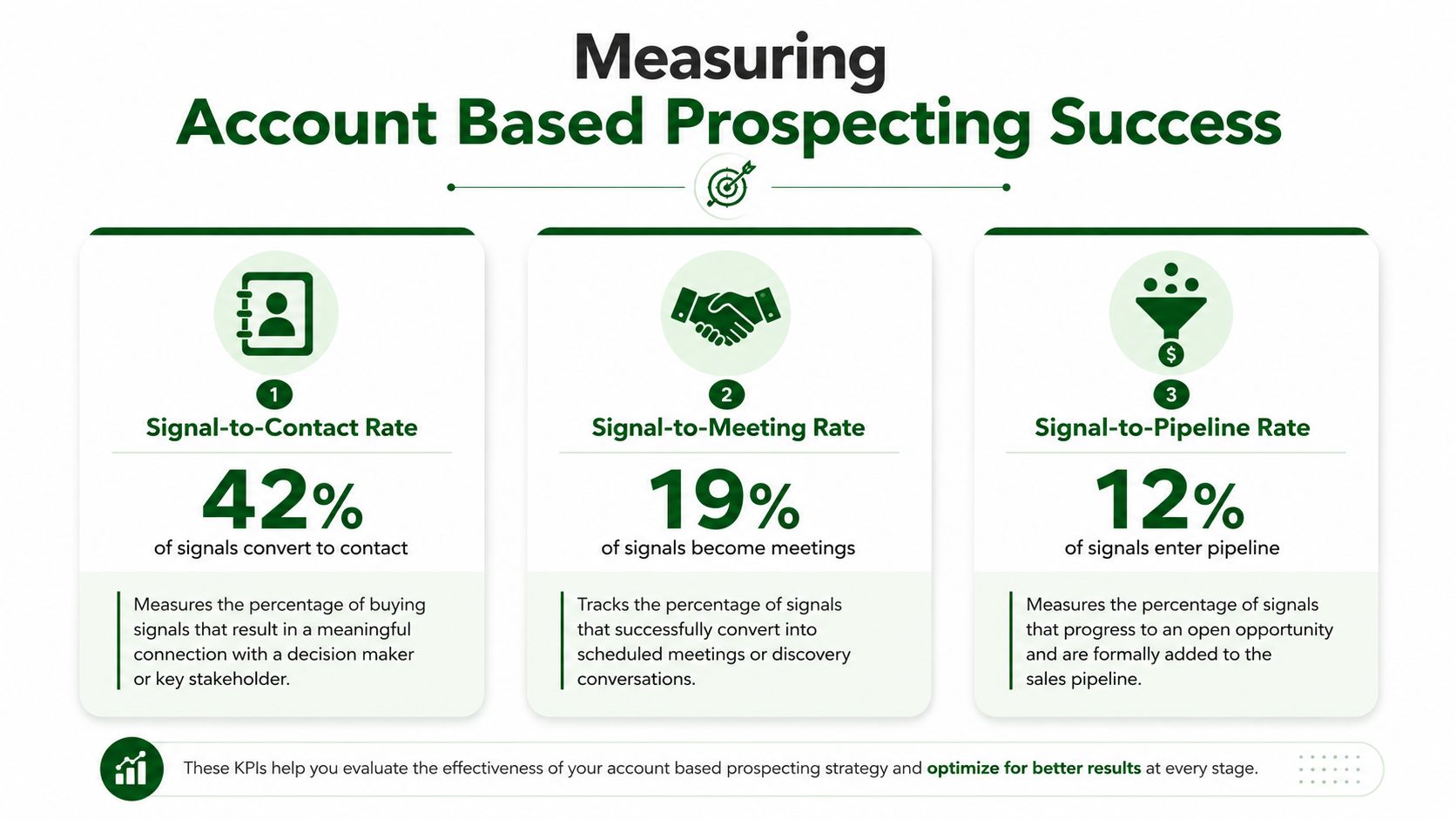
Account based prospecting falls apart when teams measure it like generic outbound. A huge send count doesn't tell you whether the targeting logic was right, and reply volume alone can hide bad qualification. The better question is whether the account moved cleanly from signal to conversation to pipeline.
Track The Conversion Between Each Stage
Three metrics matter more than vanity activity:
- Signal-to-contact rate. How often a detected signal produces a real outreach attempt.
- Signal-to-meeting rate. How often that outreach turns into a booked meeting.
- Signal-to-pipeline rate. How often the account progresses into qualified pipeline.
Those metrics tell you where the motion is leaking. If signal-to-contact is low, the problem is usually process or prioritization. If contact is fine but meetings are weak, the issue is probably relevance or timing. If meetings happen but pipeline doesn't move, the account might fit the product poorly even if the opener landed.
Use ROI As A Directional Benchmark, Not A Vanity Target
ABM benchmark data shows the economic logic behind account-level motions. A 2024 Forrester study reported that most ABM decision-makers saw ROI 21% to 50% higher than non-ABM programs, and 23% of global respondents reported 51% to 200% higher ROI, according to MarketingView's benchmark report. The useful takeaway is not that every team should chase the same return. It's that account fit and buying-stage evidence usually outperform volume-led programs.
That matters for RevOps because it gives you a cleaner way to argue for process changes. If the team is spending too much time on weak accounts, the answer isn't more activity. It's better prioritization, cleaner segmentation, and clearer signal logic.
Build A Dashboard That Shows Capacity
A good dashboard should show the account stage, the triggering signals, the rep assigned, and the next action. It should also show where time is getting burned, because manual research tends to hide inside broad activity buckets. Once that's visible, you can spot whether the problem is list quality, research depth, or follow-up discipline.
Practical rule: if the dashboard can't explain why a rep touched an account, it can't help you improve the workflow.
RevOps teams usually get the most value when they compare account stage movement against rep capacity. That exposes whether the team is handling too many accounts, researching too thoroughly, or spending effort on motions that should have been automated earlier.
Avoiding Pitfalls and Using the Right Technology
The most common ABP mistake is making research a one-off human task. A rep finds an account, writes some notes, sends a sequence, and the knowledge disappears into the inbox. The next rep starts over, even if the account is part of the same buying group or the same expansion opportunity.
Overreliance on firmographics causes a second failure. A company can look perfect on paper and still be a poor prospect for the exact product you're pushing today. Brittle personalization tokens create a third problem, because they make outreach look customized without making it more relevant.
That's why the technology choice matters. Bulk customizable research is useful when it's tied to the product you sell, not just the company you're targeting. Activity-based conversational hooks matter because they anchor the message in something the account did. Advanced segmentation matters because cross-sell, upsell, and net-new outreach shouldn't all be treated the same way.
PitchSmart's portfolio page is a useful reference for teams comparing how product-specific research and account-level sequencing get applied in practice. The broader point is simple. If the team has to rebuild the research playbook every time a new solution line launches, the process won't scale.
The right workflow turns account research into a repeatable system. Reps start with a prioritized list, get source-backed signals, and launch from a sequence that's already aligned to the account's buying context. That's the practical fix for the bleeding neck, and it's how teams get out of the manual research trap without giving up precision.
If your team is still spending hours piecing together account context by hand, it's time to move to a research process that starts from what you sell. Visit PitchSmart to see how bulk account research, signal-based hooks, and draft sequences can fit into your outbound or expansion workflow.