Salesforce reports that reps spend far more time on admin, internal process, and prep work than on actual selling. That should end the smile and dial debate for any serious outbound team. This is a capacity problem first.
Once selling time gets compressed, bad habits follow fast. Reps default to high-call blocks with weak account context. Managers chase activity because activity is easy to see. Pipeline suffers because volume without relevance rarely creates enough quality conversations.
I have seen this pattern in SDR teams over and over. The issue is not effort. The issue is where effort goes. If a rep spends the first half of the day cleaning CRM fields, switching tabs for research, and guessing at message angles, the team will try to make up for lost time with more dials. That is old outbound math, and it breaks under modern response rates.
A better fix is to remove the wasted motion before the first touch. Teams that want more pipeline need tighter targeting, faster research, and cleaner execution. That is the shift from smile and dial to intelligent velocity. If you want a sense of what that operational change looks like, review the PitchSmart pricing options for outbound teams built around faster prospect research and message prep.
The Real Cost of Your Sales Team's Activity
Sales teams lose far more pipeline to workflow drag than to weak talk tracks.
The expensive part of smile and dial is not the phone bill. It is the hours burned before a rep ever reaches a live prospect. Manual list cleanup, contact verification, account research, note entry, and one-off message drafting create a hidden tax on every meeting your team books. As noted earlier, reps spend a large share of their week on work that does not create conversations. That is not an efficiency problem. It is a coverage problem.
A team can hit activity targets and still underperform on pipeline because the activity sits on top of bad process.
What that looks like on the floor
I have seen this pattern repeatedly. An SDR starts with a full task queue and good intent. Ninety minutes later, they have fixed CRM fields, checked whether two titles are current, skimmed a funding page, rewritten an opener, and logged three partial touches. The dashboard shows motion. The rep has barely sold.
The time sink usually shows up in four places:
- List cleanup: bad records, duplicate accounts, and missing firmographic fields
- Manual research: checking LinkedIn, company sites, and news sources to decide whether an account deserves a call
- Message drafting: rebuilding outreach from scratch because the segment logic was weak at the top of the funnel
- Post-activity admin: logging notes, updating statuses, and setting follow-up tasks by hand
That workflow creates a bad trade-off. Reps either slow down to do the research properly, or they skip the research and push volume. Smile and dial survives because it feels like the only way to keep output up when the system underneath is clunky.
The fix is not telling reps to work harder. It is reducing the cost of a quality first touch. If your team has to research every prospect one at a time, personalized outbound will always be too slow to scale.
This is the shift ambitious teams need to make. Stop measuring effort as if effort alone creates revenue. Measure how much rep time reaches live selling, and then rebuild the workflow around that number.
If you are auditing that workflow now, review the options on PitchSmart pricing for outbound workflow efficiency. The useful comparison is not cost per seat. It is how many selling hours each tool gives back to the team every week.
What Is Smile and Dial Really
Smile and dial is the classic high-volume outbound habit. Call the next name, keep your energy high, sound upbeat, and trust repetition to create enough conversations to hit quota.
The phrase has been around since the telephone became part of sales work. The core logic was simple. A rep's tone matters, and a smile changes tone in a way prospects can hear. As explained in this overview of the practice, the physical act of smiling is audible to prospects, improves a rep's mood and tonality, and was taken seriously enough that Nestle USA placed mirrors at workstations to reinforce the behavior.

Why it worked for so long
Smile and dial became a staple because it solved a real sales problem from an earlier era. Teams needed a repeatable behavior that junior reps could execute under pressure. Smiling improved delivery. Repetition built confidence. More attempts created more chances for a live conversation.
In that environment, the model had real advantages:
- It reduced hesitation: reps didn't stall on perfection
- It created consistency: managers could coach around pace, tone, and script adherence
- It built resilience: a rough call didn't stop the next one from happening
There is still value in that discipline. Tone still matters. Confidence still matters. A rep who sounds flat, distracted, or apologetic won't get far on the phone.
What people get wrong about it
The mistake is treating smile and dial as a complete strategy instead of a delivery tactic.
A smile can improve tonality. It can't fix a bad list. It can't rescue irrelevant outreach. It can't create urgency where none exists. And it definitely can't compensate for calling the wrong buyer with the wrong message at the wrong moment.
The useful part of smile and dial was never the volume by itself. It was the reminder that human energy carries through the phone.
That distinction matters. Teams that kept the tone but upgraded the targeting evolved. Teams that kept the tone and kept the brute-force workflow got stuck measuring effort instead of outcomes.
The Brutal Math of Modern Cold Calling
Modern cold calling still produces meetings. But the economics have changed, and many sales organizations haven't adapted accordingly.
The clearest signal comes from a large call analysis. According to analysis of 1.4 million calls, Tuesday is the best day for prospect connectivity, with a 4.8% positive call rate. That same analysis also found that Tuesday and Wednesday account for 44% of all demos booked, that many SDRs still make 50 to 100+ calls per day, and that 50 researched calls outperform 200 random dials. The reason is painfully simple. The first 15 seconds determine the outcome.
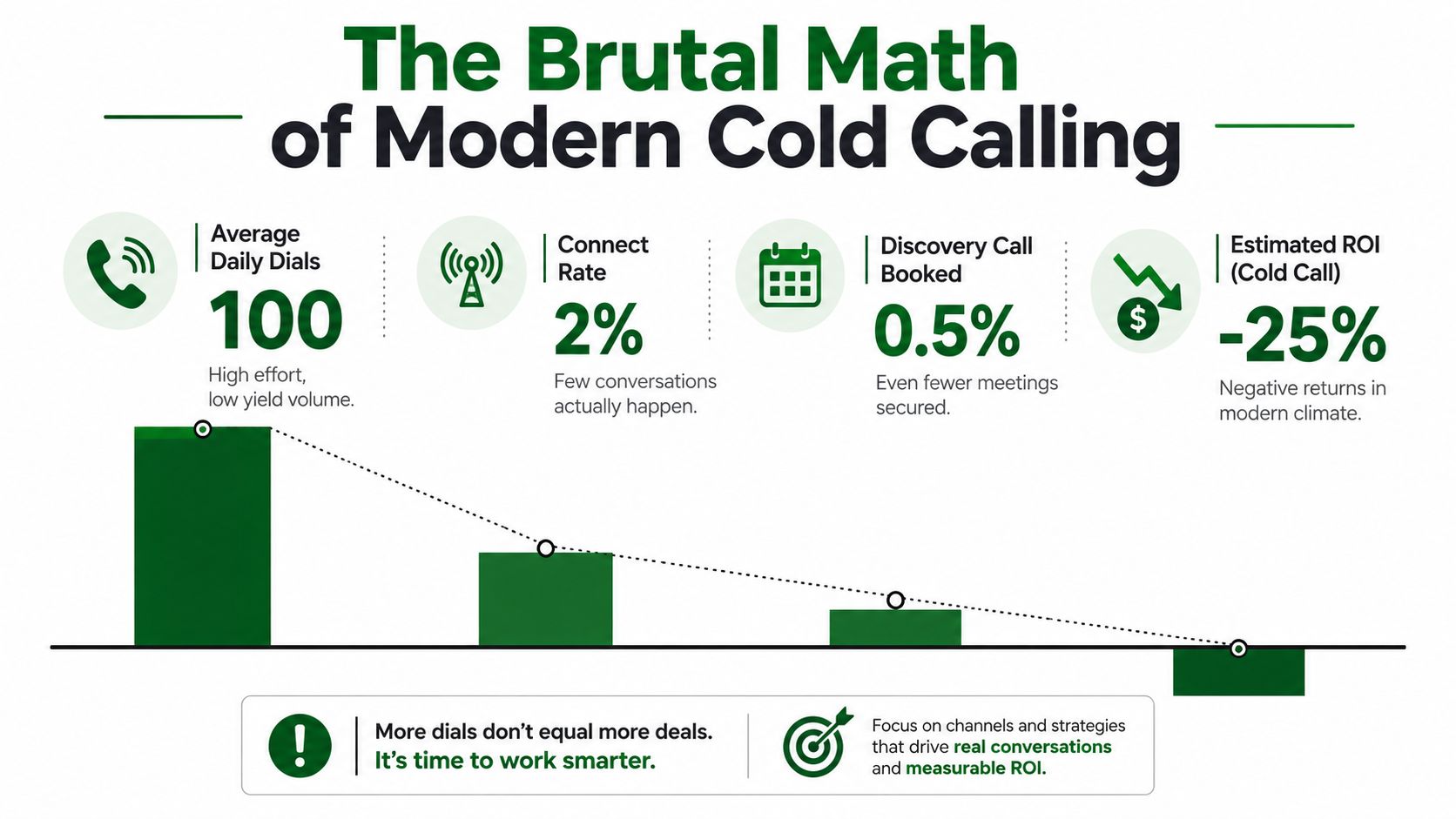
The first 15 seconds decide whether the rest matters
That should change how SDR teams work.
If the opening seconds decide the call, then the rep needs three things before dialing:
- A verified number
- A reason this account matters now
- A relevant opening tied to the buyer's world
Without those, volume just accelerates waste. Reps burn time on bad data, weak intros, and dead-end conversations that never had a chance.
Timing helps, but it doesn't save a bad process
A lot of teams hear "Tuesday is best" and turn that into a call blitz plan. That's too shallow.
Calling on the strongest day with a generic opener is still generic outreach. Hitting a high-activity block with a list you haven't segmented is still blunt-force prospecting. Timing is an edge only when the rest of the system is competent.
A more realistic reading of the data looks like this:
| Factor | What the data says | What teams should do |
|---|---|---|
| Day selection | Tuesday performs best for connectivity | Protect top call blocks for strongest accounts |
| Demo concentration | Tuesday and Wednesday produce a large share of booked demos | Front-load high-fit outreach earlier in the week |
| Call volume | Many SDRs make 50 to 100+ calls per day | Measure conversation quality, not just dial count |
| Call prep | 50 researched calls beat 200 random dials | Shift effort into list quality and opening relevance |
| Opening window | First 15 seconds decide the outcome | Script the opener around account-specific context |
Field note: If your opener sounds like it could be used on any company in your territory, it will fail like a generic opener.
Smile and dial isn't dead because the phone stopped working. It's different because the margin for irrelevance collapsed. The phone now punishes sloppy inputs faster than almost any other outbound channel.
Why Pure Volume Is a Losing Strategy
Pure volume fails for reasons that don't show up on a dashboard.
The obvious issue is conversion quality. The less obvious issue is that brute-force prospecting trains a team to confuse activity with progress. Reps learn that the job is to clear tasks, not create momentum with the right accounts. Managers get easy reporting and weak visibility into what buyers responded to.
The operational cost is huge. According to the Forrester Activity Study summary, the average rep burns nearly two full days per week on administrative tasks, with 72% of total time spent on non-selling activities like prospecting and data entry. When a rep already loses that much time before outreach begins, doubling down on more random dials just compounds the waste.
What pure volume breaks first
The first thing it breaks is message quality.
When reps are told to hit a dial target above all else, they stop asking the important questions. Why this account. Why this persona. Why now. They also stop noticing signal differences between one prospect and the next. A hiring change, a product launch, a funding event, a new team priority, or visible expansion activity all get flattened into the same opener.
Then morale goes.
A bad outbound system doesn't just create missed targets. It creates learned futility. Reps feel busy all day and still end the week without enough real conversations to show for it. That is how burnout starts in SDR teams that look "hard working" from the outside.
The brand cost is real
Buyers remember bad outreach.
They remember the caller who knew nothing about the company. They remember the email that clearly came from a list pull with no segmentation. They remember being interrupted by someone who asked a question the website had already answered.
That damage is hard to quantify cleanly, but anyone who has managed outbound at scale has seen it. Poorly researched outreach burns future opportunities because it teaches the market to ignore your name.
A better standard for SDR performance includes:
- Research discipline: can the rep identify why the account is worth attention
- Hook quality: does the opener reflect something current and specific
- Channel judgment: is the rep choosing call, email, or LinkedIn based on context
- Follow-up quality: does each touch add relevance instead of repeating the same ask
Managers who celebrate raw dial counts usually create the exact behavior they later complain about.
Volume still matters. But volume without relevance is just expensive noise.
The Alternative Research-Backed Outbound
The replacement for smile and dial isn't "do less outreach." It's run a tighter outbound system.
A research-backed workflow starts with a different belief. The most impactful work in outbound happens before the first touch. Not because personalization is fashionable, but because relevance changes whether a buyer gives you any attention at all.
What the old workflow gets wrong
Traditional outbound often looks like this:
| Metric | Traditional Smile and Dial | PitchSmart-Powered Outbound |
|---|---|---|
| Lead research | One account at a time, manually | Bulk, customizable lead research across a list |
| Opening angle | Generic script with light edits | Activity-based conversational hooks from recent signals |
| Segmentation | Basic firmographic slicing | Advanced list segmentation based on buying signals |
| Sequence setup | Manual emails and disconnected follow-up | Automated 3-step email and LinkedIn sequences seeded from the best hooks |
| Rep effort | Heavy tab switching and admin | Research packaged into a usable conversation plan |
That old model fails in predictable ways. Reps start with a CSV or CRM export, then spend hours opening tabs, validating whether the account is still relevant, and writing one-off openers from scraps. Good reps can do it. They just can't do it at the pace a modern team needs.
What a research-backed workflow looks like
A stronger process begins with the list, not the script.
First, segment accounts around buying signals and fit. Then run bulk research across the entire segment so the rep isn't discovering basic context one prospect at a time. From there, pull out activity-based hooks that make a call opener or email introduction feel grounded in something current. Finally, seed those hooks into an automated multi-touch sequence so the rep isn't rebuilding the same message architecture every day.
This is the part many teams overlook. Research only matters when it becomes execution.
That means the workflow needs to support:
- Bulk research at list level: not tab-by-tab prospecting
- Signal-backed hooks: details that help a rep open with relevance
- Sequence automation: a repeatable 3-step path across email and LinkedIn
- Segmentation logic: separating high-fit, active accounts from everyone else
For teams evaluating how this kind of system fits into the broader outbound stack, the PitchSmart blog is a useful place to compare workflows and see how research-first prospecting is being operationalized.
A short product walkthrough helps make that workflow concrete.
The important shift is philosophical and operational at the same time. Reps shouldn't have to choose between quality and speed. The system should produce both by moving the heavy research work upstream and turning it into usable outbound assets.
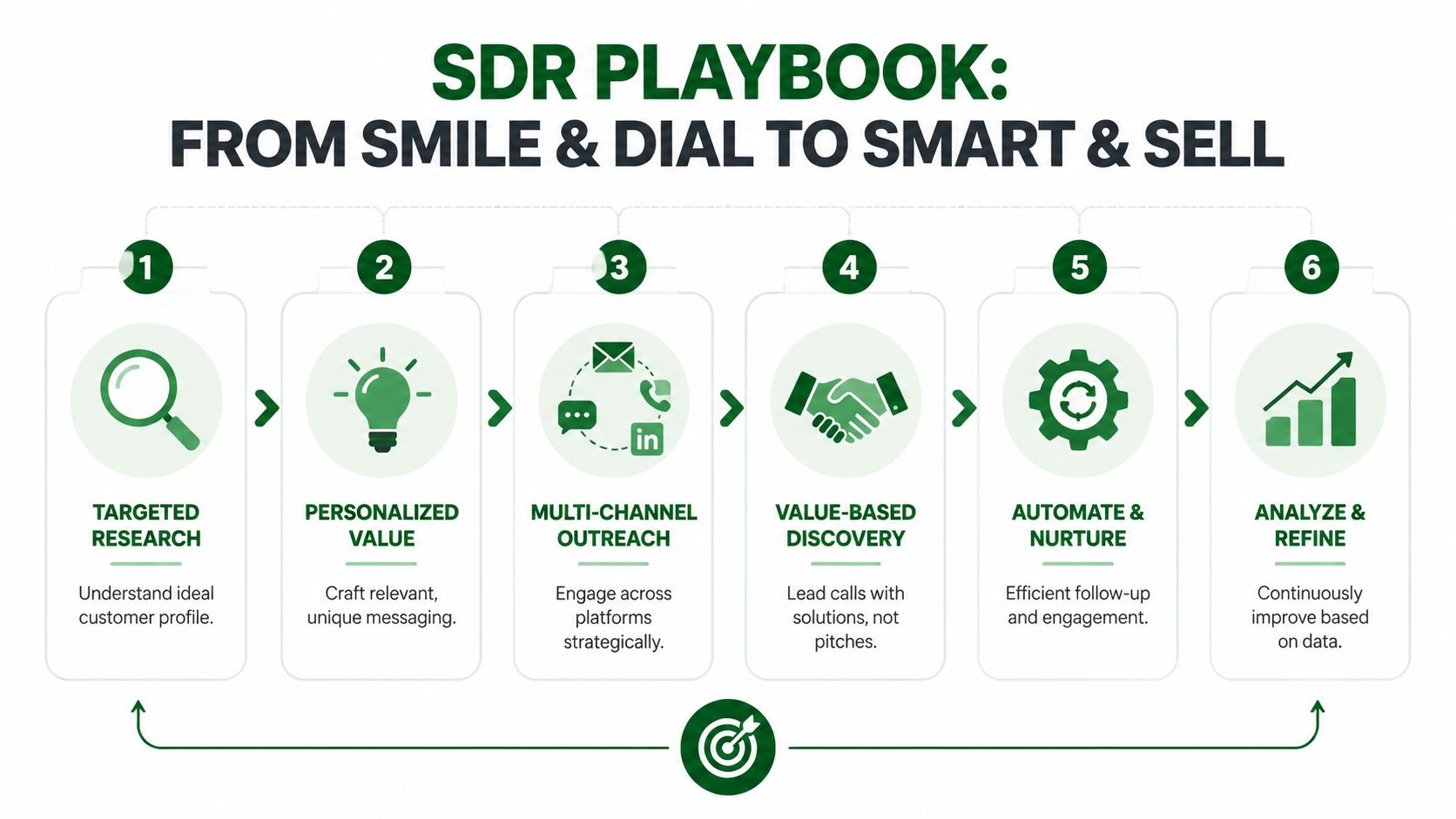
The SDR Playbook From Smile and Dial to Smart and Sell
The fastest way to change outbound performance is to change the rep's daily workflow. Not the motivational speech. Not the call block calendar by itself. The workflow.
Step 1 Build the list around intent
Start with account selection. Don't begin with a giant territory list and hope messaging sorts it out later.
Prioritize accounts that show some reason to care now. That can include visible business activity, team changes, product motion, market expansion, or signs that a relevant initiative is underway. Then segment by persona and account condition, not just industry and employee count.
A stronger list gives the rep cleaner decisions:
- Call-first segment: accounts with strong fit and a time-sensitive reason to engage
- Sequence-first segment: accounts worth nurturing across email and LinkedIn
- Hold segment: names that fit the ICP but lack a current trigger
Step 2 Turn research into message angles
Once the list is segmented, run bulk research and extract usable hooks.
The key is to avoid dumping raw information into outreach. Reps don't need more notes. They need a small set of message angles they can use immediately. A good hook ties one visible signal to one business problem your product solves.
For example, if an account is actively hiring in a function your product impacts, the outreach angle should connect that hiring motion to likely process strain, handoff risk, reporting complexity, or ramp pressure. The rep now has a reason to start a conversation that isn't fake familiarity.
Don't personalize around trivia. Personalize around operational tension the buyer is likely dealing with.
PitchSmart cleanly supports a modern SDR workflow. It lets teams upload lists or pull prospects from their existing systems, run bulk research in parallel, organize findings around qualifiers and buying signals, and move from scattered notes to a signal-backed conversation plan instead of manual one-by-one prospecting.
Step 3 Sequence the outreach
Once the hook is clear, build a simple sequence around it.
Use the first email to establish relevance. Use LinkedIn to reinforce familiarity and context. Use the follow-up touches to deepen the problem framing or add one more useful angle. If a call is part of the plan, the voicemail and opener should align with the same narrative, not feel like they came from a different campaign.
A workable SDR rhythm looks like this:
- Research and segment the list
- Generate hook categories by account
- Map the best hook to each persona
- Launch a 3-step sequence across email and LinkedIn
- Call the highest-priority accounts with the same contextual opener
- Review response quality and refine the next batch
The point isn't to remove the rep from outbound. It's to remove low-value labor so the rep can spend more time where judgment matters.
Stop Dialing Start Connecting
The useful part of smile and dial was always human energy. The obsolete part is the blind volume.
Today's outbound teams don't need fewer conversations. They need better entry points into conversations. That means cleaner segmentation, faster research, stronger hooks, and sequences built from real account context instead of recycled templates. The smile still matters. But the confidence behind it should come from preparation, not from pretending the next random dial will somehow work out.
The best SDR teams don't win by avoiding the phone. They win by earning the right to use it well. They know why the account is on the list, what changed, what tension the buyer may be feeling, and how to open without sounding interchangeable.
If your reps are still spending too much of the day on research, admin, and generic outreach assembly, the fix isn't another activity target. It's a better system.
Try PitchSmart if you want to replace manual prospecting with bulk lead research, signal-backed conversation hooks, advanced segmentation, and automated 3-step outreach that gives reps more time for real selling. The free trial doesn't require a credit card, so your team can upload a list and see the workflow in action before changing the whole motion.