Your SDR team probably isn't losing because reps are lazy or because the last email sequence was badly written. They're losing because the workflow is broken.
A rep starts the morning in LinkedIn, jumps to the company site, checks the CRM, opens a funding database, skims job postings, copies notes into a sequence tool, then writes a message that sounds personalized but is really just a thin rewrite of the same template. By lunch, they've done a lot of work and created very little selling advantage. By end of day, the team has sent a pile of outreach that looks busy in the dashboard and weak in the inbox.
That's the bleeding neck in outbound. Manual research eats the day, generic messaging kills relevance, and leadership responds by asking for more volume. More volume usually means more irrelevance.
If you want to learn how to improve conversion rates in B2B outbound, stop treating conversion as a website-only problem. For SDR and RevOps teams, conversion happens across the full outbound path: targeting, first message, reply, click, meeting booked, form completion, demo request. If that path is noisy, no amount of copy polish will save it.
Why Your Cold Outreach Fails to Convert
Busy does not mean effective
Most cold outreach fails long before the prospect sees the CTA.
It fails when the list is too broad. It fails when the account was picked because it matched a title filter, not because there was any reason to believe the company is in-market. It fails when the rep spends most of the day collecting scraps of context and has almost no time left for actual conversations.
The worst outbound teams confuse activity with progress. They celebrate send volume, automate sequences too early, and call it scale. Then they wonder why replies are thin, meetings don't materialize, and landing pages underperform even when traffic is coming from “target accounts.”
Practical rule: If a rep needs five tools and fifteen browser tabs to produce one decent first-touch email, the system doesn't scale.
The manual workflow creates two kinds of damage. First, reps spend their energy on non-selling work. Second, the quality of outreach drops because rushed research produces generic hooks. Buyers can tell. “Noticed your company is growing” is not personalization. It's filler with a company name attached.
The real problem is process quality
Many teams make the wrong diagnosis at this point. They assume the fix is stronger copywriting, stricter activity targets, or another subject line workshop.
Sometimes copy is the problem. Usually it isn't.
The bigger issue is that generic outbound creates generic learning. If every message sounds roughly the same, your test results won't tell you much. You can't learn what converts if your team isn't sending messages grounded in a specific reason for contact.
A broken outbound system usually looks like this:
- Broad targeting: ICP rules are vague, so reps chase accounts that fit a category but show no credible buying signal.
- Thin research: Reps use surface facts. New logo on the homepage, generic company description, broad industry pain.
- Template dependence: Sequences are built for convenience, not relevance.
- Unclear handoff: Prospects click through to pages or forms that weren't built for outbound intent, so interest dies at the next step.
The result is predictable. Low-quality inputs produce low-quality conversion at every stage.
Good outbound doesn't start with “what should we send?” It starts with “why would this account care right now?”
That shift matters because outbound conversion isn't one event. It's a chain. A prospect has to recognize relevance, trust the framing, take the next action, and then complete a friction-light path to a meeting. If any link is weak, the whole system underperforms.
First Map Your Outbound Conversion Funnel
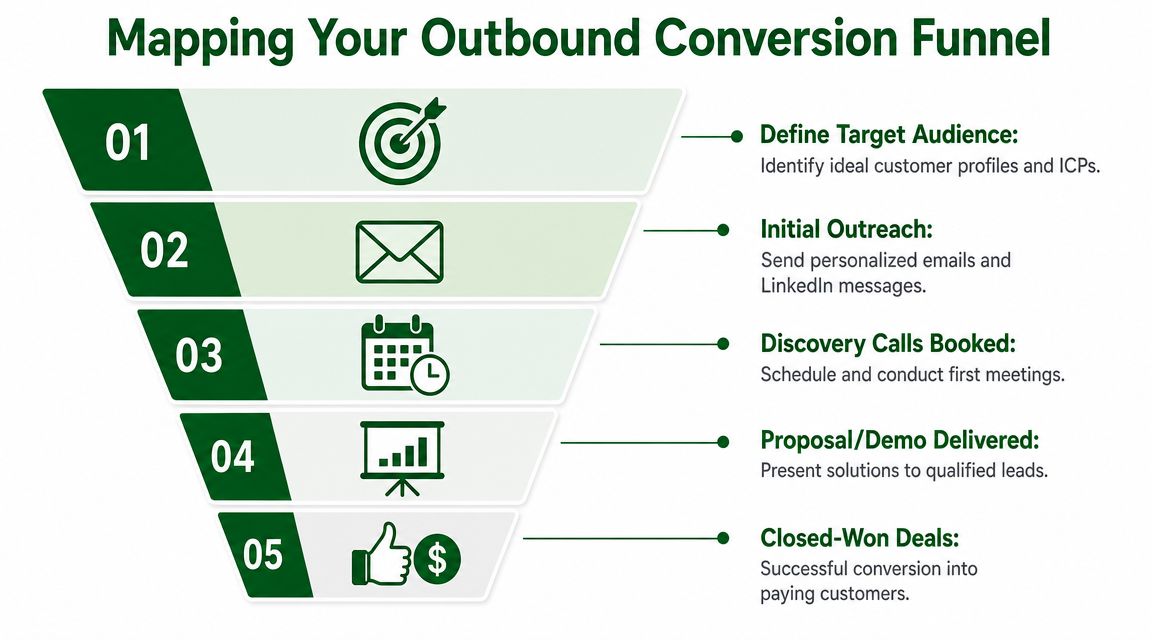
An SDR sends a sharp email, gets a click, and still ends the day with no meeting booked. That usually means the problem is not the email alone. The conversion path broke somewhere between first interest and the next step.
That is why outbound CRO starts with funnel mapping. If you lump emails, landing pages, forms, and demo requests into one top-line conversion number, you lose the thread. You need to see where interest turns into action, and where it dies.
Define the steps your team owns
A typical B2B outbound funnel includes these stages:
- Target account selected
- First touch sent
- Prospect engaged
- Reply or click generated
- Meeting booked
- Demo request completed
- Qualified opportunity created
Your sequence may look different. Some teams drive replies inside email. Others push traffic to a dedicated page, a calendar link, or a demo form. What matters is mapping the path the prospect follows in your outbound motion, including every handoff your team controls.
For outbound, that usually means three assets working together:
- the message that earns attention
- the page that carries the context forward
- the booking or demo flow that converts intent into a meeting
Miss one, and the rest underperform.
Build a baseline from your own data
A good baseline gives the team a shared view of reality. Analysts at Invesp outline a conversion workflow that starts with current performance, identifies drop-off points, and tests fixes in order. That logic applies cleanly to outbound.
Pull sequence, click, meeting, and opportunity data from the systems your team already uses. Outreach, Salesloft, HubSpot, Salesforce, and your scheduling tool usually hold enough signal to start. Use a long enough window to smooth out campaign noise and compare stages against each other, not against generic industry averages.
The goal is simple. Find the leak.
That baseline should answer questions like these:
| Funnel step | What to check |
|---|---|
| Targeting | Which segments produce replies and meetings, not just sends |
| Messaging | Which openings, hooks, and CTAs generate engagement that leads somewhere |
| Click-through | Which links get clicked, and whether those clicks turn into bookings or form starts |
| Booking flow | Where prospects drop before confirming a meeting |
| Form completion | Which fields or page elements slow down demo requests |
If your team is trying to standardize account research, sequence inputs, and outbound execution in one place, an automated outbound research workflow can make this baseline easier to maintain. The workflow still matters more than the tool. Teams need a clean map before they start testing changes.
Find the leak before you rewrite anything
Early-stage teams often edit copy first because it is easy to access and easy to debate. That habit wastes time when the core issue sits further down the funnel.
A campaign can get strong opens and decent clicks while producing weak pipeline because the landing page is too generic for outbound traffic. A rep can get replies but miss meetings because the CTA asks for too much too early. A demo page can lose warm interest because the form asks for fields that belong later in qualification.
Use this order when diagnosing the funnel:
- Start with the largest drop-off. Focus on the stage where prospects stall in meaningful volume.
- Separate relevance from friction. Low reply rates usually point to targeting or messaging. High clicks with low bookings usually point to page or form issues.
- Review by segment, not just by campaign. Good messaging sent to weak accounts will look worse than it is.
- Check message-to-page continuity. If the email promises a specific problem or trigger, the landing page needs to continue that story.
Baselines are not for reporting. They are for deciding where to work.
Once the funnel is mapped clearly, optimization gets more disciplined. You stop guessing whether outbound is underperforming and start seeing which step needs attention first.
From Generic Guesses to Signal-Based Hypotheses
Weak hypotheses create weak tests
Most outbound A/B tests fail before launch because the underlying idea is flimsy.
Teams test subject line wording, CTA length, or whether the first sentence should mention the prospect's role or company. Those tests aren't useless, but they're often too shallow to explain meaningful differences in conversion. You end up optimizing presentation when the actual issue is relevance.
Conversion optimization is an experimentation discipline. The most effective method is to use campaign analytics, determine what drives conversions, and replicate those wins with a unified measurement model, according to INFORMS on marketing analytics and experimentation. That's the standard outbound teams should use too.
What signal-based selling changes
A better hypothesis starts with a real trigger.
Instead of saying, “Maybe a shorter email will work better,” say, “Accounts showing a recent hiring shift in revenue leadership may respond to messaging about ramping outbound faster.” That's testable. It also reflects a credible reason the buyer might care now.
Signal-based selling improves outbound because it forces specificity. You segment by likely need, not just static firmographics. You change the opening because the account context changed, not because the copy felt stale. You build a sequence around a reason to act.
This is the line many teams miss. The problem isn't that they don't run tests. It's that they run tests on weak ideas generated from generic assumptions.
Here's the contrast:
| Generic guess | Signal-based hypothesis |
|---|---|
| Use a punchier subject line | Use a subject line tied to a recent company event or role change |
| Mention the company name earlier | Lead with a hook tied to a visible business priority |
| Try a stronger CTA | Offer a CTA that matches the likely urgency of the signal |
Better tests start upstream. If your list quality and account context are weak, your test design will be weak too.
Examples of better outbound hypotheses
A strong outbound hypothesis has three parts. It identifies a segment, names the reason that segment may care, and predicts which action should improve.
Examples:
- Hiring signal: Accounts expanding sales leadership may respond better to messaging about process standardization than to generic productivity language.
- Tech stack signal: Prospects using a fragmented outbound stack may engage more with operational efficiency messaging than with broad pipeline claims.
- Activity-based hook: A company showing recent go-to-market motion may respond better to a sequence framed around timing than one framed around cost savings.
Each of those hypotheses produces more useful learning than cosmetic copy tests.
The best RevOps teams build a library of these. They know which signals map to which pains, which personas engage with which framing, and which CTA fits each stage of intent. Over time, that becomes a conversion advantage because the team stops guessing and starts pattern-matching against real market behavior.
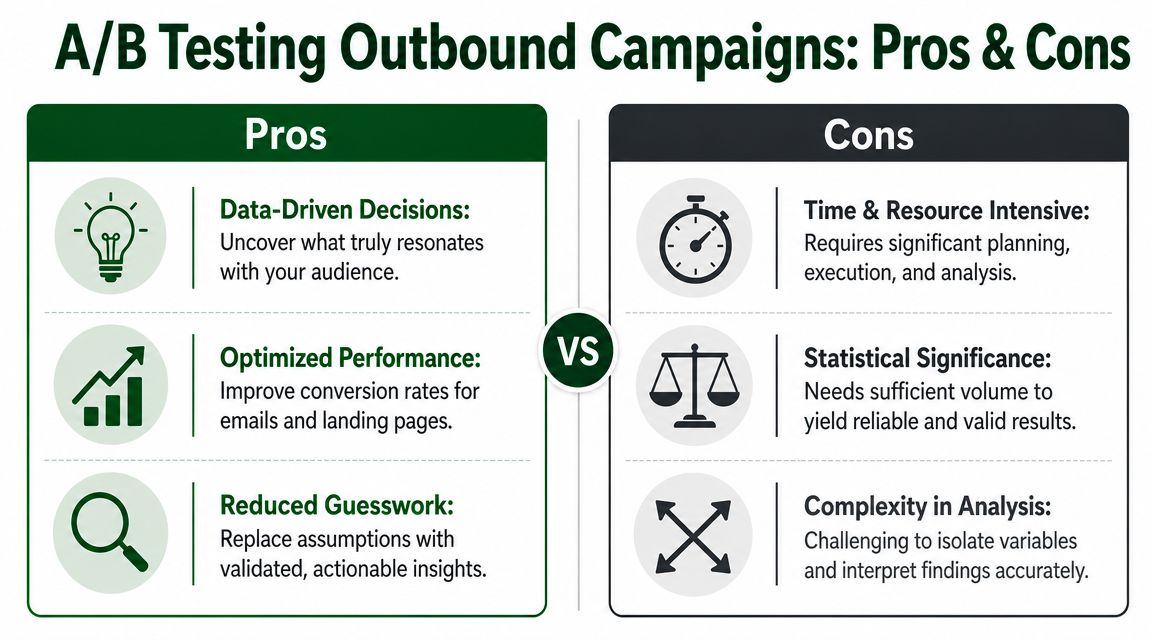
A/B Testing Your Email Sequences and Landing Pages
The right test doesn't start with creativity. It starts with control.
What to test first
In outbound, test the elements closest to buyer intent first. Don't obsess over tiny cosmetic details if the account hook is vague or the CTA asks for too much too soon.
Start with:
- Opening hook: Test a signal-based first sentence against a generic personalization line.
- Offer framing: Compare one pain angle against another for the same segment.
- CTA shape: Test a low-friction ask, such as sharing relevance, against a direct meeting ask.
- Landing page headline: Match it to the outbound message so the click feels coherent.
- Demo page copy: Remove anything that distracts from the next step.
After you have those basics under control, test smaller details. Subject lines, message length, ordering of proof points, and LinkedIn follow-up language can all matter. They just shouldn't be the first place you spend your team's energy.
How to run cleaner tests
One of the most common testing mistakes is changing too many things at once. Another is ending tests too early. Both make the results hard to trust, and both are called out in CRO guidance summarized earlier.
Use a disciplined process:
- Pick one segment. Keep persona, company type, and sequence intent as stable as possible.
- Change one meaningful variable. Hook, CTA, headline, or form element.
- Hold the rest steady. Same send window, same follow-up cadence, same rep behavior where possible.
- Define the primary metric before launch. Reply rate, meeting booked rate, click-to-book rate, or form completion.
- Document the outcome. Winning tests should become operating plays, not tribal knowledge.
A useful outbound team habit is to keep a shared testing log. Not a loose Slack thread. A real system of record. If your team wants examples of structured outbound process thinking, the PitchSmart blog is a useful reference point for building repeatable sales workflows.
If you can't explain exactly what changed, you didn't run a test. You ran a remix.
Here's a practical walkthrough on outbound testing that pairs well with the process above:
Reduce friction on the demo path
Outbound conversion doesn't stop at the click. A lot of teams write stronger emails, get better engagement, and then lose the prospect on the booking page or demo form.
Form friction is one of the most impactful elements for conversion. Removing nonessential fields, using autofill and inline validation, and adding progress indicators for multi-step flows are consistently recommended in CRO guidance. CXL warns that more fields reduce completion, and Quantum Metric recommends progressive profiling for collecting additional information later, as summarized by Quantum Metric's guide to improving conversion rates.
For outbound demo pages, that means:
- Ask only for what the next step requires: If sales can book the meeting without extra fields, remove them.
- Keep the page aligned to the email promise: Don't send a prospect from a precise hook into a generic product page.
- Make mobile input painless: Many prospects open and skim from a phone, even if they book later on desktop.
Some teams have a persuasion problem. Others have a friction problem. They solve them differently. If the click is weak, improve the message-to-offer match. If the click is healthy and the booking rate is weak, simplify the path.
Measuring Lift and Scaling Your Winning Plays
Measure business movement, not vanity movement
A test that improves opens but doesn't improve meetings isn't a real win for most outbound teams.
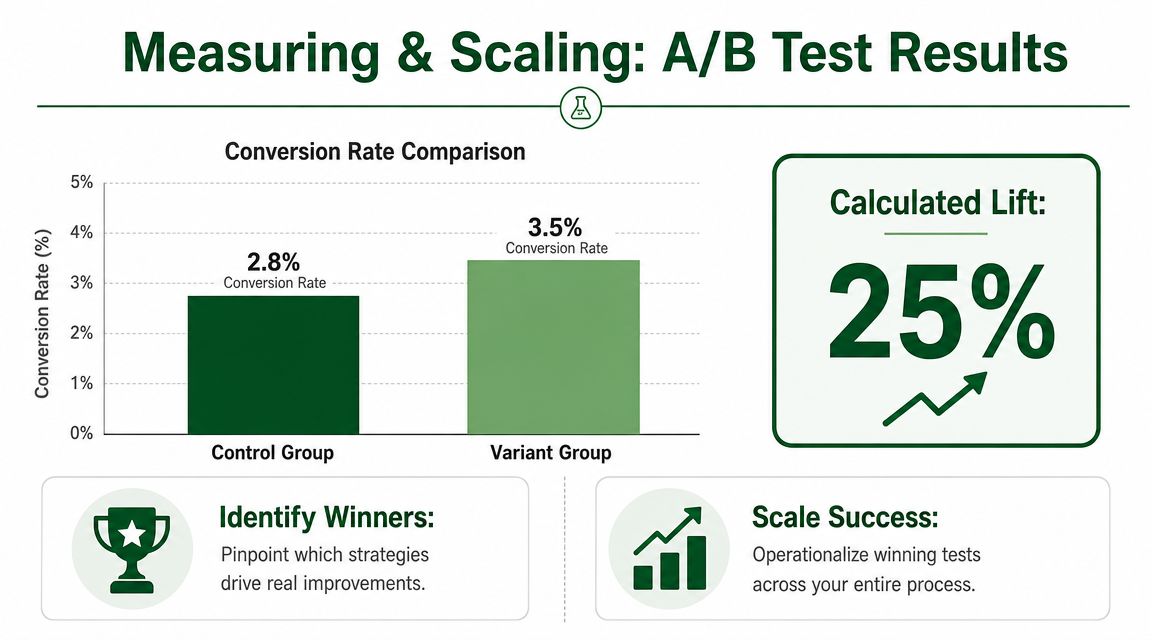
Measure each result as movement through the funnel. Did the new hook increase replies from the right persona? Did the revised landing page improve demo requests? Did better segment selection produce more qualified meetings, not just more clicks?
RevOps delivers significant value. The team should connect outreach performance to downstream outcomes so sales leaders can tell the difference between cosmetic improvement and pipeline improvement.
Small gains matter more than most teams think
This is the part many teams underestimate. The Lucky Orange benchmark on website conversion rates puts the global average website conversion rate at around 1.8%, which means roughly 98.2% of visits do not convert. The same source notes that moving from 1.8% to 2.0% is an 11.1% relative lift.
That matters in outbound because most sales conversion paths also start from a low baseline. When your initial response, click, or booking rate is modest, even a small improvement can create meaningful pipeline impact. That's why strong teams care about incremental gains. Not because they're small, but because they compound.
A low baseline changes the math. Small wins aren't marginal when the funnel leaks early.
Turn one winner into a repeatable play
A test result becomes valuable when it becomes operational.
If a specific signal-hook-sequence combination works for one segment, package it. Define the trigger, the persona, the message angle, the CTA, and the page or form experience that follows. Then roll it out to the right accounts instead of blasting it across the whole database.
A repeatable play should include:
- The segment definition: Which accounts should enter the play
- The reason for contact: What signal justifies the outreach
- The outbound sequence: Email and LinkedIn touches that match the context
- The conversion path: Where the prospect goes next and what action matters
- The success metric: What counts as a meaningful result
If you're evaluating tooling to support that kind of scale, PitchSmart pricing gives a practical view into how outbound teams can operationalize research and execution without piling more manual work onto reps.
The key is restraint. Don't scale a winner to everyone. Scale it to the audience that shares the condition that made it work.
Building a Continuous CRO Culture in Your Sales Team
Make testing part of the operating rhythm
The best outbound teams don't treat conversion work as a quarterly cleanup project. They treat it as part of the weekly operating system.
That means sales managers stop asking only for activity totals. RevOps stops acting like reporting is the finish line. SDR leaders review segment performance, message performance, and booking friction with the same seriousness they give pipeline creation.
A healthy rhythm usually includes:
- Weekly review: Which segments moved, which stalled, and where the drop-off shifted
- Hypothesis backlog: A short list of tests grounded in signals, not random copy opinions
- Shared documentation: Wins, losses, and surprises recorded so the team learns once
- Tight feedback loops: SDRs report what prospects say, and RevOps uses that feedback to refine targeting and testing
What strong sales teams stop doing
Teams build better conversion habits when they stop doing the obvious bad stuff.
They stop forcing every account into the same sequence. They stop treating personalization as token name-dropping. They stop sending prospects into bloated forms and generic pages. They stop scaling tests that produced movement in the wrong metric.
They stop trying to improve conversion rates through effort alone.
The teams that win don't outwork a broken process. They redesign it, measure it, and keep tuning it.
Outbound conversion improves when the work gets sharper. Better segmentation. Better reasons for contact. Cleaner tests. Less friction after the click. More discipline in how wins get scaled.
That's the shift from spray and pray to a data-driven outbound engine. Not more activity. Better system design.
If your team is stuck doing manual prospect research, copying scraps of context into sequences, and hoping generic outreach converts, PitchSmart is built for that exact bottleneck. It helps outbound teams run bulk lead research from their own lists, surface activity-based conversation hooks, segment accounts using buying signals, and launch automated 3-step email and LinkedIn sequences seeded from the strongest hooks. Instead of burning rep time on tab-juggling and admin, you give the team a faster path to relevant outreach and a cleaner way to scale what works.