Your reps already know how to write a sentence. That usually isn't the problem.
The problem is uglier. A rep pulls a list, opens twelve tabs per account, skims a homepage, checks LinkedIn, guesses at a pain point, writes a “personalized” opener, then sends an email that still sounds like every other email in the prospect's inbox. By noon, they've done a lot of work and created very little pipeline.
That manual grind is what breaks outbound teams. Reps burn time on research, admins call it personalization, and leaders wonder why reply quality is weak. If you're trying to figure out how to write cold emails that get replies, stop treating it like a copywriting exercise. The issue is usually process failure, not word choice.
Good cold email starts upstream. If the research is thin, the message will be thin. If the signal is weak, the personalization will be fake. If the list is sloppy, even strong copy won't save deliverability.
Why Your Cold Emails Are Being Ignored
Most cold emails get ignored for one of three reasons. They aren't relevant, they ask for too much too early, or they never had a fair shot of landing in the inbox in the first place.
Generic outreach fails fast. Prospects can spot a template in a second. Changing {{first_name}} and {{company_name}} isn't personalization. It's mail merge. When the rest of the email could go to any other company in the category, the prospect knows you didn't do the work.
The second issue is hidden labor. Reps spend most of their day on non-selling tasks, especially research, admin, and data entry. That creates a bad trade. The team puts in manual effort but still produces low-context emails because there isn't enough time to research every account at scale.
Practical rule: If your team needs twenty minutes of tab-juggling to produce one decent opener, your process won't scale.
There's also a market reality a lot of teams ignore. Inbox competition is tighter now, and open rates have become harder to earn. Woodpecker's cold email benchmark roundup notes that advanced personalization produced a 7% response rate, compared with a broader benchmark average of 5.1%. The same benchmark summary also cites Stripo data showing open rates fell from 36% in 2023 to 27.7% later. That changes the job. You don't win by writing longer or trying to sound clever. You win by being relevant immediately.
What actually kills reply rates
| Problem | What it looks like | What happens |
|---|---|---|
| Fake personalization | “Noticed your company is growing” | Prospect ignores it |
| Me-first messaging | Long intro about your product | Prospect doesn't care |
| Weak targeting | Broad list with no trigger | Low relevance from the start |
| Poor sending hygiene | Unverified data and sloppy setup | Good copy still underperforms |
Most advice on how to write cold emails stays at the surface. Better subject line. Better CTA. Better template.
That helps, but only after the fundamentals are fixed. The best outbound teams don't start with the draft. They start with research quality, list quality, segmentation, and signal quality. The email is just the final expression of that system.
Build a Research Foundation Before You Write
World-class cold emails are usually won before the first sentence is drafted.
If you don't know why this account should care right now, you aren't ready to write. The strongest campaigns come from a research foundation that tells the rep what changed, what likely matters, and what angle is worth testing.
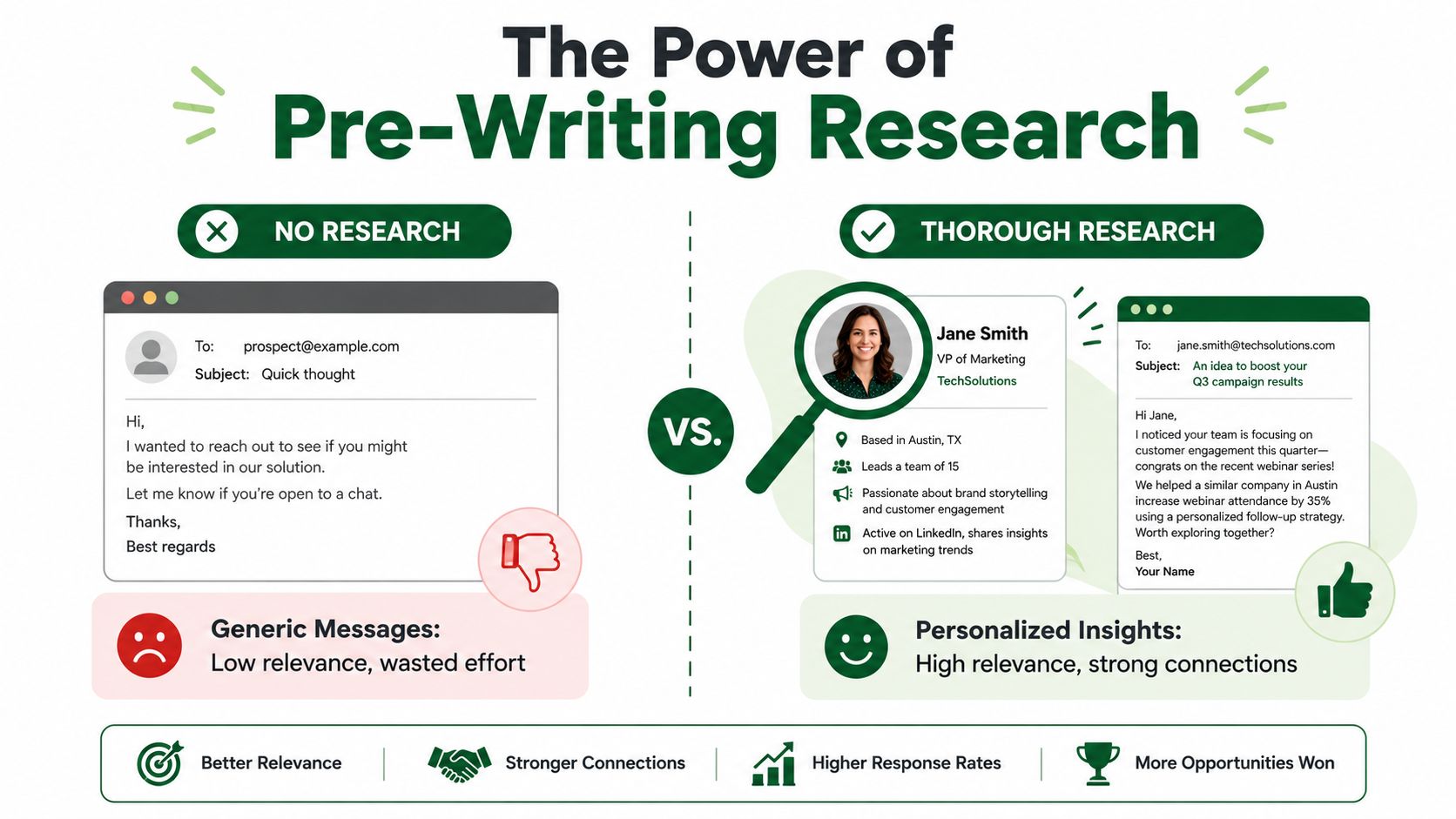
Weak personalization vs real relevance
Weak personalization is cosmetic. It mentions a company name, a job title, or a homepage slogan. It sounds custom at first glance, but it doesn't change the substance of the pitch.
Real relevance comes from buying signals or credible timing signals. Examples include:
- Hiring signals like a new role opening that suggests a team priority
- Leadership changes that often trigger process reviews
- New product motion that creates urgency around pipeline, onboarding, or enablement
- Recent content activity that reveals language, priorities, and positioning
- Operational clues such as partner announcements, category moves, or expansion into a new segment
A job post for enterprise AEs is useful because it says something concrete. It can support a “why now” message. “Saw you're hiring enterprise reps” is still weak on its own. “Saw you're hiring enterprise reps in multiple markets, which usually means messaging consistency becomes a bottleneck fast” is closer to relevance.
Good research gives the rep a reason to contact this buyer now, not just a reason to mention their company.
A practical research checklist
Before writing, pressure-test each account against a simple checklist:
What changed recently
Find one trigger that makes the outreach timely.What problem likely follows from that change
Translate the signal into operational pain, not abstract opportunity.Who owns that problem
Match the angle to the right persona. Don't send the same email to sales, marketing, and RevOps.What proof point or observation can you use
Use something specific enough to sound earned.What is the lowest-friction next step
The ask should fit the context. Most first emails shouldn't try to close a deal.
This is also where deliverability starts. Streak's cold email guidance stresses a deliverability-first approach that includes verified lists, warmed-up accounts, accurate sender identity, unsubscribe links, and avoiding deceptive subject lines. That matters because a well-researched list isn't just better for relevance. It's part of staying out of the spam folder.
If your team is still researching one prospect at a time, the bottleneck isn't effort. It's workflow. That's why sales and RevOps teams increasingly invest in systems that centralize account research, preserve source-backed signals, and standardize what qualifies as a usable hook. If you want more ideas on outbound operations, the PitchSmart blog on prospecting workflows and research systems is worth reviewing alongside your current playbook.
Craft Subject Lines and Openers That Earn the Click
A rep spends 20 minutes researching an account, then sends an email with the subject line “Quick question” and an opener that says “Hope you're well.” The research was fine. The presentation wasted it.
That is the job of the subject line and opener. They have to carry the research you already did. If they look generic, the prospect assumes the rest of the email is generic too.

Subject lines should reduce friction
Strong subject lines are plain on purpose. They read like a real business email, not a copywriting exercise.
Outbound reps often overwork this part. They chase curiosity, force urgency, or try to sound clever. That burns trust before the email even opens. A good subject line does three things: signals relevance, stays easy to scan, and matches the message that follows.
Short usually wins because inboxes are scanned, not studied. Keep it specific enough to place the topic fast.
Examples of low-friction subject lines:
- Hiring enterprise reps
- Question on outbound
- Saw the new launch
- On pipeline coverage
- Idea for onboarding
What to avoid:
- Quick question!!!!!
- 10x your revenue
- You're leaving money on the table
- Thoughts?
- Reaching out
These fail for different reasons. Some look spammy. Some say nothing. Some create a bait-and-switch problem because the body cannot support the promise.
The opener has one job
The first line needs to answer a silent question: why me, and why now?
That answer should come from research, not wordsmithing. If the opener is weak, the issue usually is not writing skill. The issue is that the sender did not find a strong enough signal before writing.
Woodpecker found that cold emails with deeper personalization outperformed broader benchmark averages on reply rate, which matches what strong outbound teams see in practice. Specific context gets attention because it proves the email was built for this account, not pulled from a sequence and lightly edited.
Useful openers usually come from one of three places:
A recent trigger
“Saw you're hiring AEs across two regions.”A likely operational issue tied to that trigger
“That usually creates ramp inconsistency and messaging drift.”A concrete observation about the go-to-market motion
“Looks like your team is pushing upmarket, which often breaks old targeting rules.”
The trade-off is straightforward. The more specific the opener, the more research time it requires. That is why high-performing teams do not ask reps to invent personalization from scratch on every account. They build a research system that surfaces usable signals fast, then write from those signals.
Here's the difference:
| Weak opener | Stronger opener |
|---|---|
| I came across your website | Saw you're expanding the SDR team |
| Love what your company is doing | Noticed your team is targeting larger accounts |
| We help companies like yours grow | That shift usually makes account research harder to keep consistent |
A strong opener also earns the next sentence. Random compliments do not. Neither does fake familiarity. If the first line says one thing and the second line drops into a canned pitch, the prospect feels the handoff immediately.
For a quick visual breakdown of email-first outreach mechanics, this walkthrough is useful:
The practical takeaway is simple. Spend less time polishing clever lines. Spend more time building a repeatable way to find timely, specific reasons to reach out. Better subject lines and openers usually start upstream, with better research.
Structure the Email Body for Clarity and Action
A prospect opens your email on a phone, scans it for six seconds, and asks one question. Is this relevant enough to answer?
The body has one job. Move that prospect from a specific observation to a low-effort next step. Anything that slows that path hurts reply rate. Long intros, company history, and feature tours are where reps waste time and lose deals.
The strongest bodies usually follow a simple sequence:
Observation
Start with the account signal you found in research.Implication
Connect that signal to a likely bottleneck, risk, or missed opportunity.Value statement
Explain how you help with that exact issue.Low-friction CTA
Ask for a small reply, not a big commitment.
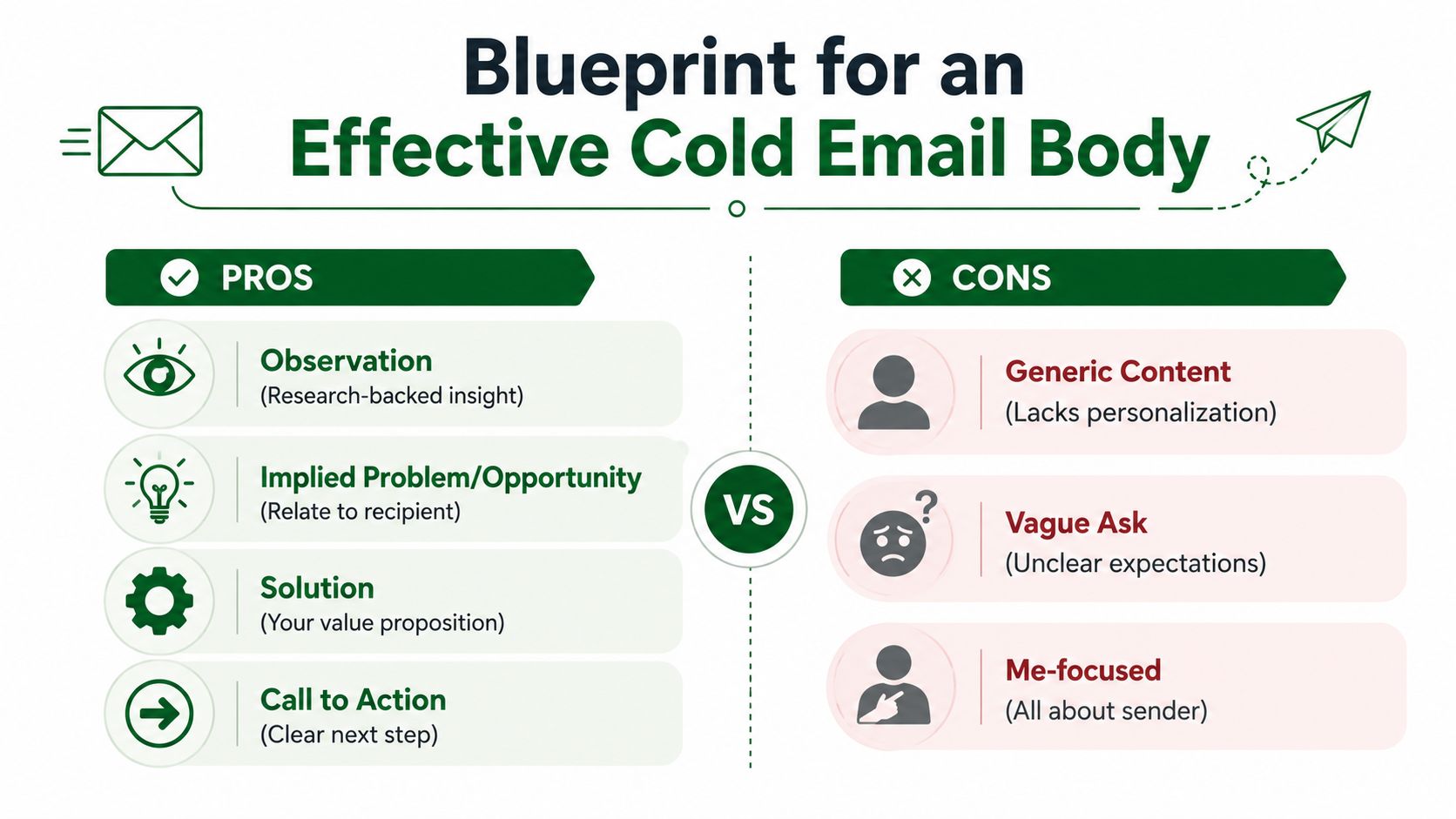
That structure works because it gives you enough room to sound informed without turning the note into a pitch deck. Earlier benchmarks in this guide made the same point. Shorter is not always better. Clearer is better. The goal is to spend your word count on relevance.
Here is a practical template:
Noticed your team is hiring outbound reps for a new segment.
That usually creates a speed problem. Reps need account context fast or personalization quality slips.
We help teams turn prospect research into usable outreach angles without the tab-switching.
Worth comparing notes next week?
The difference is not copywriting talent. It is input quality. If research gives you a real signal, the body almost writes itself. If research is weak, reps start stuffing the email with generic benefits and social proof to cover the gap.
Keep the body tight, but do not strip out the part that proves relevance. Saleshandy and Martal both support the same practical range. Enough words to establish context and value, then stop. Once you cross into brochure territory, reply rates fall because the buyer has to do too much reading before they know why you reached out.
What to cut before you send
Cut anything that does not help the prospect decide whether a reply is worth it.
- Company biography. Buyers do not care in a first touch.
- Feature lists. Features belong after interest, not before it.
- Hard-close language. Asking for a purchase decision in email one is poor judgment.
- Generic credibility filler. “Trusted by leading companies” says almost nothing.
- Multiple asks. One CTA is enough.
Martal's B2B benchmark roundup also supports a disciplined approach to length. Mid-length emails tend to perform better than bloated ones, and very long emails usually lose the reader before the ask. That is the trade-off reps need to understand. Brevity matters, but empty brevity does not convert.
A good body reads like a sharp internal note. Specific. Controlled. Easy to answer.
Persona fit matters too. A VP of Sales may care about rep output, pipeline coverage, or time lost to bad targeting. A RevOps lead may care about segmentation logic, data quality, and process consistency. Same company, different reason to reply. If the body does not reflect that, the problem is not writing. The problem is that your research system did not surface persona-specific context.
Design Follow-Up Sequences That Add Value
The problem isn't a first-email problem. It's a sequence problem.
They send one decent email, then follow it with “just bumping this” and “wanted to circle back.” Those messages don't add information, don't sharpen the angle, and don't give the prospect a better reason to respond.
Stop sending bump emails
A bump email is what reps send when they ran out of ideas. Buyers know it. It signals low effort.
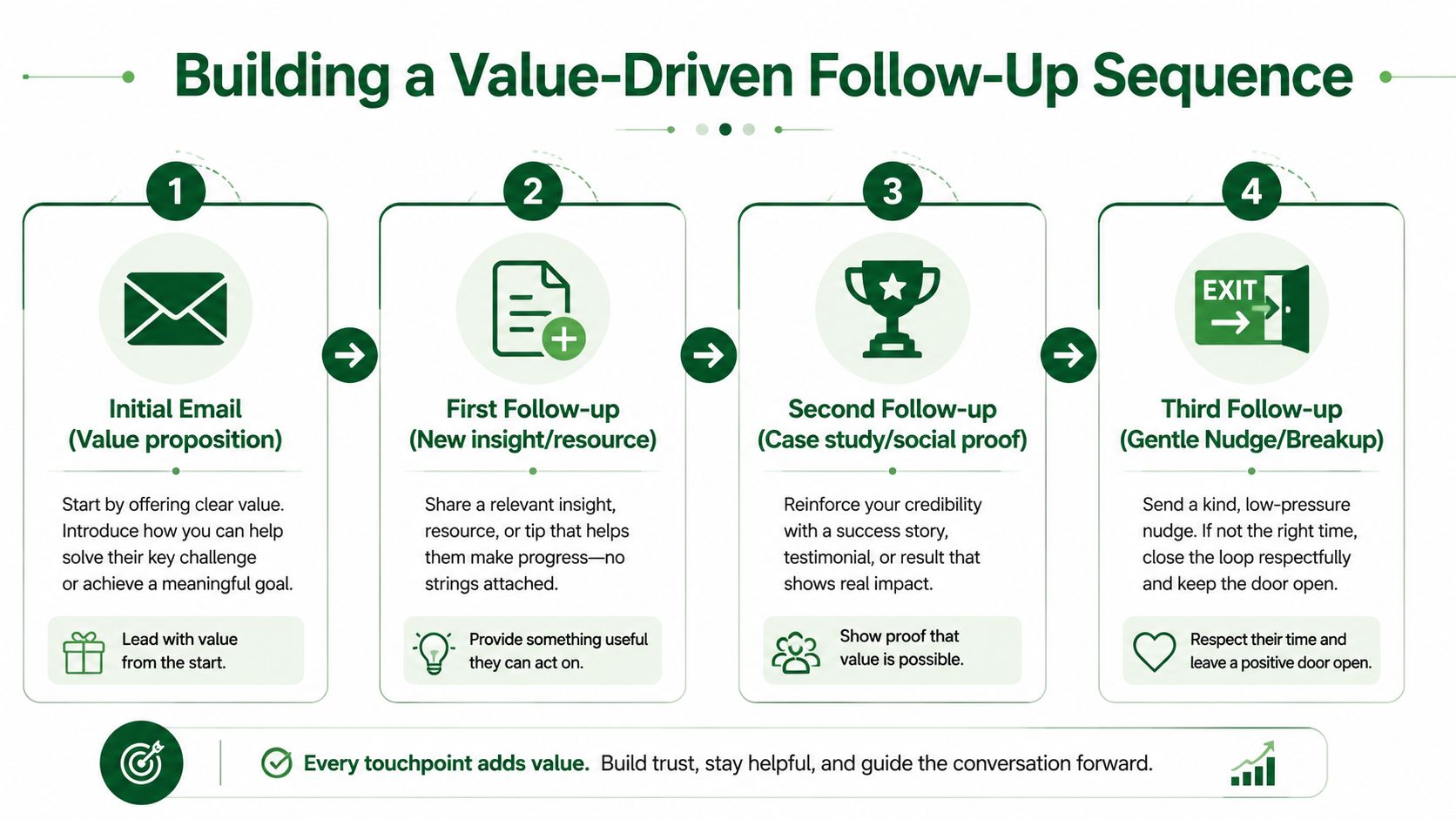
The better approach is to treat each touch as its own attempt to earn relevance. The first email might focus on one trigger. The second should not merely restate it. It should introduce a different angle, a different pain point, or a different offer framing.
This creator-focused guide on follow-up strategy makes that point well. Effective follow-ups should introduce a new angle, pain point, or offer framing rather than repeating the same pitch. It also suggests treating each segment like a mini-campaign and using non-response as a sign that the offer, not just the copy, may need to change.
Build each touch around a new angle
Here's a cleaner way to think about a sequence:
| Touch | Angle | Purpose |
|---|---|---|
| First email | Timely trigger | Establish relevance |
| Follow-up one | Different pain point | Expand the case |
| Follow-up two | Different stakeholder lens | Reframe the value |
| Final touch | Soft exit or simple close | Create a low-pressure response path |
That means your sequence should be fed by multiple pieces of research, not one recycled observation.
A strong pattern looks like this:
- Touch one ties outreach to a timely signal, such as a hiring move or segment shift.
- Touch two references a different operational consequence, such as inconsistent messaging or poor list prioritization.
- Touch three shifts perspective. For example, from seller productivity to RevOps standardization.
- Final touch makes it easy to say “not now,” “not me,” or “send details.”
Non-response is feedback. Sometimes the copy is weak. Sometimes the angle is wrong.
If you're serious about how to write cold emails that book meetings, stop thinking in single messages. Think in campaigns. The follow-up isn't a reminder. It's another shot with a different hypothesis.
Measure Performance and Protect Your Deliverability
A lot of teams still judge cold email by opens and clicks first. That's backward.
Open rates can tell you something about inbox placement and subject line appeal, but they don't tell you whether the campaign is creating pipeline. The actual scoreboard is farther down the funnel.
Track sales outcomes, not vanity metrics
At a minimum, track:
- Reply rate. This tells you whether the message is resonating enough to start conversations.
- Positive reply rate. Much better than counting every response equally.
- Meetings booked. The outcome organizations prioritize.
- Lead-to-meeting quality. If weak-fit accounts book and churn out, the targeting is off.
Also pay attention to contact strategy. Martal's B2B cold email benchmarks report that emailing 1 to 2 contacts per company yields significantly higher reply rates than blasting 10 or more contacts. That's a useful corrective for teams that confuse volume with coverage. Tight account selection and smart contact mapping usually beat carpet bombing.
Deliverability starts before the first send
Protecting deliverability isn't a technical footnote. It's part of writing effective cold email.
Use verified lists. Make sure sender identity is accurate. Warm up accounts before pushing volume. Include unsubscribe language. Avoid deceptive subject lines and spammy phrasing. Those are basic controls, but a lot of teams skip them, then blame copy when campaigns underperform.
There's also a governance angle here. Sales teams need clean handling of prospect data, clear ownership, and transparent workflow standards. If your team is reviewing vendor practices or building internal policies, PitchSmart's privacy documentation and data handling overview is the kind of operational reference RevOps teams should expect from any research platform they use.
The bigger point is simple. Better targeting helps deliverability because relevant outreach gets better engagement and fewer spam complaints. Good writing matters, but list quality and research quality protect the whole system.
Move from Manual Grind to Intelligent Outreach
The old model of outbound asks reps to do everything by hand. Build the list, research each account, guess at the angle, write the sequence, update the CRM, then repeat. That's how teams waste selling time and still end up sending forgettable emails.
The better model is research-first. Find real signals. Segment tightly. Write from context. Build follow-ups that add value. Measure replies and meetings, not just activity.
If your team is stuck in manual prospecting, PitchSmart is built for exactly that bottleneck. It helps outbound teams turn uploaded lists and CRM records into bulk, source-backed research, activity-based hooks, segmented outreach angles, and automated multi-step sequences without the usual tab chaos.
If your reps are spending more time researching than selling, it's time to replace manual prospecting with a system. PitchSmart helps outbound teams research leads in bulk, surface signal-backed conversation hooks, and turn those insights into personalized email and LinkedIn sequences. Start with the free trial and see what intelligent outreach looks like when the research is already done.