Most advice on how to research companies is built for static list building, not for live pipeline generation. That's the problem. Reps still burn time checking profiles, copying notes into spreadsheets, and writing outreach from stale data while real buying windows open and close in the background.
The cost is obvious. Outbound teams spend roughly 70% of their day on manual research and data entry, and guides that stop at static account data leave teams with a 40% lower response rate compared to signal-backed outreach. If your process depends on one rep opening ten tabs per account, your bottleneck isn't list size. It's research throughput.
Company research is also far from a side task. The U.S. Company Research Services industry was projected to reach $2.1 billion in 2026, with 208 businesses operating in the industry in 2025, and IBISWorld reports 2.2% CAGR in the five years to 2023 for the category, according to IBISWorld's industry overview. Serious teams already treat company intelligence like an operating function. Sales teams should too.
Stop Wasting Time on Manual Sales Research
Manual company research feels responsible. It also wrecks outbound velocity.
A rep opens LinkedIn, checks the company site, scans a funding database, reads a blog post, looks for hiring activity, checks recent news, then tries to stitch that into an email that sounds relevant. Do that across a target list and the day disappears before the rep has started enough conversations.
The bigger issue is quality, not just speed. Teams often confuse static profile data with buying context. Company size, industry, location, and headline funding status matter, but they don't tell you whether the account is likely to engage now. A clean ICP match with no trigger is often a slow account. A decent fit with active change inside the business is often the better bet.
Manual research usually fails in one of two ways. It's either too shallow to be useful or too slow to scale.
That's why most generic outbound underperforms. The message isn't wrong because the copy is bad. It's wrong because the timing is off, the angle is generic, and the rep is personalizing around trivia instead of business motion.
A better approach is to rank research by decision value. First confirm fit. Then find the people tied to the problem. Then prioritize live signals that suggest urgency, budget movement, process change, or initiative ownership. That's how you move from “this looks like a company we sell to” to “this looks like a company we should contact this week.”
For teams trying to fix the process, the difference isn't another browser tab. It's a workflow that turns signal discovery into outreach inputs fast enough to matter. That's the operational gap platforms like PitchSmart for outbound lead research and sequencing are built around: bulk account research, activity-based hooks, list segmentation by buying signals, and automated sequences seeded from the strongest research angles.
Tier 1 foundational fit
The first mistake reps make is over-researching bad accounts. Foundational fit is a filter, not the finish line.
Check the basics quickly:
- Commercial fit: Industry, geography, business model, and likely deal shape.
- Operational fit: Team structure, sales motion, customer segment, and whether your offer matches how they buy.
- Environment fit: Tech stack, compliance constraints, or channel strategy if those affect implementation.
If the account fails here, move on. Don't write a clever email to a company that shouldn't be in the sequence.
Tier 2 people and power
A company doesn't buy. Specific people do, and they buy for different reasons.
Research here should answer three questions:
- Who owns the problem
- Who feels the pain first
- Who can block or accelerate the process
That usually means separating executive sponsorship from operational ownership. The VP may care about pipeline efficiency. The manager may care about workflow friction. The rep may care about admin load. Good research maps all three.
Tier 3 actionable signals
At this stage, most outbound teams either win timing or waste a week.
Signals are events, patterns, and behavioral clues that change the odds of a response. New leadership, hiring shifts, a product launch, territory expansion, a pricing move, an integration push, heavy content around one theme, or a sudden change in the company's messaging can all matter. The point isn't to collect every signal. It's to identify the few that create a believable reason to reach out now.
The Modern Sales Research Framework
Good company research should feel more like triage than homework. You don't need every fact. You need the right facts in the right order.
The reason this matters is scale. As noted earlier, company research already supports a mature professional market. The work itself sits on top of huge data systems. A university business research guide notes that the World Bank tracks more than 575 socio-economic indicators across 220+ countries and 18 regional/income groups, while another major statistics portal aggregates data from over 22,500 sources on 60,000+ topics. The same guide also notes that business databases can include financials, leadership structure, competitors, trends, forecasts, and access to millions of company profiles, reports, and SWOT analyses, according to the University of Oregon business statistics guide. That's why random browsing doesn't hold up. The source universe is too large.
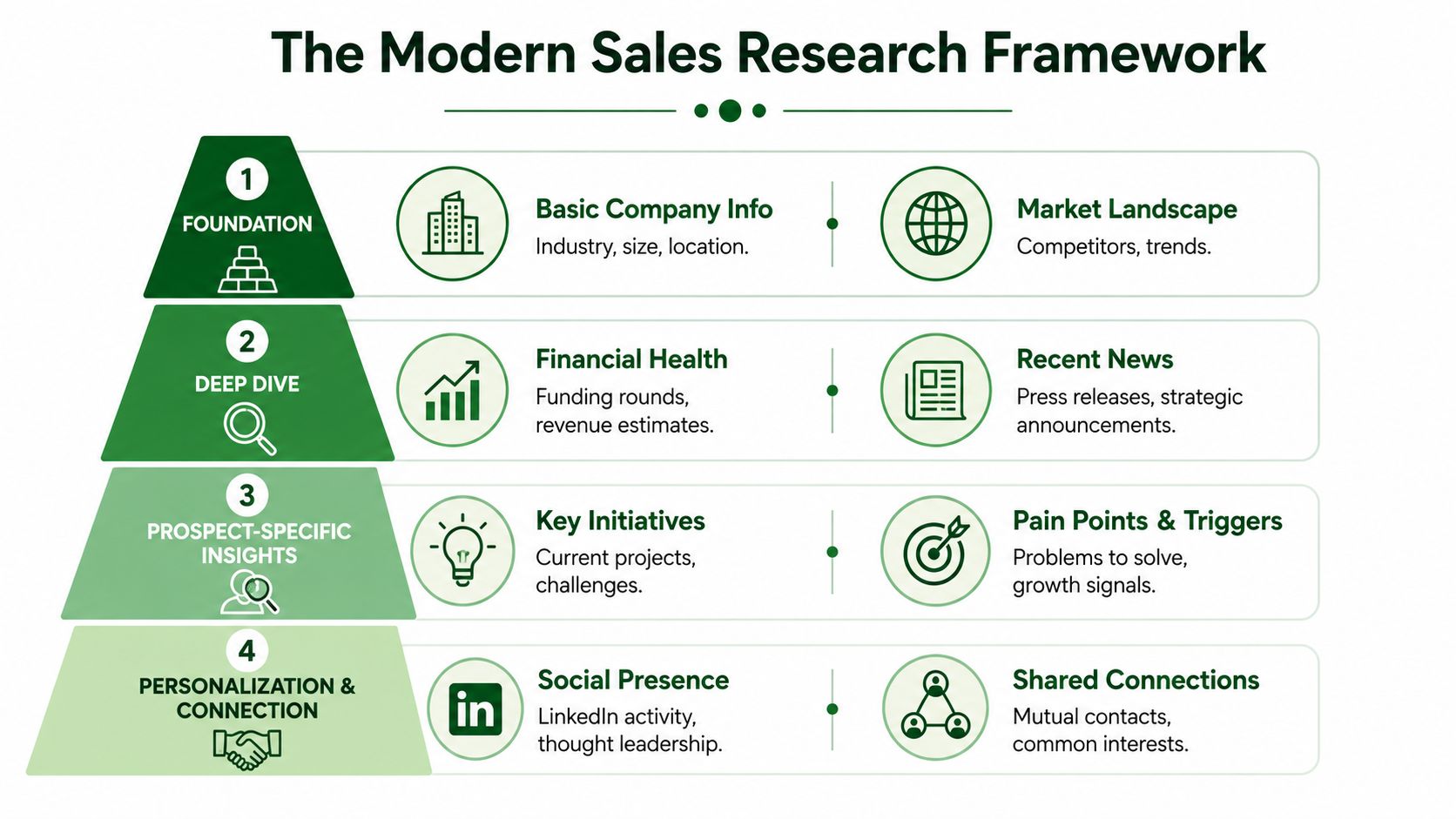
Tier 1 foundational fit
Use this tier to decide whether the account belongs in your working set.
A practical check looks like this:
| Question | What you're looking for | Why it matters |
|---|---|---|
| Does the company resemble past wins? | Similar operating model, segment, motion | Reduces time spent on bad-fit accounts |
| Can you explain the business in one sentence? | Clear value chain and buyer relevance | If you can't, your email won't land |
| Is there a visible business context? | Market pressure, expansion, or transformation | Gives future research a useful frame |
This tier should be fast. If reps spend too long here, they're usually avoiding the harder work of finding a trigger.
Tier 2 people and power
Most bad outreach fails because the rep picked a title, not a stakeholder.
Look for patterns, not just names:
- Role adjacency: The most responsive contact isn't always the most senior one. Sometimes the person next to the budget holder has the clearest day-to-day pain.
- Change exposure: New leaders, promoted operators, and recently expanded teams often have more incentive to evaluate new processes.
- Cross-functional reach: If the problem touches sales, marketing, ops, or customer teams, map more than one function before messaging.
A named decision-maker is not the same thing as a reachable buyer.
Tier 3 actionable signals
Signals tell you when fit becomes priority. That's the point where research becomes revenue work.
Look for three classes of signals:
Strategic signals
Company-wide moves such as repositioning, market expansion, new partnerships, or leadership changes.Operational signals
Hiring patterns, process redesign, tool adoption, territory shifts, or an obvious push to improve execution.Behavioral signals
What the company is doing right now in public view, including content focus, campaign themes, page updates, executive posting patterns, and other recent activity.
Signals matter most when they line up. A company adding headcount, publishing content around a pain area, and changing its go-to-market narrative is more interesting than a company that only checks one box.
Your Source-by-Source Research Playbook
The manual version of how to research companies isn't complicated. It's just time-consuming, and it's often done inconsistently. The fix is to use each source for a specific job instead of asking every source to answer every question.
LinkedIn and org mapping
LinkedIn is useful, but only if you stop treating it like a contact directory.
Use it to interpret movement:
- Track role progression: If a leader recently stepped into a larger scope, they may be reworking process, headcount, or tooling.
- Read the team shape: A company with layered leadership in sales, ops, and enablement behaves differently from one where one person owns everything.
- Check post themes, not just activity: If executives and managers keep returning to the same topic, that often points to an active initiative or recurring pain.
Look sideways too. If the obvious buyer is quiet, adjacent operators often reveal more through their profile history and posting behavior.
Company website and owned media
The company's own site is where positioning changes show up first.
Focus on pages that reveal priorities:
- Homepage and product pages: Messaging shifts can signal a move upmarket, new segments, or new problem framing.
- Press and blog pages: Announcements often reveal what the company wants the market to notice right now.
- Customer stories: These tell you who they want more of. If the examples suddenly cluster around a segment, that matters.
A lot of reps skim these pages for one line they can quote. That's weak personalization. Instead, compare what the company says about itself across pages. Inconsistency often points to change in progress.
Career pages and hiring patterns
Career pages are one of the cleanest windows into company intent.
Look for role clusters, not isolated listings:
- Repeated hiring in one function: That usually signals a strategic build, not just routine backfill.
- Operational titles appearing for the first time: New ops, analytics, enablement, or systems roles often indicate process maturity work.
- Regional hiring: Expansion into a new geography can create fresh workflow, tooling, and reporting needs.
Hiring data is especially useful because it's hard to fake. Companies may polish positioning, but they still have to recruit for what they're trying to build.
Funding databases and market context
Crunchbase and similar tools are useful, but they shouldn't drive your whole research process.
Use them for context, not messaging. Funding, acquisitions, and leadership changes help explain what might be happening inside the account, but they don't automatically create a good opening line. The stronger move is to combine market context with a more immediate operational signal.
If you're building a repeatable research process, the detailed workflow examples on the PitchSmart blog for sales research and outbound operations are useful because they connect account signals to practical outreach execution rather than stopping at data collection.
If your research source can only tell you what was true last quarter, don't let it decide who gets contacted today.
Turning Raw Data into Actionable Insights
Raw facts don't book meetings. A point of view does.
That starts with one discipline many reps skip: define the decision first. Guidance on expert research recommends starting with the decision you need to make, then working backward to the intelligence required, the raw data needed, and the mix of secondary research and primary expert input, as outlined in GLG's guidance on effective expert interviews. In sales terms, the decision usually isn't “What can I learn about this company?” It's “Should this account be prioritized now, and what angle gives me a reason to start the conversation?”
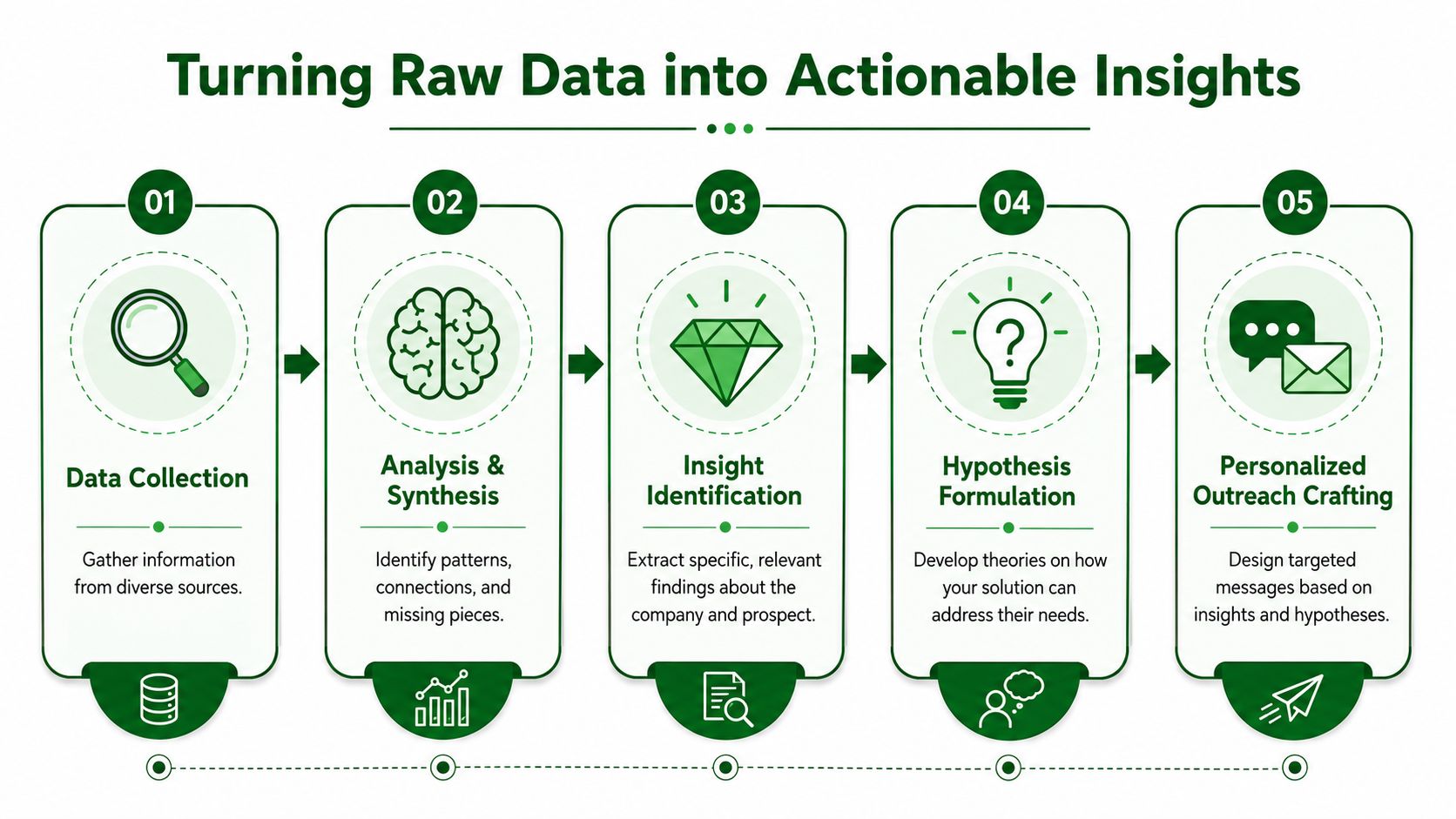
Start with the decision
Before you write a note or score an account, answer these:
- Is this account a fit now, later, or never
- What changed recently
- Who is closest to the likely pain
- What evidence supports that view
That keeps you from turning research into trivia collection.
Build an account hypothesis
An account hypothesis is a short, testable explanation of why this company may care. It should connect company motion to operational pain and then to your value.
A simple model works well:
| Input | Example of what you found | What it might mean |
|---|---|---|
| Company motion | Hiring in revenue operations | Process complexity is increasing |
| Team signal | New manager in outbound | Execution standards may be changing |
| Public activity | Messaging around pipeline efficiency | Performance pressure is visible |
Now turn that into a working hypothesis: the team is trying to improve outbound execution while headcount and process complexity rise.
That's enough to write with relevance.
Write hooks that sound informed
Good hooks don't summarize your research. They apply it.
Try structures like these:
Observed change plus implication
“Noticed the team is building more structure around outbound. That usually creates pressure around research consistency and rep time.”Strategic move plus execution gap
“Saw the push into a broader market narrative. Teams usually feel that shift first in segmentation and prospecting quality.”Hiring pattern plus problem framing
“You're adding roles that tend to increase handoffs across sales and ops. That often exposes where account research is still too manual.”
Don't overload the first message. One strong signal is enough if the implication is clear.
How to Automate Research and Scale Outreach
The manual process works for a handful of named accounts. It breaks when the team needs consistent research across a market segment, multiple territories, or a large imported list.
The biggest reason to automate isn't convenience. It's data decay and inconsistency. Most beginner guides ignore source transparency and bias auditing, and a meaningful share of contact data in major databases becomes invalid quickly. The commonly cited issue is that 30% of contact data in major databases becomes invalid within 90 days. If your reps are pulling from stale sources, they're not just wasting time. They're building sequences on top of bad assumptions.
What automation should actually replace
Automation should take over the repetitive parts of research that don't require seller judgment:
- Bulk account enrichment: Pulling core company context across an uploaded list.
- Signal collection: Surfacing recent public triggers and tying them back to original sources.
- Segmentation: Grouping accounts by fit, urgency, or trigger type.
- Sequence seeding: Turning the best signals into first-draft hooks for email and LinkedIn outreach.
That's where a tool like PitchSmart fits cleanly. It lets teams upload a list or pull from a CRM, research accounts in parallel, tie qualifiers and signals back to sources, score prospects, and generate signal-backed outreach plans. For RevOps, the value is standardization. For reps, the value is fewer tabs and less copy-paste.
After that baseline, operator judgment still matters. Automation can surface a hiring pattern. It can't decide whether that pattern supports a stronger ops angle, leadership angle, or process angle for a specific stakeholder.
Where automation still needs operator judgment
Treat automation as a force multiplier, not a substitute for thinking.
Use human review for:
- Message selection: Pick the one signal that creates urgency without sounding forced.
- Stakeholder matching: Align the trigger to the person most likely to care.
- Bias checks: Verify that the source is recent, attributable, and relevant.
A quick product walkthrough helps if you want to see what this operationally looks like inside a real workflow:
The practical standard is simple. Automate research gathering, ranking, and first-draft synthesis. Keep judgment on prioritization and message quality with the seller or manager.
Your Quick-Start Checklist and Ethical Guardrails
Most reps don't need another giant framework. They need a repeatable routine they can run before the next prospecting block.
A fast daily routine for reps
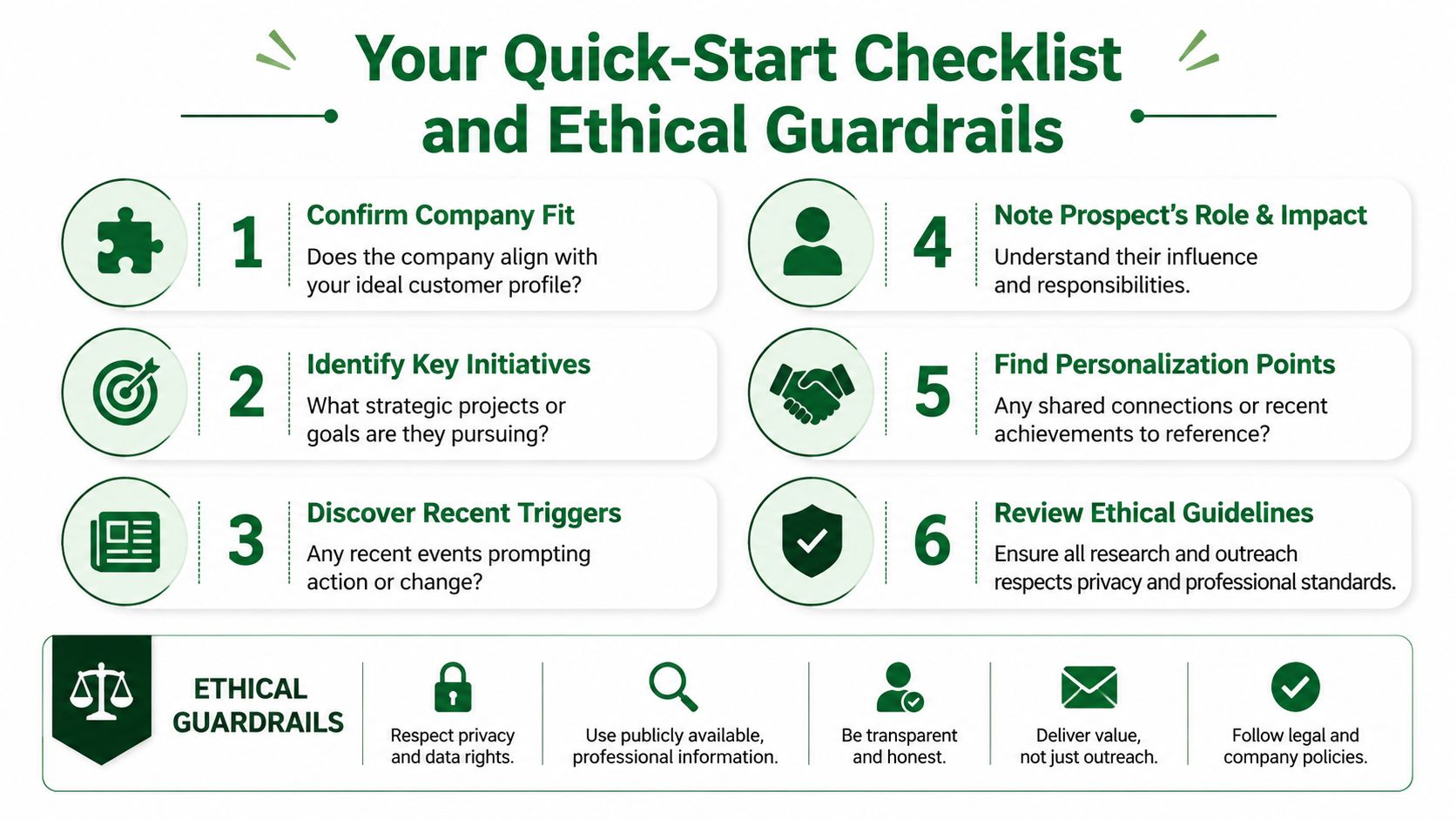
Use this checklist on every target account:
- Confirm fit first: Make sure the company matches your ICP well enough to justify deeper work.
- Find one active initiative: Look for a visible business priority, not just a static company descriptor.
- Identify a fresh trigger: Focus on recent change, movement, or public activity.
- Map one primary stakeholder and one adjacent contact: Don't rely on a single title guess.
- Draft one hypothesis: Explain why the account may care now.
- Write one opening line from the hypothesis: Don't paste facts. Interpret them.
This keeps research lean and useful. If a rep can't get to a clear hypothesis quickly, the account usually isn't ready for attention yet.
Ethical rules that keep research usable
Research quality depends on method quality. Expert guidance says credible research techniques should be testable, peer-reviewed where possible, accompanied by a known or estimable error rate, governed by clear operating standards, and broadly accepted in the field, according to Expert Institute's guidance on reliable methodology. In practical outbound work, that means validating claims across independent sources, checking legitimacy, and not treating every data vendor as neutral.
Use a few guardrails:
- Prefer business relevance over personal detail: Mention company initiatives, role context, and public activity. Skip anything that feels invasive.
- Audit freshness: If you can't tell when a data point was captured, treat it carefully.
- Check source transparency: If a tool can't show where a claim came from, verify it elsewhere.
- Respect privacy controls: Teams should understand how prospect data is handled and reviewed. PitchSmart documents that in its privacy policy and data handling page.
The goal of research isn't to prove you found information. It's to start a relevant business conversation without crossing professional boundaries.
If your team wants to apply this workflow without burning hours on tabs, spreadsheets, and one-by-one account checks, PitchSmart is built for that operating model. You can upload a list, run parallel research across accounts, surface signal-backed hooks, segment by buying signals, and turn the strongest findings into automated outreach sequences without rebuilding your process around a rented database.