
A new rep gets hired, everyone feels good for a week, and then the calendar fills with product decks, login links, and half-finished shadowing. By the third week, that rep is often spending most of the day on manual account research, generic outreach drafts, and dead-end follow-up, which leaves very little time for real selling. In a multi-product company, that problem gets worse fast because the rep isn't just learning how to sell, they're also trying to figure out which solution fits which account and when to pull in another line.
The Onboarding Problem Most Teams Ignore

The weakest onboarding programs usually fail in the same place. They hand a new rep access to the CRM, a folder full of product PDFs, and a vague instruction to start building pipeline, then act surprised when the rep burns hours trying to research accounts by hand and writes the kind of outreach every buyer ignores.
That isn't a small inefficiency. It's the start of a broken ramp.
The baseline tells the story. Industry summaries citing the Sales Management Association put the average new sales hire at 10 weeks in training and 11.2 months before productivity, while Training Industry's cited research says it typically takes 381 days for new salespeople to reach tenured-rep performance, as summarized in this benchmark roundup: onboarding sales rep productivity benchmarks. In other words, onboarding isn't a quick orientation, it's a long operating system.
Why the first month matters more than the first demo
Formal onboarding changes the curve. In the same benchmark set, 60.7% of reps in companies with formal onboarding reached full productivity within six months, compared with 42.8% in companies without formal onboarding, and 85% versus 67.8% by eleven months, according to the same source above. That gap is what managers feel as quota delay, pipeline inconsistency, and too much time spent rescuing new hires instead of coaching them.
Practical rule: if a rep is still figuring out basics in week three, they're not “moving slowly,” they're being asked to do live work before the system has built enough skill.
For multi-product teams, the pain is sharper because a generic ramp doesn't teach judgment. A rep can memorize product facts and still miss which line to lead with, which signal matters, or when to stop forcing a single-solution pitch into an account that clearly needs a broader conversation. Onboarding problem is not content volume, it's sequencing.
Pre-boarding Setup and First Week Foundation
The first mistake is assuming onboarding starts on day one. It doesn't. If a rep shows up without access, a schedule, a mentor, and a clear learning path, they spend the first week solving admin problems instead of learning how your team sells.
What to prepare before the rep arrives
A strong pre-boarding pack should be simple, specific, and already waiting in the rep's inbox. Best-practice guidance says objectives should be set before the hire begins and should include a clear checkpoint system, plus a prep pack with an org chart and a primer on the sales structure, as outlined by the PPAI onboarding guide. That gives the rep context before they're asked to absorb product detail.
The practical checklist is straightforward:
- System access: confirm CRM, sales tools, product docs, and internal systems are live before day one.
- Mentor assignment: pair the rep with a strong performer who can answer basic questions and model live execution.
- Week-one schedule: send a day-by-day calendar in advance so there's no uncertainty about what happens next.
- Company context: include mission, values, org structure, and the sales motion.
- Product map: make sure the rep sees the full portfolio, not just their immediate lane.
The first seven days should stay focused on orientation, not live pressure. A useful rule from B2B onboarding planning is to keep the first 30 days learning-only, covering company and market orientation, product training across problem-solution-feature-differentiation layers, ICP and persona work, and CRM proficiency, before moving into shadowing, objection handling, and certification, as described in this sales onboarding guide.
A day-one agenda that doesn't overload people
Day one should answer three questions, where do I fit, what do we sell, and how does the team work. Keep it practical, not inspirational. If the rep understands the sales structure, sees the org chart, and can find their way around the core tools by the end of the first week, you've removed the friction that usually gets mistaken for poor ramp performance.
The first week should reduce uncertainty, not create it.
That's especially important in acquisition-heavy environments. When a company has multiple product lines and inherited sales motions, the new rep needs to see how the portfolio fits together before anyone asks for pipeline.
First Week Onboarding Checklist
| Timing | Action | Owner |
|---|---|---|
| Before day one | Confirm CRM and core tool access | Manager and RevOps |
| Before day one | Assign mentor or shadow partner | Sales leader |
| Before day one | Send week-one calendar and prep pack | Enablement |
| Day one | Review org chart and sales structure | Manager |
| Day one | Walk through product portfolio and buyer segments | Enablement |
| Day two | Hands-on CRM navigation and data hygiene basics | Manager or RevOps |
| Day three | Review ICPs, personas, and qualification criteria | Manager |
| Day four | Shadow a live call or demo | Mentor |
| Day five | Check understanding and confirm next-stage readiness | Manager |
Week-by-Week Training Framework and Tools
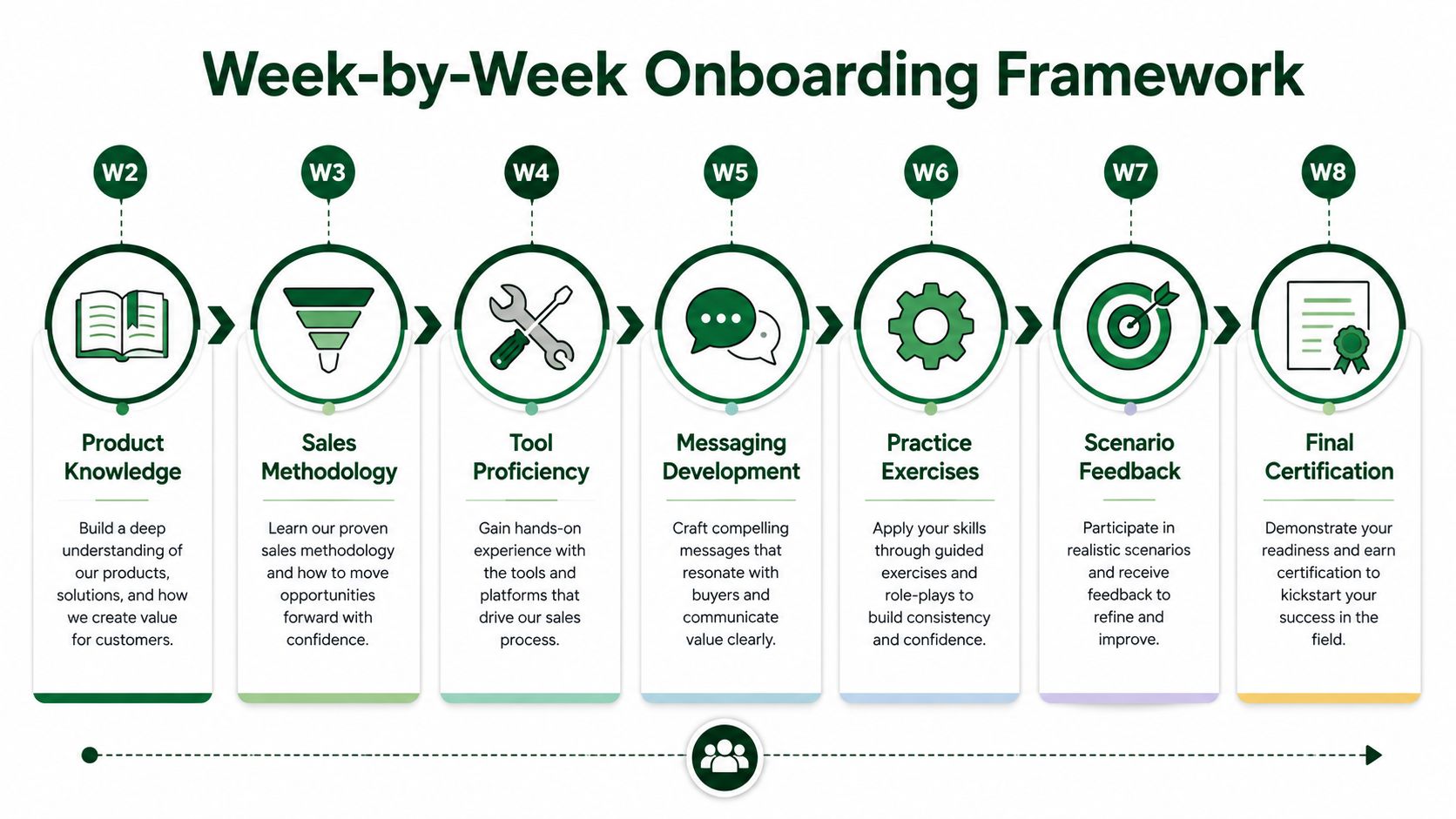
The middle of onboarding is where teams get sloppy. They either front-load everything and overwhelm the rep, or they stretch training so long that nothing feels connected to actual selling. A better approach is a week-by-week progression that maps knowledge to behaviors in the order reps need them.
Weeks two through eight should build in layers
Week two should deepen product knowledge and ICP understanding. Reps need to know not only what each product does, but which customer problem it solves, where it fits in the buying conversation, and how it differs from the rest of the portfolio. That matters in multi-product companies because the rep has to recognize when a single product is enough and when the account calls for a broader motion.
Week three should introduce CRM workflow and pipeline hygiene. By then, the rep has enough context to understand why stage discipline matters, how activity is recorded, and where forecasts get distorted when data is sloppy. Week four is the right time for competitive positioning and messaging, because the rep can finally connect product truth to buyer language.
Week five should introduce outreach sequencing, but not as a standalone writing exercise. Reps should learn how a signal maps to an opener, how one buying clue changes the angle of a message, and when a cross-sell conversation is more appropriate than a first-touch pitch. That's where PitchSmart's blog fits naturally as a source of practical outbound ideas.
Weeks six through eight should shift into live selling with coaching reinforcement. The point isn't more classroom time. It's repetition under realistic conditions.
How multi-product teams should handle cross-sell readiness
Don't expect a new rep to sell every line on day one. They should understand the portfolio, know the routing rules, and be able to say when an account signal belongs to another solution or another specialist. That's a readiness standard, not a quota target.
Useful standard: if the rep can't explain why one solution is the right entry point, they're not ready to improvise across the full portfolio.
This is also where outbound research becomes a ramp accelerator instead of a manual time sink. Teams that research accounts against the specific products they sell can teach reps faster because the account context already points to the right motion. For research-heavy outbound teams, that removes the blank-page problem before it turns into a week of generic emails.
Week-by-Week Training Progression
| Week | Focus Area | Expected Outcome |
|---|---|---|
| Week 2 | Product knowledge and ICP depth | Rep can explain core value and buyer fit |
| Week 3 | CRM and pipeline workflow | Rep can record activity and manage stages |
| Week 4 | Competitive positioning and messaging | Rep can handle basic market comparisons |
| Week 5 | Outreach sequencing | Rep can connect signals to opener strategy |
| Week 6 | Practice exercises | Rep can repeat key motions with feedback |
| Week 7 | Scenario feedback | Rep can adjust messaging after coaching |
| Week 8 | Final certification | Rep is cleared for broader live execution |
A short, realistic training cadence helps too. In one published rollout, the first month required 8 to 10 hours per week of structured enablement, then 5 to 7 hours in month two and 2 to 3 hours in month three as reps moved into live selling and coaching, according to Cincom's onboarding plan. That taper protects manager bandwidth while keeping reinforcement active.
Role-Playing, Live Practice, and Deal Readiness

The hardest question in onboarding is the one generic guides often skip. When does a new rep get to touch a live deal? If you wait too long, they stall. If you rush too fast, they learn bad habits in front of buyers.
Readiness should be milestone-based, not calendar-based
A rep is ready for more live exposure when they can do specific things without help. Can they ask three discovery questions without prompting, handle a common objection without handing it back to a manager, and map a prospect's signal to the right product in the portfolio? Those are behavior checks, not time checks.
That matters because reps ramp at different speeds. Guidance in this area favors milestone-based progress and low-stakes live involvement over fixed-calendar training, especially when the account context is supported and the learning is tied to actual deals, as noted in Teachable's sales onboarding guidance.
Here's the progression that usually works:
- Recorded call review. The rep learns what strong discovery sounds like.
- Live shadowing. The rep watches how objections are handled in real time.
- Co-sold calls. The rep speaks, but a manager or mentor stays close.
- Independent execution. The rep owns the conversation, with feedback after the call.
The mistake is treating shadowing as a box to check. Shadowing only helps if the debrief is specific. “Good job” doesn't build skill. “You missed the buying trigger on the second objection” does.
Repetition and mentorship are not optional
Multiple onboarding guides recommend pairing the new rep with a strong performer or mentor and using call listening, shadowing, and live observation so they can learn from real conversations, according to AlphaRun's onboarding checklist. Repetition matters too, because one exposure rarely sticks. The practical guidance from enablement teams is to revisit the same material two to four times in the first two to four weeks so the rep can retain and apply it.
Practice should feel close enough to live selling that the first live call isn't the first live lesson.
That standard matters even more in multi-product B2B teams. If the rep walks into a call already knowing which buying signals matter and which products fit the account, the conversation starts with substance instead of guesswork. I've seen that difference more than once, the rep sounds prepared, the manager coaches on nuance, and the buyer doesn't have to sit through a warm-up act.
For teams that want a tighter handoff from practice to live execution, a PitchSmart demo can help standardize how reps rehearse account-specific motions before they own a live conversation.
Measuring Success with KPIs and Coaching Cadence
If onboarding goals are not set before the rep starts, managers end up judging progress by feel. That creates avoidable noise. Onboarding works better when the expectations are visible, the checkpoints are fixed, and the rep knows what “ready” means before the first call.
Build the scorecard before the start date
The strongest onboarding programs define objectives up front and use checkpoints to decide when a rep moves forward. That matches the best-practice guidance in the PPAI guide, which calls for new-hire objectives before day one, clear stage gates, and a prep pack that gives the rep structure and context.
The KPIs should be simple enough to review weekly and specific enough to catch drift early:
- Time to first sale
- Ramp to productivity
- Call quality scores
- Compliance pass rate
- New hire retention
Structured onboarding also pays off in the outcomes revenue leaders care about. Benchmark summaries from Mural point to higher quota attainment, faster ramp, stronger retention, and better productivity when onboarding is standardized. Those are the kinds of results that justify a real coaching system instead of an ad hoc check-in.
Keep coaching frequent, but don't let it eat the manager's week
Weekly one-on-ones make sense through the first 60 days, then biweekly after that. Each meeting should review milestone progress, call quality, pipeline blockers, and the next live behavior the rep needs to prove. If the conversation drifts into generic status updates, the cadence is too loose.
A useful warning sign is manager time. One onboarding framework flags programs that consume more than 40 hours of manager time per rep as candidates for automation. That usually means the process depends too much on manual reminders, scattered notes, and repeat explanations. The fix is tighter structure, not more manager heroics.
If coaching requires heroics every week, the process is broken.
The benchmark examples are useful because they show what good measurement looks like in practice. They point to certification completion within a short window, faster first wins, and reps reaching quota earlier than teams expect when onboarding is tracked from the start. Those figures are not templates, but they do show how specific a program can get once the team defines readiness instead of guessing at it.
For multi-product teams, the scorecard should also cover portfolio mapping and cross-sell readiness. A rep may know the core offer and still miss the right moment to introduce a second product. That is where a portfolio mapping template from PitchSmart helps managers check whether the rep can connect account needs to the right product set before they own the conversation.
The best dashboards do not just report outcomes. They show whether the rep is moving from learning to execution on schedule, whether the manager is coaching the right behavior at the right time, and whether the team has enough evidence to say the rep is ready for live deals.
Templates, Checklists, and the 30-60-90 Day Plan
A useful onboarding plan is one that leaves paper behind. Managers need one timeline, one expectation set, and one place to see whether the rep is learning, selling, and becoming productive in the right order.
A 30-60-90 plan should separate learning from selling
The simplest way to keep the program honest is to define each phase by what the rep must learn, what they must start selling, and what productivity proof you expect.
| Phase | Learning Milestones | Selling Milestones | Productivity Milestones |
|---|---|---|---|
| 30 days | Company, market, product, ICP, tools | Shadowing and guided practice | Tool fluency and basic certification |
| 60 days | Messaging, objections, workflow | Co-sold calls and supported outreach | First meaningful pipeline movement |
| 90 days | Portfolio understanding and refinement | Independent execution on agreed scope | Consistent activity and early quota path |
That structure stops managers from asking for full independence before the rep has earned it. It also gives the rep a concrete picture of what success looks like in each phase.
Use scripts that reflect real cross-sell moments
Cross-sell conversations in multi-product teams usually fail because the rep opens with too much product and too little context. A better opener sounds like this: “You've already shared enough for us to look at a second problem area, can I ask one quick question to see whether that belongs in the current motion or another one?” That keeps the conversation tied to the account, not the rep's quota.
For a prospect showing signals across multiple product lines, the sequence should be signal first, fit second, product last. The rep should say why the timing matters, then connect the issue to one solution, and only then branch into the broader portfolio if the buyer confirms the need.
A practical role-play rubric should score three things, not ten. Did the rep identify the buying signal, did they ask a clean follow-up question, and did they route the account to the right solution or specialist? Anything beyond that becomes noise.
Keep one manager agenda and one pre-boarding checklist
The pre-boarding checklist should cover access, mentor assignment, schedule, org chart, product map, and first-week expectations. The manager agenda should cover milestones, call review, objections heard live, and the next proof point. If every manager uses the same agenda, you remove the variability that turns onboarding into a personality contest.
A good onboarding system doesn't try to make every rep identical. It makes sure every rep gets the same starting conditions, the same ramp logic, and the same standard for readiness.
If you're trying to ramp new reps faster without turning managers into full-time researchers, build the process around account context instead of generic activity. PitchSmart helps teams research what they sell, organize signals by product and buying motion, and turn that context into sharper outbound work. Visit PitchSmart if you want a practical way to connect onboarding, prospect research, and cross-sell readiness in one workflow.