Most articles about the stages of a sales pipeline start in the wrong place. They define prospecting, qualification, demo, proposal, and closing as if the process is clean, sequential, and mostly under control.
It isn't.
Sales reps spend approximately 70% of their workday on non-selling work such as data entry, prospect research, and CRM updates, leaving only 30% for calls and meetings, according to Dock's overview of sales pipeline stages. That single number changes how you should think about pipeline design. The first stage isn't just the top of the funnel. It's the place where most outbound teams lose speed, data quality, and seller capacity before a real conversation even starts.
Traditional guides treat prospecting like a checkbox. In practice, it's a labor problem. Reps bounce between LinkedIn, company sites, funding databases, CRM fields, and inbox drafts, then management wonders why stage conversion is soft and forecasting feels shaky. If the entry point is manual, the rest of the pipeline inherits that drag. Teams that want to fix it need to rethink the stages of sales pipeline management around throughput, signal quality, and enforceable stage exits, not just labels in a CRM.
Your Sales Pipeline Is Broken Before It Even Starts
Most pipeline problems don't begin in proposal or negotiation. They begin much earlier, when reps are expected to build coverage through manual research, one account at a time.
The damage is operational. Reps spend the day compiling lists, checking job titles, validating contact details, scanning for trigger events, updating records, and rewriting generic messaging into something usable. By the time they reach live outreach, the best selling hours are already gone. That's why the top of pipeline can't be treated as admin. It's the production line for every downstream stage.
Manual prospecting creates fake pipeline confidence
A CRM can look full while the pipeline is weak. That's common when stage one is based on list volume instead of researched readiness.
Here's what usually happens:
- Lists get built too broadly. Teams start with static firmographics and call it targeting.
- Outreach starts too early. Messaging goes out before anyone has a reason to contact the account now.
- Qualification becomes reactive. Reps wait for replies instead of entering conversations with a point of view.
- Managers inspect later stages first. They coach demos and proposals while the primary bottleneck sits upstream.
Practical rule: If prospecting is manual, your pipeline stages are documenting delay as much as buyer progress.
The fix isn't to add more pipeline stages. It's to make the earliest stage measurable and strict. A prospect shouldn't move because a rep touched a record. A prospect should move because the account has been researched, segmented, and matched to a valid outreach angle.
The first stage needs a system, not heroics
High-performing teams don't rely on reps to manually discover every hook from scratch. They standardize research inputs, define what qualifies as a buying signal, and reduce the time between list creation and first relevant outreach.
That changes the meaning of pipeline management. Instead of asking whether reps are "working hard enough," RevOps should ask whether the system is producing sales-ready accounts consistently. That's the fundamental top-of-funnel question.
If you're evaluating process changes, the fastest way to see the issue is to compare your current workflow to a platform built for parallel outbound research and signal-backed prospecting. The gap is usually obvious within one team review.
The Traditional Sales Pipeline Stages Reimagined
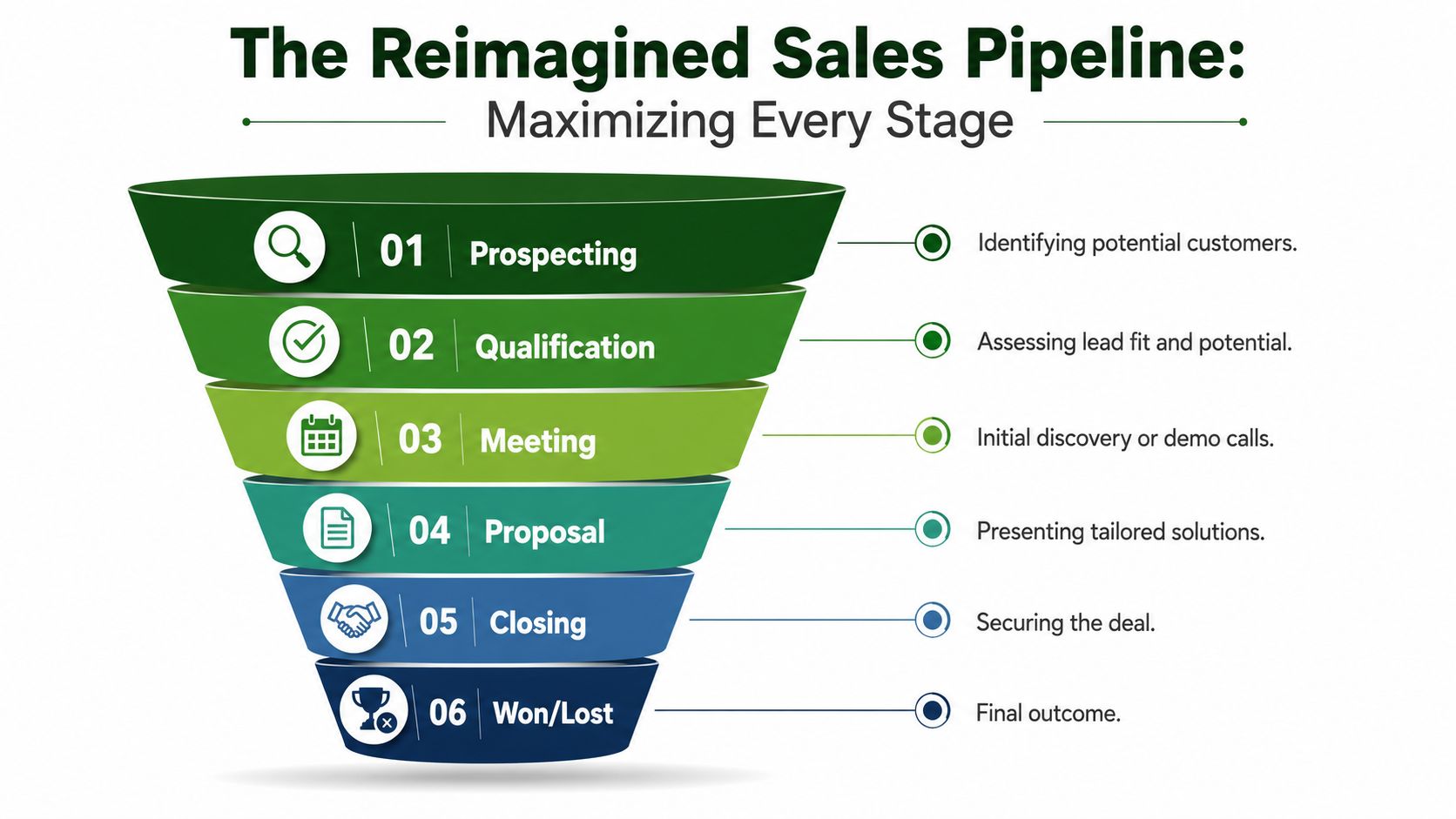
The conventional B2B pipeline still uses the same six labels. The mistake is treating them as a clean sequence when the first stage now includes research, data work, timing analysis, and message development that often happen in parallel.
The classic stage map still matters
The conventional B2B sales pipeline includes these familiar stages:
| Stage | What it should mean |
|---|---|
| Prospecting | A target account or contact has been identified and researched |
| Qualification | The team has confirmed fit, relevance, and a reason to engage |
| Meeting | A discovery call, intro call, or demo is scheduled and completed |
| Proposal | The seller has translated requirements into a concrete recommendation |
| Closing | Commercial and stakeholder issues are being resolved |
| Won/Lost | The opportunity is either converted or closed out with a clear reason |
Teams still need this structure. SDRs, AEs, managers, and RevOps need shared definitions if they want clean reporting, accountable handoffs, and useful pipeline reviews.
What changed is the workload inside each stage. In older pipeline models, prospecting looked like a light setup task before the "real" sales work began. In practice, prospecting now determines whether the rest of the pipeline has any chance of producing efficient revenue.
Where the old model breaks
Traditional stage design hides the biggest operational cost. Teams bundle list building, account research, contact validation, trigger identification, and first-message drafting into one vague bucket called prospecting. That makes upstream delay look like normal pipeline progression.
I see this constantly in CRM audits. A record gets pushed forward because a rep found a contact and sent an email, not because the account was researched well enough to justify sales time. The stage appears active, but the opportunity has almost no evidence behind it.
A more useful model assigns each stage a stricter job:
- Prospecting is account selection and research quality.
- Qualification is proof that the problem, person, and timing are real.
- Meeting is confirmation that the buyer will engage around a defined issue.
- Proposal is a test of solution fit and deal structure.
- Closing is stakeholder alignment, procurement, and risk removal.
That framing matters because stage movement should reflect increasing certainty, not increasing rep activity.
A pipeline is a chain of evidence. Each stage should add enough proof to justify the next investment of time, money, or executive attention.
A grounded view also matters in long sales cycles. If stage definitions are loose, weak early opportunities survive for months, inflate forecast coverage, and absorb rep capacity that should have gone to better accounts.
The fix is not a new set of labels. The fix is tighter entry criteria, especially in prospecting, where modern teams use automation to research accounts faster, compare signals across segments, and create better starting points before outreach begins. For teams reworking that operating model, the RevOps articles on pipeline design and outbound research workflows are a useful reference.
Optimizing Top of Pipeline Stages Prospecting and Qualification
Most pipeline leakage starts before the first meeting. Teams don't fail here because they lack effort. They fail because they still run top-of-funnel work as a manual queue instead of a signal-driven system.

Prospecting needs exit criteria, not activity theater
Prospecting should end when a record is usable, not when a rep has merely looked at it. A workable exit standard usually includes a verified persona, a relevant business context, and a reason this account belongs in the current campaign.
Manual prospecting often misses that bar because reps are rushed. They pull a name, confirm a title, send a template, and hope the reply tells them whether the account is worth more attention. That's backwards. The research should shape the message before the message goes out.
A better top-of-pipeline review asks questions like these:
- Why now? Was there a recent trigger that makes outreach timely?
- Why this person? Does the role align with the problem you solve?
- Why this segment? Is the account in a cluster with shared buying conditions?
- Why this message? Does the outreach reference something real, not generic personalization?
Qualification should be signal-backed
The old model moves a lead into qualification after a response. Modern outbound teams can do better than that. In a parallel research workflow, qualification starts with pre-validated signals.
Generic cold emails that lack activity-based hooks or recent online signals achieve a response rate of less than 1%, while personalized outreach using specific prospect behaviors and recent digital signals can increase response rates by over 100%, according to CaptivateIQ's discussion of sales pipeline stages. That should change how you define qualified.
Signals worth using include role changes, technology adoption, recent funding, and other account events that explain timing. Those aren't just personalization details. They are transition triggers from prospecting to qualification.
Stop using "they replied" as your main proof of quality. A reply measures activity. It doesn't always measure fit.
Teams that want higher-quality stage movement should build qualification around evidence, not inbox luck. That means segmenting by likely buying conditions, then pairing each segment with a relevant outreach angle. If your reps are still building that one lead at a time, the process won't scale cleanly. A useful starting point is reviewing modern outbound workflows such as the examples collected in the PitchSmart blog on research and sequencing.
Driving Momentum in Mid-Pipeline Stages Meeting and Proposal
By the time an opportunity reaches a meeting, the rep should already know why the account matters. If the meeting starts with basic fact-finding that could have been done during research, the pipeline has already slowed down.
Meetings should advance a decision, not just fill a calendar
A solid first meeting does three jobs. It confirms the problem, validates stakeholder relevance, and earns the next commitment. It shouldn't be a generic walkthrough.
The easiest way to lose momentum is to treat meetings as isolated events. They aren't. An average of 6 to 8 distinct interactions are required to convert a prospect from the prospecting stage to deal won, according to Salesforce's sales pipeline guide. That means each meeting has to fit into a deliberate engagement sequence, not a series of disconnected touches.
Use the meeting stage to tighten the opportunity:
- Confirm the use case. Make the business problem specific.
- Surface the buying group. Identify who shapes the decision.
- Define next-step evidence. Leave with a concrete action, not a vague promise.
- Document risk early. If urgency, ownership, or internal alignment is fuzzy, flag it now.
Proposals need to reduce uncertainty
Poor proposals are often just polished brochures. They repeat product information, add pricing, and assume the buyer will connect the dots. Strong proposals remove ambiguity.
That usually means structuring the proposal around the conversation you already had. Reference the operational pain, the desired outcome, the implementation path, and the open issues that still need resolution. If procurement or an executive sponsor will review it later, the proposal should help your internal champion retell the story accurately.
A proposal should make the next internal conversation easier for the buyer.
This stage is also where weak qualification shows up fast. When proposals stall, many teams blame pricing. In practice, stalled proposals often point to a missing stakeholder, an unclear problem statement, or outreach that created curiosity without building a credible business case.
Mid-pipeline execution works best when reps treat every meeting and proposal as part of a designed progression. The stages of sales pipeline discipline matter here because momentum isn't self-sustaining. Reps have to create it touch by touch.
Instrumenting Your Pipeline with Automation
Automation isn't just about saving clicks. It changes what your pipeline can reliably process.
When teams automate the right parts of top-of-funnel work, they stop forcing reps to choose between volume and relevance. That's the operational shift most legacy pipeline guides miss. Manual research assumes the rep is the workflow. Automation treats research, segmentation, and sequence prep as systems work.
What to automate first
The first candidates for automation are the tasks that are repetitive, rules-based, and upstream of selling conversations.
Start with these:
- Bulk lead research: Enrich an entire list at once instead of inspecting records one by one.
- Signal capture: Pull recent role changes, company activity, and other buying clues into one view.
- Segmentation logic: Group accounts by relevant conditions rather than static fields alone.
- Sequence assembly: Turn research outputs into structured outreach steps across email and LinkedIn.
Dynamic segmentation matters. Advanced list segmentation based on buying signals such as job changes or technology implementations improves lead conversion rates by up to 45% compared with segmentation based only on static firmographics, according to Pipefy's analysis of sales pipeline stages. The lesson isn't that every segment needs more complexity. It's that segment logic should reflect buyer motion, not just company attributes.
How parallel research changes stage design
Once you can research a full list in parallel, prospecting stops being a slow, one-record queue. Qualification becomes the new gate that deserves the most attention.
That requires different pipeline mechanics:
| Old workflow | Modern workflow |
|---|---|
| Rep finds one lead at a time | Team processes a list in parallel |
| Qualification starts after reply | Qualification starts with pre-validated signals |
| Messaging is hand-built record by record | Messaging themes are built by segment |
| CRM updates lag behind activity | Research and outreach prep stay structured from the start |
After teams make that shift, they can automate outreach more safely because the inputs are better. The sequence isn't carrying the whole burden. The research has already done real work.
A practical example helps. If a segment is built around role changes, the first-touch message can acknowledge the transition and connect it to a likely operational gap. The second touch can build on that context instead of restarting the conversation. The third can offer a concise point of view or example. At this stage, a short product walkthrough is useful:
If you're weighing whether to operationalize this across a team, review the PitchSmart pricing options for outbound teams against the cost of keeping research and sequence prep manual. For most RevOps leaders, the trade-off isn't hard to see.
Pipeline Health Metrics That Matter for Managers
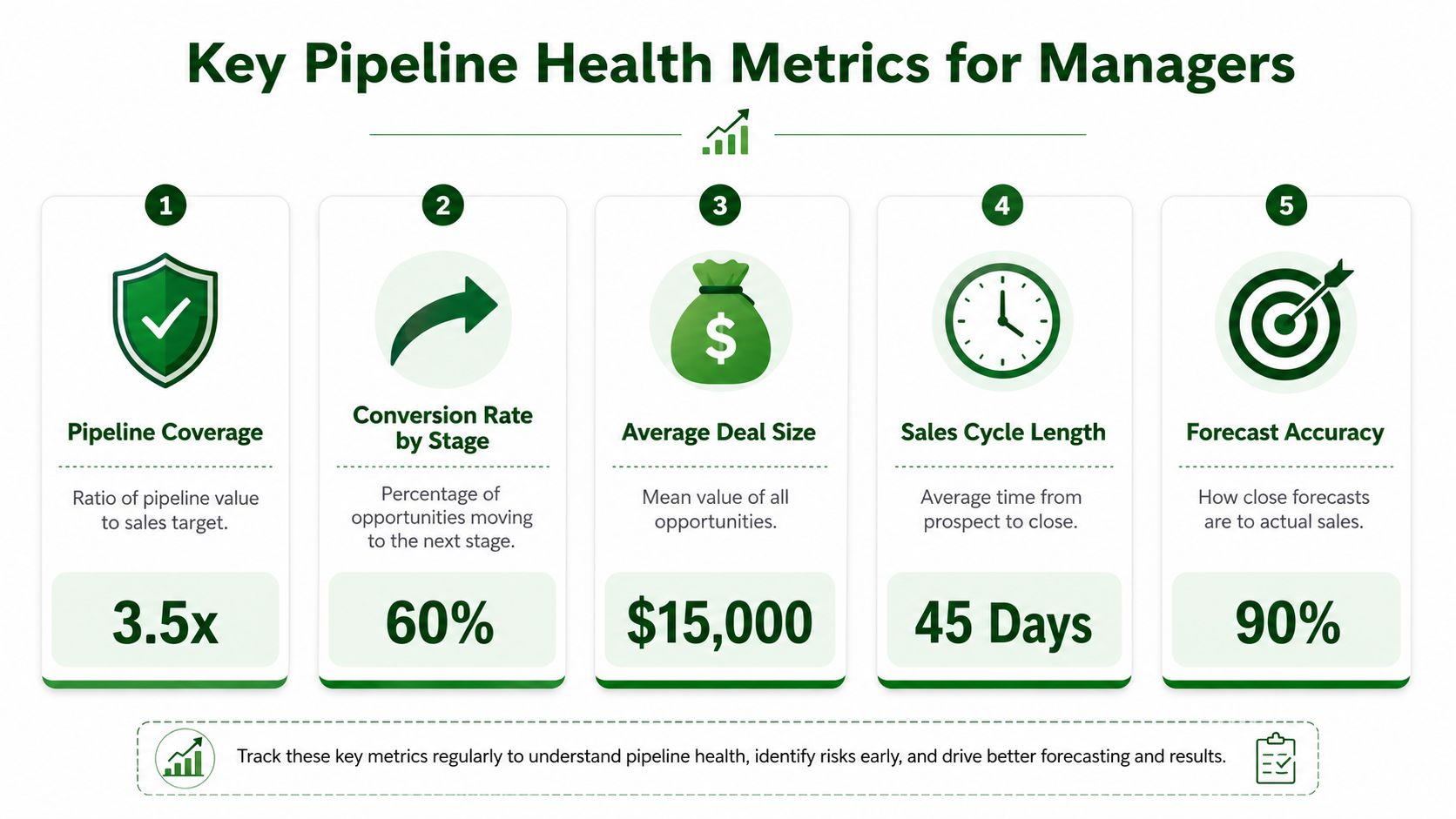
Managers need a short operating view of pipeline health. The goal is to spot whether pipeline is being created with enough quality at entry to support later-stage conversion, or whether the team is carrying inflated volume that will never turn into revenue.
The metrics worth reviewing every week
Start with coverage. As noted earlier, teams need enough pipeline against target to absorb normal deal loss, slippage, and timing risk. Low coverage usually gets blamed on closing performance, but the root cause is often upstream. Manual prospecting slows account production, weakens qualification, and leaves managers depending on a small set of late-stage deals to carry the number.
Then review movement quality:
- Stage conversion: Are opportunities advancing at rates that fit your segment, sales motion, and average deal complexity?
- Time in stage: Where are deals sitting without buyer action?
- Entry source quality: Which prospecting channels, lists, or signals produce opportunities that continue to move?
- Forecast discipline: Are reps advancing deals based on confirmed next steps, or based on rep activity alone?
A healthy review prioritizes pipeline quality over short-term closing targets. Managers should ask which new opportunities entered with enough evidence to become real pipeline, not just which deals might get pulled into the quarter.
What healthy data discipline looks like
Forecast problems usually start much earlier than commit calls. They start when weakly researched accounts enter the pipeline and no one enforces a proof standard for stage progression.
The practical fix is simple:
Reps can't move a record forward unless the next stage's required evidence is present in the CRM.
That evidence should match how your team sells. If qualification requires a confirmed problem, an involved stakeholder, and a plausible timing trigger, those fields should be required before the opportunity advances. If a meeting stage is supposed to represent buyer engagement, the record should show that engagement clearly. Without that discipline, stage reporting becomes an activity log dressed up as pipeline management.
Managers can keep reviews tight with a checklist like this:
- Check entry criteria: Did this opportunity earn a place in pipeline based on research quality and fit?
- Check progression logic: What did the buyer say or do that justifies the stage change?
- Check segment quality: Which segments generate opportunities that keep moving after creation?
- Check stale volume: Which records are consuming rep time without producing forward movement?
The healthiest pipeline shows buyer commitment in the data, not just rep effort.
Used this way, metrics become a control system for pipeline velocity. Managers coach earlier, forecast with less debate, and catch top-of-funnel waste before it spreads through every later stage.
Stop Managing Stages Start Fueling Velocity
The standard conversation about sales pipeline stages is too shallow for modern outbound. It names the stages, but it rarely deals with the actual constraint. Many teams aren't short on stage definitions. They're short on throughput at the top.
That's why the first stage deserves more scrutiny than the rest. Manual prospecting slows list production, weakens message quality, and pushes qualification into guesswork. Once that happens, every later stage carries avoidable friction. Meetings become exploratory in the wrong way. Proposals go out before the account is aligned. Forecasts become stories instead of operating signals.
A stronger model is simpler than it sounds. Treat prospecting as a structured research operation. Treat qualification as a proof standard based on signals and segment logic. Treat meetings and proposals as momentum stages that should only receive opportunities with enough evidence behind them. Then instrument the whole system so managers can see where progression is real and where it's inflated.
For RevOps leaders, this is the central trade-off. You can keep paying reps to gather and normalize information manually, or you can redesign the entry point so sellers spend more time in conversations that move pipeline forward. The stages of sales pipeline management still matter. They just matter most when the system feeding them is fast, consistent, and evidence-based.
If your team wants better pipeline performance, don't start by renaming stages in the CRM. Start by removing the friction that keeps qualified outreach from happening at scale.
PitchSmart helps outbound teams replace manual prospecting with parallel research, signal-based segmentation, and automated outreach preparation. If you want to see what happens when reps stop spending their day on tabs, copy-paste, and generic messaging, try PitchSmart.