B2B reps can lose most of their day to non-selling work, and manual account research is often the first place the clock disappears. That's why generic endings fail so often. A strong close only works when the email body has already earned it with a real signal, a real account detail, and a real reason to reply. If the close sounds detached from the research, the whole message feels like spray-and-pray with better grammar.
The fix is simple. Treat the ending as the last step in a signal-based sequence, not a polite afterthought. That means the final sentence, the sign-off, and the signature have to work together, with the final sentence doing the actual selling. PitchSmart fits that motion because it researches accounts against what you sell, surfaces buying signals and conversational hooks, and drafts outbound sequences from those hooks so reps aren't inventing the ending from scratch.
1. The Direct Ask with Timeline
The cleanest ending email phrases remove friction. “Happy to jump on a brief call next week if this resonates.” works because it gives the reader a clear next step without forcing a same-day decision. The ask is bounded, but it still respects autonomy.
Use it after one real trigger
If you found a concrete signal, the phrase lands. A company launch on LinkedIn, a new mobile app announcement, or a customer-side hire in a key function gives the email a reason to exist. Without that, the line reads like a generic meeting request.
For revenue teams selling multiple product lines into the same account, timing matters even more. The signal has to be fresh enough that the rep can still connect it to a live business issue. That is why bulk account research and activity-based hooks matter, because the email close should follow the signal, not chase it. PitchSmart supports that motion because it researches accounts against what you sell, surfaces buying signals and conversational hooks, and drafts outbound sequences from those hooks so reps are not inventing the ending from scratch. See the PitchSmart blog for more examples of signal-based outbound structure.
Practical rule: Lead with one researched detail, then use a bounded ask. The close should feel like the next logical step, not a cold interruption.
Avoid softening the sentence into uncertainty. “Happy to jump on a call if you're interested” weakens the ask because it sounds like you are unsure the fit is real. Use “next week” only when the body of the email has already earned a conversation. If the message is built on a real trigger, a direct timeline close keeps the reply easy and the next step clear.
1. The Direct Ask with Timeline
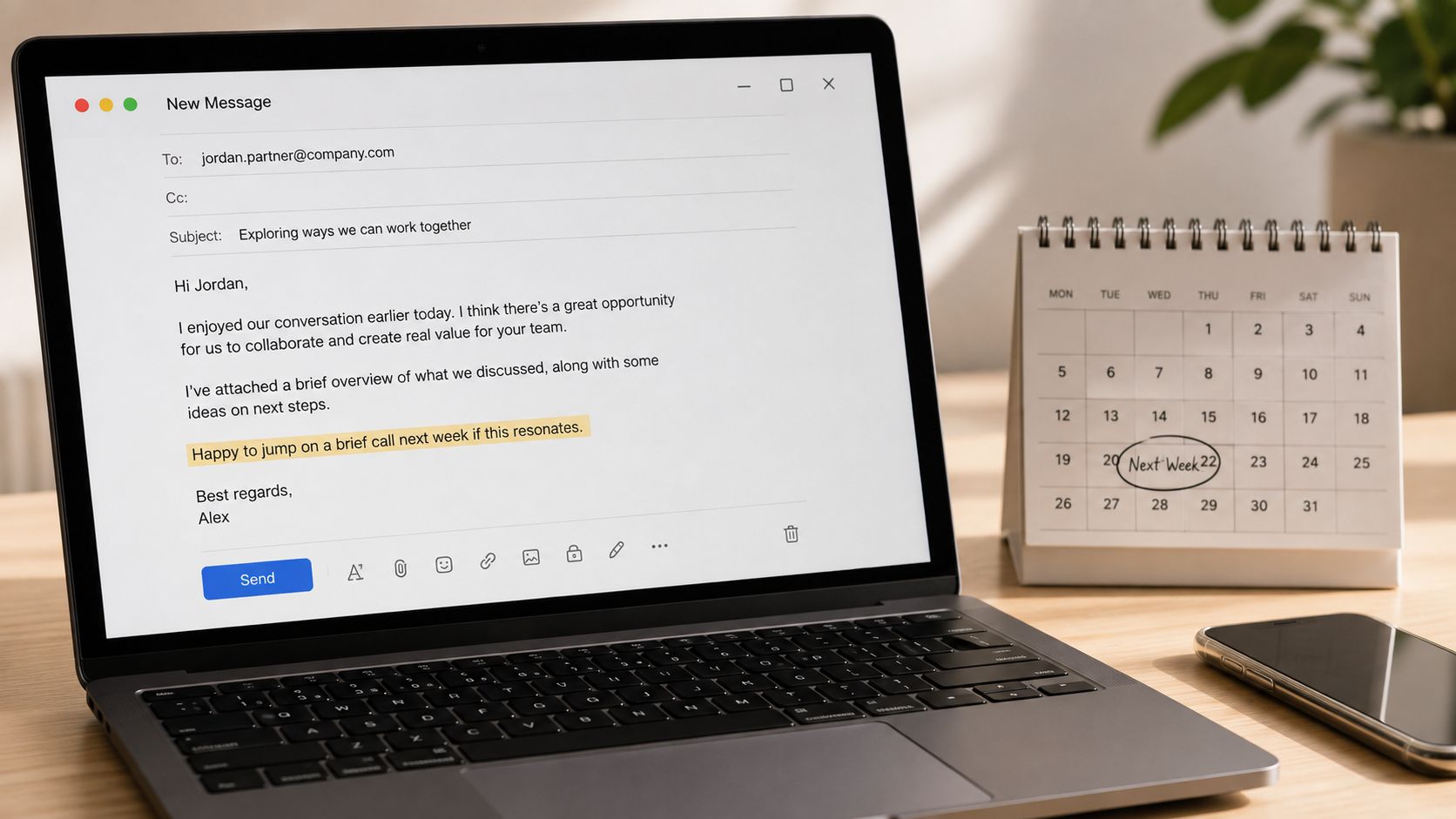
The cleanest ending email phrases remove friction. “Happy to jump on a brief call next week if this resonates.” works because it gives the reader a clear next step without forcing a same-day decision. The ask is bounded, and it still respects autonomy.
Use it after one real trigger
If you found a concrete signal, the phrase lands. A company launch on LinkedIn, a new mobile app announcement, or a customer-side hire in a key function gives the email a reason to exist. Without that, the line reads like a generic meeting request.
For revenue teams selling multiple product lines into the same account, timing matters even more. The signal has to be fresh enough that the rep can still connect it to a live business issue. That's why bulk account research and activity-based hooks matter, because the email close should follow the signal, not chase it. PitchSmart supports that motion because it researches accounts against what you sell, surfaces buying signals and conversational hooks, and drafts outbound sequences from those hooks so reps are not inventing the ending from scratch. See the PitchSmart blog for more examples of signal-based outbound structure.
Practical rule: Lead with one researched detail, then use a bounded ask. The close should feel like the next logical step, not a cold interruption.
Avoid softening the sentence into uncertainty. “Happy to jump on a call if you're interested” weakens the ask because it sounds like you're unsure the fit is real. Use “next week” only when the body of the email has already earned a conversation. If the message is built on a real trigger, a direct timeline close keeps the reply easy and the next step clear.
For expansion conversations, tie the ask to a department-specific pain. If a new VP of Product joins an existing customer, the rep should anchor the close to a product-line issue that the new leader will care about immediately. PitchSmart's segmentation and signal matching make that easier. Explore more strategies at PitchSmart's blog.
2. The Observation + Permission
“I noticed [specific detail]. Curious if this is on your radar, let me know if it makes sense to chat.” flips the pressure. You're not asking for time first, you're offering relevance first.
This is the right close when you're entering an existing account with a second product line. The prospect already knows your company, so a hard ask can feel presumptuous. A specific observation, tied to a buying signal, gives them room to decide whether the topic deserves attention.
Use it when the detail is real. That can mean LinkedIn activity, a website change, a recent hire, or known product usage. If you observed that a finance team is running two systems in parallel, the close can acknowledge that reality without turning into a pitch fight. The sentence works because it lets the buyer choose whether the issue is on their radar.
A few variations work, but the logic stays the same:
- Specific observation first: Name the thing you found.
- Permission second: Let the prospect decide if it matters.
- Low pressure last: Keep the close open, not needy.
For multi-solution companies, this style is especially useful in cross-sell emails. It respects the relationship and keeps the message from sounding like a brand-new cold call in disguise. PitchSmart's segmentation and signal matching make this easier because the rep isn't guessing which account details matter, they're starting from researched evidence.
3. The Named Next Step
“I'll send over a brief overview of how we've helped [similar company type] solve [specific problem]. If it resonates, we can find 15 minutes.” is stronger than a vague “let me know.” It sets the sequence clearly. Review first, meeting second.
This matters in cross-sell and expansion work because many buyers do not yet see why a second product line belongs in their workflow. They need context before they commit to a conversation. A named next step gives them that bridge without forcing an immediate calendar decision.
The best use case is when you already know the pain and just need to make it concrete. Maybe a customer's finance team is dealing with disconnected reporting across product lines, or a prospect's ops group is buried in manual reconciliation. In both cases, the rep can offer a one-page overview or a short video, then make the call conditional on relevance.
Keep it tight. Send the overview fast, and make it specific.
That means pre-building short assets for common scenarios. A one-page summary from a similar company type, a short product-line explanation, or a concise workflow example all work. Long collateral usually gets ignored. If the prospect does not reply, the follow-up can reference the exact overview they were offered, which keeps the sequence coherent instead of random.
This also fits automated sequence drafting. If PitchSmart has already matched the account to the right product, the rep does not have to guess the next step. The ending can point to a concrete asset and keep the conversation warm without sounding scripted.
4. The Problem-First Redirect
“Most of the teams I talk to in [industry/function] are dealing with [problem]. If that's not you, no worries, but if it is, worth a conversation.” reframes the email as a diagnostic. You're not selling a solution first, you're testing whether the problem exists.
This close works because it gives the prospect an easy out while also naming a real issue. That combination lowers defensiveness. It's especially useful in revenue enablement and expansion motions where the buyer may not yet be shopping for a product, but the pain is real enough to discuss.
The email body should do most of the work here. Spend the bulk of the message on the problem itself, then use the ending to open a conversation around it. Don't mention the product too early. Let the reader decide whether the problem is familiar before you introduce anything else.
A good version is specific enough that the prospect can self-identify. “Most teams” is weak. “Most of the finance leaders in multi-product B2B companies” is stronger because it sounds like a real segment, not a lazy generalization. If the problem is fragmented data across product lines, say that plainly. If it's visibility into how tools connect, say that plainly too.
For customer expansion, the strongest version references their own environment, not just the market. That's where research-backed hooks matter. A rep who knows the company structure, the business unit, and the likely pain can close with confidence instead of fishing for curiosity.
5. The Conditional Credibility Check
“We work with [specific company type]. If you're dealing with [specific scenario], I think there's a fit. If not, no hard feelings.” combines social proof with a clean exit. The buyer gets context, but not pressure.
This is one of the strongest ending email phrases for accounts where trust matters more than urgency. It shows you know who you serve, and it also tells the reader you are not forcing a meeting. That matters in multi-solution companies, where prospects can be cautious about internal politics and vendor overlap.
The key is specificity. Name a company type the reader recognizes or can verify quickly. Then name the scenario in plain language. If you're talking to a finance leader, “consolidating your tech stack” is more concrete than “optimizing operations.” If you're talking to an account that manages multiple product lines, “integration or visibility challenges” is stronger than a vague reference to growth.
Credibility gets checked fast. If the example sounds made up, the email is dead.
That is why you should never name-drop a company you haven't worked with or researched. Reps will test the claim. If they find nothing, you lose the chance for future outreach in that account and likely in the wider network around it.
For expansion, the best version references a unit inside the prospect's own company whenever possible. Internal examples beat external ones because they feel immediate and relevant. PitchSmart's cross-sell mapping is useful here because it helps teams tie a signal to the right business unit before the email goes out. PitchSmart's portfolio-aware research makes it easier to match the outcome to the right department, see examples at https://pitchsmart.io/portfolio.
6. The Social Proof + Scarcity Hybrid
“I'm working with a few [specific type] of companies on this right now. Most have seen [specific outcome]. Might be worth exploring if it applies to you.” creates momentum without sounding pushy. It tells the reader the issue is active for peers, and that others are already moving.
This close works best when the outcome matches the buying signal. If the trigger is fragmented reporting, the outcome should talk about better consolidation. If the trigger is integration visibility, the outcome should talk about clearer handoffs or easier onboarding. The closer the outcome is to the pain, the more credible the sentence sounds.
The “few” needs to be true. Don't inflate it. If you're working with a small number of similar accounts, say so. The point isn't to fake volume, it's to show that the issue has real traction.
Use this format when you have a relevant result but don't want to overstate the case. It's softer than a hard scarcity play and more grounded than vague hype. Avoid phrases like “we're seeing a lot of interest” because they don't say anything useful. A buyer can smell filler immediately.
For expansion teams, this is especially effective when one product line solves a pain that another team inside the account is already feeling. The sentence gives the prospect a reason to believe the conversation matters without forcing urgency. PitchSmart's portfolio-aware research makes it easier to match the outcome to the right department and the right hook.
7. The Two-Track Offer
“Happy to send over some context on how this works. Or if you'd prefer, I can jump on a quick call to see if it's even relevant. Your call.” works because it offers two paths, not one forced response. Busy executives often prefer that.
This is a strong ending email phrase when the recipient may want to vet the idea asynchronously first. Some buyers want a short written summary. Others want a direct conversation. This close respects both behaviors, which makes it easier for the prospect to reply at all.
The async option has to be concrete. “Some context” is too vague unless you immediately define what that context is. A case study, a one-pager, or a short workflow note is better. If the prospect chooses the call, you've already framed the purpose: check relevance, not stage a big pitch.
Use this when you know the buyer has limited time and a real decision to make. It's especially useful in expansion conversations where the person you're emailing might need to forward the idea internally before they book anything. The phrase gives them a safe way to engage without committing too soon.
For outbound teams, this style pairs well with prebuilt assets. If the email is triggered by a buying signal, the context piece should already exist. PitchSmart can help by drafting sequences around the best hook so the rep can send the right follow-up without delay.
8. The Constraint-Aware Close
“I know you're busy. If this is worth 15 minutes, I'm available [specific day/time]. If not, I get it.” removes calendar friction and acknowledges the obvious constraint. That's why it works.
A busy VP or director doesn't want another email asking, “What works for you?” They want a clean option. Offering two or three specific slots makes the decision easier and keeps the conversation moving. The sentence also shifts the ask from open-ended scheduling to a simple yes or no.
Keep the availability real. If you offer a time, you need to hold it. Offering slots you can't take damages credibility fast. Keep the options tight, and if you're working across regions, include the time zone.
This close is especially useful in accounts with multiple stakeholders and long approval chains. The prospect may not be ready to coordinate a meeting, but they can react to a concrete window. If you know their calendar is packed, that empathy should show up in the wording, not just the intent.
The close should reduce work for the buyer, not add another task.
For expansion outreach, this can pair well with a department-specific issue that already has attention internally. The rep isn't asking for an exploratory chat in the abstract. They're offering a narrow window to discuss a real business problem that research has already surfaced.
8 Email Closing Strategies Compared
| Closing (phrase) | Implementation Complexity 🔄 | Resource Requirements ⚡ | Expected Outcomes ⭐ / 📊 | Ideal Use Cases 💡 | Key Advantages |
|---|---|---|---|---|---|
| The Direct Ask with Timeline, "Happy to jump on a brief call next week if this resonates." | Low, simple phrasing; effectiveness depends on prior research | Low–Medium, quick account signal research + calendar slots | ⭐⭐⭐, clear CTA; improves timely meetings when signal is fresh 📊 | Multi-solution teams, recent buying signals, cold outreach & expansion | 📊 Clear next step; non-pushy; scalable across sequences |
| The Observation + Permission, "I noticed [specific detail]. Curious if this is on your radar, let me know if it makes sense to chat." | Medium, must surface a genuine, specific observation | Low, one researched datapoint per email | ⭐⭐, collaborative tone; increases honest yes/no replies 📊 | Expansion into existing accounts; introducing secondary solutions | 📊 Respects prospect autonomy; lowers negative replies; fosters dialogue |
| The Named Next Step, "I'll send over a brief overview... If it resonates, we can find 15 minutes." | Medium, sequences commitment; needs concise assets | Medium, personalized one-pagers or short videos + follow-up | ⭐⭐⭐, high conversion to engagement after low-effort asset review 📊 | Cross-sell, longer buying cycles, accounts needing education | 📊 Breaks ask into two stages; natural re-engagement opportunity |
| The Problem-First Redirect, "Most teams I talk to... If that's not you, no worries, but if it is, worth a conversation." | Medium–High, requires accurate, segment-validated problem statements | Medium, segment research to validate shared pain | ⭐⭐⭐, high reply rates when problem identification is correct 📊 | Outbound to targeted roles/segments; expansion across cohorts | 📊 Frames conversation as diagnosis; lowers resistance; scalable |
| The Conditional Credibility Check, "We work with [specific company type]. If you're navigating [scenario], I think there's a fit..." | Medium, needs real, verifiable customer examples | Medium, evidence of peers / case references | ⭐⭐⭐, high perceived credibility; honest responses 📊 | Accounts needing internal champions; multi-solution fits | 📊 Specific social proof + opt-out builds trust; forwardable internally |
| The Social Proof + Scarcity Hybrid, "I'm working with a few [type]... Most have seen [outcome]. Might be worth exploring." | Low–Medium, simple copy but must be truthful about peers | Low–Medium, case studies and outcome metrics | ⭐⭐, raises perceived urgency and reduces risk; dependent on credibility 📊 | Expansion to peers/industry clusters; proving momentum | 📊 Outcome-focused credibility with mild urgency; lowers perceived risk |
| The Two-Track Offer, "Happy to send over some context... Or... I can jump on a quick call. Your call." | Low, straightforward choice framing | Medium, prepared async materials + readiness for calls | ⭐⭐⭐, higher engagement; accommodates buyer preference but risk of async ghosting 📊 | Busy executives; prospects preferring async review; expansion | 📊 Flexible pathways increase replies; respects autonomy and work styles |
| The Constraint-Aware Close, "I know you're busy. If this is worth 15 minutes, I'm available [day/time]. If not, I get it." | Low, simple but must offer real, manageable slots | Low, calendar availability; scheduling tool recommended | ⭐⭐⭐, reduces calendar friction; good conversion with execs 📊 | Executive outreach; high-level stakeholders; busy decision-makers | 📊 Concrete time options speed booking; builds rapport by acknowledging constraints |
From Phrase to Pipeline Operationalize Your Closings
The best ending email phrases are not a writing trick. They're the final move in a research-led sales motion. If the ending sounds generic, the problem usually started earlier, when the rep didn't have enough signal to make the email worth reading.
That's why the bottleneck is rarely the wording itself. It's the account work behind it. Reps need the right trigger, the right segment, and the right reason to ask for a reply. When that research happens manually, the ending becomes a guess. When the research is automated against what you sell, the close becomes the logical last line of the message.
PitchSmart is built for that kind of workflow. It researches your accounts against your product definitions, surfaces buying signals and conversational hooks, and drafts sequences from those hooks so reps can stop assembling every email by hand. For revenue enablement, RevOps, customer success, and outbound teams in multi-product B2B companies, that matters because the close only works when the body earned it.
If you want better replies, stop polishing endings in isolation. Build the research that makes the ending believable, then use a close that matches the signal. Run your first account research, see the hooks your team can work with, and turn them into outreach that earns a response.
PitchSmart helps you research accounts against what you sell, then turn the signal into the right ending email phrases, opener, and sequence. If you want to build closings from real account activity instead of guessing, visit PitchSmart and see how the research starts.