
Most advice about a quotation request template starts from the wrong assumption. It assumes your team should wait for a buyer to define the need, issue a formal document, and invite you into a price comparison exercise you didn't shape.
That's outdated thinking. A standard RFQ process helps procurement compare vendors, not sellers win strategically. Worse, your reps are already overloaded. Sales representatives spend 70% of their time on non-selling tasks, according to ZDNet's coverage of industry reporting including Salesforce and the 2024 State of Sales. If your team burns most of the day on research, admin, and reactive quoting, waiting for RFQs isn't just inefficient. It's a pipeline problem.
The better move is to use the language and structure of a quotation request template, then flip it into a proactive proposal. That puts your team in front of demand instead of behind it.
You Searched for the Wrong Template
You probably wanted a cleaner quotation request template. That's not the actual issue. The actual issue is that your team is accepting a buyer-controlled process that turns your offer into a line item.

When a seller starts with a quotation request template, the seller is already late. The buyer has named the categories, set the fields, narrowed the decision criteria, and usually invited competitors into the same box. You're no longer diagnosing a problem. You're complying with a spreadsheet.
That's why the common advice misses the point. It teaches teams how to complete requests faster, not how to avoid getting trapped in them.
Reactive selling is expensive
Manual research is the bleeding neck in most outbound teams. Reps bounce between LinkedIn, company sites, job boards, news pages, CRM records, and old notes just to produce one decent message. Then they wait for inbound intent signals that may never arrive.
Practical rule: If your outreach starts after procurement gets involved, you've already lost leverage.
A seller who waits for RFQs ends up doing two kinds of low-value work at once. First, the rep spends hours assembling context manually. Second, the rep enters a process designed to compare price, delivery terms, and compliance fields side by side.
That's not a selling motion. It's administrative participation.
A better use of the template mindset
Templates still matter. Just not in the way they are commonly utilized.
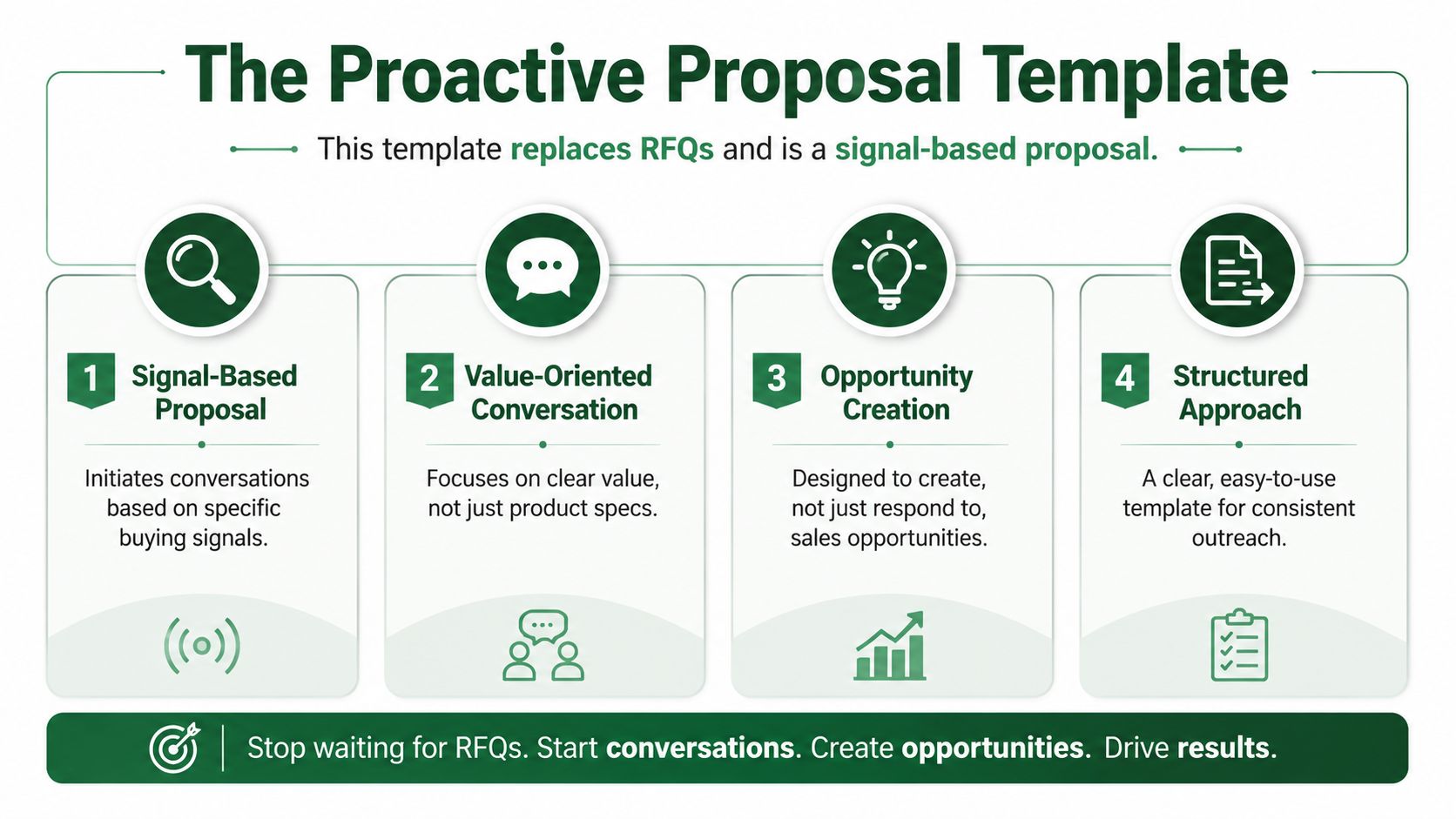
Use the structure buyers expect from a quotation request template, then deploy it earlier as a proactive proposal. That means your message should be organized, specific, and credible enough that the buyer sees a defined path before they ever issue a formal quote request.
A simple comparison makes the shift obvious:
| Approach | What happens |
|---|---|
| Wait for RFQ | Buyer defines the problem, vendors compete on formatting and price |
| Send proactive proposal | Seller identifies a live issue, frames the commercial problem, and shapes the buying criteria |
The team that defines the problem usually shapes the shortlist. The team that arrives at RFQ stage usually fights over margins.
Why Standard RFQs Kill Your Sales Velocity
An RFQ is a standardized procurement document designed to make it easier to objectively sort through competing bids by aligning line items for price per unit, quantity, and shipping costs for fair evaluation, as explained in Asana's RFQ template guide. That's useful for buyers. It's brutal for sellers.
The standard RFQ process strips out context. Procurement wants normalized inputs, comparable totals, and clean evaluation. Your differentiation gets compressed into fields.
RFQs turn your offer into a commodity
Once a buyer issues an RFQ, they usually believe the solution is already defined. Your job becomes proving you can supply it within the framework they set. That narrows the conversation fast.
Instead of discussing business impact, your team gets pulled into details like units, shipping assumptions, discounts, and compliance confirmations. Those details matter operationally, but they don't create advantage. They erase it.
Buyers use RFQs to reduce uncertainty. Sellers should recognize that the same process also reduces room for persuasion.
This is why so many teams feel busy without feeling effective. They're responding diligently to opportunities that were framed by someone else.
The process rewards the wrong behavior
The standard RFQ motion rewards speed, formatting accuracy, and low-friction pricing. It doesn't reward original diagnosis or strong point of view. If your company solves complex operational or revenue problems, that's a terrible arena to enter by choice.
Here's the seller-side reality:
- You lose discovery control: The buyer has already decided what they think they need.
- You lose narrative control: Your solution appears next to rival bids in the same format.
- You lose margin control: Procurement can compare totals without engaging in detail on why your approach is different.
If you want more tactical material on avoiding seller passivity, the PitchSmart blog is worth reviewing for outbound workflow ideas.
The fix isn't writing prettier RFQ responses. The fix is creating conversations before the RFQ exists.
The Proactive Proposal Template That Replaces RFQs
A seller who wants better deals shouldn't ask, “What quotation request template should I use?” The better question is, “What can I send before procurement formalizes the purchase?”
A strong RFQ template asks suppliers for precise line items. A well-constructed RFQ template requires suppliers to submit a bill of quantities that clearly lists each item, unit price, quantity, and total prices, according to Responsive's RFQ template examples. Your outbound proposal should mirror that level of specificity, but in seller-led form. Don't send vague promises. Send a hypothesis with structure.
What to send instead
Use this framework:
Start with a live trigger
Reference a concrete business signal. New executive hire. Expansion into a new market. Hiring pattern. Product launch. Tech stack change. Public initiative.Name the likely operational issue
Don't pitch features first. State the friction you suspect the buyer is dealing with.Offer a structured recommendation
Give enough detail to show rigor. Buyers trust sellers who think in operational terms.Ask for a working session, not a demo request
A demo is product-first. A working session is problem-first.
Don't send “just checking if this is relevant.” Send a reasoned point of view.
A short video can help sharpen how you structure persuasive outreach in practice.
A copy-ready proactive proposal
Subject line options
- Idea based on your recent hiring pattern
- A faster path than an RFQ process
- Saw a signal that usually precedes vendor evaluation
- Possible gap in how your team is handling [category]
- Thought on [company name] after recent changes
Email template
Hi [First Name],
I noticed [specific signal].
When teams hit that point, they usually run into [specific business problem]. Most buyers wait until the issue gets big enough to trigger a formal quote process. By then, they're comparing vendors against requirements that were written too late and too narrowly.
Based on what I saw, I'd suggest evaluating this in four parts:
- Current workflow: Where requests, approvals, and handoffs are getting delayed
- Commercial impact: Where time, cost, or missed output is stacking up
- Required capability: What the future-state process needs to support
- Decision structure: What should be validated before anyone issues an RFQ
If helpful, I can send a one-page breakdown with a suggested scope, assumptions, and a rough comparison model so your team can pressure-test options before procurement turns it into a price-only exercise.
Open to a short discussion next week?
Best,
[Your Name]
This works because it does what a quotation request template never does. It introduces insight before the buyer standardizes the conversation.
Customizing Your Outreach with Buying Signals
A template without context is just spam with formatting. The quality of your outreach depends on the signal behind it.
Teams often personalize at the surface level. They mention the company name, maybe reference a funding round, and call it relevance. Buyers ignore that because it doesn't prove timing or urgency. Good outreach ties a specific external signal to a plausible internal problem.
Signals that justify outreach
Not all signals are equal. Some are noise. Some are strong enough to support a direct commercial hypothesis.
Use signals like these:
- Leadership changes: A new executive often brings new priorities, vendor reviews, or process changes.
- Hiring concentration: Multiple roles in one function can indicate expansion, operational strain, or new budget ownership.
- Public messaging shifts: Press releases, webinars, and interviews often reveal strategic priorities in plain language.
- Technology changes: New tools usually create integration work, handoff issues, and process redesign.
- Competitive movement: If a prospect reacts publicly to a rival's launch or market move, there's usually internal pressure behind it.
A weak opener says, “Congrats on the recent announcement.” A strong opener says, “Your recent hiring suggests your team is building capacity around X, which usually creates Y issue before the process catches up.”
How to turn a signal into an opening line
Use a simple conversion model.
| Signal | Weak message | Strong message |
|---|---|---|
| New VP hire | Congrats on the new leader | Saw the new VP appointment. Teams usually reassess tools and workflows in that window |
| Hiring spree | Noticed you're growing | You're adding headcount in one function, which usually exposes process bottlenecks fast |
| New market launch | Exciting expansion news | Expansion often forces teams to standardize vendor decisions earlier than expected |
The opening line should do three things fast:
- Anchor to something real: The buyer should know why you chose them.
- Infer a business issue: Don't stop at observation.
- Earn the next sentence: Curiosity is the job of the first line.
The prospect doesn't care that you researched them. They care that your research led to a useful conclusion.
Most outbound teams falter here. They collect facts but don't form an argument. Signals are only valuable when they support a point of view.
Automating Your Workflow from Research to Proposal
One good email doesn't change pipeline coverage. A repeatable system does.
A 2026 analysis from Sales Motion says the average sales rep spends only 28% of their time in direct selling activities, while top performers achieve 35–40% by systematically automating manual research and CRM administration using account intelligence platforms, as reported in Sales Motion's sales time management analysis. That gap isn't about talent alone. It's about operating model.
Build segments, not one-off messages
Stop treating prospecting as a handcrafted art project. Start with segments built around buying signals.
Examples:
- Companies with a recent senior leadership change
- Accounts hiring heavily in one operational function
- Firms that publicly emphasize efficiency, compliance, or automation
- Target accounts that likely entered a vendor review cycle after expansion
Each segment should support a distinct hypothesis. That's what makes the outreach coherent at scale. The structure stays consistent. The trigger and angle change.
If you want a platform built around that workflow, PitchSmart is designed for list-based research and signal-backed outbound execution.
Use a sequence that carries the same argument
Most sequences fail because each step sounds like it came from a different rep. Keep the same core thesis through all touches.
A simple three-step pattern works well:
Initial email
Lead with the signal and your diagnosis.LinkedIn follow-up or second email
Add context. Expand the operational implication or share a concise framework.Final touch
Make the choice easy. Invite the buyer to validate whether your hypothesis is relevant.
You don't need more volume. You need consistency across research, segmentation, and message logic.
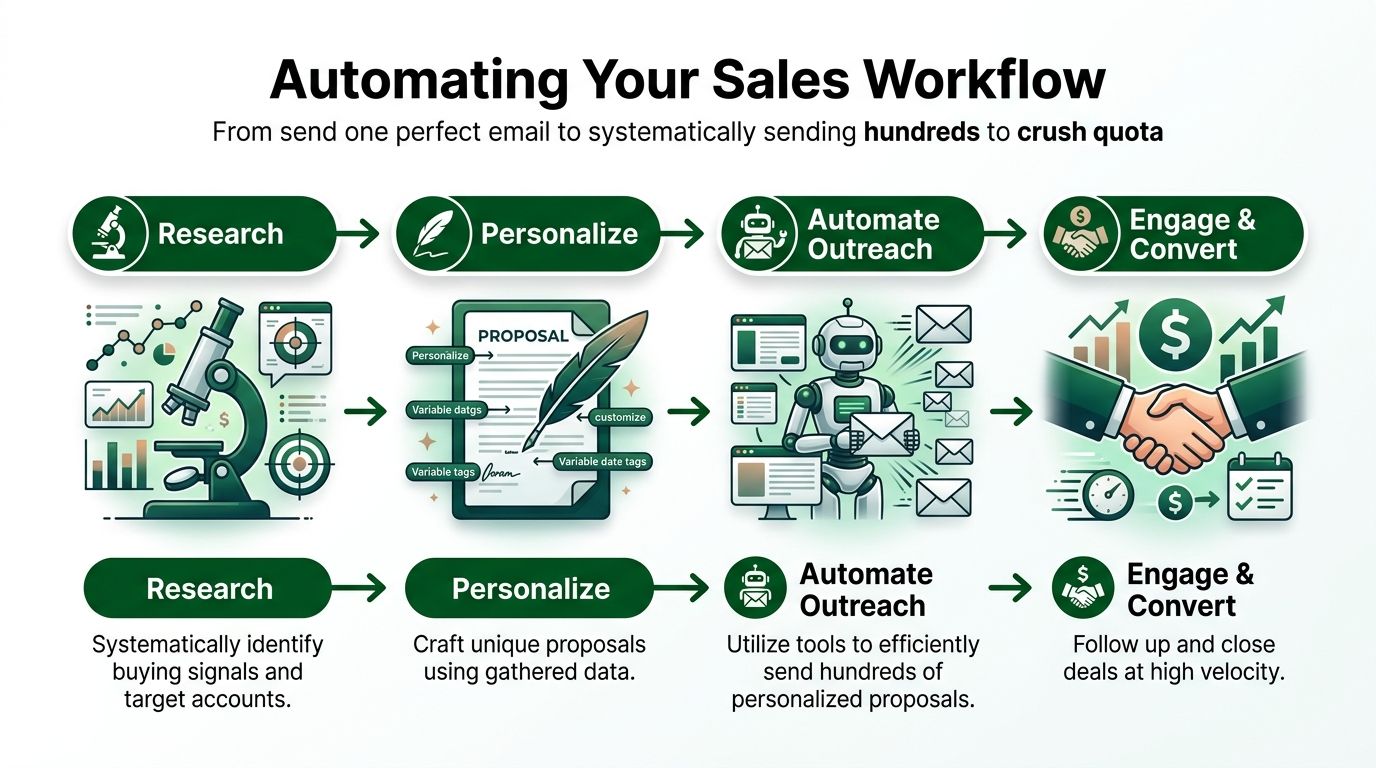
A good workflow also keeps your team from rebuilding the same outreach from scratch every day. Research feeds segmentation. Segmentation feeds proposal logic. Proposal logic feeds sequence execution. That's how sellers reclaim selling time.
A Simple Checklist for Follow-up and Conversion
If your first message was built on a real signal, your follow-up shouldn't sound like a generic nudge. Don't “bump” the thread. Add something useful.
Follow-up checklist
- Reconnect to the original signal: Remind the buyer why you reached out in the first place. Keep it tied to the event or pattern that made the account relevant.
- Add one new layer of value: Share a sharper assumption, a mini diagnostic, or a brief framework the buyer can react to.
- Make the reply easy: Ask a binary question, offer a short review call, or suggest they redirect you to the right owner.
- Preserve commercial gravity: Don't switch into casual chasing language. Keep the tone consultative and direct.
- Know when to stop: If there's no engagement after multiple thoughtful touches, move the account back into monitoring rather than flooding the contact.
A compact follow-up can be stronger than a long one:
Saw one more indicator that this may be relevant. If this isn't a priority yet, I'm happy to close the loop. If it is, I can send a short decision framework your team can use before formal vendor comparison starts.
When to move from email to conversation
Move to a live conversation when the buyer does one of three things:
| Buyer behavior | Your move |
|---|---|
| Confirms the issue exists | Offer a short working session |
| Asks for more detail | Send a concise outline, then suggest discussion |
| Redirects you internally | Reframe the note for the new stakeholder, keeping the original signal intact |
Pricing discussions should come after the buyer agrees that the problem is worth solving and the evaluation criteria make sense. If they ask for numbers early, answer clearly, but don't let the deal collapse into a premature quote exercise.
For teams that want a cleaner way to operationalize this process, the PitchSmart pricing page lays out the available options.
If your reps are still burning hours on manual research and waiting for buyers to issue RFQs, you're choosing a slower, weaker sales motion than necessary. PitchSmart helps outbound teams research entire lists in parallel, surface signal-backed conversation hooks, segment accounts by buying signals, and launch automated multi-step outreach without the copy-paste grind. That means fewer reactive quote chases and more seller-led conversations that start before procurement takes over.