Most outbound teams don't have a messaging problem first. They have a research throughput problem.
A lot of revenue still comes from outbound. One industry roundup reports that nearly 28% of B2B revenue comes from outbound sales efforts, and another benchmark says 31% to 40% of pipeline generation comes from SDR outbound work, according to Martal Group's outbound sales benchmark roundup. Yet the work that powers outbound is still painfully manual inside many teams. Reps jump between LinkedIn, company sites, CRM records, job pages, and random tabs just to find one usable angle for one prospect.
That hidden work is where most outbound strategies break.
The issue isn't that teams don't know they should personalize, qualify tightly, and follow up across channels. They know. The issue is that manual research makes those best practices too slow to execute consistently at scale. If every decent email requires one-by-one prep, the outbound engine stalls before it ever reaches the buyer.
The Urgent Case for a Better Outbound Sales Strategy
Outbound teams lose far more time to prep work than most leaders account for. The visible work is emailing, calling, and following up. The hidden work is account research, contact validation, message drafting, CRM updates, and list cleanup. That hidden layer is where a large share of outbound capacity disappears.
The follow-up problem makes the cost obvious. As noted earlier, many deals require repeated touches, while many reps quit far too early. In practice, that gap usually comes from workload design, not effort. If a rep spends the first half of the day gathering context one account at a time, consistency breaks by the second or third touch.
That is the true urgency.
A weak outbound sales strategy does not fail only because messaging is off or cadences are thin. It fails because the operating model asks reps to do serial research before they can do parallel outreach. One rep researches one account, writes one message, logs one update, then starts over. The process looks thoughtful, but it does not scale.
I have seen this pattern repeatedly. Leadership responds by asking for more activity, tighter supervision, or new templates. Pipeline still stalls because the constraint sits upstream. Manual research limits how many quality accounts a rep can work, how fast sequences can launch, and how much context survives past the first touch.
Three signs your current approach is breaking:
- Prep work overwhelms selling time: Reps spend prime hours collecting company context, finding contacts, and checking data instead of starting conversations.
- Persistence drops after the first touch: Early outreach may be personalized, but later steps get rushed, delayed, or skipped because the rep has already moved back into research mode.
- Reported activity looks healthy while pipeline stays uneven: The team logs sends and dials, but account coverage, reply quality, and meeting conversion remain inconsistent.
This is why better tactics alone rarely fix outbound. Better scripts help. Better channel mix helps. But the biggest gain usually comes from removing the manual work between target selection and first contact.
Tools that support parallel account research, structured signal capture, and fast handoff into execution change the economics of outbound. A team using an automated prospect research workflow can prepare more accounts with better context and still protect rep time for actual selling.
Good outbound is a production system. If the system depends on reps doing hours of one-off research to create a few decent touches, pipeline will stay fragile. If the system turns research into a repeatable, automated input, outreach velocity rises, follow-up becomes realistic, and pipeline generation stops depending on heroics.
What a Modern Outbound Strategy Actually Is
A modern outbound sales strategy is an operating model for turning a defined market into repeatable pipeline. It sets the rules for account selection, research, prioritization, messaging, follow-up, and measurement so output does not depend on rep heroics.
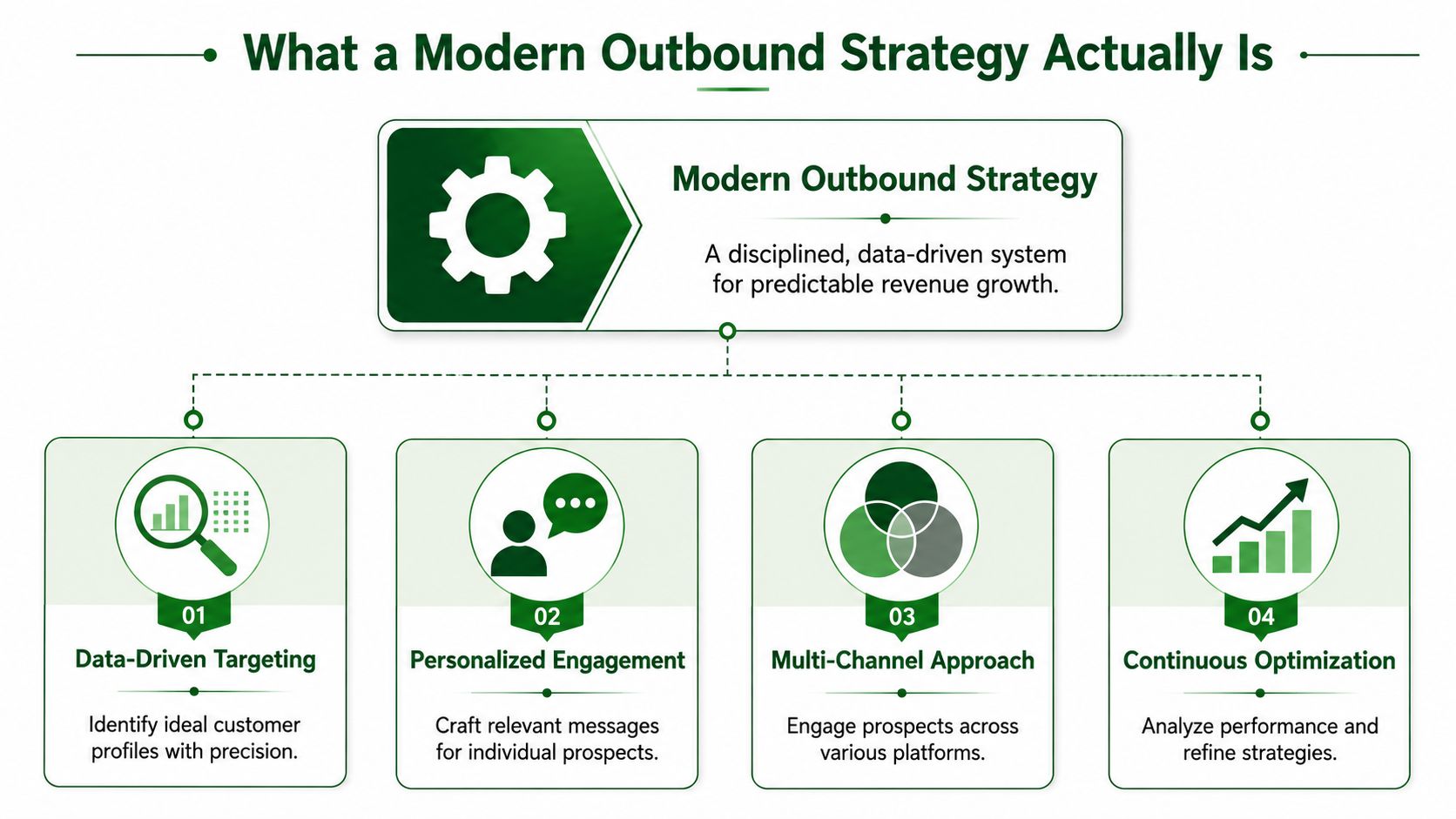
The difference from older outbound models is not just better copy or more channels. The fundamental shift is operational. Strong teams reduce the manual work between account selection and first touch, because that hidden research time is usually the biggest constraint on volume, quality, and follow-up consistency.
Precision beats raw activity
High-performing teams treat targeting as a production problem. They define a narrow ICP using firmographics, buying context, likely pain points, and committee roles, then apply qualification standards before a rep spends serious time on an account. Callbox's overview of B2B outbound sales strategies points to the same principle. Better outcomes start with better selection.
That changes the economics of outbound.
If a rep has to open six tabs, check job changes, scan the website, verify contacts, and write notes before sending one email, the team does not have a messaging problem first. It has a throughput problem. Outreach quality then falls for a predictable reason. Research takes too long, reps cut corners, and follow-up gets delayed.
A modern strategy fixes that upstream. It gives the team a clear standard for what must be known before outreach and a faster way to collect it.
In practice, that means:
- ICP definition happens before list building: Industry, size, operating model, trigger conditions, and role coverage are set in advance.
- Qualification starts before discovery: Account fit, contact relevance, and timing signals are checked early, not after a meeting lands.
- Priority is signal-based: Teams rank accounts by fit and context, not by whoever appeared in a static list export.
- Research is structured: Required fields, approved sources, and handoff rules are documented so context is usable across reps and sequences.
Teams that still rely on one-by-one prospecting usually hit the same ceiling. Reps can either research well or move fast, but not both for long. A structured outbound research workflow changes that trade-off by turning account prep into a repeatable input instead of a manual tax on every touch.
The strategy is a system, not rep improvisation
A usable outbound strategy answers a specific set of questions. Which accounts enter the program. Which contacts matter inside those accounts. What evidence justifies outreach now. What message angle fits each segment. How many touches the team will attempt. When an account gets recycled, paused, or disqualified. What gets written back to the CRM so the next person does not start from zero.
That operating discipline matters more than any single script.
I have seen teams with average messaging produce steady pipeline because their research standards, routing rules, and follow-up process were tight. I have also seen teams with strong copy underperform because every rep was building their own list, using their own qualification logic, and storing context in private notes.
Good outbound creates focus and preserves rep time for selling. It narrows the account set, raises context quality, and makes personalization realistic at scale.
What modern outbound avoids:
- Loose list building: Broad lists force reps to do hidden qualification work manually.
- Single-channel dependence: Buyers respond in different places, and the process has to support that.
- Rep-specific workflows: If process quality varies by rep, pipeline quality will vary with it.
- Research bottlenecks: When prep lives in browser tabs and spreadsheets, throughput stays capped no matter how good the sequence looks.
The point of the strategy is not more activity. The point is a system that can prepare the right accounts fast enough, with enough context, for reps to execute consistently and create pipeline on purpose.
The Core Components of a High-Performing Outbound Engine
Most outbound programs underperform because one component is weak and leadership keeps trying to solve the wrong one. A sequence won't save a bad list. A clean list won't save weak messaging. Better copy won't fix a broken handoff between research, outreach, and measurement.
ICP and list construction
The first job is deciding who belongs in the program.
That sounds obvious, but many teams self-sabotage at this point. They define the ICP too loosely, then ask reps to compensate later with better messaging. That creates bloated lists full of accounts that look acceptable on paper but don't share the same pain, urgency, or buying context.
A workable list does more than name companies and titles. It should reflect:
- Firmographic fit: Industry, size, geography, and business model.
- Role relevance: The actual buying committee, not just the most senior title available.
- Operational context: Tech stack, hiring motion, or visible conditions that support the pitch.
When teams skip this, SDRs end up doing hidden qualification work manually. That slows everything downstream.
Messaging and personalization at scale
Personalization is where outbound gets expensive.
Many teams agree that generic cold email performs poorly. The problem is that they still rely on one-by-one research to make messaging relevant. A rep opens LinkedIn, checks the company site, looks for recent activity, scans the CRM, and tries to turn that into a custom opener. Repeat that across a real target list and the time cost becomes obvious.
The better approach is to standardize what counts as useful context. Don't ask reps to find anything. Ask them to work from a repeatable set of qualifiers and hooks.
Useful personalization usually comes from a short set of inputs:
- Role-based pain: What this function is usually responsible for.
- Company context: What changed, launched, shifted, or became visible recently.
- Signal-backed hook: A concrete reason the outreach is timely.
Relevance doesn't mean writing poetry. It means giving the prospect a believable reason to read the next line.
Cadence design across channels
Cadence design is where strategy becomes behavior.
An effective outbound engine doesn't depend on one perfect message. It uses planned repetition across multiple surfaces. Email may create awareness. A call may create urgency. LinkedIn may create familiarity. Used together, they give the rep more ways to earn attention without repeating the same ask in the same format.
That requires operational choices:
- Touch spacing: Leave enough room for context to build, not just activity to pile up.
- Channel purpose: Don't use every channel the same way.
- Exit criteria: Decide when to pause, recycle, nurture, or disqualify.
Without those rules, cadences become noise. Reps either over-contact low-fit accounts or under-contact strong ones.
Data, tooling, and operational discipline
The final component is the machinery behind the motion.
A high-performing outbound engine needs clean movement between list sourcing, enrichment, research, sequencing, CRM updates, and reporting. If reps copy and paste data between tools all day, the system leaks time everywhere. If managers can't trace performance back to segment, message angle, or sequence path, optimization turns into guesswork.
A practical stack usually needs these layers:
| Layer | Purpose | Common tools |
|---|---|---|
| CRM | Record activity and opportunity movement | Salesforce, HubSpot |
| Prospecting data | Build and enrich target lists | LinkedIn Sales Navigator, Apollo, ZoomInfo |
| Engagement | Run coordinated outreach | Outreach, Salesloft |
| Research workflow | Turn account context into usable conversation hooks | Internal research processes or specialized research platforms |
The lesson is simple. Outbound quality depends on how well the system reduces friction before the first message goes out.
Actionable Frameworks and Sample Outreach Playbooks
A playbook should tell reps what to do on Monday morning, not just what principles leadership believes in.
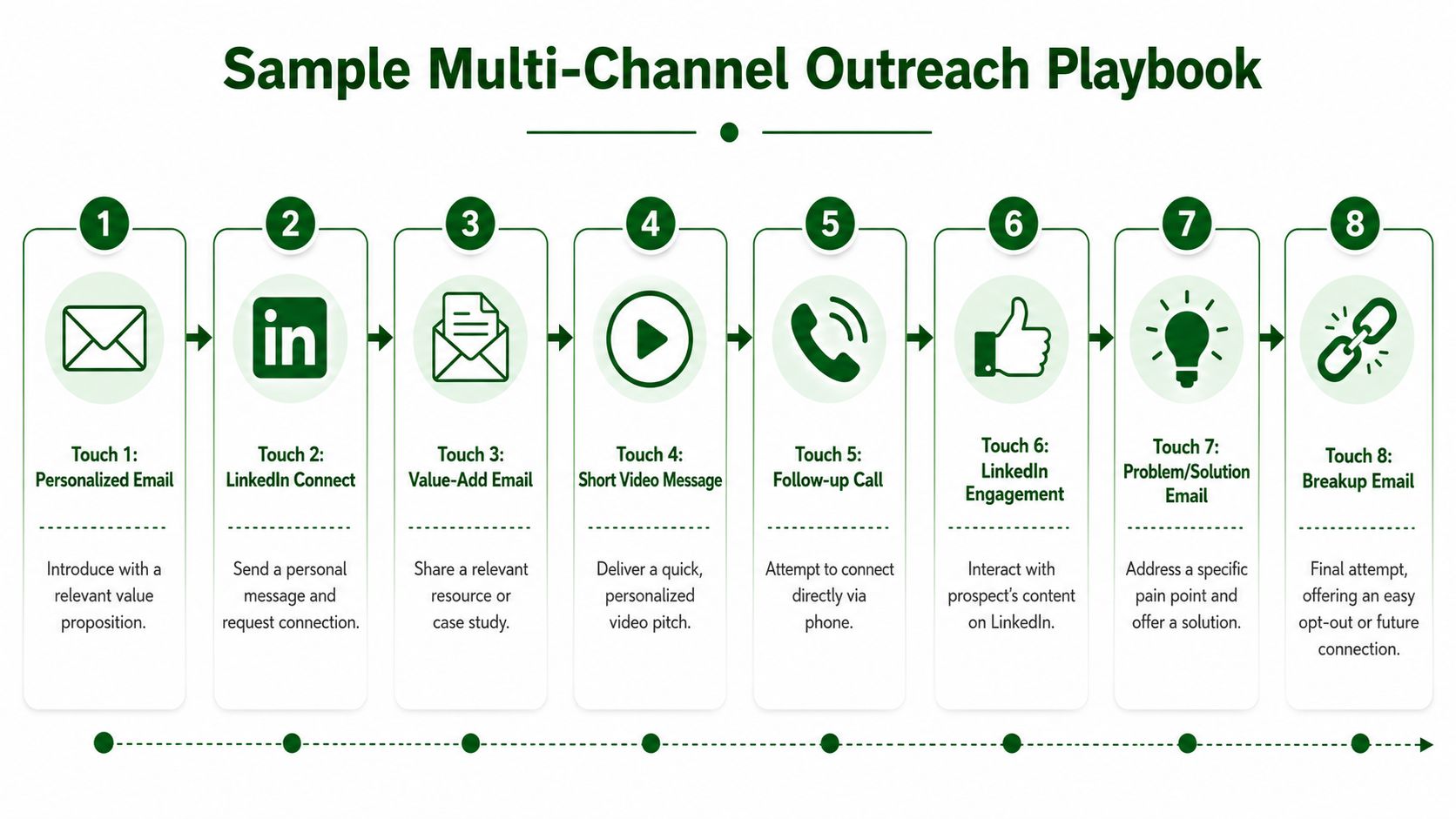
The best guidance in current sales strategy points to 8 to 10 follow-ups over 3 weeks using a multi-channel mix, and says smaller, highly targeted campaigns outperform broad outreach by 2.76x, according to SalesHive's 2025 outbound sales strategy review. That's useful because it gives teams a practical shape for outreach. Tight targeting. Planned persistence. Multiple channels doing different jobs.
A practical sequence structure
A workable outbound playbook doesn't need to be clever. It needs to be executable.
Here's a simple pattern many B2B teams can adapt:
Touch 1 starts with context
Send an email with one clear reason the account fits and one plausible pain tied to the role.Touch 2 creates familiarity
Use LinkedIn to connect or engage lightly. Don't paste the same email into a direct message.Touch 3 adds value
Send a follow-up email that sharpens the problem statement or references a useful angle the buyer would care about.Touch 4 tests direct contact
Call with a short opener tied to the same thesis. The goal is not a full pitch. It's a live reaction.Touch 5 revisits from another angle
Return to email or LinkedIn with a fresh hook, not a generic "just bumping this."Touch 6 forces a decision
Use a short final message that makes it easy to reply, defer, or opt out.
This is why generic sequence libraries usually disappoint. The sequence structure can be standardized. The reason for contact can't be.
A lot of teams also look to PitchSmart's outbound sales articles and guides for examples of signal-led outreach workflows, especially when they want to connect list segmentation and message hooks more tightly.
A simple three-step message pattern
If you need a message framework that reps can use, keep it this tight:
Step one: trigger
Open with the specific business context, role context, or buying signal that justified outreach.Step two: implication
Connect that trigger to a likely pain, risk, or inefficiency. Keep it grounded in the prospect's world.Step three: low-friction ask
Ask for a short conversation, a reaction, or permission to send something relevant.
That same structure works across email, LinkedIn, and voicemail. The wording changes. The logic doesn't.
A strong opener doesn't just sound personalized. It explains why this prospect is hearing from you now.
The most useful refinement is turning raw signals into conversation plans. If a prospect showed pricing interest, attended a webinar, or repeatedly engaged with a topic, the rep needs a clean way to reference that context without sounding robotic. That's much harder when every rep is inventing the approach alone.
The Pivot From Manual Research to Automated Intelligence
Outbound teams spend a large share of their week on work that never reaches a prospect. That is the constraint leaders underrate.
The bottleneck is not usually sequence copy or channel selection. It is the time required to find context, verify fit, gather signals, and turn that raw input into something a rep can use. As noted earlier, non-selling work consumes too much rep capacity. In practice, that means the outbound engine slows down before messaging ever has a chance to perform.
Why linear prospecting breaks
The traditional workflow is one rep, one account, one research session at a time. It feels careful. It does not scale.
I have seen this pattern cap output in otherwise strong teams. A rep opens LinkedIn, checks the company site, scans recent news, looks for hiring trends, hunts for a trigger, writes a few lines, then starts over on the next account. Even if each step is done well, the process is slow, inconsistent, and hard to manage.
Three problems show up quickly.
Research quality varies by rep and by day. Good reps still cut corners when activity pressure rises.
Useful insight does not accumulate. One rep may notice that a segment reacts to funding events, new leadership hires, or expansion into a new market, but that learning often stays buried in tabs and private notes instead of feeding the team's targeting rules.
Signal timing slips. If it takes days to work through a list, the accounts with the strongest reason to contact first may get touched last.
This is the hidden cost of manual research. Leaders think they are choosing between personalization and scale. The actual trade-off is between a linear workflow and a system that can process context in parallel.
What parallel research changes
A better model runs research across the list before reps begin outreach. The team defines the market, fit criteria, and target signals once, then applies that workflow at scale so reps start with ranked accounts and usable context instead of blank tabs.
That shift changes operations in four practical ways:
- Qualification gets tighter: accounts are checked against the same fit rules instead of each rep making judgment calls alone.
- Signal capture gets cleaner: trigger events are pulled into one workflow instead of being found inconsistently.
- Segmentation improves: teams can group accounts by urgency, pain pattern, or message angle before writing sequences.
- Rep time moves to higher-value work: more hours go to prioritization, calls, follow-up, and objection handling.
The gain is throughput. A team that can research fifty or five hundred accounts in parallel can test more segments, refresh lists faster, and reach prospects while the trigger is still relevant.
This short demo shows the shift clearly in practice:
Automation matters because it changes where human judgment is used. Reps should spend time deciding which accounts deserve attention, which angle fits the signal, and how to handle a live objection. They should not spend most of the day copying details from one tab to another.
Teams usually search for better scripts first. The larger gain often comes from removing the research work that keeps good scripts from being used at scale.
That is the key pivot in modern outbound. Better research throughput, cleaner signal capture, and faster movement from list to informed outreach raise outreach velocity more than another round of template edits.
Measuring What Matters The Right KPIs for Outbound Success
If your outbound dashboard starts with emails sent, you're measuring effort before effectiveness.
Best-practice guidance for modern outbound recommends combining email, phone, and LinkedIn, then tracking sequence-level metrics such as open rate, response rate, meetings booked, and win rate to ascertain which channel combinations move pipeline, as outlined in Artisan's guide to outbound sales strategy. That's the right frame. Measure the system, not just the rep's activity inside one channel.
Leading indicators
Leading indicators tell you whether the motion is healthy before revenue outcomes show up.
They matter because they help isolate where the process is breaking. If open rates are fine but replies are weak, messaging may be off. If replies exist but meetings don't, qualification or call-to-action quality may be weak. If one segment responds and another doesn't, the issue may be targeting, not copy.
Essential Outbound Sales KPIs
| KPI | Category | What It Measures |
|---|---|---|
| Open rate | Leading indicator | Whether emails are getting seen |
| Response rate | Leading indicator | Whether prospects react to the message |
| Positive reply rate | Leading indicator | Whether responses indicate actual interest |
| Meetings booked | Lagging indicator | Whether outreach converts into conversations |
| MQL to SQL movement | Lagging indicator | Whether qualified interest progresses through the funnel |
| Lead-to-customer conversion | Lagging indicator | Whether sourced leads become customers |
| Win rate | Lagging indicator | Whether outbound-generated opportunities close |
A few practical rules keep these metrics useful:
- Track by segment: A blended average can hide the fact that one ICP slice works and another doesn't.
- Track by sequence: Don't judge an email in isolation if the call or LinkedIn touch did the primary work.
- Track by message angle: Problem framing often matters as much as channel choice.
Lagging indicators
Lagging indicators tell you whether the outbound engine creates business value, not just engagement.
Meetings booked is the obvious one, but it isn't enough by itself. A weak outbound program can still book meetings if reps push hard enough. The true test is whether those meetings turn into qualified pipeline and eventually into won business.
That means leadership should review lagging metrics alongside the inputs that created them. Did a specific segment move cleanly from first touch to SQL? Did one conversation hook produce better downstream quality than another? Did a particular sequence blend create more real opportunities than a higher-volume alternative?
RevOps earns its keep. Measurement should create a closed loop between targeting, research, messaging, and outcomes.
The best outbound dashboards don't reward motion alone. They show which combinations of account type, signal, sequence, and message are worth repeating.
When teams do this well, optimization stops being guesswork. It becomes operational learning.
Conclusion Building Your Outbound Flywheel
A modern outbound sales strategy works when it converts research quality into rep capacity, and rep capacity into pipeline.
Teams usually spend the most time on the least visible work. Account selection, contact gathering, qualification checks, trigger research, and message prep happen before the first touch. When that work stays manual, output drops fast. Reps send fewer sequences, follow-up slips, and personalization turns into surface-level token details instead of relevant context tied to an actual business problem.
That is the hidden cost in outbound. The bottleneck is not usually call blocks or email copy. It is the hours burned assembling context one prospect at a time.
The strongest outbound teams treat research as production infrastructure. They define a tight ICP, set qualification rules, standardize signal capture, and run account research in parallel so reps can spend their time on conversations and objection handling. That shift changes the economics of the whole program.
A healthy outbound flywheel looks like this:
- Tighter targeting reduces wasted coverage.
- Faster research increases outreach volume without lowering quality.
- Better context improves reply quality and meeting quality.
- Stronger conversion data sharpens the next round of targeting and messaging.
Each part feeds the next. That is what makes outbound scale without turning into spam.
If you lead SDRs, BDRs, or RevOps, the question is simple. How much selling time is your team losing to manual prospect research every week? If the answer is "too much," fix that system first. Outreach tactics matter, but they sit downstream from the primary constraint.
For teams evaluating how to replace one-by-one prospecting with a faster research workflow, review your current process against that standard. If reps still build account context by hand, pipeline growth is getting capped before the first email or call goes out.