Your reps already know the pain. A target list lands in their lap, the quota clock is ticking, and the first draft looks polished enough, but it still reads like every other outbound email in the inbox. The problem isn't just weak copy, it's the time burned on manual research, the broad company descriptions, and the generic intros that give a buyer no defensible reason to reply.
That's why introduction email sales work has changed. Cold email reply rates have tightened as inbox competition has intensified, with SalesHive citing 2024 average B2B reply rates around 3% to 8%, and a referenced benchmark dropping from 6.8% in 2023 to roughly 3.43% in 2024 (SalesHive). At the same time, 77% to 83% of B2B buyers still prefer vendors to reach out by email over other channels (SalesHive). Email still matters, but the opener has to earn its place.
Why Generic Introduction Emails Fail
A generic introduction email usually starts from the wrong place. It describes the company, nods at the industry, throws in a vague benefit, and ends with a polite ask that could have been sent to any account on the list. That is indistinguishable from mass outreach.
The buyer can feel that gap immediately. If the message does not show what you sell, why this account fits, and why now matters, the recipient has no reason to spend attention on it. The result is predictable, especially when the opening sentence sounds like it came from a template that never saw the account.

Relevance has to start with the offer
The better standard is narrower. Define the product or solution, the problem it solves, the account traits that make it a fit, and the signal that justifies the outreach now. When those four pieces line up, the first email stops being a writing exercise and becomes the final step in a research process.
Practical rule: if you cannot explain why this account fits this offer today, the email is still generic even if the first name is correct.
Structured account research matters here. A multi-product company cannot rely on a generic firmographic profile and hope the prospect connects the dots. Teams need qualifiers, fit scoring, source-linked evidence, and activity-based hooks that connect the account to a specific product line rather than to the company in the abstract.
For revenue enablement and RevOps leaders, that shift matters after acquisition or portfolio expansion. Reps will not cross-sell outside their own lane unless the opener makes the offer feel concrete, credible, and timely. A research process that maps accounts to the right product and the right signal gives the first email a real reason to exist.
Build a High-Converting Introduction Email
A strong first touch does not need to be long, but it does need to be disciplined. ScaledMail recommends keeping sales introduction emails around 60 to 90 words, with five parts in order, a subject line, a specific observation, who you are and what you do, one proof point, and a low-friction CTA (ScaledMail). That structure works because it keeps the writer close to the account thesis instead of drifting into product explanation.
A three-email sequence seeded from the selected hook keeps the same product, qualifier, and signal intact while still giving the rep room to review the final language before sending. The first message sets the frame, the follow-up can tighten the proof, and the third touch can ask for a clear response without forcing a long back-and-forth.
Write from one signal, not five
Start with one product, one account reason, and one current signal. The signal should come from a source the rep can defend, and the account should match the offer closely enough that the message feels like a fit, not a guess. PitchSmart's account research model is useful here because it ties the opener to the selected solution, the buying signal, and the source behind it.
A practical example for a revenue enablement leader at a multi-product software company:
“I saw your team just posted for a manager focused on expansion coverage. We help revenue enablement teams keep reps from selling only the product they already know, so I thought it'd be worth reaching out about how you're handling cross-sell routing across the portfolio.”
That version is still short, but it has a job to do. It names a real signal, connects it to a problem the seller can solve, and frames the offer around expansion behavior rather than a generic business update.
A tighter version cuts the extra explanation:
“Noticed the expansion coverage hire. Are you looking at ways to route cross-sell opportunities across product lines more consistently?”
That second version works better because it keeps the ask small. It does not explain the whole catalogue, and it does not overstate the case.
| Component | What to Include | Failure to Avoid |
|---|---|---|
| Subject line | Specific reason for the outreach, tied to the account | Broad greetings or generic curiosity |
| Opening observation | A source-linked trigger or account fact | Compliments with no business relevance |
| Role sentence | Who you are and why you matter to this problem | Product descriptions that read like a brochure |
| Proof point | One concrete, relevant claim or asset | Stuffing in every capability |
| CTA | One yes/no or low-friction next step | Asking for a long meeting too early |
The best teams draft this as a repeatable standard. Reps keep the same product, qualifier, and signal intact, then review the final language before it goes out. That keeps the sequence consistent while still leaving room for judgment on tone, proof, and timing.
Choose Subject Lines and Opening Hooks
The subject line and the first sentence are one test, not two separate copy problems. If the subject line promises urgency, the opener has to prove it. If the opener starts with a trigger, the subject line should make the trigger visible without sounding theatrical.
Subject line formulas that stay defensible
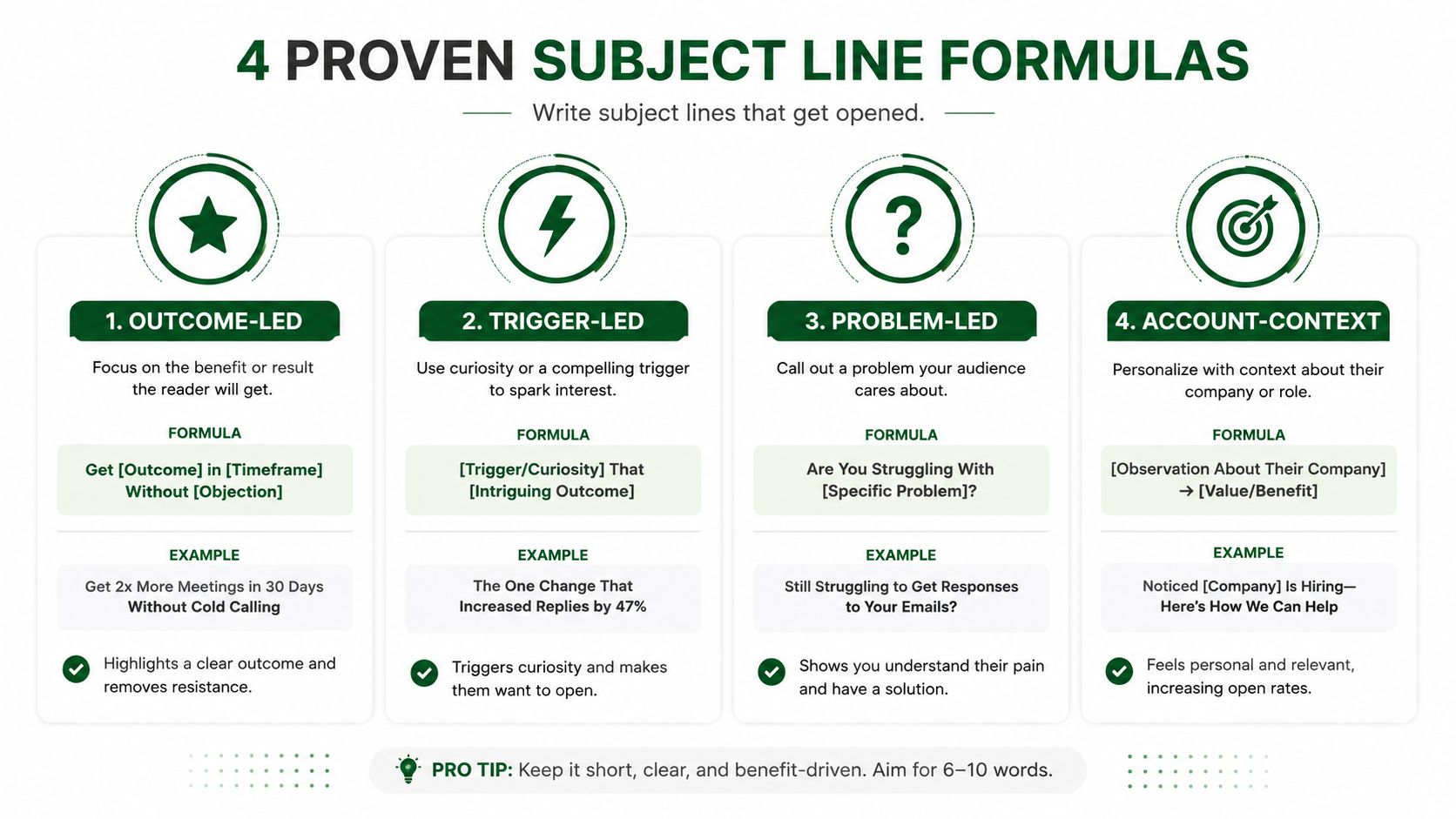
Salesforce recommends subject lines that are short, personalized, timely, and relevant, and it specifically pushes sellers to answer the prospect's questions of why now, why me, and why my industry (Salesforce). That gives you a clean filter. If the line can't support one of those questions, it's probably decorative.
Different formulas fit different account stories:
- Outcome-led: works when the result is easy to state and closely tied to the role.
- Trigger-led: works when a recent event justifies the outreach now.
- Problem-led: works when the pain is obvious and already visible in the account.
- Account-context: works when the message needs to reference a known product line, team structure, or expansion motion.
The opening hook should match the subject. A job change only matters if it changes the buyer's responsibilities in a way your offer can address. A funding announcement only matters if the company is likely to face the operational problem you solve. Hiring, launches, and social activity are useful only when they connect to a real business need.
Opening hooks that sound like business context
A RevOps leader might open with a cross-sell adjacency:
“I noticed your CS team owns renewal risk, but your sales reps still control expansion motions. That split usually creates mixed ownership on the same account.”
A customer success leader might get a role-specific problem:
“Your team is probably seeing the same pattern most CS orgs do, good adoption in one product line, then no obvious path to the second product.”
A BDR or SDR writing to a multi-product account could use an activity-based hook:
“Your recent hiring pattern suggests you're building capacity around a product line, but the follow-on cross-sell motion may still be manual.”
PitchSmart fits in the research layer here, because it links recent activity to account fit and to product-specific hooks. That matters more than a clever opener with no proof behind it. A decorative detail gets ignored. A defensible hook gives the buyer a reason to keep reading.
Create a Three-Touch Follow-Up Sequence
A lot of teams lose the thread after the first send. They either stop too soon or follow up with near-identical nudges that add nothing new. The sequence needs to keep the same account thesis, but each touch has to move the conversation a little further.
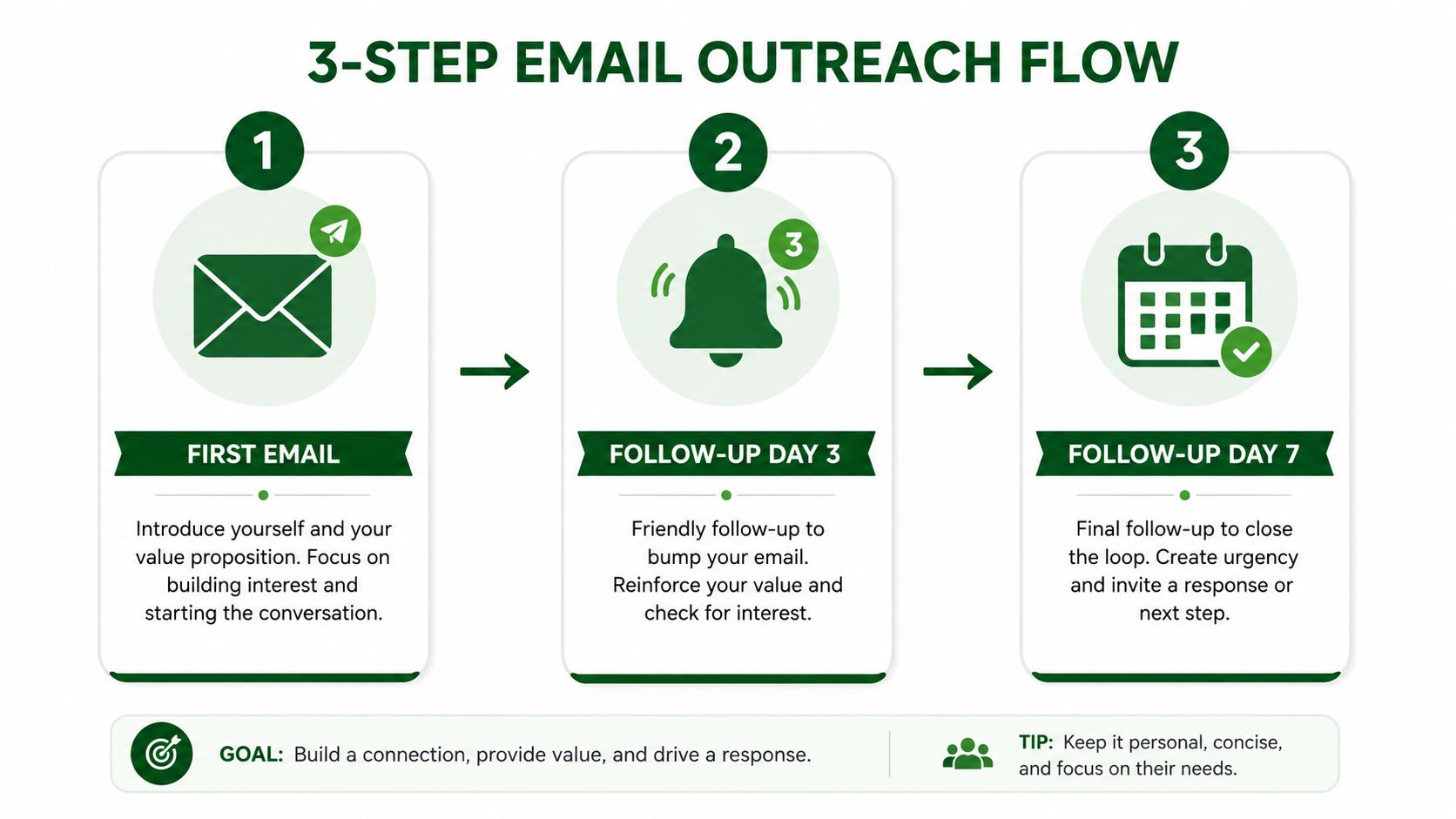
Keep the first touch, then add context
A practical cadence is to send the first email, wait about three days, then send a follow-up with a different angle, then send a final touch a few days later if there's no response. Outreach's template guidance notes that persistence matters and that multi-touch sequences are normal in prospecting (Outreach). The point isn't to nag, it's to let the account thesis show up from more than one angle.
For a multi-product company, the first message might open on cross-sell routing. The second message can introduce an adjacent product only if the account evidence supports it. For example, if the first touch referenced expansion coverage, the follow-up might explain how a second solution helps unify handoff logic across customer success and sales without changing the offer into a full catalogue pitch.
The final touch should be respectful. A simple permission-to-pause note works better than a dramatic breakup line. It keeps the door open without forcing the buyer to make a decision they aren't ready for.
LinkedIn has a narrow role in this sequence. It can add context, support a conversation, or reinforce that the seller has done the homework, but it doesn't replace the email. If the first email is weak, a LinkedIn nudge won't rescue it.
For teams wanting to operationalize the sequence without building custom workflow logic, PitchSmart demo shows how research can seed the first touch and the follow-up from the same account thesis.
Keep the same thesis across the sequence, but don't keep repeating the same sentence. Each touch should earn its own place.
Measure Reply Quality and Pipeline
A first touch can generate replies and still miss the mark. The useful question for outbound leaders is whether those replies turn into real conversations, then qualified opportunities, and eventually pipeline by product or segment. Delivery and bounce indicators matter, but they only tell part of the story. If a team only watches opens, it will optimize for curiosity, not conversation.
Start by checking whether the research was right. If a segment replies but the responses come from the wrong roles, the targeting thesis is off. If one product line keeps producing qualified conversations while another gets noise, the offer definition is probably too broad for that audience.
Compare outcomes by signal type and segment
Break results down by role, signal type, product line, company stage, and rep. That makes it easier to see whether the hook, the offer, or the list is doing the work. A weak message and weak account fit can look the same on the surface, so the team needs to review a sample of replies and non-replies before changing copy.
| Metric | What it tells you | What to adjust if it lags |
|---|---|---|
| Reply rate | Whether the opener gets attention | Targeting, subject line, hook |
| Positive reply rate | Whether the message resonates | Offer fit, relevance, proof |
| Qualified reply rate | Whether the conversation is worth pursuing | CTA, list quality, product match |
| Opportunity creation | Whether the motion supports pipeline | Sequence design, rep follow-up |
| Progression by product | Which offer is actually getting traction | Product definition, segmentation |
The review rhythm matters more than the dashboard. Inspect first-touch performance regularly, read a small sample of replies, and compare the signal used in each message with the account's actual fit. A structured review framework keeps the message anchored on the reason for reaching out, relevant context, and a clear call to action, and review your full product portfolio performance against the same standard so product-level fit is visible instead of assumed.
If the signal is strong but the reply quality is weak, the CTA may be too ambitious. If the CTA is fine but the signal is generic, the research needs work. Either way, the result should point to a sales decision, not just an opinion about copy.
Avoid the Outreach Mistakes That Kill Replies
The quickest way to lose a reply is to make the buyer do the interpretation work for you. If the list is broad, the opening sounds generic, or the ask is too heavy, the recipient has to guess why the message matters. Strong outbound removes that friction before the email is sent.
| Mistake | Why It Fails | Replacement |
|---|---|---|
| Broad list with no product-level fit | The opener cannot connect to a clear use case | Segment by the product and the signal |
| Generic compliment | It reads like mass outreach | Open with a business observation |
| Unconnected trigger | The reader cannot see the problem | Tie the trigger to an account-level issue |
| Full catalogue pitch | It weakens the reason to reply | Focus on one solution only |
| Multi-team introduction | The message loses ownership | Lead with one accountable team or motion |
| CTA that demands a meeting too soon | It creates unnecessary friction | Use a yes/no or small next step |
| Follow-up that repeats the first email | It adds no new reason to respond | Add a new angle or evidence point |
The point is not to sound clever. The point is to make the first touch easy to judge. A rep should be able to point to the offer, the account fit, the buying signal, and the source-linked evidence without stretching the logic.
A before-and-after example shows the difference clearly. Weak version, “Loved seeing your growth, our platform helps teams across sales, CS, and operations, and I'd love to set up time.” Stronger version, “I noticed your expansion motion sits across CS and sales, and that usually makes cross-sell ownership messy. We help revenue teams map one product line to the right account signal, so I wanted to ask whether that is a current priority.”
The stronger version narrows the offer, points to a specific cross-sell hypothesis, and gives the buyer a reason to judge fit quickly. It also carries less reputational risk, because source-linked evidence, visible qualifiers, and traceability make it easier for the rep to verify why the account was selected. For more examples of poor outreach patterns in practice, see the notes on PitchSmart's blog.
Turn Research Into a Repeatable Sales Habit
A good outbound motion makes the same judgment every time. Define the product and the fit criteria, identify the account and current signal, verify the source, select the strongest hook, write one short first email, add a distinct follow-up, and review replies by segment and product. If any of those steps is missing, the message is probably not ready to send.
For a RevOps or enablement leader, the review should stay practical. Check whether product definitions stay consistent, whether qualifiers point back to evidence, whether each opener connects the signal to a real problem, and whether your metrics reflect qualified conversations instead of opens. That audit shows whether the motion is improving or just creating more activity.
PitchSmart fits naturally into that operating model when teams need to research multiple accounts in parallel, score them against a chosen product, keep source-linked evidence attached to each qualifier, and draft a three-email sequence from the strongest hooks. The PitchSmart research layer works alongside rep judgment, and it gives teams a repeatable way to keep account research, product fit, and source-linked proof in the same workflow.
Replace broad company personalization with a product-led, source-backed reason to write. That is the change worth making in the next campaign.
PitchSmart helps teams research accounts against the exact product they're selling, keep source-linked qualifiers attached to each account, and draft a three-touch sequence from the strongest hook. If you're rebuilding your introduction email sales motion around product fit and defensible signals, visit PitchSmart and see how the research layer fits into your outbound process.