The fastest way to improve a business email isn't always the subject line or the opener. Sometimes it's the last line. In outbound, a weak closing wastes the work that came before it, and a strong one gives the recipient a clear next step when they're deciding whether to reply, ignore, or archive.
That matters even more when reps are already buried in manual research and generic outreach. If someone spent half the morning copying company news into a draft, but the ending still says something fuzzy like “Let me know what you think,” the email still dies at the finish. The closing is where clarity, timing, and tone either turn interest into action or let it slip away.
Why Your Email Closing Determines Reply Rates
The closing line is not decorative. A large-scale analysis cited by Woodpecker found that the sign-off “Thanks in advance” produced a 65.7% reply rate, ahead of “Thanks” at 63% and “Thank you” at 57.9% across 350,000+ email threads (Woodpecker's sign-off analysis). That does not mean one phrase closes every deal, but it does show a pattern reps feel in the pipeline, the final words in an email change response behavior.
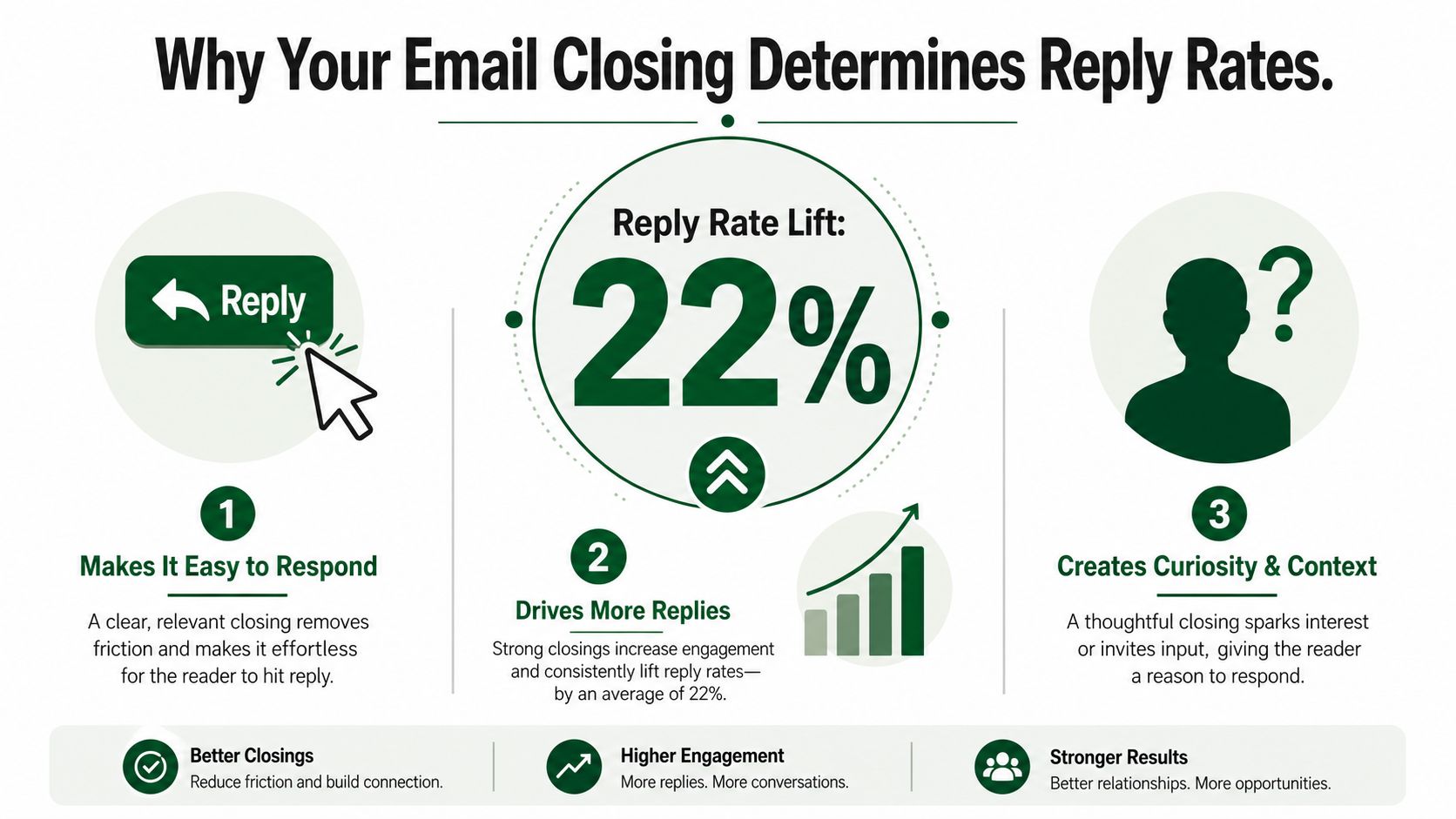
The ending is a conversion mechanic
Outbound sales teams face a simple problem, the close has to reduce friction fast. Campaign Monitor describes the ending as the closing section and says it generally includes a summary plus a call to action, such as requesting an update, scheduling a meeting, or reviewing an application (Campaign Monitor on email endings). The last line gets extra attention, which is why it cannot read like filler.
Practical rule: if the recipient has to infer the next step, the email has already made them do too much work.
That pressure gets worse in outbound sequences because reps usually fight two problems at once. Too much time goes into manual research and admin instead of selling. At the same time, generic messages blur together in crowded inboxes, and weak endings make them even easier to ignore. The result is wasted pipeline.
The ending also has to fit the workflow behind the send. If you are using an automated sequence, the close should still feel specific to the trigger, the prospect's role, or the signal that got them on the list. A closing line tied to a recent hiring push, a product page visit, or a funding event gives the reader a reason to answer now instead of later. The internal link to pitchsmart.io belongs in that same mindset, because the strongest closings are built from the same research that shaped the rest of the email.
Proton's business guidance reinforces the structure that works, a succinct call to action, a professional closing phrase, and then a full name, job title, company, and contact information (Proton on how to end an email). The point is straightforward, the ending should tell the reader who you are, what you want, and what to do next. If it does not, the email may sound polite, but it will not drive replies.
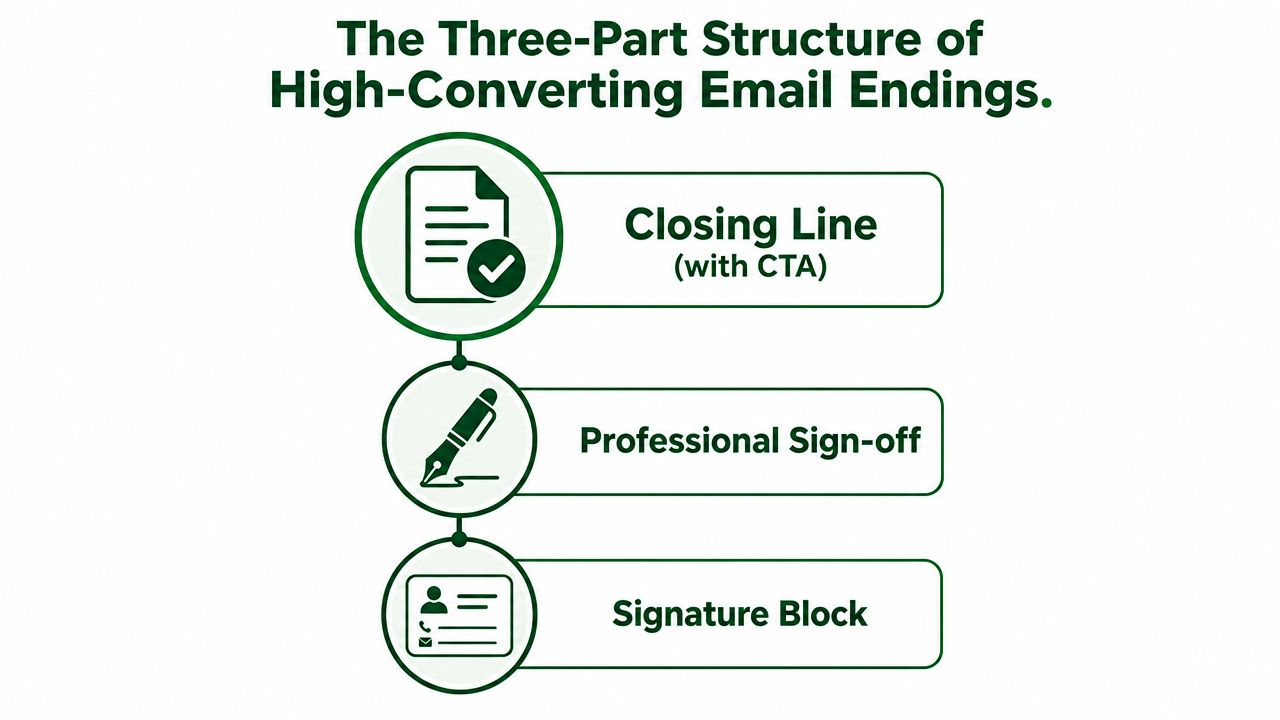
The Three-Part Structure of High-Converting Email Endings
A strong ending has three pieces, and each one does different work. The closing line drives the reply, the sign-off sets tone, and the signature removes confusion about identity and context. When one of those pieces is missing, the email feels less deliberate and harder to answer.
Start with a single explicit CTA
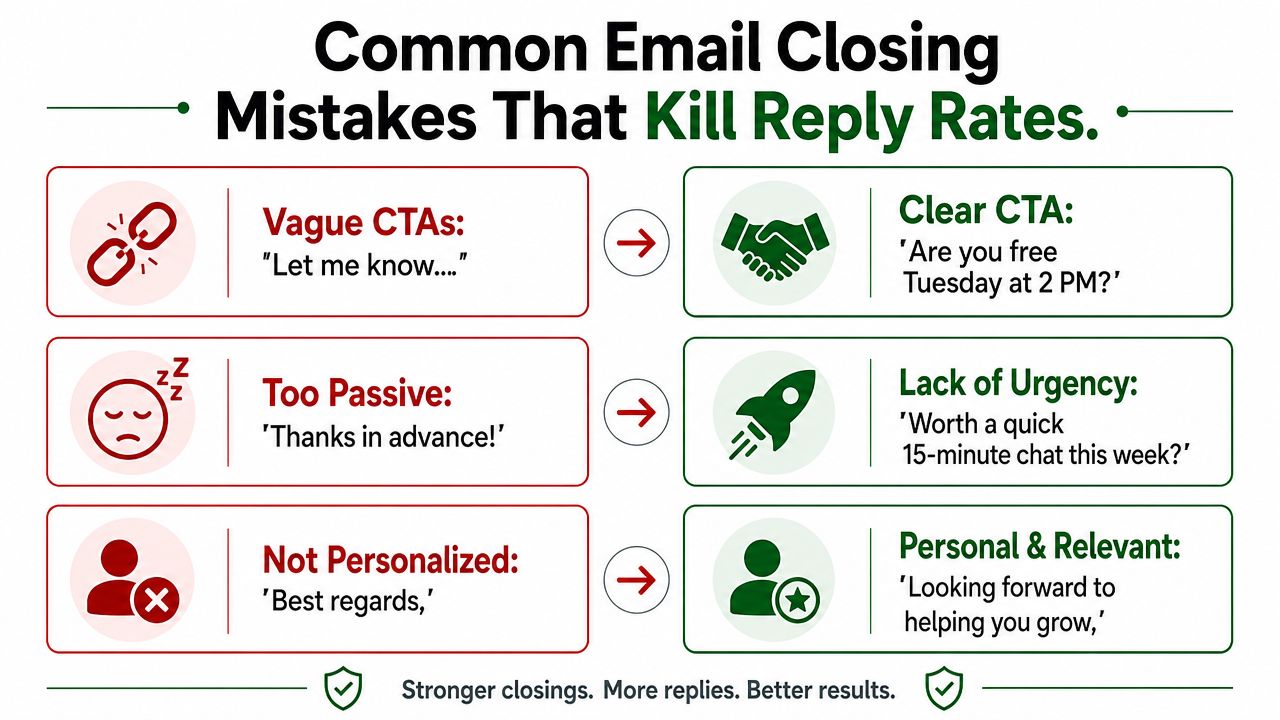
The closing line should ask for one thing. Not three. A direct ask like “Are you free Tuesday at 2pm for a 15-minute call?” works because it gives the recipient a concrete decision.
This contrasts with vague closings like “Let me know what you think,” which shift the burden onto the buyer to invent the next move and often kill momentum. The better habit is to make the next action obvious and easy to answer in one reply. In outbound sequences, that matters because weak closes waste the signal your research already earned.
Match the sign-off to the relationship
The sign-off is where tone lives. First-touch outreach usually needs something professional and neutral, while a follow-up to a warm contact can sound a little more familiar without getting sloppy. Skipping the sign-off entirely makes the email feel impersonal and careless, and punctuation or capitalization mistakes can make the whole note look rushed.
Short version: the sign-off shouldn't try to sell. It should make the email feel human and complete.
Keep the signature clean and scannable
A signature should help the recipient verify who's writing without making them hunt. Woodpecker recommends a final line, full name, job title, and a clean 4-line signature. In practice, that means enough context to be credible, but not so much clutter that the ending turns into a wall of badges and banners.
A simple format works best:
- Call to action: one clear next step
- Sign-off: polite and context-appropriate
- Signature: full name, title, company, one contact method
A structured outreach process keeps this from getting sloppy. PitchSmart fits that approach because the same discipline that helps the final line earn replies also keeps the whole message aligned with the prospect's signal.
Closing Strategies for Different Sales Email Scenarios
Generic advice fails because the recipient's relationship to you changes the right ending. A cold email to a stranger should not close like a follow-up to a warm lead, and an internal note should not read like a prospecting message. The closing has to match the level of trust, urgency, and expected response, because that last line can change whether a prospect replies now, later, or not at all.
Use the right end for the right message
For cold outreach, low-friction curiosity usually works better than pressure. A line like “Worth a quick chat?” gives the buyer a lightweight decision and does not overbuild the ask. For follow-ups, the closing can reference the prior conversation and point to a new reason to respond, especially if you have learned something relevant since the last touch.
For meeting asks, time specificity matters. A closed-ended question with a proposed window gives the recipient less room to stall and more room to answer. Internal emails can be more direct, especially when the audience already knows the context and does not need a full identity block.
The University of Pennsylvania career guidance makes the same point in a different way, the ending should vary based on whether you know the recipient, whether the contact is outside the organization, and whether you need a fast reply (UPenn Career Services). This is the practical approach, context first, template second.
A simple matrix keeps the trade-offs visible:
| Email Type | Closing Line Example | Sign-Off | Signature Elements |
|---|---|---|---|
| Cold outreach | “Worth a quick chat next week?” | Best, | Full name, title, company |
| Warm follow-up | “Does this change your priorities for Q2?” | Thanks, | Full name, title, company, contact method |
| Meeting request | “Are you open Tuesday at 2pm or Wednesday at 10am?” | Best regards, | Full name, title, company, calendar link if relevant |
| Internal update | “Can you confirm by 3pm?” | Thanks, | Full name, team, direct contact if needed |
Keep the ask aligned with urgency
The cleanest closes do not overexplain. Model Reef recommends a micro-recap, a single next step, and a deadline or timing cue so the reader can answer “who owns what?” and “by when?” without scrolling. That matters in sales because the closer the ask is to a real business action, the less chance it gets lost in the inbox.
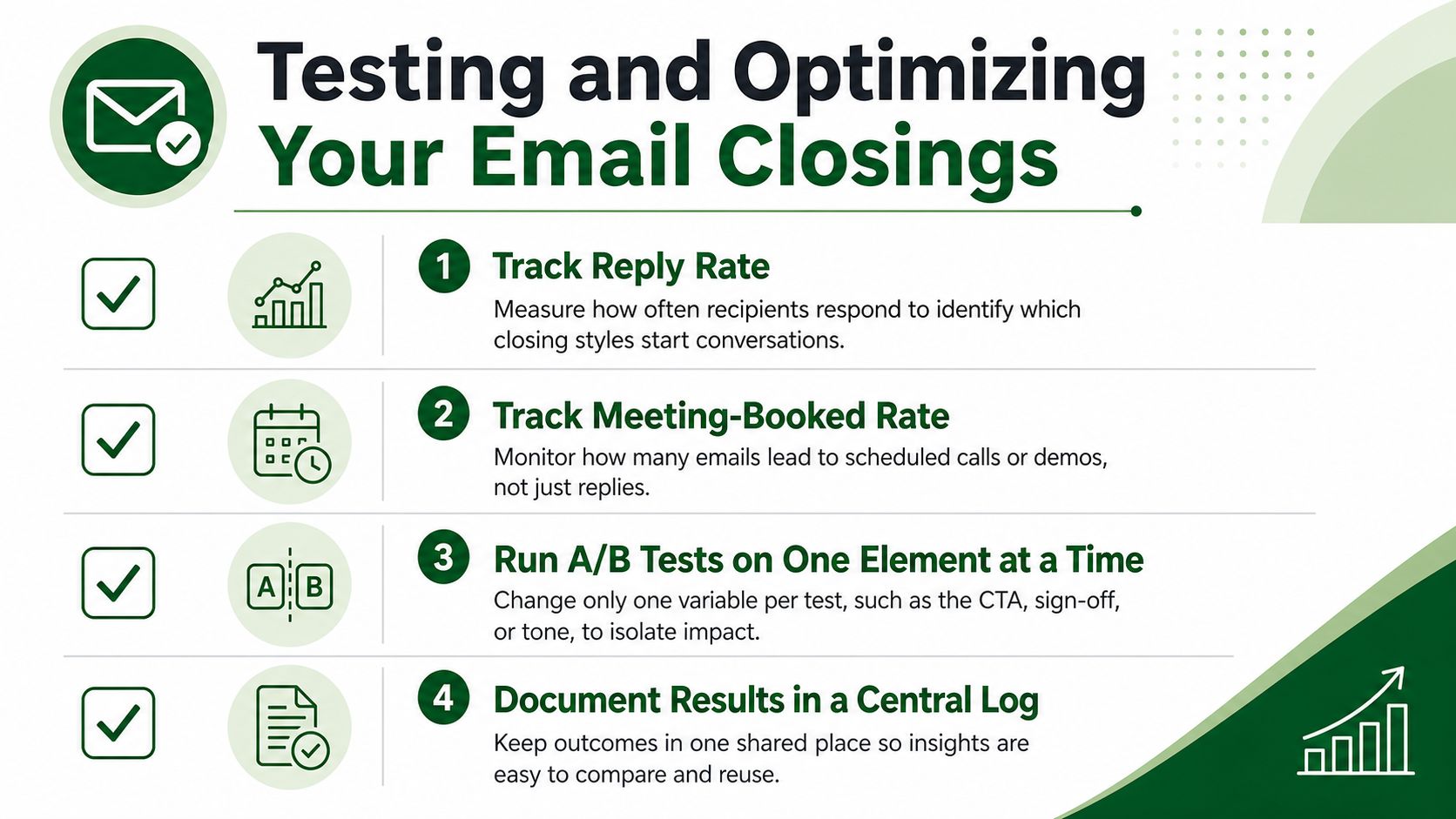
A decision-maker does not need a polished essay at the bottom of the email. They need a clear ending that tells them why you are reaching out, what reply you want, and whether the request is time-sensitive. That is what keeps the closing line useful in outbound sequences, and why reps should treat the ending as a measurable reply-rate lever instead of a formality.
For teams building around signal-based outreach and automated sequencing, PitchSmart's blog is a useful place to look at how closing language fits into the larger sending workflow. The right ending should reflect the signal behind the email, then make the next action easy to take.