If your SDRs are still opening every morning with a bloated spreadsheet, a half-clean CRM export, and a stack of tabs from LinkedIn, you already know the core problem. The team isn't short on hustle, it's drowning in manual research, stale data, and generic outreach that never had a chance to feel relevant.
That's why how to score leads can't be treated like a math exercise alone. A scoring model only works when the inputs are trustworthy, the thresholds are calibrated to closed-won history, and the sales team can act on the score without wasting hours hunting for context.
Why Most Lead Scoring Models Fail Before They Start
Most scoring projects don't fail in the spreadsheet, they fail in the data layer. If reps are still spending their day stitching together account details from browser tabs, copying titles by hand, and guessing at fit from a LinkedIn headline, the score is already compromised before the first point is assigned.
A lead score is supposed to rank prospects objectively. Oracle frames it as a structured ranking system built from explicit-data categories for profile fit and implicit-data categories for engagement, then weighted into a final score that helps sales separate real buying signals from noise Oracle lead scoring framework. That only works if the underlying records are complete, current, and consistent.
The actual bottleneck is research, not scoring math
In production, bad inputs show up in predictable ways. A lead gets a high engagement score because someone clicked three emails, but they're in the wrong industry, too small to buy, or outside the territory. Another lead looks weak because the CRM missed a title field, so the model undercounts a person who was a strong match.
That is why lead scoring needs to sit on top of bulk research and clean enrichment, not one-by-one rep judgment. PitchSmart blog is a useful place to compare research workflows, because the operational problem is the same across teams, gathering enough reliable firmographic and activity data to make the model worth trusting. PitchSmart is one option that fits this workflow, because it enriches entire lists in parallel, ties signals back to source material, and gives outbound teams a way to score prospects without forcing reps to do the research by hand.
Practical rule: if the team can't trust the firmographics and activity history, the model should stay in pilot mode.
The actual point is simple. Lead scoring is not a replacement for research, it is the output of research at scale. Once the list is clean and the signals are usable, scoring becomes a routing system instead of a guess.
Building the Two Pillars of Fit and Behavior
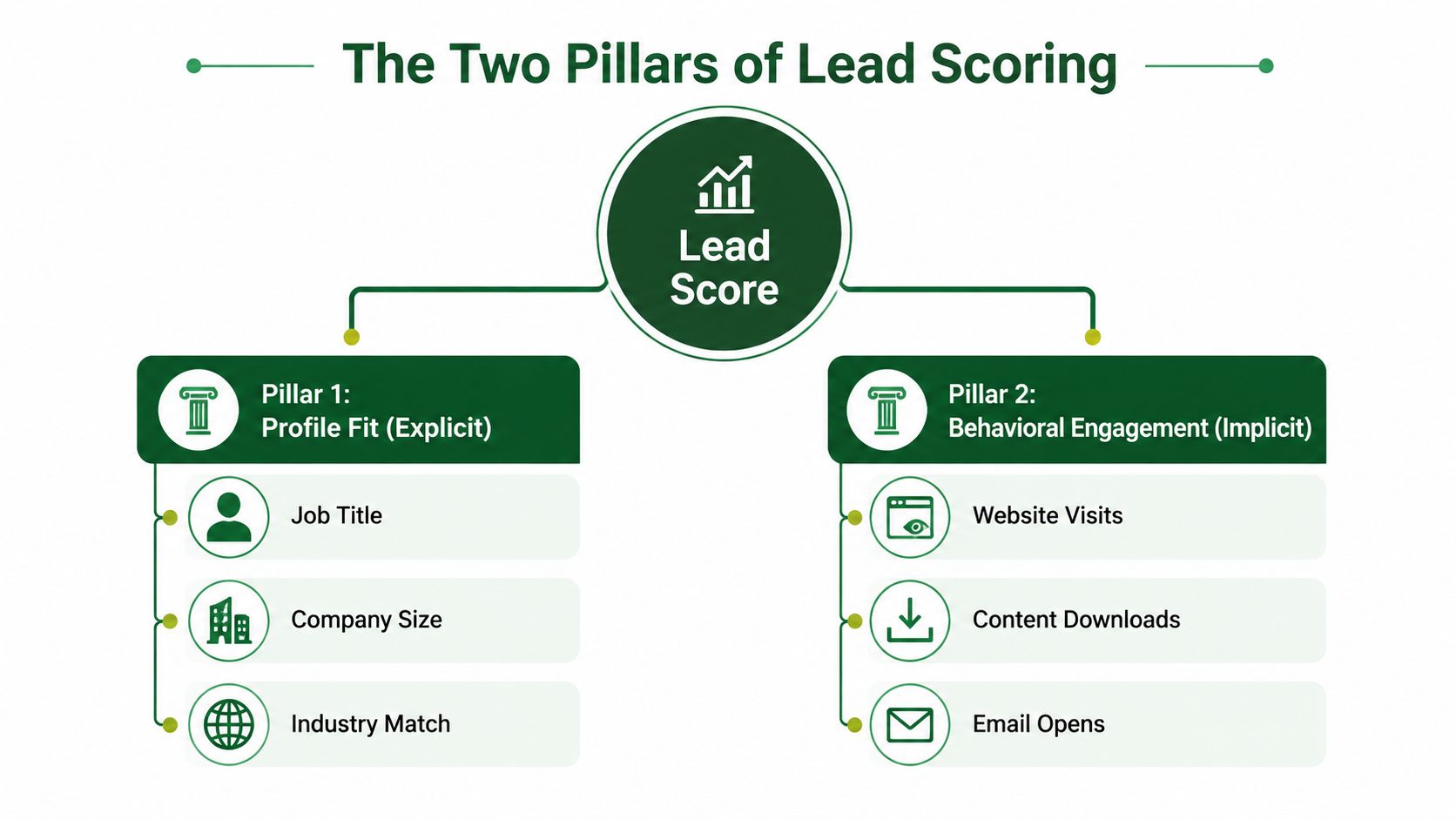
A durable model starts with two separate questions. Who is this person? and what have they done? Oracle's split model answers those with explicit data for fit and implicit data for engagement, which keeps the scoring logic clean enough for sales to trust and marketing to tune Oracle split model.
The fit layer
For fit, define four to five identity categories, then assign percentage weights that total 100% Oracle lead scoring framework. In most B2B SaaS motions, those categories usually include industry, company size, job title, geography, and sometimes technology stack or ownership model. The point isn't to maximize complexity, it's to isolate the attributes that best separate closed-won accounts from the rest.
Oracle also recommends classifying fit with a letter grade from A to D and using that structure as the profile side of the final rating Oracle split model. In practice, that makes it easier to tell sales whether a contact is structurally strong even before engagement kicks in. A person can be an excellent fit and still need nurturing, or they can be active but structurally weak.
The behavior layer
Behavior needs a different logic. Oracle recommends weighting actions by recency, then ranking engagement from 1 to 4, where A1 is the strongest combination and D4 the weakest Oracle split model. That gives you a way to reward signals that show intent now, not six months ago.
The weighting has to reflect real buying intensity. A pricing page visit should count more than a blog read. A demo request should count more than a newsletter open. Salesforce's guidance is to assign higher point values only to attributes whose close rates beat the overall baseline, which keeps the model anchored to conversion behavior instead of opinion Salesforce lead scoring guidance.
Practical rule: fit tells you whether a lead belongs in the market, behavior tells you whether they're moving now.
Once those two pillars are separate, the final score becomes much more useful. Sales can prioritize fast-moving, high-fit leads. Marketing can keep lower-intent contacts in nurture without pretending they're sales-ready.
Calculating Point Values from Historical Conversion Data
Gut feel is the fastest way to make a scoring model useless. If a team assigns points because sales reps like webinar attendees or because pricing page visits feel important, the model turns into folklore fast.
Start with your lead-to-customer conversion rate. Compare each attribute's close rate against that baseline, so the score reflects closed-won behavior instead of opinions. HubSpot uses the same baseline idea and notes that teams can compare property-level close rates against the overall rate before deciding what earns points HubSpot scoring tool.
A comparison table beats a guess
Build a simple table from CRM history, then rank each attribute by how it performs against the baseline. If an attribute closes better than average, it deserves points. If it underperforms, it should get fewer points, zero, or even a subtraction if your model supports negative scoring.
| Attribute Close Rate vs Baseline Comparison | Attribute | Close Rate | Baseline Rate | Lift | Points Assigned |
|---|---|---|---|---|---|
| Example scoring rubric | Industry match | Higher than baseline | Overall conversion rate | Positive | Higher points |
| Example scoring rubric | Job title match | Higher than baseline | Overall conversion rate | Positive | Higher points |
| Example scoring rubric | Webinar attendance | Higher than baseline | Overall conversion rate | Positive | Moderate to high points |
| Example scoring rubric | Blog visit only | Lower than baseline | Overall conversion rate | Negative or zero | Low or no points |
The point values should come from the same history you are trying to model. Validate against historical leads that had enough time to convert or be rejected, then check whether converted leads score higher on average. Look for outliers where winners scored too low, because that usually means a useful signal was undervalued or buried under noisy engagement. Salesforce recommends grounding point assignment in actual closed-won behavior and using the conversion history as the test, not intuition Salesforce lead scoring guidance.
What the validation loop is really doing
A low-value action can look powerful if it happens often, but that does not mean it closes. Raw engagement volume can drown out more predictive signals when teams score by frequency alone instead of comparing conversion lift, which is why the historical review has to separate noise from buying intent Salesforce lead scoring guidance.
Use closed-won data from your own funnel, not a universal playbook. Monday recommends analyzing closed-won deals from the past year and scoring on a 100-point scale, then reviewing the last 6 to 12 months of scores and watching MQL volume, MQL-to-SQL conversion, and SQL-to-closed conversion after threshold changes Monday lead scoring rules. That gives you a model tied to what happens in your pipeline.
Negative Scoring and Signal Decay Rules
A lot of teams build scores that can only go up. That looks tidy in a dashboard, but it creates bad routing, because stale interest and disqualifying traits never really leave the model.
Negative scoring fixes the first half of that problem. Outfunnel explicitly notes that many guides stop at closed-won analysis and positive actions, while better frameworks also review losses and subtract points for disqualifying traits or behaviors Outfunnel lead scoring. That matters because a lead can be active and still be a bad fit.
Closed-lost analysis should shape the negative list
Look at your rejected opportunities and ask which patterns showed up before the deal died. Common negatives include unsubscribes, invalid data, no buying authority, or long stretches of silence. HubSpot's scoring tool supports subtracting points for negative behaviors, such as an unsubscribe or a region you don't serve, which makes the score reflect disqualification as well as interest HubSpot scoring tool.
Decaying stale engagement matters just as much. Prospeo recommends adding decay rules from day one, with an example of subtracting 10 points after 30 days of no interaction and another 10 points at 60 days, so that by 90 days of silence the lead drops back into nurture instead of sitting in the MQL queue Prospeo decay guidance.
Negative signals should be deliberate. If a lead keeps opening emails but never shows real intent, decay and subtraction should eventually beat the vanity of activity.
Why decay saves the sales queue
Decay prevents old attention from masquerading as current intent. HubSpot's scoring logic also supports time-based event decay, which is useful because the value of an interaction should fall as it gets older HubSpot scoring tool. Without that, sales keeps chasing leads that were hot weeks ago and cold now.
A production model needs both mechanics together. Negative scoring removes obvious bad fits. Decay removes stale momentum. If you leave either one out, the score stops representing buying readiness and starts representing historical noise.
Automating Research and Scoring in Your CRM
A score that only exists in a spreadsheet is decoration. It has to update when records are created, when data changes, and when new signals arrive from research or engagement systems.
The first job is data hygiene. Remove duplicates, normalize fields, and make sure marketing and sales aren't using different conventions for titles, industries, or regions. HubSpot's scoring model depends on criteria rules tied to properties and events, so dirty fields create inconsistent evaluation from the start HubSpot scoring tool.
Feed the model with research, then let CRM automation do the rest
Bulk research changes the economics. PitchSmart can take a list, research it in parallel, surface proprietary data points and activity-based hooks, and push those signals into the fields a scoring model depends on. That means the score isn't waiting on a rep to manually open tabs and copy over context.
A practical workflow looks like this:
- Standardize the record. Normalize company names, domains, titles, and territory fields.
- Map research outputs to score inputs. Tie fit signals to explicit fields and behavior signals to engagement fields.
- Automate score updates. Let the CRM recalculate the score on create and update, the way HubSpot updates score properties retroactively and continuously once a score is live HubSpot scoring tool.
- Route by threshold. Send sales-ready leads to SDRs, and put lower-scoring records into nurture or sequence logic.
PitchSmart works in that flow because it is built around your own lists, not a rented database. It also supports bulk research and built-in outreach creation, so the same signals that improve scoring can become the basis for a first message.
Warning is simple. Automation without clean research inputs just automates bad decisions faster. If the scoring fields are weak, the routing logic will be weak too.
Calibration KPIs and Review Cadence
Lead scoring drifts as soon as the market moves. ICP definitions change, buying committees shift, and the signal that predicted conversion last quarter can lose sharpness fast.
That is why the model needs an owner and a review process, not just a setup project. Review the last 6–12 months of scores, then watch MQL volume, MQL-to-SQL conversion, and SQL-to-closed conversion in the 30-day window after any threshold change. Those KPIs show whether the score is improving handoff quality or just creating more activity at the top of the funnel. The point is to measure downstream movement, not celebrate a bigger pile of scored records.
The feedback loop has to come from sales
Sales disposition data matters as much as marketing analytics. When reps reject leads, the reason should feed back into the scoring model so you can correct false positives and false negatives. ZoomInfo is direct on this point, cross-functional calibration between sales and marketing is part of a sound scoring workflow, and the model should be based on your own closed-won and closed-lost history rather than generic assumptions ZoomInfo lead scoring.
That feedback loop needs a schedule, not an ad hoc cleanup when someone notices routing has gone sideways. A quarterly review cadence usually works because it gives enough time for real patterns to emerge without letting drift sit too long. HubSpot also lets teams inspect score history and score property usage, which helps when you are tracing why a threshold change altered routing behavior HubSpot scoring tool.
| Model Checkpoint | What to Review | Why It Matters |
|---|---|---|
| Score distribution | Are too many leads landing in the same band? | Flags threshold compression |
| Sales rejects | Which leads were passed, then rejected? | Reveals false positives |
| Closed-won outliers | Which winners scored lower than expected? | Exposes missing signals |
| Threshold impact | Did handoff improve after the change? | Confirms the update worked |
A useful review also checks whether your inputs are still current. If research is still being gathered by hand, the model starts to drift before the score even gets a chance to work. Bulk enrichment tools like PitchSmart reduce that manual cleanup, and the PitchSmart pricing page is useful if you are comparing the cost of automation against the time your team spends patching bad records.
What good calibration looks like
The model should get stricter where false positives are high and more forgiving where strong leads are being missed. Salesforce recommends comparing each attribute's close rate to the overall baseline, then updating weights as customer behavior changes, which is the kind of review logic a RevOps team should standardize and revisit often Salesforce lead scoring guidance.
A healthy score is never finished. It is a living configuration that gets sharper when sales is honest about poor handoffs, when marketing is willing to adjust the assumptions behind the model, and when negative signals, score decay, and review cadence are treated as part of the operating system rather than cleanup work after the fact.
How Scored Leads Transform the SDR Daily Workflow
The biggest change in an SDR team isn't the score itself, it's the shape of the morning. Instead of opening a 200-lead queue and starting from zero, the rep opens a ranked list where the highest-fit, highest-intent accounts are already surfaced and the weaker ones are already routed elsewhere.
That changes the entire job. High-priority leads get immediate outreach. Mid-tier leads enter a shorter sequence. Weak-fit or stale records stay in nurture. The score becomes a working queue, not a reporting artifact.
The first touch gets sharper because the research is already done
Lead scoring and research should meet. If the scoring system is connected to bulk enrichment and activity-based hooks, the SDR isn't guessing at a message angle. They're opening with a relevant signal from recent online behavior, then using that signal to make the first touch feel informed instead of sprayed.
PitchSmart is built for that workflow because it combines bulk list research, signal-backed hooks, and automated sequence creation from those hooks. In practice, that means the rep can act on the score without spending the first hour of the day assembling context.
Operational truth: the best scoring system doesn't just rank leads, it tells the SDR what to say next.
The difference shows up in consistency too. When score bands are tied to routing logic, managers stop relying on tribal judgment. The team knows what a hot lead means, what a nurture lead means, and what needs a human review before outreach starts.
A scoring model only creates pipeline when the SDR can trust it and move fast on it. If you want that kind of workflow, PitchSmart gives outbound teams a way to research lists in bulk, surface buying signals, and turn those signals into outreach sequences without the manual grind that breaks scoring in the first place.