Your AE has a list of accounts that match the ICP, a few contacts from LinkedIn, and a CRM full of old notes. Before writing a single outbound message, they open company websites, scan job posts, check product pages, search for leadership changes, and try to work out whether the account has a problem your product solves. By the time they send the email, the research is thin, the message sounds generic, and the prospect has little reason to reply.
That work consumes selling time. Salesforce's 2026 sales statistics page says reps spend 60% of their time on non-selling tasks, including hunting for pitch materials, entering customer notes manually, and chasing internal approvals, as reported in this summary of the sales-rep time data. Cold outreach gives teams little room for waste: one 2026 benchmark based on more than two million emails reported a 2.09% average reply rate in cold-email research, while Belkins reported a 0.45% average reply rate for strict cold outreach across 2025 campaigns in its cold-email study.
For a quota-carrying AE, qualification isn't a formality. It decides which accounts deserve research, which contacts deserve a message, and which opportunities deserve a place in the forecast. For RevOps, it determines whether marketing and sales are using the same definition of “ready.”
Introduction Why Most Teams Qualify Too Many Wrong Leads
Teams qualify too many wrong leads because they treat qualification as a property of the account instead of a decision about a specific problem and a specific solution. A software company may fit your firmographic profile perfectly, yet have no reason to buy the product you're prospecting for. The same company might be an excellent expansion target for another product line.
That distinction matters even more in a multi-solution business. Revenue enablement leaders, customer success teams, and CROs often manage a customer base assembled through acquisition, with several products sold into the same accounts. If each rep knows only the product they inherited, cross-sell research becomes a sequence of guesses. One team calls an account “qualified” because it's large enough. Another calls it qualified because someone visited a pricing page. Neither answer says qualified for what.
Qualification is therefore a resource-allocation filter. It helps a team decide where human attention is justified, not whether a contact has performed an isolated action. A form fill can indicate curiosity. A well-matched account with a current operational change, several involved stakeholders, and a clear problem gives an AE a more defensible reason to spend time.
The practical question: Would you assign a rep to this account today, for this product, based on evidence another rep could inspect?
The rest of the process follows from that question. You need a shared definition, a clean distinction between MQL and SQL, a framework that fits the deal, and scoring that reflects both fit and intent. You also need a handoff rule that doesn't collapse when one company sells several solutions into the same customer base.
The durable answer isn't more manual browsing or more generic sequences. It's product-defined research that connects each qualifier to a source, separates accounts by buying signal, and gives the rep a relevant reason to start a conversation.
What a Qualified Lead Means in B2B
A qualified lead matches the product's ideal customer profile and shows enough intent or engagement to justify sales effort. Qualification commonly examines industry, company size, role, budget, timing, and need before a lead moves to sales as an SQL, as outlined in this B2B qualified-lead definition and benchmark synthesis.
The definition has two dimensions, and both must be evaluated for the specific product.
Fit asks whether the account and contact make sense for the solution. Does the company operate in the target market? Is its size compatible with the commercial model? Does the contact influence the workflow the product changes? In an expansion motion, fit may also include use of a related product, the right operating structure, or ownership of the problem the solution addresses.
Intent asks whether the prospect's current behavior justifies sales time. A pricing-page visit, demo request, repeated content engagement, hiring pattern, product change, or participation from several stakeholders may indicate active evaluation. None proves a buying process alone. The AE still needs context about why the signal occurred and whether it connects to the product being sold.
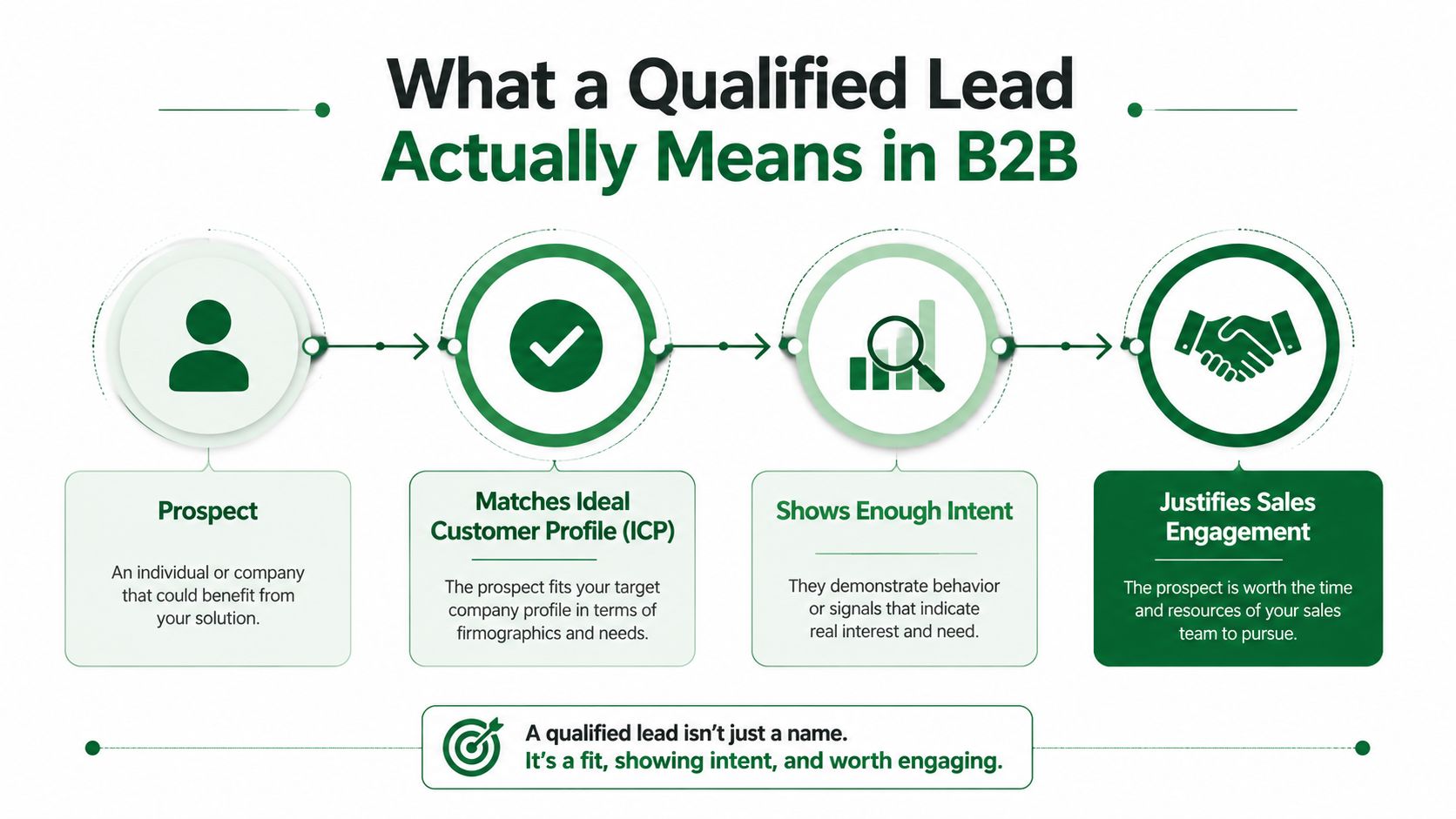
A useful analogy is a building. Fit is the right building. Intent is seeing the lights on inside. A large software company may be the right building, but if its current situation has no connection to your product, the address alone should not trigger an intensive sequence. An active researcher at a company outside your serviceable market may show intent while remaining a poor use of sales capacity.
Why a shared threshold matters
Teams need a common threshold because funnel stages leak. One synthesis reported that only 13% of MQLs become SQLs, while the broader funnel converts 2.3% of website visitors into leads, according to the qualified-lead benchmark review. The figures do not predict your conversion rate. They show why “interested” and “sales-ready” need separate definitions.
A useful qualification record captures the evidence behind the decision:
- Fit evidence: The company, role, and use case match the product's target profile.
- Intent evidence: The prospect or account has shown behavior connected to the problem.
- Context: The signal has a plausible business explanation, rather than activity alone.
- Next action: The rep knows whom to contact and which issue to discuss.
Treat qualification as a product-specific probability gate. Strong fit with credible intent can justify active outreach. Strong fit with weak intent may belong in monitored nurture. Strong intent with weak fit may require no sales action at all. The same account can therefore qualify for one solution and fail the threshold for another, which is why scoring rules must be tied to each product's buyer, problem, and evidence.
MQL SQL and Other Lead Types Explained
Lead types describe who has qualified the record and what evidence exists, not four interchangeable labels for “good lead.” The distinction matters because each stage carries a different owner, action, and expectation.
MQL
A marketing-qualified lead has met marketing's engagement or scoring criteria. That might include repeated content engagement, a form submission, or another behavior the team has decided is worth tracking. An MQL is a prioritization signal, not proof that the buyer has a confirmed project.
Marketing owns the quality rule. RevOps should make the rule visible, define which actions contribute to it, and monitor whether sales accepts the resulting records.
SQL
A sales-qualified lead has passed marketing's score and then been validated by sales. The conversation should confirm a real need, relevant authority, a realistic buying horizon, and budget where it matters. This SQL qualification guidance describes the state as a higher-resolution judgment because sales has tested the buying situation rather than relying on surface engagement.
An SQL is ready for active pursuit, but it isn't automatically an opportunity. Opportunity creation should require enough evidence that the account has a problem, a plausible path to a decision, and a reason for the rep to invest further.
PQL
A product-qualified lead is defined by meaningful product use. The person or account has experienced the product, explored relevant functionality, or reached a usage pattern your team associates with value. PQL criteria will differ sharply between a self-serve product and an enterprise platform, so the threshold must reflect the actual product journey.
A PQL can still be a poor sales target if the company doesn't fit the commercial profile. Product activity supplies evidence of interest, not a waiver for fit.
SAL and other internal states
A sales-accepted lead, or SAL, is an internal handoff state. Sales has accepted responsibility for working the record, even if the rep hasn't yet confirmed need, authority, timing, and budget. It helps RevOps separate “marketing sent it” from “sales agreed to act.”
The historical shift from contact collection to structured qualification made these distinctions useful. By the early 2020s, qualification was described as a systematic way to identify prospects most likely to become profitable customers, with scoring separating raw leads from SQLs. A published review found an average prospect-to-qualified-lead conversion rate of about 10%, while 1% to 6% of leads ultimately became customers, as summarized in this lead-qualification history and research review.
The handoff breaks when marketing optimizes for activity and sales is judged on conversations. The fix isn't to remove MQLs. It's to document the evidence required to move from MQL to SAL to SQL, then review rejected records for a specific reason such as poor fit, weak need, wrong role, or no current priority.
Common Qualification Frameworks and How to Apply Them
BANT, MEDDIC, and CHAMP are different lenses on the same job. They help a rep test whether an account has a problem worth solving, the ability to make a decision, and a credible path to purchase. They shouldn't become rigid scripts that force an AE to ask for information a prospect can't reasonably provide.
BANT for a fast screen
BANT, Budget, Authority, Need, and Timeline, works well when an AE needs a quick first pass. It asks whether money exists, whether the contact can influence the decision, whether a real need exists, and whether the timing is credible.
Its weakness is sequencing. Asking about budget before establishing a problem can make a discovery call feel like procurement. In outbound, much of BANT should remain provisional. Public research may suggest the company is expanding or changing direction, but the contact must validate budget, authority, and timing.
MEDDIC for complex sales
MEDDIC, Metrics, Economic Buyer, Decision Criteria, Decision Process, Identify Pain, and Champion, suits a complex enterprise motion with multiple stakeholders. It forces the AE to understand how the customer measures value, who controls the economic decision, how the decision will be made, and whether someone inside the account will advocate for the purchase.
The cost is time and information. Don't run a full MEDDIC inspection on an account that hasn't shown a credible problem. Use the lighter elements first, then deepen the record as the opportunity earns attention.
CHAMP for challenge-led discovery
CHAMP, Challenges, Authority, Money, and Prioritization, starts with the prospect's problem. That makes it useful for outbound because an AE can lead with a business change rather than an unverified product pitch.
The decision rule is simple:
- Use BANT when you need a quick qualification screen.
- Use MEDDIC when several stakeholders, a significant implementation, or formal decision criteria are involved.
- Use CHAMP when the primary uncertainty is whether the problem matters now.
Framework rule: Use one framework to guide the conversation, then record only the fields that change your next action.
The framework also needs to change by product. Budget and authority mean something different for a focused departmental tool than for a broad platform with multiple owners. A VP of Customer Success might be the economic buyer for one solution, while Revenue Operations controls evaluation for another. The account hasn't changed. The buying journey has.
Real Signals That Reveal a Qualified Lead in Outbound
A software company hires revenue operations staff and then visits a pricing page. Those signals work together. The hiring suggests a change in operating capacity, while the pricing activity suggests evaluation of a solution related to that change. Urgency remains unproven, but the AE now has a specific problem to investigate.
The same pricing-page visit means something else when it comes from a student, consultant, or competitor. Activity alone does not identify a buying project. A single visit shouldn't move an account into a sales sequence on the basis of page-ease alone.
Stronger signals have context
Durable qualification signals combine fit, behavior, and business context. The right combination depends on the product being sold. A lead can qualify for a departmental tool while failing the fit test for an enterprise platform with broader ownership and implementation needs.
Examples include:
- A relevant operating change: The company introduces a product line, reorganizes a team, or hires for a function connected to your solution.
- A connected behavior pattern: The account returns to product or comparison content while reviewing implementation, integration, or commercial information.
- Multiple stakeholders: Relevant people engage with the same topic, suggesting the issue may extend beyond one person's research.
- A usable conversation hook: The signal gives the rep a defensible opening, such as a new customer-success structure or a cross-sell challenge visible in the account's public activity.
The strongest opener is a relevant observation about the prospect's situation, followed by a question that tests whether the related problem exists. The product determines which observation matters. A new RevOps hire may support outreach for workflow software, yet carry less weight for a solution aimed at customer-success teams.
Research behavior can mislead
A committee may browse comparison pages for weeks while one member gathers background. Several people may return to the site to prepare a presentation, benchmark vendors, or research a competitor. Repeated activity adds context, but it does not establish need or priority.
Guidance on qualification often emphasizes demo requests, pricing-page visits, and form fills without clarifying when those actions mislead during longer buying cycles. This analysis of intent signals and research behavior examines why the useful question is which signals remain trustworthy for a particular product and market.
For an SDR, the change in messaging is concrete. An opener such as, “Would you be interested in learning more about our platform?” offers no account-specific reason to respond. A stronger version connects a public operating change to a product-specific issue, then asks whether that issue is on the roadmap. The message tests qualification instead of assuming it.
At scale, store the signal's source, the product it relates to, and the next sales action. That structure helps teams distinguish a lead qualified for one solution from a lead that belongs in another motion. For a practical view of how account research and outbound actions can be organized, review the PitchSmart portfolio.
How Scoring and Handoff Turn Qualification Into Pipeline
A scoring model becomes useful when it tells a rep what to do next. The model should separate fit score from intent score, then combine them without allowing a burst of activity to hide a poor account match.
Start with fit attributes. Product-specific fit might include industry, company size, operating model, role, existing product footprint, or a known problem. Add intent behaviors such as relevant page visits, demo requests, repeated engagement, public business changes, and participation from more than one stakeholder.
Build the matrix before the formula
Think in quadrants rather than one mysterious number:
| Low intent | High intent | |
|---|---|---|
| High fit | Monitor and develop a product-specific hook | Route to sales for active qualification |
| Low fit | Suppress or disqualify | Nurture, investigate, or redirect to another product |
One industry guide notes that teams commonly set a sales handoff threshold in the 60 to 80 range, as described in this lead-scoring guidance. Treat that range as an operating reference, not a universal answer. Your threshold should reflect the cost of sales time, the product's buying cycle, and the quality of evidence available.
Avoid score inflation by applying negative rules. A high-volume content consumer shouldn't outrank a well-matched account with a credible business change. A competitor, student, supplier, or irrelevant geography may need a hard exclusion even if activity is high.
Route by product, not just account
Multi-product companies need separate scoring models or product-specific score layers. A single account can be:
- High fit for a customer-success solution because it has a large service organization and a visible retention initiative.
- Low fit for an outbound enablement product because its sales motion doesn't require the workflow.
- High intent for a RevOps solution because the company is consolidating systems after an acquisition.
The routing record should therefore answer four questions: which account, which product, which evidence, and which action. Marketing can nurture high-fit, low-intent accounts. Sales can pursue high-fit, high-intent accounts. Customer success can receive cross-sell actions when an existing customer shows a product-specific need.
Set a review loop with sales. When an AE rejects an SQL, record the reason. When an opportunity advances, check which signals were present. RevOps can then remove weak indicators, strengthen durable ones, and adjust product thresholds instead of arguing from anecdote.
Teams that want to examine this model against their own account and product definitions can request a PitchSmart demo.
Putting It All Together With Smarter Research and Automation
The manual process fails because reps research one account at a time, across disconnected sources, without a stable definition of what they're looking for. The replacement is not generic automation. It is product-specific research at account scale.
Define each solution by the problem it solves, the accounts that fit, and the signals that matter. Then research the account against that definition. For an outbound team, the workflow should produce:
- Traceable qualifiers: Each fit attribute and buying signal links to the source behind it.
- Product-level scoring: The account receives a fit assessment for the selected solution, not a universal account grade.
- Signal-based segmentation: Accounts separate into active buying, relevant change, weak intent, expansion opportunity, or disqualification.
- Conversation hooks: The most useful recent signals become possible openers for the rep.
- A short sequence: The system drafts a three-step email or LinkedIn sequence from the strongest hook, while the rep reviews whether the interpretation is accurate.
That structure answers the question most qualification guides leave open. A prospect isn't qualified or unqualified. It is qualified for a particular solution, problem, and buying motion. This discussion of qualified B2B leads makes the same central distinction: universal thresholds miss the fact that one prospect can be strong for one solution and poor for another.
For a multi-solution company, the same process also supports expansion. Revenue enablement and customer success leaders can map existing accounts against the full portfolio and produce a concrete action: this account, this product, this signal, this opener. Outbound teams can upload their own lists, research accounts in parallel, and export the resulting contacts and sequences into the tools they already use.
You can find more practical guidance in the PitchSmart blog. The immediate test is small: take one account, define the product you want to qualify it for, inspect the evidence, and ask whether the recommended outreach would make sense to an experienced AE.
PitchSmart researches accounts against the specific product you sell, scores fit using traceable evidence, segments buying signals, and drafts three-step email or LinkedIn sequences from relevant hooks. Visit PitchSmart to research one account and see whether product-specific qualification gives your team a clearer next action.