Your sales reps are wasting most of their day, and the damage shows up in pipeline before it shows up in dashboards. Reps should be researching the right accounts, opening conversations, and moving deals forward. Instead, they get stuck in browser-tab work, manual enrichment, CRM cleanup, and generic outbound that sounds like it was written for nobody.
That's a bigger problem now because the sales model itself has changed. In B2B, 70% to 80% of sales interactions now happen through digital channels, according to Flowlu's sales statistics roundup. If your motion is digital-first, then sloppy research and weak messaging don't just slow execution. They are execution.
The mistake I see most often is treating types of sales like labels. Outbound. Inbound. ABS. PLG. Channel. Those labels matter, but they hide the core question: what operational work does each model require, and can your team execute it without drowning in admin? That's where many teams break down. They choose a model that sounds right, then run it with bad segmentation, stale signals, and outreach copied from the last campaign.
This guide breaks down 10 types of sales for B2B teams, but from the practitioner angle that matters most. What each model is, where it fits, what usually goes wrong, and how to run it without wasting rep time on manual research.
1. Outbound Prospecting
80 percent of B2B sales interactions are expected to happen in digital channels by 2025, according to Gartner's sales research. That shifts outbound from a pure volume play to an operational choice. Teams still need reps to create demand, but they also need a repeatable way to research accounts, personalize quickly, and run enough touches to earn a response.
Outbound prospecting works best when the team needs control over pipeline creation. Startups use it to reach a narrow ICP before brand demand exists. Mid-market SaaS teams use it to open new segments or territories. Agencies use it to keep meetings coming even when referrals slow down. The common thread is simple. Outbound gives you coverage where inbound is too slow, too uneven, or too expensive.
What fails is usually the operating model. Reps get handed broad lists, weak account context, and a message that could apply to anyone. Then leadership wonders why reply rates stay low and call blocks rise.
What works in outbound now
Modern outbound rewards preparation. A rep who knows the account's trigger, business model, and likely pain point can send a message that feels relevant without writing a custom essay for every prospect. A rep who starts with a scraped list and no context burns time and domain reputation.
Three practices separate productive teams from busy teams:
- Segment before writing: Build lists by industry, company size, role, and trigger. The message for a newly funded SaaS sales leader should not look like the message for an operations director at a regional services firm.
- Use real signals: Hiring patterns, expansion moves, leadership changes, new product launches, and visible process friction give reps a reason to reach out now.
- Run coordinated sequences: Email, LinkedIn, and selective calling work better together than as disconnected activities. The sequence should reflect account value and likely buyer behavior, not just rep preference.
I use one rule here. If a rep needs six tabs and fifteen minutes to produce one decent opener, the outbound motion is too expensive to scale.
That is the strategic trade-off with outbound. It offers control, but it also creates research and execution overhead. Teams can brute-force that work with more headcount, or they can reduce the manual steps. PitchSmart helps on the second path by pulling account research, surfacing usable signals, and turning them into structured outreach workflows reps can act on fast. If you are designing this motion, review modern sales workflow guides first, then decide whether a platform with usage-based outbound workflow pricing fits your team better than adding more list building and copywriting labor.
2. Account-Based Selling
Account-based selling works when the account is valuable enough to justify concentrated effort. Instead of chasing volume, you focus on a shortlist of high-fit accounts and treat each one like its own market. That usually means mapping stakeholders, understanding current priorities, and coordinating outreach across functions.
This is the right motion for enterprise SaaS, complex services, infrastructure software, and any sale where multiple stakeholders can slow or kill a deal. Salesforce selling into a large enterprise buying committee is different from a startup trying to book a fast demo with a single manager. The sales type changes because the buying environment changes.
A useful way to think about ABS is economic fit. Bain argues that teams need to balance service, segmentation, and scale, while evaluating route-to-market choices such as digital engagement, inside versus outside coverage, and partnerships in underserved segments, as explained in Bain's analysis of small-business sales economics.
Where ABS wins and where teams waste effort
ABS wins when the account has enough potential to justify deeper research and tighter coordination. It fails when teams call everything ABM or ABS, then spread enterprise-level effort across too many accounts.
Common failure patterns:
- Researching one champion only: Real deals often involve finance, operations, IT, procurement, and the business owner.
- Using generic personalization: Mentioning the company name and recent funding round isn't account strategy.
- Ignoring motion economics: Some accounts deserve high-touch treatment. Others need a lighter sequence and faster qualification.
ABS should feel expensive on purpose. If it feels cheap, it's probably just outbound with better branding.
PitchSmart helps here by letting teams segment high-priority accounts differently, gather signal-backed research across the account, and automate outreach around the strongest hooks instead of forcing reps to hand-build every sequence. For teams deciding whether to run broad outbound or concentrated account work, the PitchSmart pricing page makes that trade-off easier to evaluate operationally.
3. Inbound Sales
Inbound sales begins with buyer activity, but the hand-raise alone tells you very little. One lead downloaded a guide for research. Another visited the pricing page twice in a week because a budget conversation is already happening. A third signed up for a free tool with no buying intent at all.
That mix is why inbound is a strategic choice, not just a source of leads. Teams that rely on inbound need strong routing, fast follow-up, and clear rules for separating curiosity from active demand. Without that operating layer, reps spend prime selling time on low-intent conversations and respond too slowly to the accounts that are ready now.
Why inbound still needs operational discipline
Modern buyers often do a large share of their evaluation before they ever speak to sales, and many arrive with a shortlist already in mind, as noted earlier. The job in inbound is to diagnose intent quickly, add context the buyer has not found on their own, and move the right opportunities into a real sales process.
The best inbound teams usually get three things right:
- They read the buying signal, not just the form fill. A demo request, pricing-page visit, webinar attendance, and template download should not trigger the same workflow.
- They match the first response to the path in. A lead coming from educational content needs a different conversation than an account comparing vendors.
- They qualify with enough structure to route well. Good inbound qualification reduces wasted meetings without turning the first touch into an interrogation.
HubSpot is still a useful example because its content, tools, and product education work together to create demand and shape buyer expectations before a rep steps in. But even inbound-heavy teams need some of the same research habits found in outbound and ABS. If a high-fit account comes in, the rep should understand the company, likely stakeholders, and probable reason for urgency before sending the first reply.
The operating trade-off becomes evident. Inbound can lower acquisition friction, but it creates a different execution burden. Teams need clean lead-source data, visible engagement history, smart routing logic, and response workflows that adapt to intent. Platforms like PitchSmart help by organizing those signals and giving reps enough account context to prioritize serious opportunities without manually piecing the story together from forms, page views, and scattered CRM notes.
4. Consultative Selling
Consultative selling is what strong reps do when the deal is too important for a scripted pitch. The rep acts like an advisor, not a feature narrator. That means discovery comes first, recommendations are customized, and the process keeps returning to the buyer's actual constraints.
This model works especially well in enterprise software, professional services, healthcare technology, and any category where implementation, process change, or internal alignment matters. A rep selling SAP, a consultant selling transformation work, and a sales engineer guiding a complex evaluation are all operating in consultative territory.

Good consultative selling starts before the call
The biggest mistake in consultative selling is showing up unprepared and trying to improvise insight live. Buyers notice immediately. If your first three questions could apply to any company, you're not consulting. You're extracting information because you didn't do the work beforehand.
Forecastio highlights the data that supports this motion: lead and contact data, opportunity data, activity data, and pipeline metrics such as stage conversion, aging, coverage ratio, and velocity, all described in its guide to sales data analysis. Those inputs matter because consultative selling isn't just about rapport. It's about connecting actions, patterns, and outcomes.
The best discovery question is usually built on something the rep already knows.
A strong consultative rep will enter the call with a view of company context, likely operational friction, stakeholder roles, and recent signals that suggest why the conversation is happening now. PitchSmart supports that prep work by turning bulk research into usable context before the meeting, which is far more valuable than asking reps to gather it one account at a time.
5. Solution Selling
Solution selling shifts the conversation from individual features to the larger problem the buyer is trying to solve. Instead of pitching a point product in isolation, the rep shows how a set of capabilities works together to fix a broader workflow, reduce fragmentation, or improve an end-to-end process.
This model is common in platform companies. Microsoft doesn't just sell a single tool. Atlassian often wins by showing how Jira, Confluence, and Bitbucket fit together. ServiceTitan sells operational coverage, not just one isolated function. The buyer is evaluating the completeness of the answer, not only the quality of one feature.
When solution selling works best
Solution selling is strongest when buyers are already juggling multiple tools, teams, or handoffs. In that environment, the rep has to understand the current stack, where the process breaks, and what the target state should look like.
That's why relationship-based channels still matter so much here. Zety reports that 74% of U.S. consumers have bought from a direct sales representative, and it describes direct sales as a $34 billion industry with more than 5 million professionals, according to Zety's sales statistics roundup. Different market, same lesson. Person-to-person trust still helps buyers understand and commit to a broader solution, not just a product transaction.
Use solution selling when:
- The product portfolio is broader than one pain point: Buyers need help seeing the architecture of the answer.
- Implementation crosses functions: Operations, finance, IT, and end users may all care about different parts of the solution.
- Differentiation comes from fit: Competitors may have similar features but weaker workflow coverage.
Solution selling fails when reps jump to bundle mode and overwhelm the buyer. A solution should simplify the buying decision. If it adds complexity, the rep hasn't framed the problem well enough.
6. Value-Based Selling
Value-based selling is the right choice when price is not the true obstacle. Priority is. The buyer already believes the category matters. What they need is a credible case for why this purchase should happen now, with this budget, and with your team.
That changes the rep's job. The goal is not to explain the product in more detail. The goal is to connect the offer to a measurable business result the account already cares about, such as lower operating cost, faster execution, less risk, stronger retention, or better expansion economics.
You see this model in enterprise SaaS, infrastructure, security, data, and workflow software. In these deals, a feature list rarely closes the gap. A defendable value case does.
How to keep value-based selling credible
Value-based selling fails when reps make big promises without enough account evidence. Buyers hear "ROI" all day. They discount it quickly if the rep cannot show how the number was built or which current problem is creating the loss.
Start with the buyer's current state. Look for waste the team already feels. Manual steps, approval delays, tool overlap, poor handoffs, forecast gaps, slow onboarding, weak adoption, or churn risk tied to process friction. Then tie your product to the business consequence of those issues, not just the workflow itself.
A practical value case usually has three parts:
- The current cost: Show what the account is already paying in time, missed output, avoidable risk, or lost revenue confidence.
- The operational change: Explain what your product changes in the day-to-day process.
- The business result: Connect that change to a metric the buyer is responsible for.
The audience matters. A sales leader may care about rep capacity and conversion rates. A finance leader may care about payback period, margin, and planning accuracy. An operations leader may care about process control and fewer exceptions. Good reps adjust the value frame without changing the core story.
This is also where operational discipline matters for outbound teams. If a rep is building value cases for account-based or intent-led motions, the research load climbs fast. They need clean account context, message consistency, and a fast way to turn findings into buyer-ready outreach. Platforms like PitchSmart help there by reducing prep time and making the value argument more specific across segments, personas, and campaigns.
Value-based selling also matters after the initial deal. The same proof points used to win a customer often support expansion, renewal, and multi-team adoption. If the original value case was vague, those follow-on conversations get harder.
A value conversation breaks the moment the rep speaks in generic ROI language instead of the buyer's actual operating reality.
7. Social Selling
Social selling works when buyers leave useful signals in public and your team knows how to act on them without wasting hours on manual research. LinkedIn posts, comment threads, podcast appearances, hiring activity, and niche communities all give reps clues about timing, priorities, and language that will land better in outreach.
Used well, social selling supports pipeline creation. It helps reps show relevance before the first email or call. Used poorly, it becomes performative busywork. Prospects can spot that fast. Generic comments, recycled opinion posts, and connection requests written like cold emails do not build trust. They show the rep is chasing visibility, not understanding.
The strategic choice here is simple. Social selling is not a full sales model for most B2B outbound teams. It is an intelligence layer that improves outbound, account-based selling, and intent-led outreach.
That distinction matters because the operating requirements are different. A rep who sells socially without a process will spend too much time scrolling and too little time starting real conversations. A team that uses social signals with discipline gets sharper messaging, better timing, and cleaner personalization.
A practical example makes the point. A VP of Revenue starts posting about forecast accuracy, comments on territory coverage problems, and shares an open role for new SDRs in EMEA. That tells a good rep three things: growth is active, planning pressure is rising, and team productivity is under scrutiny. The first message can now speak to a live operating issue instead of sounding like a template.
Good social selling usually follows a simple pattern:
- Watch for signals with sales relevance: Hiring, team expansion, budget pressure, system changes, leadership hires, and public comments on process problems all matter more than generic engagement.
- Use the signal to sharpen the message: Reference the issue behind the post, not the post itself as a gimmick.
- Move to direct outreach quickly: Public engagement can warm the path, but email, calls, and direct messages still do the selling.
There is a trade-off. The more a team depends on social signals, the more research load it creates. That is manageable for a small list of named accounts. It gets expensive when every rep is expected to monitor dozens of accounts, capture context, and turn it into usable copy every day.
That is why tools matter here. Teams need a way to collect fresh account context, turn it into relevant hooks, and keep message quality consistent across reps. PitchSmart fits this motion because it helps reps use recent online signals to create timely outreach without spending half the day piecing together context by hand.
Social selling is a good strategic choice when your buyers are active in public and your team has the discipline to convert those signals into direct pipeline activity. If the team treats it like content theater, it will absorb time and produce very little.
8. Channel Sales
Channel sales means you grow through partners instead of relying only on direct reps. Those partners can be resellers, agencies, consultants, systems integrators, distributors, or referral partners. Microsoft, Salesforce, and HubSpot all use channel motions because partners bring reach, trust, and implementation capacity that internal teams can't always build quickly.
This model is powerful when you want coverage in new markets, access to established customer relationships, or support in segments where your direct team isn't efficient. It also introduces control problems. Partners don't automatically position your product the way your best reps do.
The operational challenge in partner sales
The hard part in channel sales isn't signing partners. It's enabling them with the right message, signals, and account selection so they can win without constant hand-holding.
Map Business Online points to data mapping, demographic segmentation, and territory mapping as practical ways to find underserved markets, as outlined in its article on underserved-market identification. That's especially relevant in channel strategy because partner value often depends on local or segment-specific coverage that your direct team lacks.
A few trade-offs are worth stating plainly:
- More reach, less control: Partners can open doors fast, but messaging drift is common.
- Faster entry, slower feedback: You may enter a market quickly while losing direct visibility into why deals stall.
- Lower direct effort, heavier enablement: Internal reps do less prospecting, but your org does more training, co-selling, and pipeline governance.
Channel sales works best when partner motions are tightly defined. Who owns which territory, segment, and deal type? Which signals matter? What gets registered? What gets escalated? Without those rules, channel conflict will consume time that should go into pipeline creation.
9. Product-Led Growth
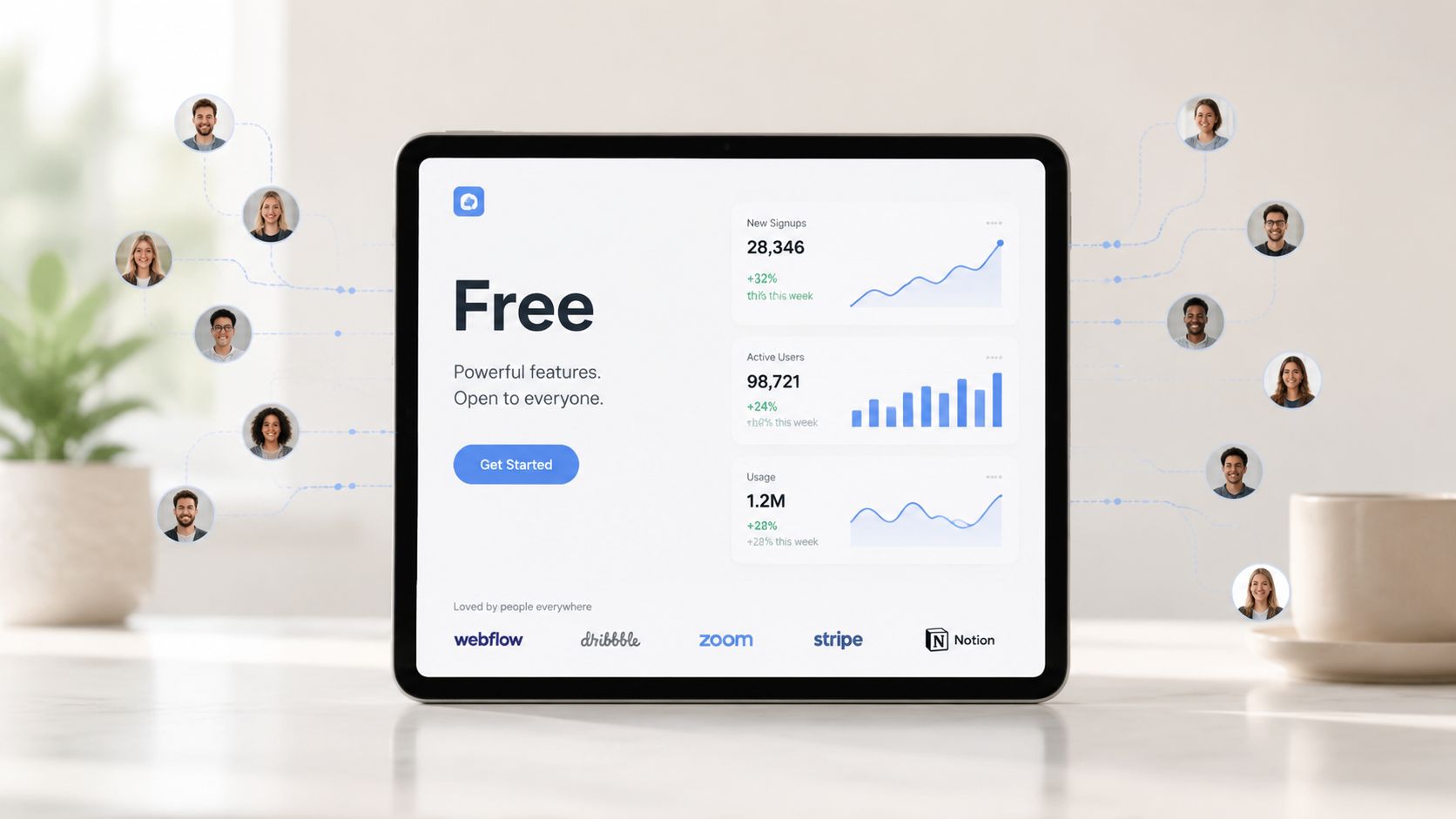
Product-led growth wins on efficiency because the product handles early education, trial, and initial adoption. The trade-off is operational. Sales enters later, with less control over who adopted first, why they adopted, and whether usage is broad enough to support expansion.
Slack, Notion, Figma, Loom, Calendly, and Canva made this motion familiar. In each case, the product creates demand before a rep joins the conversation. Sales still has a job. It shifts from first-touch prospecting to account conversion, expansion, and risk reduction once an account shows real traction.
Where PLG needs a sales team
PLG needs a sales team at the point where product usage stops being enough. A champion may have strong adoption inside one team, but the deal still stalls on security review, procurement, budget ownership, or rollout planning across departments.
That handoff is where many PLG motions break. Reps get involved too early and create friction for users who are still evaluating on their own. Or they wait too long and leave an active account without a commercial path, which gives another vendor time to frame the enterprise conversation first.
A strong PLG sales layer usually focuses on three operational questions:
- Expansion timing: Which product-qualified accounts show enough depth, frequency, and multi-user activity to justify outreach?
- Stakeholder mapping: Which buyer, admin, security contact, and budget owner need to be involved to move from team usage to company rollout?
- Commercial packaging: Which plan, contract structure, and rollout proposal match the account's actual usage pattern?
This is why PLG is a strategic choice, not just a go-to-market label. It reduces top-of-funnel sales effort, but it increases the need for clean product signals, fast account research, and disciplined follow-up once usage crosses a threshold. Teams that run PLG well treat product data as a trigger for sales execution, not as a substitute for it.
For B2B outbound teams, the practical challenge is scale. Reps still need to identify which active users belong to real buying groups, which accounts merit human outreach, and which message fits the account's current stage. A platform like PitchSmart for signal-driven account prioritization helps teams turn product activity into a workable expansion motion instead of another queue of accounts to sort by hand.
10. Intent-Based Selling
Intent-based selling prioritizes accounts that are showing signs of active interest. Those signs can include category research, content engagement, job changes, hiring activity, technology shifts, or other buying signals that suggest timing is changing. In practice, this model sits close to outbound and ABS, but it changes the order of operations. You don't start with a list and hope. You start with signals and rank effort accordingly.
For B2B outbound teams, this is often the most impactful model because it helps reps spend time where change is already happening. But intent data alone isn't enough. Many teams collect more signals than they can operationalize.
Signals are only useful if reps can act on them fast
The larger market is moving toward analytics-led sales execution. Salesforce reports that 83% of sales teams using AI saw revenue growth, compared with 66% of teams not using AI, according to Salesforce's statistics on AI and marketing performance. That doesn't mean any AI feature fixes pipeline. It means teams with stronger systems for surfacing and acting on signals tend to perform better.
Intent-based selling also fits the reality that inside motions are cheaper and increasingly dominant. Flowlu reports that inside sales can cost 40% to 90% less to close a lead than traditional outside sales. If you're prioritizing high-signal accounts and handling them through digital workflows, you improve both focus and operating efficiency.
A practical workflow looks like this:
- Layer signals: One weak signal is noise. Multiple recent signals are useful.
- Segment by motion: High-value accounts with strong intent may justify ABS treatment. Mid-market accounts may fit a lighter outbound sequence.
- Write to the signal: Outreach should connect directly to the observed trigger, not drift back into generic pain-point copy.
For teams that want to make intent usable, not just visible, PitchSmart's outbound platform is built around the exact problem. It researches accounts in bulk, ties buying signals back to sources, segments lists by signal strength, and seeds personalized multi-step outreach without forcing reps into manual one-by-one prep.
Here's a quick look at the kind of motion intent-based teams are trying to support in practice.
10 Types of Sales: Side-by-Side Comparison
| Method | Complexity 🔄 | Resources 💡 | Expected Outcomes ⭐📊 | Speed/Efficiency ⚡ | Ideal Use Cases |
|---|---|---|---|---|---|
| Outbound Prospecting (Cold Outreach) | Medium–High, manual research + sequence management | SDRs/BDRs, outreach tools, quality lists, CRM | ⭐ Moderate pipeline growth; measurable ROI but low initial response | ⚡ Moderate speed; time-intensive research | SDR teams, startups, B2B with defined ICPs |
| Account-Based Selling (ABS) | High, cross-functional planning and coordination | ABM tools, intent data, marketing + sales resources | ⭐⭐ Higher close rates and larger ACV; account-level ROI | ⚡ Slower ramp; high conversion when engaged | Enterprise accounts, long sales cycles, high-value deals |
| Inbound Sales | Medium, content strategy + nurture workflows | Content creators, SEO, marketing automation, analytics | ⭐ High-quality leads with lower CAC over time | ⚡ Slower to ramp; efficient once content performs | Marketing-driven orgs, self-directed buyers, community-led brands |
| Consultative Selling | High, deep discovery and advisory sales skills | Senior sellers, industry expertise, time for discovery | ⭐⭐ Strong customer satisfaction, retention, upsell potential | ⚡ Slow cycles; low transaction volume per rep | Complex B2B, transformation projects, enterprise deals |
| Solution Selling | High, multi-product mapping and integration work | Product specialists, demo/POC resources, CS/implementation | ⭐⭐ Larger deal sizes and stronger stickiness via bundling | ⚡ Longer cycles; implementation complexity | Platform vendors, integrated systems, competitive markets |
| Value-Based Selling | High, ROI modeling and executive engagement required | Data analysts, senior reps, customer metrics, case studies | ⭐⭐⭐ Premium pricing, higher margins, reduced churn when proven | ⚡ Slower due to validation but high payoff | High-ticket enterprise solutions, ROI-driven buyers |
| Social Selling | Medium, consistent content + relationship building | Personal branding time, LinkedIn/Twitter tools, community effort | ⭐ Builds credibility and warm conversations; variable attribution | ⚡ Variable; time-intensive to scale but effective for intent | Digitally-native buyers, thought leaders, SDR outreach |
| Channel Sales (Partner Sales) | High, partner recruitment, enablement, governance | Partner programs, co-marketing budgets, enablement teams | ⭐ Scales reach quickly; variable margin and control | ⚡ Slower ramp; scalable long-term reach | Market expansion, SMB/mid-market scaling, regional entry |
| Product-Led Growth (PLG) | Medium, product UX and analytics focus | Engineering, product design, in-product analytics, community | ⭐⭐⭐ Low CAC, organic expansion, strong PMF signals | ⚡ Fast adoption if product delivers an "aha" moment | Intuitive SaaS, SMB-focused offerings, viral network effects |
| Intent-Based Selling | Medium, data integration and scoring systems | Intent data providers, CRM, analytics, alerting workflows | ⭐⭐ Higher conversion and shorter cycles when signals are strong | ⚡ Fast response required; efficient prioritization | Outbound teams, ABM programs, firms needing prioritization |
From Theory to Pipeline Automate Your Sales Model
Choosing among the different types of sales isn't a branding exercise. It's an operating decision. Each model asks your team to do different work, at different levels of depth, with different expectations around timing, personalization, and account coverage.
Outbound prospecting needs fast research, segmentation, and disciplined sequences. Account-based selling needs deeper account intelligence and stakeholder mapping. Inbound needs context-rich follow-up, not just speed. Consultative and solution selling require preparation that lets reps ask smart questions and frame the right problem. Value-based selling needs grounded evidence. Social selling needs timely public signals. Channel sales needs territory clarity and partner enablement. PLG needs the judgment to step in when product usage turns into commercial opportunity. Intent-based selling needs a system that turns signals into action before they go stale.
Across all of those models, the same bottleneck keeps showing up. Manual research.
Reps lose time gathering basic context, checking sources, pulling company updates, reviewing contact records, and building outreach one prospect at a time. Managers feel it when sequence quality drops. RevOps feels it when process compliance weakens. Buyers feel it when messaging sounds generic, late, or disconnected from what's happening in their business.
That's why the conversation about types of sales should always come back to execution. A good model run badly still underperforms. A clear model backed by strong workflows, clean segmentation, and usable signals gives your team a chance to win consistently.
PitchSmart addresses that execution gap directly. Instead of asking reps to research accounts one by one, it runs bulk lead research across your list. Instead of making them guess at relevance, it surfaces source-backed buying signals and activity-based hooks they can use in outreach. Instead of forcing reps to write every touch from scratch, it seeds automated three-step email and LinkedIn sequences from the strongest conversation angles. Instead of treating every account the same, it helps teams segment by signal strength and likely buying fit.
That matters whether you're running a high-volume SDR team, a focused ABS program, an agency outbound engine, or a hybrid motion where inbound, outbound, and expansion all overlap. The win isn't just speed. It's better use of rep attention. Less tab-juggling. Less copy-paste work. More live conversations with accounts that make sense to pursue.
If your team has already picked a sales model but still struggles to execute it consistently, that's the constraint to fix next. The best playbook in the world won't save a workflow built on manual research and generic outreach.
PitchSmart gives outbound teams a practical way to run any modern sales model with less admin and better signal quality. If you want to replace manual prospect research with bulk, source-backed account intelligence and launch personalized outreach faster, start a free trial of PitchSmart.