PitchSmart uses essential cookies to keep the platform running. With your permission, we also use analytics cookies to improve the product. We never sell your data. See our Privacy Policy for details.

    Back to blog
    channel managementchannel management meaningB2B saleschannel partnersoutbound sales

    Channel Management Meaning Explained for B2B Sales Teams

    Discover channel management meaning and why it matters for B2B sales and outbound teams. Learn core activities, KPIs, examples, and best practices.

    July 23, 2026/14 min read
    Channel Management Meaning Explained for B2B Sales Teams

    Channel management is the discipline of selecting, enabling, compensating, and optimizing indirect partners, like resellers and distributors, to scale B2B revenue efficiently. It's not a side task or a synonym for “distribution.” It's the operating system behind an external sales ecosystem.

    For SDRs and BDRs, that matters because the pain usually shows up first in outbound work. Reps drown in manual research, copy-paste into CRM fields, and generic cold emails that never get a reply, while partner programs add more chaos through stale lists, unclear ownership, and inconsistent incentives. PitchSmart fits that same workflow problem by automating bulk lead research, surfacing activity-based conversational hooks, and turning signals into structured outreach, which is exactly the kind of discipline channel programs need when they're supposed to scale.

    Recognizing the Channel Management Crisis

    An SDR opens the day with 120 prospects, three partner-fed leads, and a spreadsheet that no one trusts. By lunch, half the morning has vanished into tab juggling, note cleanup, and rewriting the same intro for the fourth time because the last email sounded like everyone else's. The core problem isn't effort, it's that manual research and ungoverned partner motion keep pushing reps into admin work instead of conversations.

    Practical rule: if the channel cannot tell a rep who owns the lead, what the offer is, and why the timing matters, the channel is already leaking pipeline.

    That leak gets worse when partner programs grow without clear rules. One reseller gets a discount the next reseller can't access, a distributor shares stale product content, and the sales team spends its week patching over confusion instead of creating demand. The result is familiar to any RevOps leader, more noise, less trust, and a pipeline that feels busy but moves slowly.

    The crisis is easy to miss because it looks like normal sales friction. In reality, it's a systems problem, and systems problems don't get fixed by asking reps to “work harder.” They get fixed by making the channel easier to research, route, and measure so the team can stop chasing the same broken motion every day.

    Understanding Channel Management Meaning
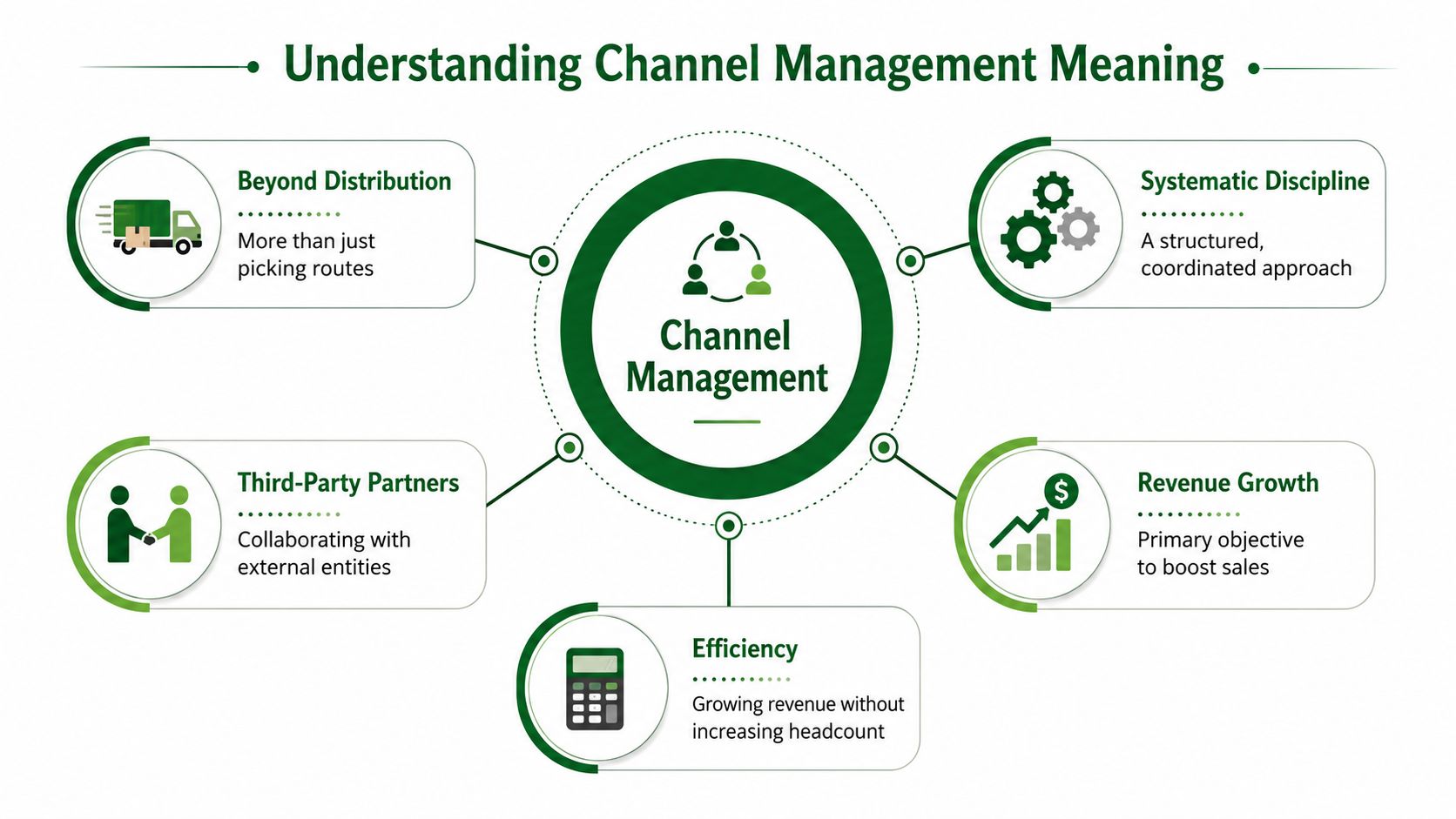
    A diagram explaining the meaning of channel management with icons for distribution, partners, efficiency, discipline, and revenue.

    The simplest channel management meaning is the discipline of coordinating indirect sales routes instead of relying only on your own sales team. In B2B software, SaaS, and telecom, that usually means recruiting, enabling, and improving third-party partners such as resellers, distributors, VARs, MSPs, and system integrators so revenue can grow without adding headcount in the same proportion (Magentrix).

    Channel management works like an outsourced revenue network

    Channel partners extend your reach, but they do not run themselves. Someone still has to decide who gets recruited, what they are trained on, how they are compensated, and what happens when they create conflict or miss targets. Channel management is wider than choosing a route to market, it is the operating discipline that keeps that ecosystem aligned.

    A useful way to see the shift is to compare older distribution oversight with modern channel performance management. Ipsos describes channel measurement as a mix of channel sizing, mystery shopping, execution measurement, customer counting, and voice-of-customer programs used together, not in isolation (Ipsos). For RevOps teams, that matters because the channel is more than a list of partners. It is a measurable operating system, much like SDR and BDR research workflows become useful only when the inputs, handoffs, and follow-up steps are tracked with discipline.

    Why the lifecycle matters

    Gartner frames channel management as a lifecycle that runs from partner recruitment and onboarding through enablement, joint business planning, performance measurement, and conflict resolution (Gartner). Umbrex adds the governance angle, describing it as the work of designing, activating, governing, and improving a channel so it produces profitable growth while protecting customer experience, brand, and compliance (Umbrex).

    That is the meaning of the term. It is not a checkbox. It is a controlled system for making indirect revenue predictable.

    Why Channel Management Matters for B2B Sales Teams

    For B2B sales teams, channel management matters because it turns scattered partner activity into usable pipeline. A simple way to see it is through the day-to-day work of SDRs and BDRs, since both teams depend on clean handoffs, clear targeting, and consistent follow-up. Without that structure, reps inherit messy leads, duplicated outreach, and mixed positioning. With it, the channel can extend coverage into regions, industries, and buying groups your direct team will not reach alone.

    The sales team benefit is operational, not abstract

    A healthy partner ecosystem takes pressure off SDRs and BDRs in practical ways. Partners can create awareness, surface referral opportunities, and bring in accounts that already have a reason to talk. That means less time spent cold-starting every conversation and more time spent qualifying real demand. It also makes partner research workflows easier to scale, because teams can use shared criteria instead of letting every rep guess which accounts belong in the funnel. For teams that want to standardize that motion, PitchSmart's blog is one place where partner process automation is discussed in a RevOps context.

    It also supports margin discipline. When content, pricing, and handoffs are uncoordinated, sales teams often compensate by discounting or over-explaining. Channel management gives the business a way to set rules before reps improvise their own, which keeps the selling motion clearer and easier to forecast.

    Unmanaged channels create avoidable friction

    More channels can create more confusion if governance is weak. Direct, indirect, digital, retail, and marketplace motion can all compete for the same account, and that overlap makes ownership harder to sort out. NTS Retail points to the need for tighter performance measurement, clear policies, and structured interventions when partner results lag.

    A channel strategy that adds reach but removes clarity usually slows the team down.

    For sales leaders, that is the key point. Channel management is about making sure reach does not turn into overlap, conflict, or stale opportunity data that drags the whole revenue engine. It gives the team a cleaner operating model, which matters just as much as raw coverage.

    Core Activities in Channel Management
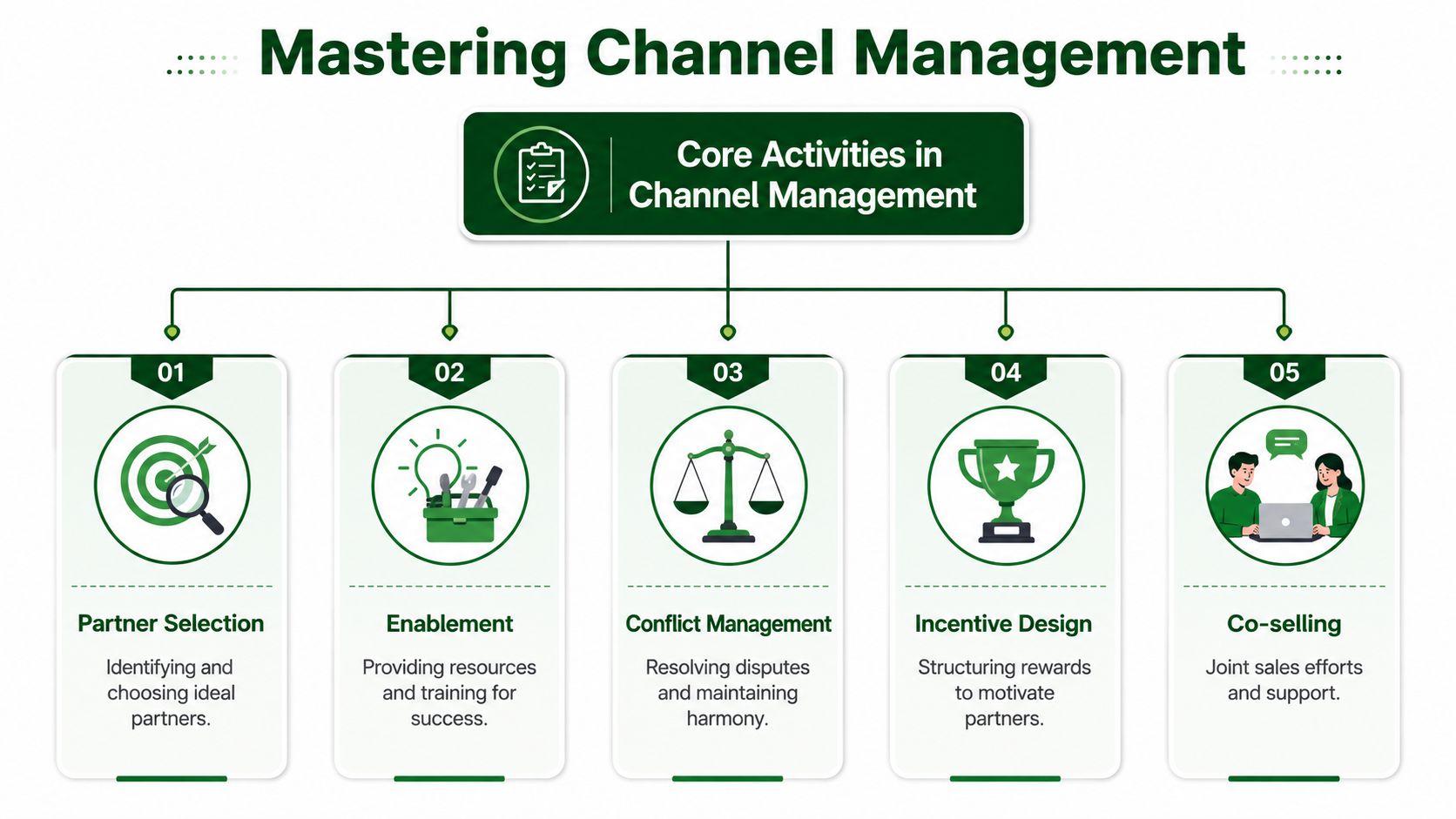
    An infographic titled Mastering Channel Management detailing five core activities with icons and brief descriptions.

    Channel programs work only when five activities stay aligned, partner selection, enablement, conflict management, incentive design, and co-selling. Each one shapes the next, so a program that treats channel management as a one-time setup usually drifts as soon as real selling starts.

    Partner selection and enablement

    Partner selection starts with fit, not headcount. The right partner already reaches the audience you want, sells through a similar motion, and has the customer relationships needed for your offer. A partner who can explain the value clearly is far more useful than one who merely agrees to sign on.

    Enablement comes after selection. It covers onboarding, training, sales content, and simple rules that partners can use from the first day. Without that support, the buyer hears one version of the story from your team and another from the partner, and the channel stalls before it becomes repeatable.

    Conflict management and incentive design

    Conflict management is where many programs lose trust. Territory overlap, lead disputes, and tension between direct reps and partners can slow deals and create hesitation on both sides. Clear governance prevents those problems from becoming routine.

    Incentive design works the same way. Partners respond to what the program rewards, so the structure has to fit the business model and the behavior you want to see. AWS's partner program updates show how channel programs can shift toward stronger incentives, simpler benefits, and deal registration tools that make partner motion easier to track and more predictable (AWS).

    Co-selling needs a shared operating rhythm

    Co-selling is more than passing leads back and forth. It works when both sides know when to engage, how handoffs should happen, and what each party owns after the introduction. If those rules stay vague, the result is extra coordination work without a clear plan for the deal.

    For teams that want to standardize that rhythm, PitchSmart's lead research process can sit upstream of partner outreach and SDR qualification. It turns raw account lists into signal-backed inputs, which gives channel managers a cleaner way to coordinate partner follow-up with outbound research and targeted outreach.

    Examples and Common KPIs in Channel Management

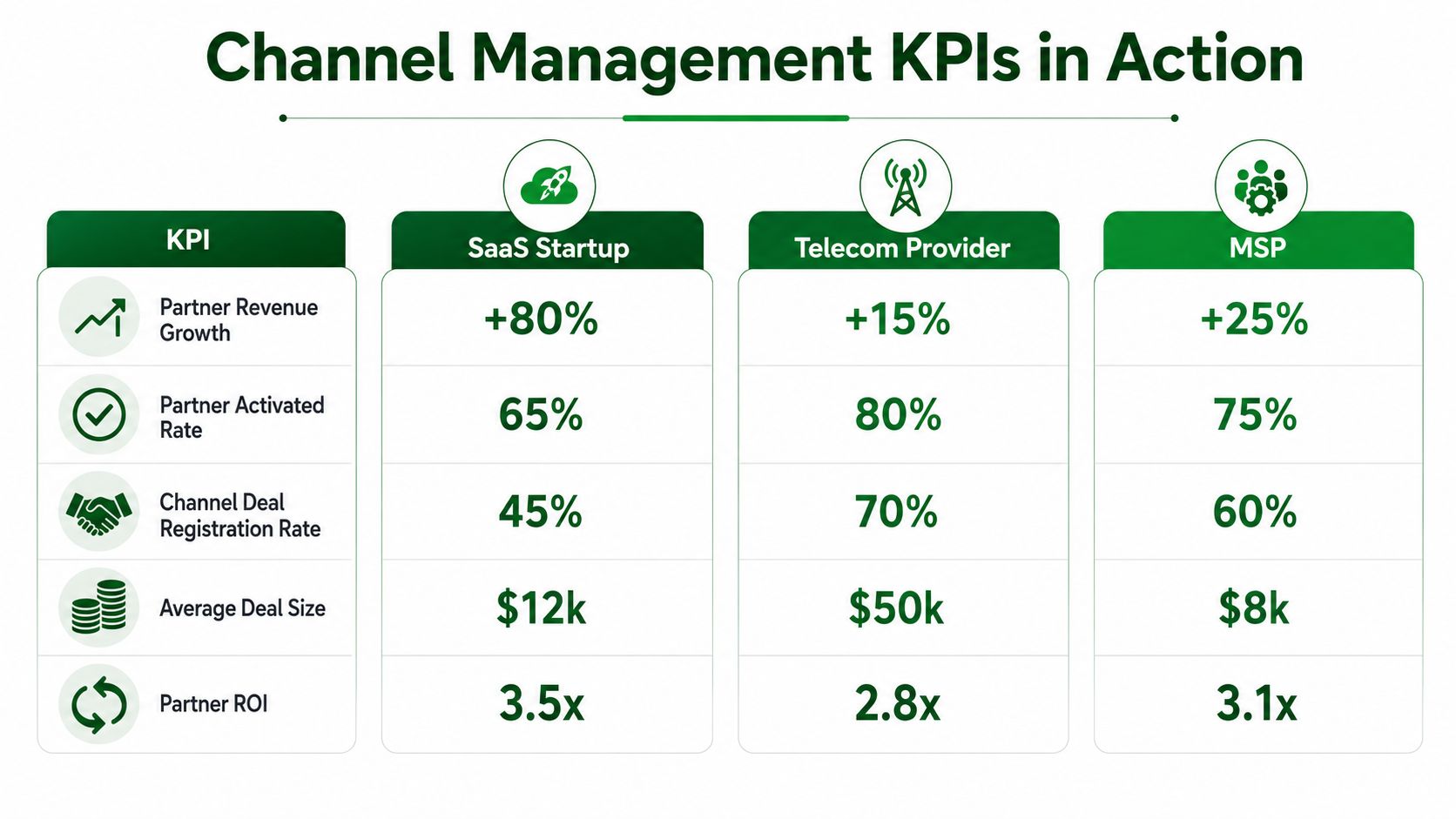
    A comparison table showcasing key performance indicators for channel management across SaaS, Telecom, and MSP business models.

    Channel performance gets easier to manage when the metrics are plain. A SaaS startup might care most about partner activation and registration discipline, while a telecom provider may focus on coverage consistency and deal flow, and an MSP often watches how reliably partners convert into qualified opportunities.

    KPI Description
    Partner-sourced revenue Revenue originating from indirect partners
    Partner activation rate How many recruited partners actually begin selling
    Deal registration rate How often partners register opportunities
    Average deal size Typical value of a closed deal through the channel
    Data consistency Whether content, pricing, and availability stay aligned across routes

    A technically important part of channel management is keeping product content, pricing, stock availability, and channel-specific metrics synchronized across every selling path so conversion, returns, and margin can be managed at the channel level (Atrocore). That's why KPI work cannot sit apart from the system that feeds the data.

    If the data differs by route to market, the channel team ends up managing arguments instead of performance.

    One useful habit is to review the same KPI set by partner type. A reseller, a distributor, and an MSP won't need the same support motion, even if they sell the same product. The point of the metrics is not to decorate a dashboard, it's to show where the process is working.

    For teams building their reporting stack, PitchSmart's pricing information is relevant because the workflow starts with research and segmentation before outreach, and those inputs shape how cleanly channel follow-up can be measured.

    Best Practices and Common Pitfalls in Channel Management

    Strong channel programs usually look orderly from the outside. The rules are clear, the handoffs are defined, and partners know what happens next. Weak programs often look active too, with many partner names and plenty of motion, but little real accountability.

    Best practices

    • Set clear performance thresholds. Partners should know what counts as good performance, otherwise every review turns into a debate about expectations.
    • Run quarterly business reviews. QBRs create a steady rhythm for pipeline reviews, enablement, and next-step planning, which keeps partner activity tied to real business outcomes.
    • Automate lead distribution. Fair routing reduces delays and keeps reps from manually deciding who receives each opportunity.
    • Provide continuous training. Product details, pricing, and positioning change over time, so partners need current material they can trust.
    • Gather partner feedback. The people closest to the customer often notice friction first, before it shows up in revenue reports.
    • Keep research and routing connected. Channel teams that feed partner data into SDR and BDR workflows can spot which accounts are active, which ones need follow-up, and which partner motions deserve attention. Tools such as PitchSmart can support that research process by turning account data into cleaner outreach inputs.

    Common pitfalls

    • No clear strategy. A partner list without goals usually becomes passive inventory instead of a working growth channel.
    • Insufficient support. If partners do not get content, training, or timely responses from the vendor, their momentum slows.
    • Channel conflict. Direct and indirect teams can end up chasing the same deal, which creates confusion for both the rep and the buyer.
    • Poor communication. Broken handoffs leave gaps in ownership and slow the buyer's path through the process.
    • Ignoring feedback. Teams that do not listen keep repeating the same program mistakes, even when the warning signs are already visible.

    NTS Retail's point about omnichannel coordination is useful here, because channel management is rarely just about adding more routes to market. It is about setting rules, measuring performance, and stepping in when the system drifts. That work is operational, not cosmetic.

    Integrating Channel Strategies With SDR and BDR Workflows

    Channel management and outbound prospecting should share the same data backbone. If the partner program knows which accounts matter, but SDRs can't access that logic, the business creates two separate motions that keep stepping on each other. The cleaner approach is to make partner research, segmentation, and outreach look like one system.

    PitchSmart helps that workflow by letting teams upload CSVs or pull CRM lists, run bulk account research in parallel, and surface proprietary buying signals, then use those signals to build conversational hooks and outbound sequences. It also supports list segmentation based on buying intent, which is useful when a channel team wants to separate active partner opportunities from colder accounts before routing them to reps.

    Where the workflow gets easier

    The value is not just speed. Reps stop rewriting the same account notes by hand, and RevOps gets cleaner inputs for routing and attribution. That matters in channel programs because stale research creates stale follow-up, and stale follow-up kills partner confidence fast.

    Automated research also helps co-selling. When a rep can see a signal-backed reason to reach out, the message sounds informed rather than generic. That's especially useful when a partner expects the vendor team to carry its weight on first contact.

    A good channel workflow should tell the rep what to say before the rep opens the email draft.

    The bigger idea is simple, channel management and SDR motion both depend on consistent data, explicit rules, and repeatable execution. When those pieces are shared, the business stops treating indirect revenue as a separate world and starts treating it like part of the same operating model.

    Driving Growth With Channel Management

    Channel management meaning is about building a reliable partner ecosystem that grows revenue without creating avoidable chaos. The work is part governance, part data discipline, and part outbound execution. When those pieces align, the channel becomes a predictable route to revenue instead of a loose collection of relationships.

    Teams that connect partner rules with research workflows move faster because reps waste less time on manual prep and spend more time on real conversations. If you want to see how that can fit into a B2B outbound stack, start with PitchSmart and use your own lists to test what automated research and signal-backed outreach can change in the channel motion.


    A CTA for PitchSmart.

    Table of contents

    • Recognizing the Channel Management Crisis
    • Understanding Channel Management Meaning
    • Channel management works like an outsourced revenue network
    • Why the lifecycle matters
    • Why Channel Management Matters for B2B Sales Teams
    • The sales team benefit is operational, not abstract
    • Unmanaged channels create avoidable friction
    • Core Activities in Channel Management
    • Partner selection and enablement
    • Conflict management and incentive design
    • Co-selling needs a shared operating rhythm
    • Examples and Common KPIs in Channel Management
    • Best Practices and Common Pitfalls in Channel Management
    • Best practices
    • Common pitfalls
    • Integrating Channel Strategies With SDR and BDR Workflows
    • Where the workflow gets easier
    • Driving Growth With Channel Management

    Keep reading

    More articles

    Buy Email Accounts in Bulk: Expert Guidelines 2026
    buy email accounts in bulkbulk email accountsemail deliverability

    Buy Email Accounts in Bulk: Expert Guidelines 2026

    Learn how to safely buy email accounts in bulk in 2026. Our expert guidelines help you choose reliable vendors and ensure secure transactions for your business

    July 22, 202612 min read
    Managing Email Lists for Maximum Sales Pipeline
    managing email listssales prospectingoutbound sales

    Managing Email Lists for Maximum Sales Pipeline

    Stop wasting time on dead-end prospects. Learn the B2B sales and RevOps process for managing email lists to boost deliverability, relevance, and pipeline.

    July 17, 202616 min read
    How to Track Website Visitors: Turn Traffic Into Leads
    website visitor trackingb2b saleslead generation

    How to Track Website Visitors: Turn Traffic Into Leads

    Learn how to track website visitors to uncover B2B buying signals & convert anonymous traffic into qualified sales leads for 2026.

    July 16, 202617 min read