
If you're in a multi-product B2B company, you already know the feeling. A rep opens a deal review, asks which line to lead with, and the room goes quiet because everyone knows the answer depends on the account, the trigger, and which alternative the buyer is considering. Meanwhile, outbound keeps producing generic opens, cross-sell stays trapped inside one product team's territory, and the same phrase shows up in every pipeline review, our positioning is unclear.
That's usually not a messaging problem. It's an operational problem that starts with the wrong competitors, fuzzy differentiators, and no proof a buyer can repeat back. In a market where only 23% of buyers said competing solutions are meaningfully different and 77% saw them as commodity-like in Gartner's 2024 B2B Buying Survey, weak positioning doesn't just sound sloppy, it shows up in revenue outcomes. The same benchmark set also reports an average B2B competitive deal win rate of 21%, which is why positioning has to survive a real sales call, not just a workshop slide deck. Gartner-backed B2B competitive positioning benchmarks
Why Most Competitive Positioning Quietly Fails
A multi-product company acquires two smaller lines, folds them into the same customer base, and tells the sales team to cross-sell. The deck looks clean. The battlecards look polished. Then a rep gets on a call, hears the buyer mention a legacy vendor, a spreadsheet, and one internal workaround, and the whole room realizes the company has been positioning against the wrong thing.
That's the bleeding neck. Reps default to the product they know best, managers hear the same excuse in every review, and enablement keeps refreshing slides that don't change what happens on calls. The failure isn't lack of effort. It's that the position never made it into the actual selling motion.
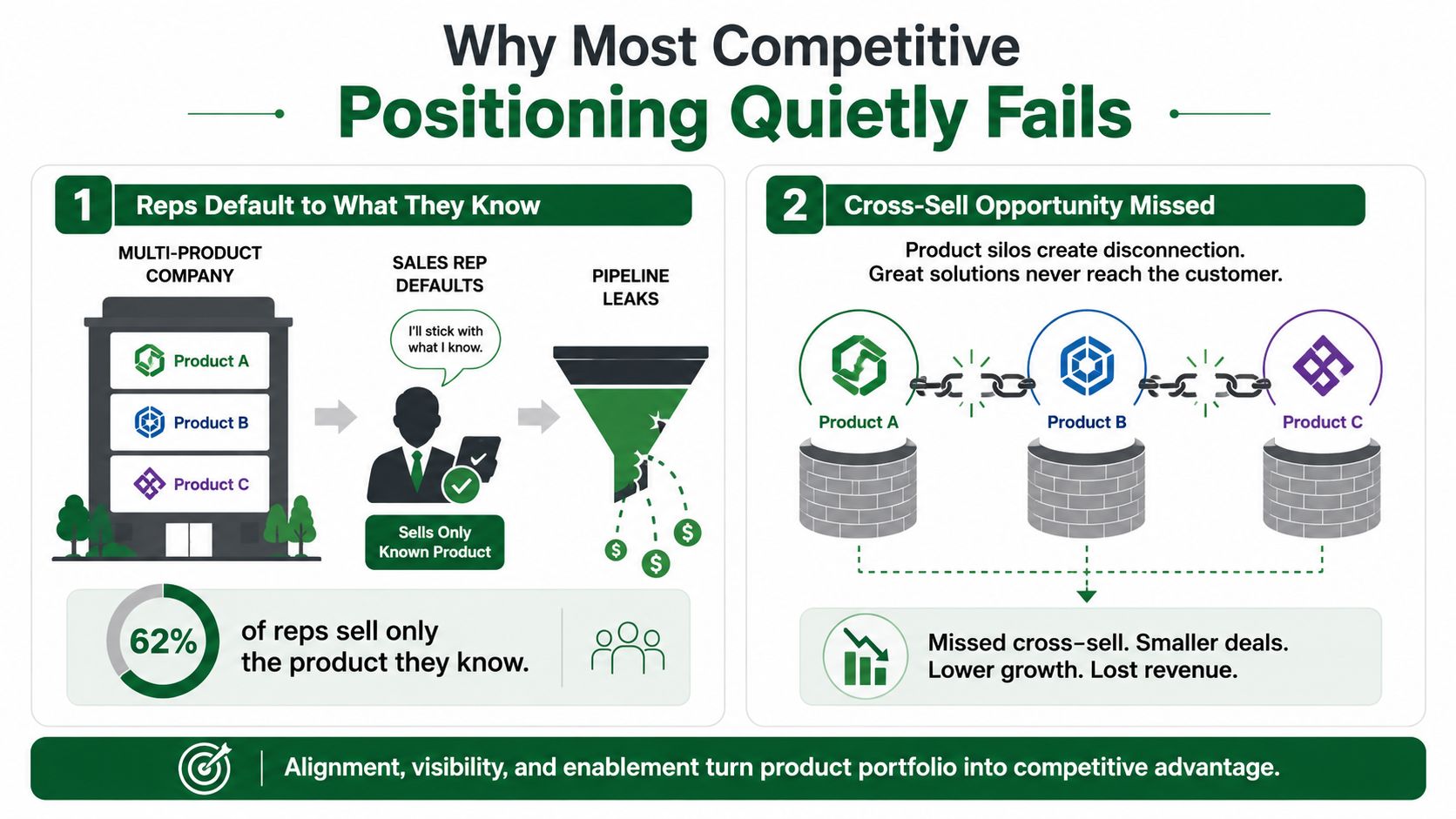
The common pattern underneath the failure
The first break usually happens at the competitor level. Teams compare themselves to the loudest rival in the market, or to the product they lost a huge deal against last quarter, while buyers are comparing the offer against the status quo or a substitute. That's the sort of blind spot that makes a positioning document look smart and sell poorly.
A second break comes from vague differentiators. “Easy to use,” “faster time to value,” and “better visibility” sound fine until the buyer asks, “Compared with what?” If the answer is just another slogan, the rep has nothing to work with.
Practical rule: if a rep can't turn the position into a two-sentence explanation without reaching for the deck, it won't hold in the field.
The third break is proof. Buyers don't need abstract confidence, they need evidence they can compare with their own world. That's why strong claims need customer-verifiable metrics, not puffed-up adjectives. Once proof disappears, messaging drifts into feature parity and price pressure follows.
What Competitive Positioning Means in B2B
Competitive positioning is the deliberate choice of where your offer stands relative to the alternatives a buyer is weighing. That includes the obvious competitor, but it also includes the status quo and the substitute the buyer would keep if your case does not hold up.
That definition matters because positioning is not brand poetry. It is not your tagline, your logo story, or a loose promise about being cutting-edge. In practice, it needs a clear frame of reference, a point of difference, and proof the buyer can verify. One useful template is, “For [target customer] who [problem or need], [product] is the [frame of reference] that [most important point of difference] because [proof].” Competitive positioning template and proof guidance
A position only matters if reps can use it in live selling. If a new rep cannot turn it into a clear explanation without reaching for the deck, it will not survive the first few calls.
What belongs in the one-page artifact
A usable position should fit on one page and survive a new rep skimming it in two minutes. It should tell them what market they are in, who they are compared against, what matters most to the buyer, and what evidence backs the claim. If it needs a 40-slide narrative to explain, the field will not use it.
The cadence matters too. Positioning should not be rebuilt every quarter because someone saw a new competitor webinar. It should be durable enough to review on a yearly rhythm and adjusted when the market or the offer changes. That matches the practical guidance that positioning is a deliberate market choice, not a living mood board. Competitive positioning guidance
Buyers do not reward internal consensus. They reward the vendor that makes their decision easier, safer, and more defensible.
The artifact also has to travel through the revenue workflow. If the position cannot become a researched outbound hook, a battlecard line, a segmentation rule, and a claim that managers can defend in a QBR, it stays stuck in strategy docs. That is where a lot of positioning work dies, because the statement looks clean in a workshop but never changes what reps say on calls.
How it differs from generic branding work
Branding asks how you want to be seen. Positioning asks what buying alternative you want to win against. That is a harder question because it forces the team to name the exact market frame, the exact rival set, and the exact proof that makes the claim believable.
In B2B, that usually means the position comes from buyer jobs, not internal preference. It should also be grounded in economics, because revenue leaders need more than language that sounds differentiated. They need a position that creates a reason to choose, a reason to switch, and a reason to pay.
The Four Lenses That Make a Position Defensible
Most weak positioning breaks because the team looks at only one angle. They write down a feature, a market label, or a competitor list, then call it strategy. The stronger approach is to test the position through four lenses that force the team back to evidence.
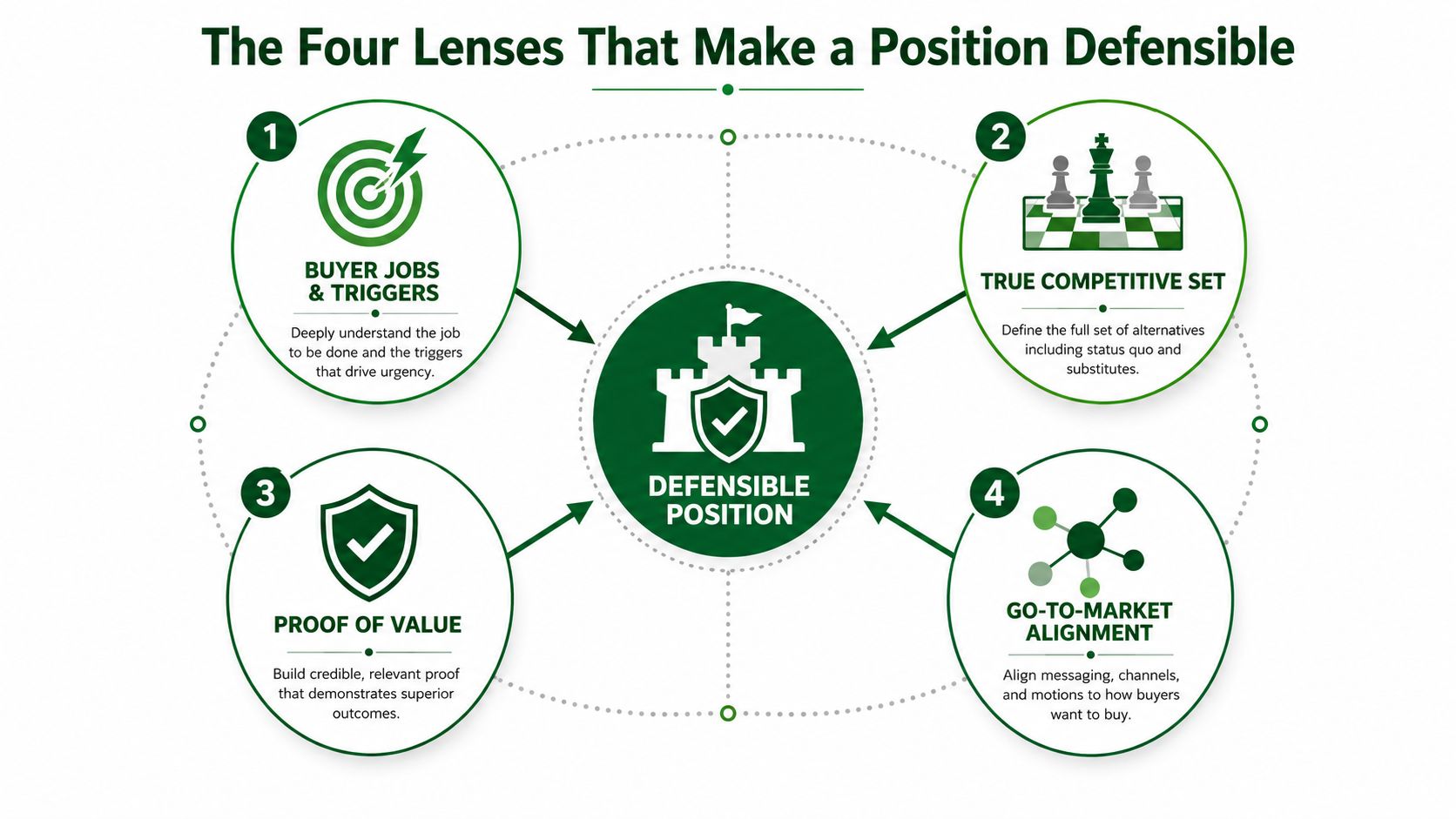
Buyer jobs and triggers
This lens asks what problem caused the buyer to look. If the team can't describe the trigger, they're probably writing positioning for the wrong moment in the cycle. The artifact here is a jobs-to-be-done list tied to real account events, not an abstract persona summary.
The failure mode is easy to spot. Discovery calls stay generic, and the rep keeps pitching the product instead of the buyer's immediate job. In deal reviews, that usually shows up as “They liked us, but timing wasn't right,” which often means the position never matched the buying trigger in the first place.
The true competitive set
This lens is where sloppiness creeps in. The true set includes the status quo and substitutes, not just the named competitor everyone expects to see in the slide deck. The artifact should be a competitive set memo that names what the buyer would do if you didn't exist.
The common mistake here is interviewing only wins. That gives you a flattering picture and a weak position. A better read comes from loss calls, late-stage stalls, and the recurring reasons buyers decide not to move at all.
Proof of outcomes and trust
This lens asks what the buyer can verify. You're looking for integration depth, implementation confidence, customer evidence, and any trusted metric that reduces risk. The output is a proof pack with sourced claims and examples the field can cite.
If proof is thin, the position becomes a hope statement. That's when reps start filling in the blanks with enthusiasm, and buyers usually notice.
Economics and risk
This lens forces the team to compare value in terms the buyer already uses. Total cost of ownership, payback, and risk all belong here. The output is an economics sheet that makes the choice legible to finance, operations, and the line owner.
The trap is simple. Teams build TCO math that ignores implementation effort or switching drag, then wonder why the buyer doesn't care. If the economics ignore the costs of change, the position won't hold up outside the workshop.
Common Mistakes That Kill Win Rates
The fastest way to weaken a position is to make it about the product team's favorite feature. The buyer doesn't care that a capability is elegant. The buyer cares whether it solves the thing they're trying to get done, with less risk than the other options.
The mistake pattern I see most often
Feature-led positioning usually creates one of two outcomes. Either the team lists too many differences and nobody remembers the important one, or the team abstracts so far that the claim stops meaning anything. Both lead to the same result, a rep goes into the call without a sharp line to use.
Another mistake is leaving the status quo out of the competitive set. That's a costly omission because many deals are really a choice between moving and doing nothing. If you never position against inertia, you'll keep hearing that the prospect “liked the conversation” but still chose not to change.
Buyers don't compare you to your best slide, they compare you to their safest alternative.
What to check in a week
A RevOps lead can usually diagnose the problem quickly.
- Review late-stage losses: Look for the alternative named in the last meaningful objection, not the competitor listed in the CRM.
- Audit talk tracks: Scan discovery and demo notes for proof. If the rep can't cite one concrete reason the buyer should believe the claim, the position is too soft.
- Read the battlecards: If every card says “different” but none says “different because,” the team has a branding problem, not a positioning one.
- Check for quarterly rewrites: If the statement changes every time a new rival appears, the team is reacting instead of choosing.
The goal isn't more words. It's a position the field can repeat under pressure. That's the difference between a slide deck that looks polished and a position that improves the win conversation.
Battlecards, Perceptual Maps, and Messaging Hooks in Practice
Battlecards and perceptual maps only help when they reflect how buyers decide. If they're built as generic marketing artifacts, reps ignore them. If they're built as field tools, they change how people open conversations and respond to objections.
A battlecard that a rep might actually use
A good battlecard doesn't start with product trivia. It starts with the situation the rep is likely to face, the trap the buyer may be setting, the proof to use, and the landmine to avoid.
| Field | Purpose | Example |
|---|---|---|
| When to use it | Signals the deal situation | Buyer mentions a current workaround |
| Trap to set | Frames the alternative the buyer is really choosing | Surface the cost of staying put |
| Proof point | Gives the rep a believable line | Customer-verifiable implementation evidence |
| Landmine to defuse | Prevents a weak objection response | Don't lead with every feature difference |
For a live example of how a team can package this kind of workflow, see the PitchSmart demo.
A perceptual map works only when the axes match the buying decision. Price versus benefit can be useful. Fit versus switching cost can be even more useful in a replacement deal. A random two-axis chart with “innovation” and “trust” on it is decoration, not enablement.
Hooks that come out of the position
A positioning statement should feed outbound in a way the rep can use immediately. Three useful hook types usually show up:
- Trigger hook. It names the event that made the account worth researching.
- Contrast hook. It contrasts the buyer's current approach with the outcome the position promises.
- Proof hook. It attaches a specific piece of evidence to the claim.
Each one should map to a persona. A VP of Revenue Enablement needs a line that helps the rep open the conversation. A BDR needs a line that is short enough to personalize without rewriting the message from scratch. A CS leader needs a line that supports expansion without sounding like a separate pitch.
A compact reference can help here, especially when teams are standardizing how they talk about the same position across sellers. Competitive positioning guidance for field-ready artifacts
From Positioning Statement to Outbound Research Workflow
A position only matters if it changes what a seller does next. That's where many teams stop too early. They write the statement, share the deck, and then expect BDRs and SDRs to invent a good opener on their own.
How the workflow should actually run
Start by defining the product or solution you're selling, the buyer problem it solves, and the signals that matter for that offer. Then research accounts against that definition, not against a generic firmographic profile. The point is to connect the position to account-level evidence, because a hook written from a real signal lands differently than one written from a guess.
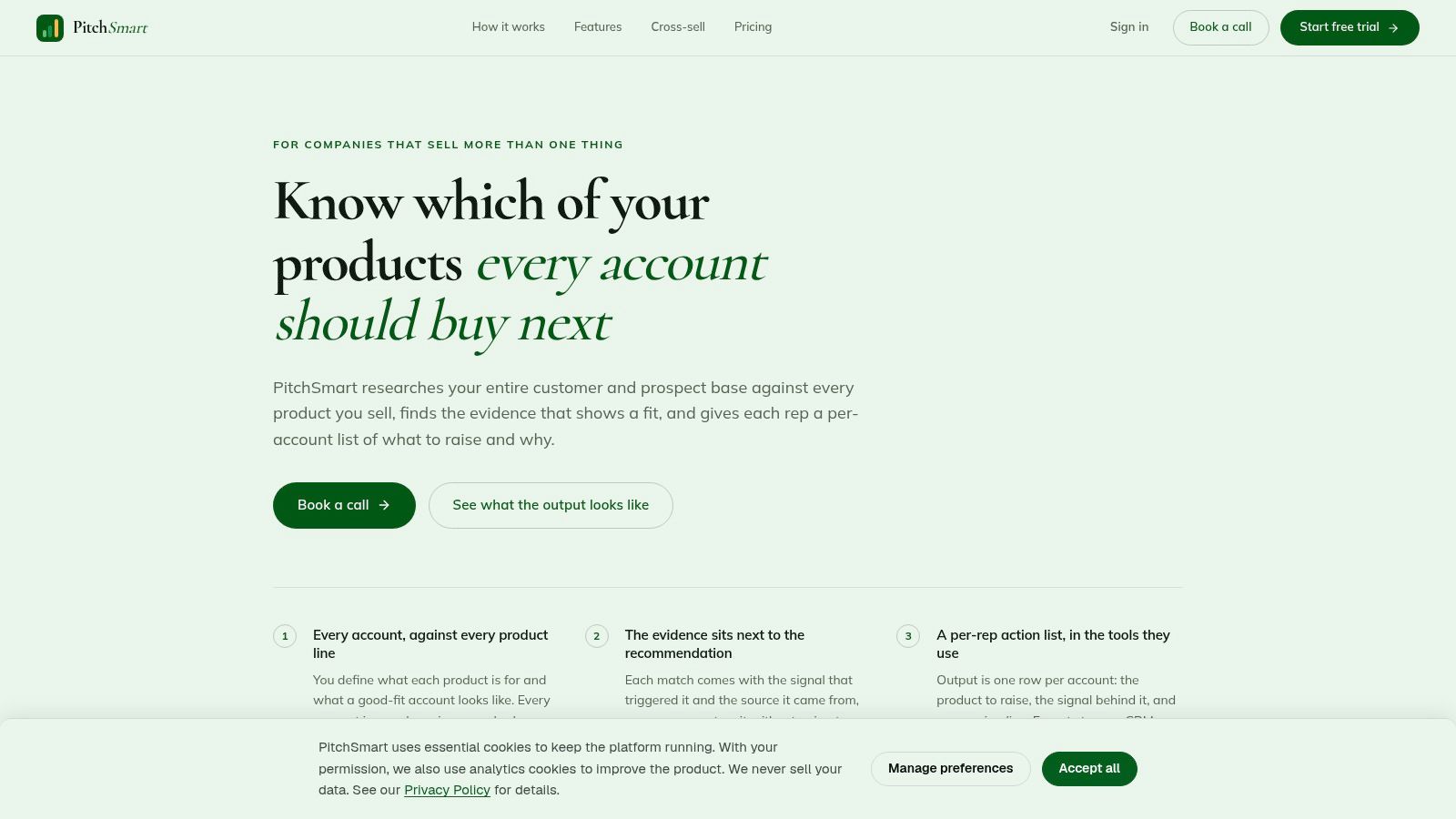
That's the place where a tool like PitchSmart fits naturally. It researches accounts from the product definition outward, scores fit against the solution you picked, pulls recent online signals into conversational hooks, and drafts a three-step email and LinkedIn sequence from the strongest hooks. In a multi-product company, that matters because the research can also be segmented around buying signals instead of forcing every rep to use the same broad list.
PitchSmart's model is account-first, not rented-database-first, which matters for enablement teams that need the same research logic to support outbound and expansion. The workflow also gives revenue teams a way to tie a position to a per-account opener, a per-segment rule, and a repeatable sequence rather than asking reps to improvise under quota pressure. PitchSmart blog
What to segment on
Firmographics still matter, but they're not enough. If the position is about a replacement motion, then the segment should reflect the trigger behind the move. If the position is about cross-sell, then the segment should reflect buying signals inside the installed base.
That gives BDRs and SDRs a cleaner path. They can research accounts in parallel, use the position to pick the right hook, and launch a short sequence that doesn't read like a template. More critically, enablement can see which hooks get used and which ones get ignored, which is the kind of feedback loop that makes positioning operational instead of decorative.
A 90-Day Operating Cadence for Enablement and RevOps
Positioning work gets real when it has an owner, an artifact, and a review date. Without that, it becomes another document in the folder nobody opens. The easiest way to make it stick is to run it like an operating motion instead of a one-time project.
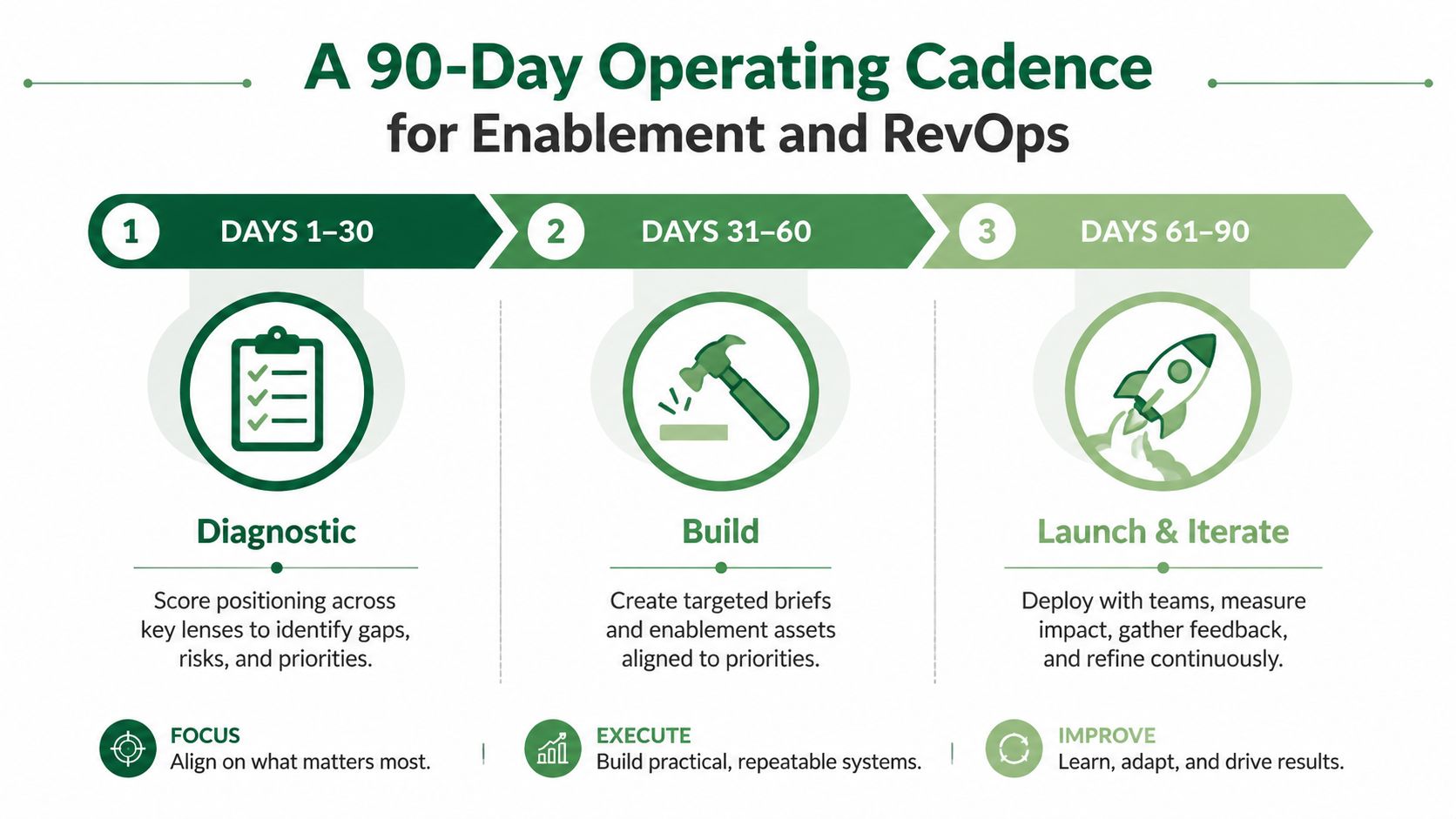
Days 1 to 30
Run a diagnostic across the four lenses. Pull loss notes, talk tracks, proof gaps, and the competitive set the field is naming. The artifact is a scorecard, and the owner should be RevOps with enablement and CS input.
The metric to watch is simple, whether the team can agree on one position without debating three different competitor lists. If they can't, you haven't got a messaging problem yet, you've got a market-definition problem.
Days 31 to 60
Rewrite the positioning statement, refresh the battlecards, and wire the account research workflow into outbound. This is also the point to tighten segmentation rules so the right accounts get the right opener and sequence.
The owner here is usually enablement, with RevOps making sure the workflow doesn't become a one-off manual task. If the team uses a research platform, a PitchSmart portfolio view can support the solution mapping across products and account segments.
Days 61 to 90
Review what changed. The report to the CRO should cover win rate against the named competitive set, hook-to-reply rate, and cross-sell pipeline created inside the current customer base. That's enough to tell whether the position is becoming a selling tool or staying a document.
If the numbers don't move, don't rewrite the whole strategy first. Check whether the position is too broad, whether the proof is weak, or whether the research workflow is still disconnected from the actual outreach motion. Competitive positioning frameworks for operating reviews
Build the cadence into the next QBR and keep it there. In a multi-product B2B company, positioning has to work in two directions at once, new-logo acquisition and expansion inside the existing base. If it can't survive both, it isn't defensible.
If you want the position to show up in outbound, battlecards, and expansion motions instead of living in a deck, PitchSmart can research your accounts against what you sell and turn the strongest signals into usable hooks and sequences. Visit PitchSmart to see how that workflow supports competitive positioning that reps can use on real calls.