Inside sales is no longer the junior cousin of field sales. In a 2026 benchmark, 72.6% of all B2B sales interactions happen through inside sales channels, up from 45% in 2019 GreetNow's inside sales statistics. That's the answer to what is an inside sales representative in 2026, a remote seller who runs prospecting, qualification, demos, negotiation, and closing through digital channels, not a call-center script-reader.
The problem is that most reps still burn their day on junk work. Manual research, list building, copying notes into CRM, and rewriting basic outreach eat the time that should go into live conversations. If you're coaching a new SDR, that's the bleeding neck. Pipeline doesn't come from looking busy, it comes from better research, better timing, and better follow-up.
Defining the Inside Sales Representative Role in 2026
An inside sales representative is a remote seller who manages prospecting, qualification, product demonstration, negotiation, and closing through phone, email, video, chat, and CRM workflows instead of in-person visits. That definition is the one that matters if you're hiring for revenue, because the role is measured by output, not location.
The primary cost in inside sales is manual research. Reps waste hours digging for buyer signals, verifying contact data, and rebuilding context before every outreach attempt, which slows pipeline creation and turns follow-up into busywork. The better model is a signal-driven revenue operator who works from intent, timing, and account data, then uses automation to handle the repetitive research that should never sit on a rep's plate.
Inside sales is a pipeline engine built for repeatable digital touchpoints across a large prospect list. Career guidance published in 2026 says inside sales reps often handle the entire sales cycle, and the US Bureau of Labor Statistics expects 1.8 million job openings in sales occupations each year between 2024 and 2025 Coursera's inside sales representative overview. That scale explains why managers care less about how polished a rep sounds on a call and more about whether they can create, qualify, and advance real opportunities.
The job also maps cleanly to how modern B2B teams sell. Modern definitions from HubSpot describe the role as selling from an office or home office through digital channels rather than traveling to clients HubSpot's inside sales representative glossary. In practice, that means the rep owns a sequence of touches, not a single conversation. The best reps spend their time on response quality, objection handling, and next-step control, while software handles list building, enrichment, and routing.
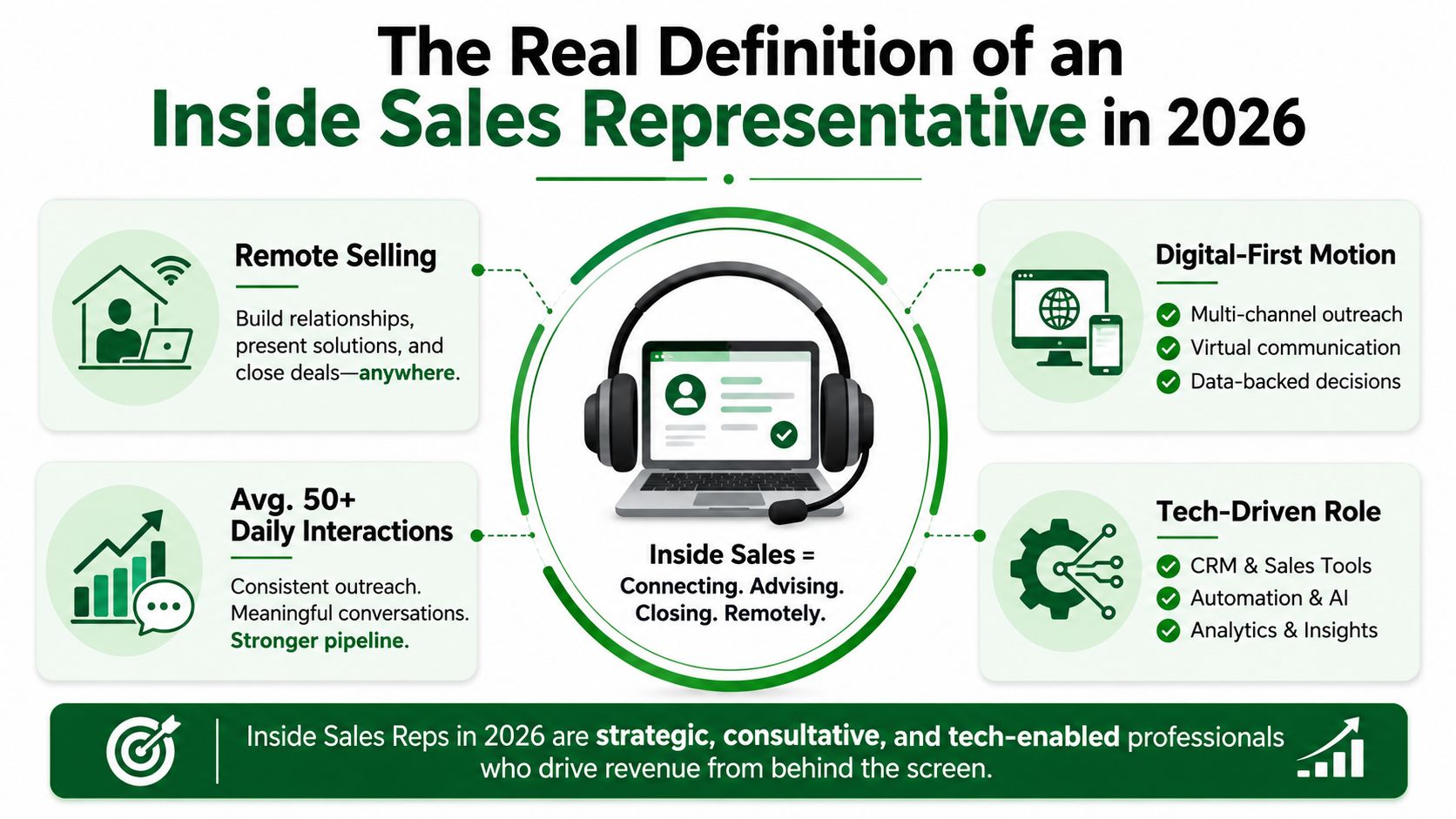
Inside Sales by the Numbers in 2026
| Metric | 2026 Benchmark |
|---|---|
| Share of B2B sales interactions through inside sales channels | 72.6% GreetNow |
| Median outbound SDR or BDR calls per day | 52 |
| Meaningful conversations per day | 3.2 |
Practical rule: if a candidate talks about “smiling and dialing” but can't explain how they qualify, sequence, and close, they don't understand inside sales.
The title sounds simple. The operating model isn't. A real inside sales rep is a signal responder, a follow-up machine, and a deal mover. If your hiring scorecard still treats the role like a phone job, you're already behind.
How Inside Sales Compares to Outside and Inbound Roles
Inside sales, outside sales, and inbound sales are not interchangeable labels. They're different motions with different economics, different buyer expectations, and different daily work. Most hiring confusion comes from pretending the channel decides the job. It doesn't. The deal motion does.
Inside sales is digital-first. Outside sales is field-first. Inbound sales is reaction-first. That's the clean split. Inside reps work through phone, email, video, chat, and CRM workflows Salesforce's inside sales guide, while outside reps travel to meetings, events, and customer sites. Inbound reps respond to leads that already raised their hand, which means the urgency and personalization problem is different.
Where SDRs and BDRs fit
SDR and BDR titles sit under the inside sales umbrella, but they don't always own the same work. In many teams, SDRs are more outbound-heavy, while BDRs may split attention between inbound qualification, outbound prospecting, and support for account executives. That distinction matters because the workflow changes the skill set. If you're booked onto new logos all day, you need research discipline. If you're triaging demand, you need speed and qualification judgment.
Inside sales rewards teams that know exactly who owns the first touch, the meeting, and the close. Blurry ownership creates lazy handoffs.
Side-by-side comparison
| Role | Primary motion | Travel | Typical focus | Best fit |
|---|---|---|---|---|
| Inside sales | Digital outreach and virtual selling | Minimal | High-volume pipeline creation, qualification, demos, closing | SaaS, recurring revenue, short to mid-cycle deals |
| Outside sales | In-person selling and on-site meetings | High | Relationship depth, field demos, complex negotiations | Large enterprise deals, physical products, high-touch accounts |
| Inbound sales | Responding to demand that already exists | Low | Fast conversion of raised-hand leads | Demand-gen heavy teams, demo requests, content-driven funnels |
Inside sales wins when speed and volume matter. Outside sales wins when physical presence changes the decision. Inbound wins when marketing has already done the heavy lifting. If you force the wrong motion onto the wrong buyer, you'll burn budget and confuse your team.
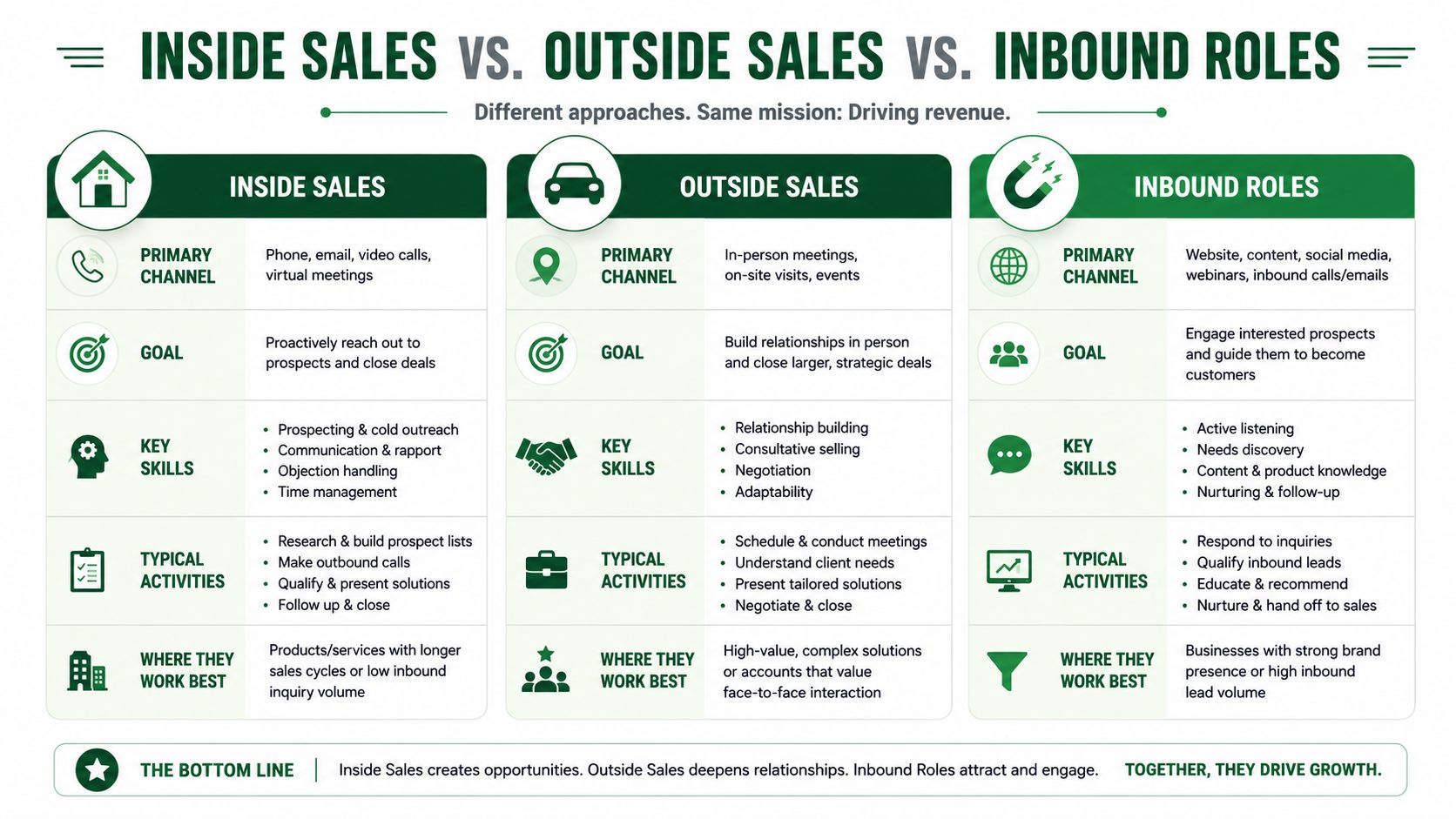
The useful takeaway is simple. Hire inside sales when the buyer can be moved through a screen, when the product needs explanation more than physical inspection, and when you need repeatable pipeline generation rather than one-off relationship theater.
A Realistic Day in the Life of an Inside Sales Rep
A real inside sales day starts before the first call. The rep opens CRM, checks pipeline stages, reviews yesterday's replies, and decides which accounts deserve attention first. If that morning starts with random activity instead of a ranked list, the day will drift.
The work is mostly non-selling
A large portion of the day often gets consumed by research, data entry, list cleanup, and internal administrative tasks. This is why inside sales frequently faces a productivity challenge rather than just a talent one. Reps don't typically lose deals due to a lack of communication skills. They lose them because they don't secure enough high-quality conversations with the right prospects.
A realistic block-by-block day looks like this:
- 9:00 AM, CRM review. Check open opportunities, overdue tasks, and any account movement from the night before.
- 10:30 AM, outreach block. Call, email, and send LinkedIn touches to the top-priority accounts.
- 12:00 PM, meeting prep. Pull context, review notes, and tighten the agenda before discovery or demo calls.
- 2:00 PM, discovery calls. Qualify interest, pain, urgency, authority, and next step.
- 4:00 PM, follow-ups and admin. Update CRM, send recap emails, book next meetings, and clean the list.
The job gets worse when research is manual
Manual prospect research is the hidden tax. Reps jump between LinkedIn, company sites, news pages, and CRM tabs just to build one decent email. Then they repeat it for the next account. That's not selling, that's clerical work with a quota attached.
If the rep can't explain why the account matters before outreach, the message is already late.
The better model is to treat time as a scarce asset. The rep should spend the most energy on accounts with real buying signals and on conversations that can progress. Everything else belongs in a workflow that doesn't require mental overhead.
KPIs and Skills That Separate Top Performers
The first thing I look at in an inside sales team is the scoreboard. Activity by itself is cheap. A rep can rack up calls, emails, and LinkedIn touches and still produce weak pipeline if the list is bad, the message is lazy, or the follow-up is slow.
What to measure
A useful scorecard tracks the full chain from outreach to revenue. Calls, emails, and LinkedIn touches only tell you that someone is busy. You also need pipeline created, conversion rates at each stage, meetings held, and revenue qualified or closed. Without those downstream numbers, managers end up rewarding motion instead of real progress.
Here's the simple truth: volume does not guarantee quality. As noted earlier, outside benchmarks show that outbound activity still produces only a small number of real conversations, so every weak list and every bland hook costs you time and opportunity. That is why a rep's job is to generate the right conversation, not to create noise.
| KPI | What It Measures | Target Benchmark |
|---|---|---|
| Calls, emails, LinkedIn touches | Activity volume | Consistent daily execution |
| Meaningful conversations | Actual live engagement | Strong enough to beat the baseline |
| Meetings booked | Interest converted into time on calendar | Rising week over week |
| Pipeline generated | Opportunities created from outreach | Healthy enough to support quota |
| Conversion rate by stage | Efficiency from one stage to the next | Stable or improving |
| Revenue closed or qualified | Commercial impact | The metric that matters most |
The scorecard should force honesty. If activity is high and pipeline is flat, the problem is targeting, messaging, or speed to lead. If meetings are booked but few turn into qualified opportunities, the rep is talking to the wrong accounts or failing to control the next step.
What top reps do differently
Top performers are precise. They know who to call, why the account matters now, and which message angle deserves a reply. They also move fast after a response, because intent has a short shelf life and slow follow-up kills momentum.
The skill stack is smaller than most job descriptions admit. You need written communication, discovery, objection handling, time management, CRM hygiene, and the judgment to read buying signals without treating every click as intent. If a rep cannot write a clean follow-up, keep notes current, and separate curiosity from real buying behavior, pipeline will stall.
PitchSmart's blog is worth reading if you want practical thinking on list quality, sequencing, and signal use. The bigger lesson is simple, better inputs create better output.