Lead generation sits at the top of the B2B revenue agenda for a reason. In 2025, 91% of B2B marketers said it was their top priority, according to Cirrus Insight's lead generation statistics roundup. But priority doesn't equal performance. A lot of outbound teams still run on a broken workflow: buy a list, hand it to SDRs, ask them to research one prospect at a time, then wonder why reply quality is weak and pipeline feels random.
That manual research loop is the bottleneck in modern B2B sales lead generation. It slows list building, weakens personalization, creates inconsistent qualification, and burns rep time on work that should never have been done by hand in the first place. When reps spend their day switching between LinkedIn, company sites, funding databases, job boards, and CRM records, they aren't selling. They're doing unpaid data assembly.
The teams that outperform don't just “do more outreach.” They build systems that turn research, scoring, messaging, and follow-up into a repeatable operating model. That's what scalable outbound looks like now.
The Hidden Bottleneck in Your Sales Process
Most outbound problems get diagnosed in the wrong place.
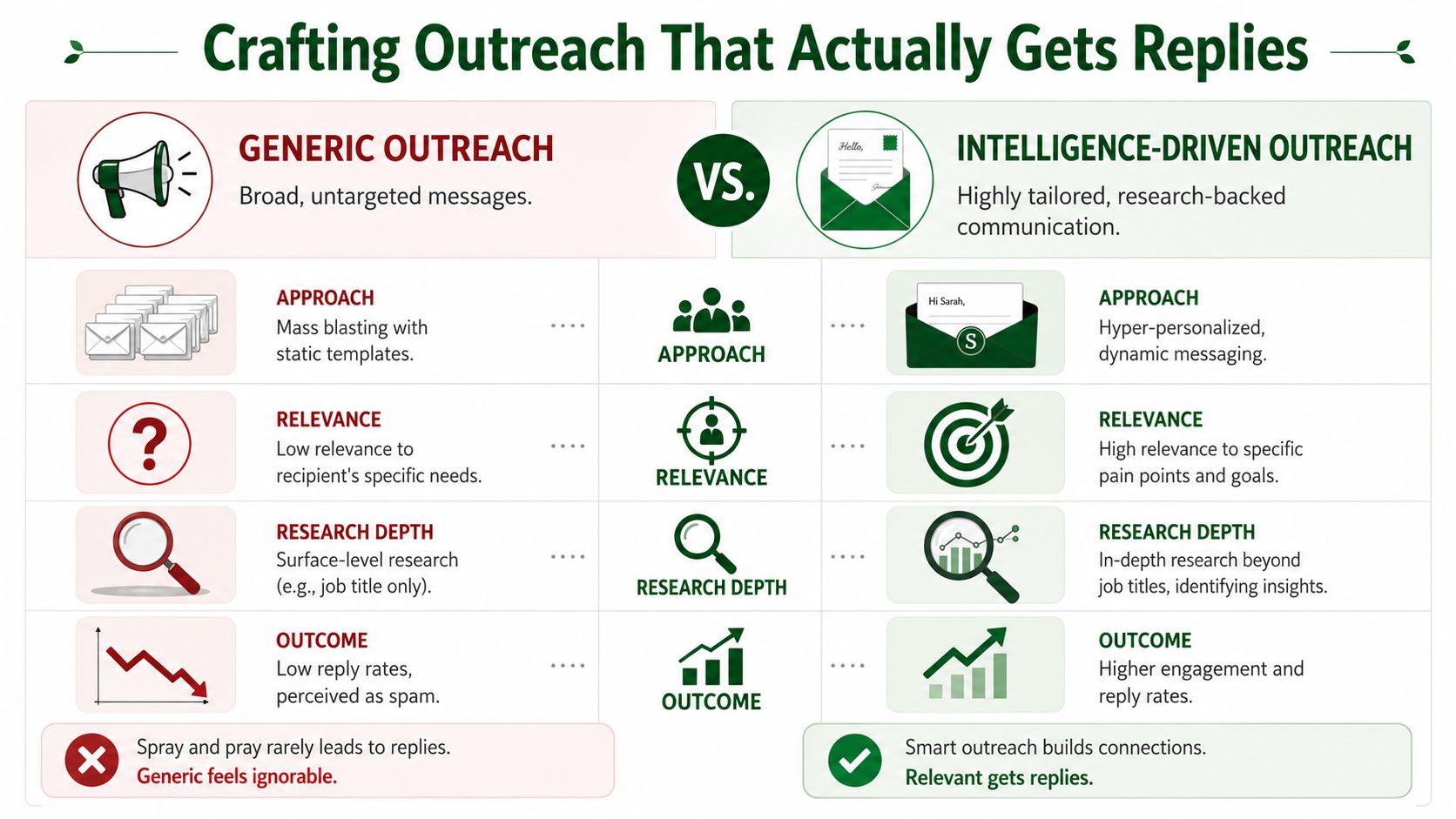
Leaders blame low reply rates on copy. They blame missed targets on list quality. They blame weak pipeline on rep execution. Sometimes those are real issues. But the deeper problem is usually operational. Reps are stuck doing slow, fragmented research before they ever get to a live conversation.
The pattern is familiar. An SDR opens the CRM, checks a LinkedIn profile, scans the company homepage, looks for recent announcements, searches for hiring activity, checks whether the account fits the territory rules, then tries to guess whether any of that is strong enough to justify a message. That process gets repeated prospect by prospect, tab by tab, hour after hour.
The result is predictable:
- Research gets rushed: When reps are under pressure, they stop after surface-level facts like title, company size, and industry.
- Personalization gets fake: Emails mention a generic compliment or a weak observation because the rep never found a real business trigger.
- Qualification gets inconsistent: One rep treats a target as hot because of firmographic fit. Another ignores the same account because there's no obvious signal.
- Morale drops: Reps know they're being judged on output, but their day is clogged with work that doesn't move a deal forward.
Manual prospecting doesn't fail because reps are lazy. It fails because the workflow asks humans to do machine work.
Hiring more SDRs rarely fixes this. It scales the mess. Buying more contact data doesn't fix it either, because a bigger list with no signal layer just gives the team more names to process badly.
Why this hurts quota faster than leaders expect
A rep who spends the morning researching ten accounts feels productive. The dashboard may even show activity. But if those ten accounts produce weak hooks, low-confidence scoring, and generic messaging, the whole motion degrades.
You see it in three places:
| Area | What happens in a manual workflow | What it causes |
|---|---|---|
| List prep | Reps clean and enrich records one by one | Slow campaign launches |
| Message quality | Hooks rely on shallow facts | Low relevance |
| Follow-up | Good prospects get buried in admin | Delayed response to intent |
That's why bad outbound often looks busy from the outside. Lots of records touched. Lots of drafts written. Not enough real pipeline created.
What strong teams do differently
They treat research as a system, not a rep chore.
That means standardizing what gets collected, how signals are prioritized, how leads are segmented, and how outreach gets built from those inputs. Once that happens, SDRs stop acting like part-time analysts and start acting like account-focused sellers.
The goal isn't to eliminate judgment. It's to remove the repetitive prep work that crowds out judgment.
What B2B Sales Lead Generation Means in 2026
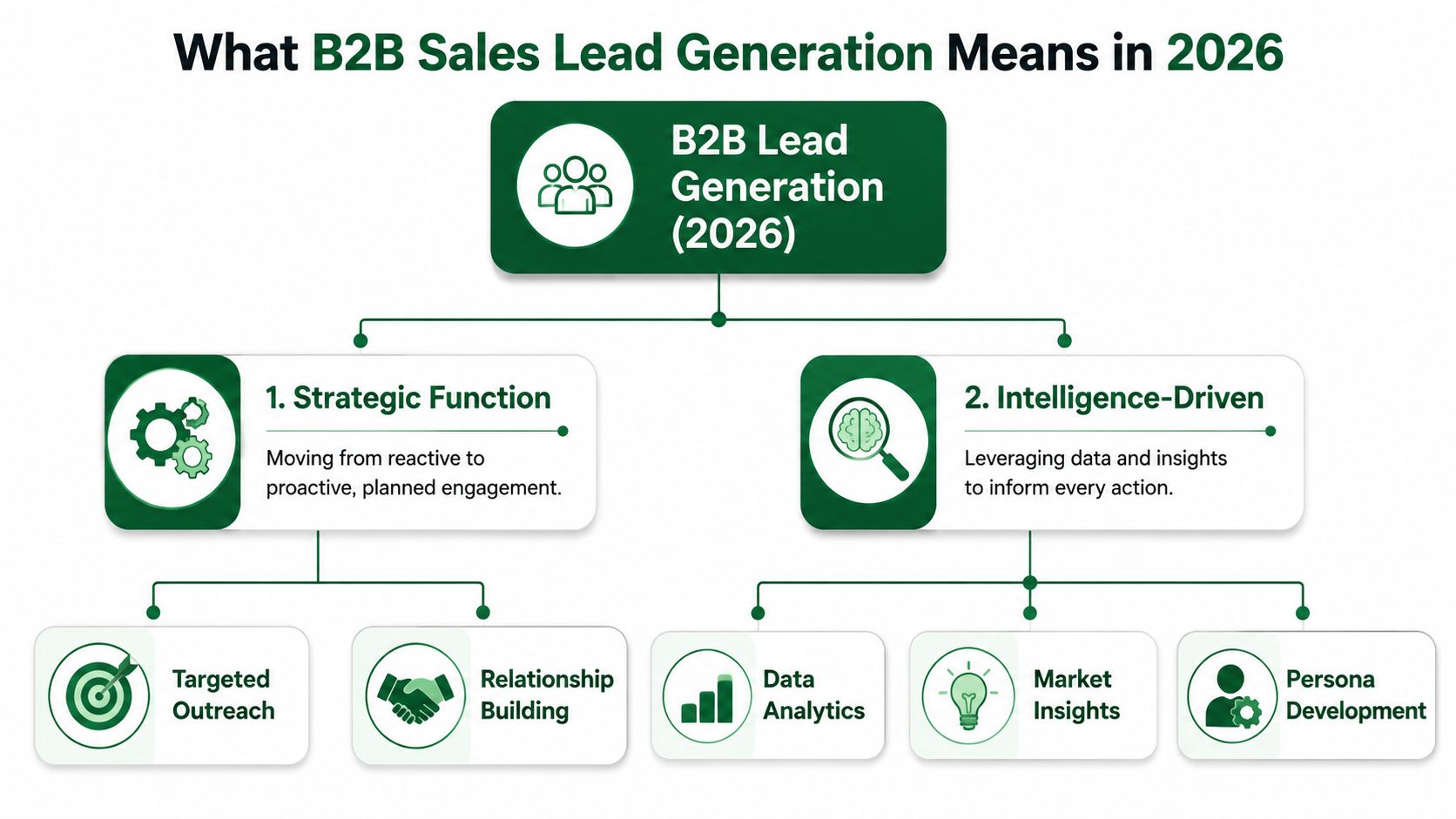
B2B sales lead generation in 2026 is less a list-building problem and more an operations problem.
Teams already have access to contact data, sequencing tools, enrichment vendors, and AI writing assistants. Pipeline still stalls because the handoff between data, research, prioritization, and outreach is too manual. SDRs spend hours stitching together context from five tools, then send messages built on thin signals. That workflow does not scale, even with good reps and decent data.
Analysts at Salesloft have documented the continued shift toward digital, multi-touch buying journeys. For outbound teams, the implication is straightforward. Lead generation now depends on how fast you can turn raw account data into usable sales context, then route that context into the right sequence before the moment passes.
This changes the definition of a lead generation program. A strong program does more than collect names and push them into cadences. It identifies who fits, who shows movement, what signal matters, and how that signal should shape the first touch.
A lead is a record plus context
A company can match your ICP and still be a poor outbound target this week.
That distinction is where many teams lose efficiency. They treat firmographic fit as enough, so reps are left to manufacture urgency from job titles, headcount bands, or generic industry pain points. The result is predictable. Weak hooks, vague copy, and reply rates that depend too much on volume.
A better definition separates two inputs:
- Fit signals: Industry, size, geography, team structure, tech environment, buyer role, and likely use case
- Buying motion signals: Hiring activity, new leadership, product launches, funding events, expansion moves, intent data, website behavior, or recent strategic change
When those inputs are scored separately, teams stop pushing every matched account into the same workflow. They can hold fit-only accounts for nurture, push high-fit and high-timing accounts into outbound, and keep reps focused on accounts with a reason to engage now.
Manual research is the failure point
This is the bottleneck generic lead gen advice skips.
Lead generation breaks long before the email is sent. It breaks when account research lives in rep tabs, lead scoring lives in a spreadsheet, and message inputs are inconsistent across the team. Two SDRs can look at the same account and produce two different priorities, two different hooks, and two different outcomes. That is not a rep performance problem. It is a system design problem.
High-performing teams standardize the research layer. They define which signals count, where those signals come from, how often records refresh, and what qualifies an account for outreach. Tools such as automated prospect research workflows help by turning scattered account data into structured inputs reps can use.
Channel strategy now follows account context
Channel selection used to be treated as a preference question. Email or LinkedIn. Calls or content. That framing is too shallow.
The stronger approach is to match the channel to the account situation and the signal you have. A hiring-triggered account may respond to a direct email tied to team growth. An executive change may justify a call-first approach. A broad awareness play may need content touches before any cold outreach gets a reply. The point is coordination, not channel loyalty.
That coordination only works if each touch shares the same source context. If email says one thing, LinkedIn says another, and the call opener uses generic talk tracks, prospects feel the disconnect immediately.
AI raised the floor for execution
AI did not remove the need for SDR judgment. It changed where judgment should be used.
Reps should not spend their best hours cleaning records, summarizing company pages, or drafting first-pass copy from scratch. They should spend those hours deciding which accounts deserve attention, refining a message angle, and handling replies well. Automation handles prep. Reps handle decisions.
A modern lead generation system should support four jobs reliably:
- Enrichment: Add account and contact context before the record reaches a rep
- Prioritization: Score accounts using fit and timing, not just basic ICP rules
- Message inputs: Generate usable research summaries and draft angles from real signals
- Routing: Push accounts into the right sequence, owner, and channel path quickly
That is what B2B sales lead generation means in 2026. A scalable outbound engine depends on how well the research layer, scoring logic, and execution workflow work together. Without that system, teams stay busy and still miss pipeline.
Building Your High-Velocity Outbound Machine
High-performing outbound teams don't rely on heroic reps. They rely on systems.
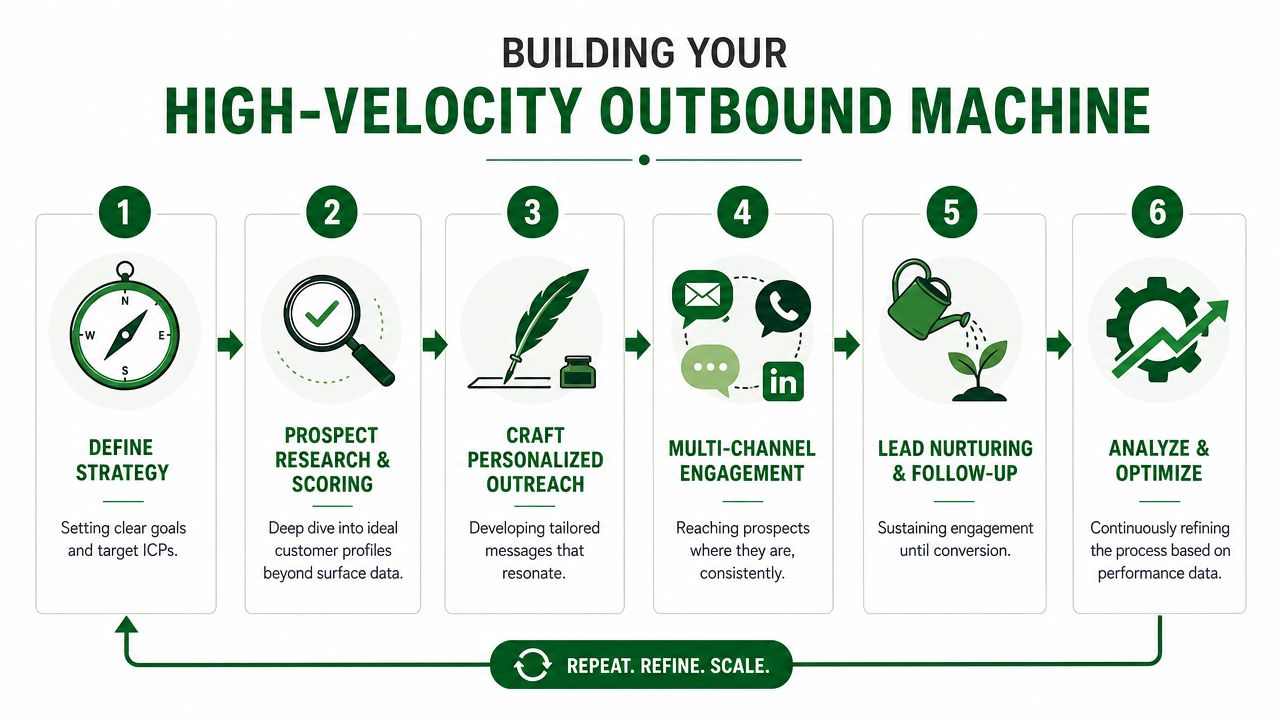
The system needs to answer five questions clearly. Who are we targeting? Why now? What message fits this account? Which channel should go first? How do we know the motion is improving? If any one of those questions is handled ad hoc, the engine slows down.
This framework from monday.com's guide to B2B sales lead generation is directionally right: strong programs use data-driven channel selection and continuous measurement across ICP definition, offer design, qualification, nurturing, and scoring.
A clear process helps. This one is a good visual model.
Start with constraints, not a giant TAM
Teams often aim too broad at the start. They define an ICP that reads well in a strategy doc but creates chaos in execution. “Mid-market SaaS companies” isn't tight enough for outbound. Neither is “operations leaders” or “heads of sales.” Reps need practical targeting rules.
A usable outbound target definition should narrow by:
- Segment choice: Pick the customer type your team can message with confidence
- Buyer access: Focus on roles your reps can consistently reach and understand
- Pain clarity: Choose accounts where the problem is visible from outside the business
- Signal availability: Prioritize segments where buying motion can be observed
Broad targeting creates soft messaging. Narrow targeting creates stronger hypotheses.
Build the workflow around speed to relevance
Once the target is defined, the process should move in a straight line:
- List assembly: Pull accounts from CRM, sales intelligence tools, or internal target lists.
- Research enrichment: Add role, company context, qualification markers, and current signals.
- Scoring and routing: Separate priority accounts from nurture or later-stage targets.
- Sequence creation: Build email and LinkedIn touches around the strongest available hook.
- Measurement: Watch reply quality, meeting creation, and stage conversion.
The old version of this workflow was one-to-one and manual. One rep researched one prospect and wrote one message. That doesn't scale. It also produces wildly uneven quality because every rep has a different threshold for what counts as useful context.
A modern workflow handles research and segmentation in bulk, then leaves the rep to review, refine, and send.
Here's where teams usually stall. They still expect sellers to act as researchers, list cleaners, and copywriters before they can do any actual selling.
Use tools that remove repetitive work
Your stack should reduce decision friction, not add another tab.
In practice, that means using systems that can:
- Research accounts in parallel: Not one browser session at a time
- Group leads by buying signal: So reps don't write the same idea from scratch over and over
- Seed multi-step outreach: Using the strongest available account context
- Feed results back into operations: So targeting and messaging improve over time
If your team is still copying notes from source pages into a CRM field manually, the process is behind. If SDRs need to build every first-touch message from a blank page, the process is behind. If qualification depends on whoever researched the account that day, the process is behind.
The better path is to build a repeatable machine and give reps a clean handoff: qualified accounts, visible signals, draftable hooks, and a sequence path. That's the difference between random outbound and an actual engine.
For teams evaluating how to operationalize that workflow, PitchSmart's platform is built around the exact bottleneck teams often tolerate: manual, one-by-one research before outreach.
Mastering Prospect Research and Lead Scoring at Scale
Prospect research is where most outbound programs gradually lose efficiency.
Not because research is unnecessary. It's necessary. The problem is that many teams still do it in the least scalable way possible. They ask SDRs to investigate every account manually, then expect consistent quality across the team. That almost never happens.
The better model is structured research tied to a scoring system. According to DataBees' guidance on B2B lead research techniques, qualification becomes materially more effective when teams combine explicit fit attributes with behavioral and intent signals. That approach reduces wasted rep time on accounts that match the ICP but aren't actively buying, while preserving fast follow-up on higher-intent leads.
What to research before a rep writes a line
A lot of teams stop at title and company. That's not enough.
For outbound, useful research falls into three buckets:
| Research type | What to capture | Why it matters |
|---|---|---|
| Account fit | Industry, size band, business model, geography, department relevance | Tells you whether the account belongs in the motion |
| Contact fit | Role, seniority, team scope, likely priorities | Tells you whether this person can act on the problem |
| Buying context | Recent activity, initiatives, digital behavior, strategic signals | Tells you whether now is a good time to reach out |
Strong reps also look for friction indicators. Is the company hiring into the function your product serves? Has it launched a new initiative that likely created process strain? Is the target person newly in role and likely evaluating systems? Those observations create real openings.
What doesn't work is pretending a weak detail is personalization. Mentioning that someone “has an impressive background” or that their company is “doing great work” wastes the first sentence.
A practical scoring model for outbound
Scoring should help routing. It shouldn't become a science project.
A simple model works if it distinguishes between fit and intent. Keep the categories separate so the team can tell whether an account is a strategic match, a timely opportunity, or both.
A practical scoring framework can include:
- Core fit factors: Segment, employee range, buyer role, department, geography, and existing tech environment
- Signal factors: Repeat website activity, pricing-page interest, demo-page behavior, active initiative indicators, or externally visible movement
- Negative factors: Student titles, irrelevant departments, low-confidence data, duplicate accounts, or companies outside the sales motion
Practical rule: If a lead scores high on fit but low on intent, nurture it lightly. If it scores high on both, route it fast.
That one distinction saves a lot of rep time. It stops the team from chasing every plausible logo just because it looks good on paper.
Why scale changes the method
Manual research can work for a founder selling to twenty target accounts. It breaks when an SDR manager needs consistent research quality across hundreds or thousands of records.
At that point, the challenge isn't “can a smart rep find useful context?” It's “can the team collect useful context in a repeatable format, score it consistently, and move it into outreach without delay?”
That's where operational advantage matters. Bulk research, source-backed qualifiers, and signal-based segmentation change the economics of outbound. The team spends less time gathering context and more time using it.
For RevOps teams, this also creates cleaner governance. You can audit what information was used, which signals drove prioritization, and where qualification logic needs to change. That's hard to do when the process lives in browser tabs, personal notes, and copy-pasted snippets.
If you want deeper workflows around research, segmentation, and outbound operations, the PitchSmart blog is worth reviewing because it stays focused on the mechanics, not generic lead gen advice.