Your reps don't have a lead problem. They have a research problem.
A widely cited benchmark says admin and data-entry work consume roughly 70% of a rep's day. In practice, that usually means manual prospect research. Reps bounce between LinkedIn, company sites, funding pages, job boards, CRM notes, and old call logs just to write one relevant opener that doesn't sound copied from a template.
That workflow breaks outbound twice. First, it burns hours on non-selling work. Second, it still produces weak outreach because manual research rarely scales beyond surface-level personalization. You get emails that mention a title, a company name, and nothing that proves timing or relevance.
Modern B2B sales prospecting tools should fix that. The best ones don't just hand over contacts. They help teams identify the right accounts, enrich the right people, surface usable signals, and move those prospects into sequenced outreach without adding more tab-hopping. That matters even more now that prospecting software has grown into full data platforms, not simple contact finders.
If you're building or cleaning up your outbound stack, treat these tools as parts of one workflow. Use one tool for list sourcing, one for research and signal extraction, and one for execution. That's how you stop paying reps to do internet detective work and start getting more live conversations.
1. PitchSmart
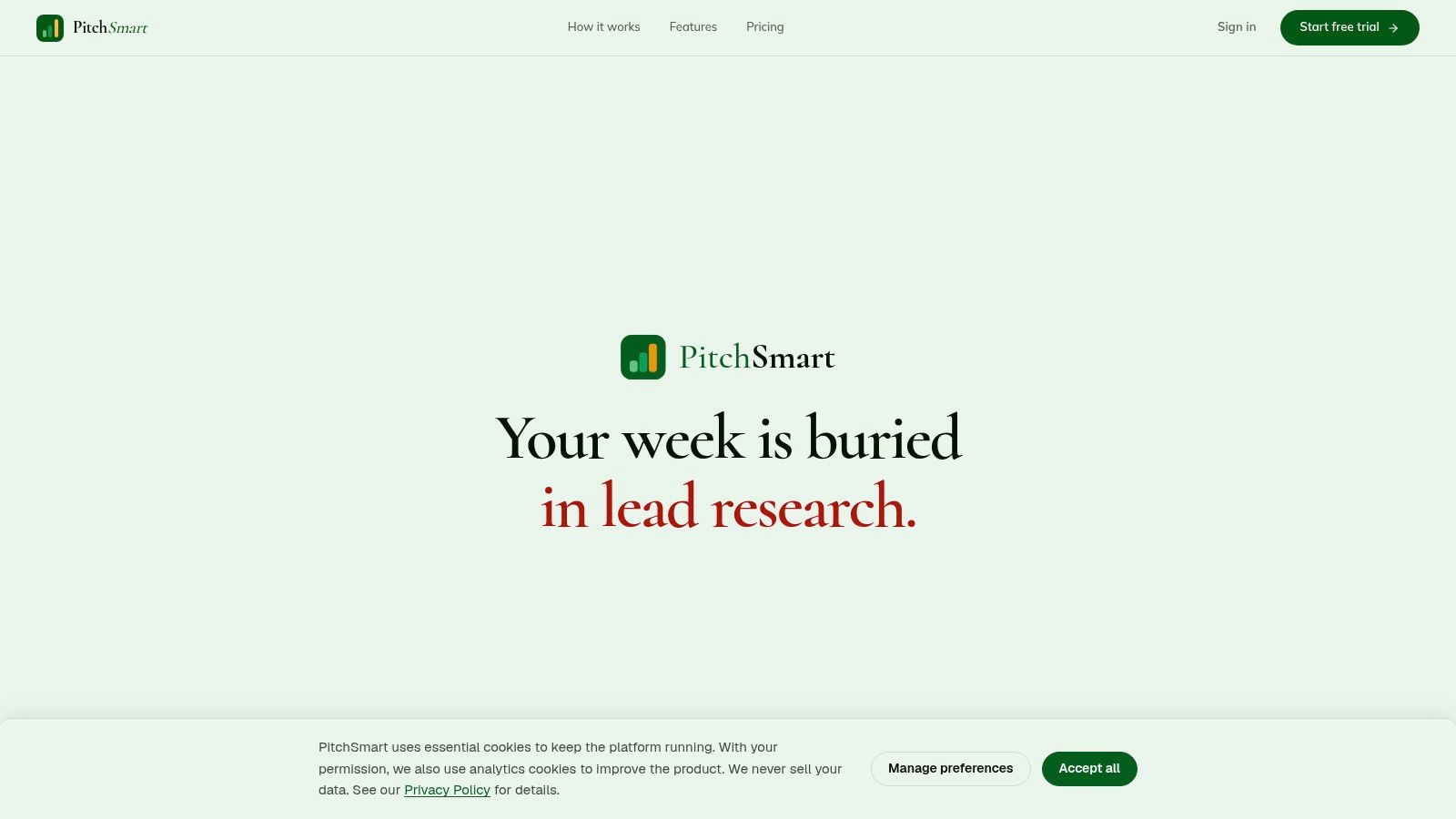
PitchSmart solves the part many sales teams ignore. Not list building. Not bulk sending. The painful middle layer where reps have names but still need a reason to reach out.
Instead of renting another database, PitchSmart works from your existing list. Upload a CSV or export accounts from your CRM, then it runs bulk research across the entire set, surfaces public signals, ties findings back to the original source, scores fit, and drafts outreach around those signals. That's the right design if your SDRs already have targets but keep losing time turning raw leads into usable messaging.
Why PitchSmart earns the top spot
The platform is built around research throughput. Reps don't need to open ten tabs per account just to find one conversation hook. They get signal-backed context, suggested angles, and draft copy they can review before sending. That keeps quality control with the rep instead of handing everything to a black-box writer.
For outbound teams, that's the core value. AI prospecting is now mainstream, with one industry roundup reporting that 81% of sales teams have implemented or are experimenting with AI. The same roundup says teams use AI most for writing outreach messages, prospect research, and improving data quality. PitchSmart sits directly in that lane, but in a more practical way than generic AI assistants because it starts with your accounts and public evidence.
Practical rule: If your reps already know who they want to target, a research engine usually creates more pipeline value than buying yet another contact source.
Where it fits in a real outbound stack
PitchSmart is strongest when paired with a data provider and a sequencer. Use Apollo, ZoomInfo, Cognism, Lusha, or LeadIQ to build the list. Run the list through PitchSmart to extract buying signals, research hooks, and draft messaging. Then push the output into Apollo, Outreach, or Salesloft for execution.
That stack fixes the bleeding neck. Your team stops spending its day copying firmographics into notes and starts reviewing messaging that's already grounded in account context.
A few trade-offs matter:
- Best for teams with lists already in hand: PitchSmart isn't a lead discovery database. You bring the accounts.
- Best when relevance matters more than volume: It's built for stronger first touches, not spray-and-pray.
- Less useful for thin public footprints: Some accounts publish little information. When signals are weak, hooks will be weaker too.
- Good operational guardrails: Source-cited outputs and rep review are important if you care about message accuracy and brand risk.
If your outbound team's bottleneck is research, PitchSmart is the fastest fix in this list.
2. Apollo.io
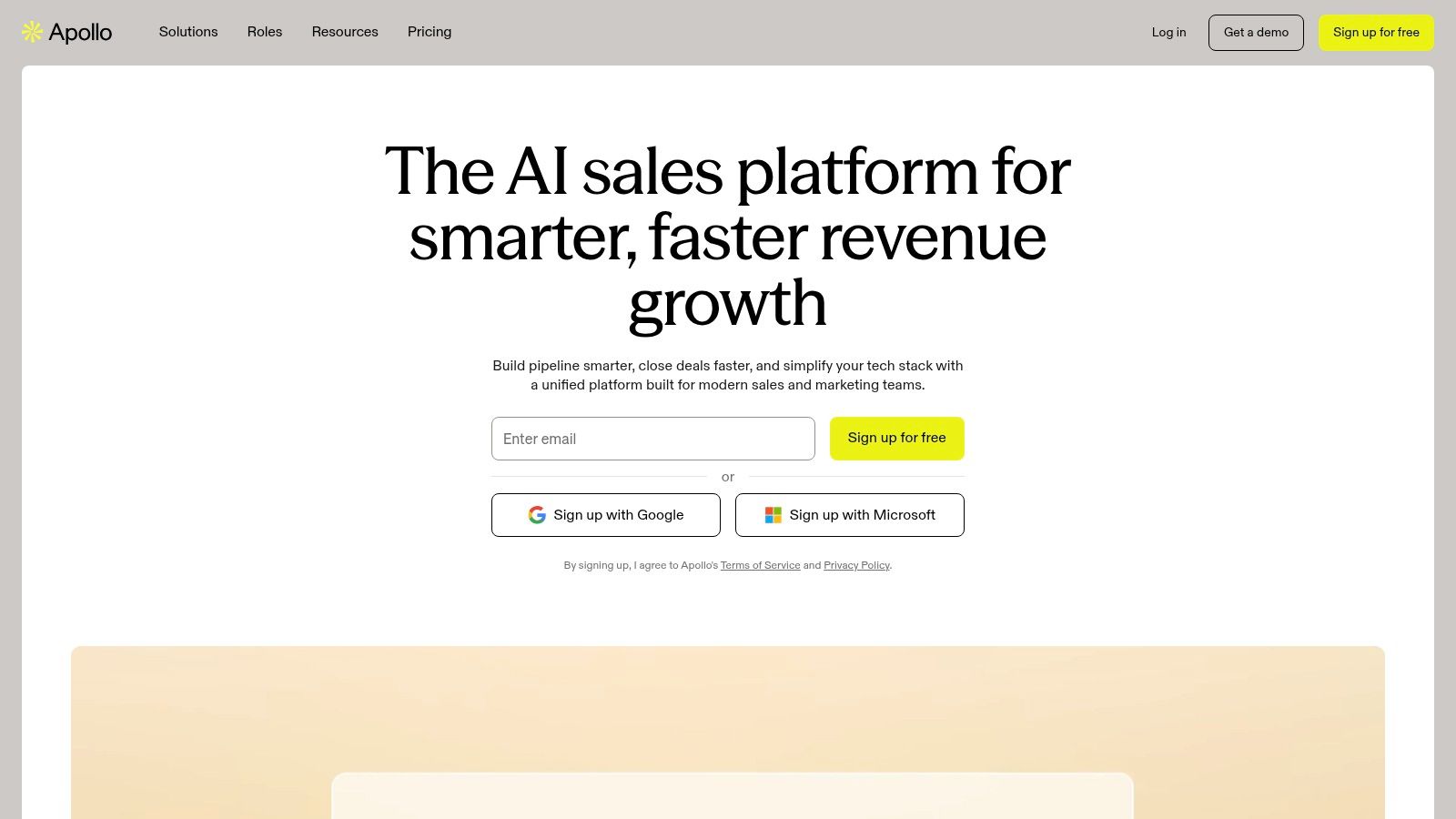
Apollo is a common choice for teams that want prospecting and execution in the same system. You can build lists, enrich records, route leads, and launch sequences without buying a separate tool for each step. For lean SDR teams, that usually means faster ramp time and less operational overhead.
Apollo's value is straightforward. It reduces stack sprawl. A rep can go from account search to first-touch email in one workflow, which matters when speed is the priority and ops support is limited.
Best for teams that want one tool to cover the core outbound workflow
Apollo fits SMB and mid-market teams that need acceptable data, solid filtering, and built-in sequencing at a price they can usually justify. It is often the first real outbound system a company standardizes on because it covers enough of the motion to get reps productive quickly.
The trade-off is quality variance. Coverage can be good, then uneven once you move into narrower ICPs, lower-volume industries, or certain international markets. Teams that care about precision usually find this out fast. They source in Apollo, then add a second provider or verification step for the records that matter most.
That makes Apollo a useful stack component, not necessarily the whole answer.
A practical setup looks like this:
- Use Apollo to build the list: Filter by firmographics, titles, headcount, technology, and intent where relevant.
- Use Apollo to launch the sequence: Keep basic email and task workflows in the same place so reps are not exporting CSVs all day.
- Add a research layer before send: Run priority accounts through PitchSmart so the messaging reflects actual company context instead of generic role-based copy.
- Set rules around data confidence: For top accounts, require verification or a second source before reps call or send volume.
The modern outbound stack view holds particular significance. Apollo handles list building and execution well enough for many teams. It does not solve the harder problem on its own, which is writing outreach that sounds informed at scale.
If your reps are missing meetings because the message is generic, buying Apollo will not fix that by itself. If your reps are losing hours bouncing between tools just to find contacts and start sequences, Apollo usually will.
3. ZoomInfo
ZoomInfo fits teams that need one system to support prospecting, enrichment, routing, and account planning across a larger GTM org. It is usually a better fit for companies with established RevOps processes than for lean teams trying to get their first outbound motion working.
The appeal is clear. Coverage is broad, the company hierarchy data is useful, and ops teams get more control over how records move into Salesforce or the rest of the stack. That matters when SDRs, AEs, marketing, and ops all depend on the same account and contact data.
Where ZoomInfo earns its keep is operational control.
Large teams use it to build target account lists, map buying committees, standardize enrichment, and keep territory rules from breaking every time a rep uploads a CSV. Managers also get more consistency in reporting because list building and data maintenance are less fragmented across tools.
The trade-off is straightforward. ZoomInfo is expensive, implementation takes work, and many teams buy more platform than they use. If your outbound team is small, your CRM process is loose, or your reps mainly need a fast way to find a contact and send a sequence, the ROI can get shaky fast.
That is why ZoomInfo works best as the data backbone in a modern outbound stack, not as the full prospecting answer.
A practical setup looks like this:
- Use ZoomInfo for account and contact coverage: Build the target list, pull org charts, and enrich CRM records at scale.
- Use PitchSmart before outreach: Turn raw account data into relevant messaging based on actual company context, not generic persona copy.
- Use your sequencer for execution: Send the emails, manage tasks, and track reply patterns in the platform reps already work from.
- Set tighter rules for high-value accounts: Require review on messaging and record quality before the first touch goes out.
That stack solves a real problem. ZoomInfo helps teams find the right people and keep data operations under control. PitchSmart handles the harder part most data platforms do not solve, which is giving reps enough context to write outreach that sounds specific. Without that layer, teams often end up with expensive data feeding average messaging.
4. Cognism
Cognism earns its place for one reason. Market coverage and compliance are not evenly distributed across prospecting tools, especially outside North America.
That matters because many “best tools” lists flatten everything into feature comparisons and ignore field performance by geography. An independent 2026 test across 15 tools and 100 real leads found email accuracy ranging from 40% to 98% and phone coverage from 0% to 85%. That spread is massive. It means the wrong tool can damage your workflow before a rep even starts writing.
A stronger fit for EMEA outbound
Cognism is often the safer pick when your team sells into EMEA and needs stronger compliance controls. It's also a better fit when phone outreach is central and your managers care about mobile coverage quality, not just having more rows in a CSV.
Use Cognism when these conditions apply:
- EMEA is core to pipeline: Regional depth matters more than broad global claims.
- Compliance review is strict: Legal and ops teams usually prefer a cleaner posture.
- Phone-first outreach matters: Mobile quality is more important than bulk email volume.
Cognism is usually overkill for teams doing light outbound in one domestic market. But for cross-border prospecting, “good enough” data can create expensive rep waste. This is one of the better tools when you need confidence in regulated outbound motions.
5. LinkedIn Sales Navigator
LinkedIn is still the fastest place to confirm whether an account is changing, who likely owns the problem, and which stakeholders sit around the deal. That makes Sales Navigator a core research layer in an outbound stack, especially for SDR teams selling into larger accounts where title nuance and reporting lines matter.
The value is context.
Sales Navigator helps reps answer the questions that generic contact databases usually miss. Who just got promoted? Which VP joined from a competitor? Is the company hiring around the pain your product solves? Those details shape the message before a rep ever looks for an email address.
Still the best source for role context
Sales Navigator works best as the first step in a workflow, not as the whole system. Use it to build the account view and identify the right people. Then pass those contacts into a provider like Apollo, ZoomInfo, or Cognism for verified emails and phone numbers. After that, run the account through PitchSmart or another research layer to turn raw contacts into outreach angles tied to the company's actual situation.
That stack matters because contact data alone does not create replies. A rep with the right person and the wrong message still misses quota.
The common mistake is buying Sales Navigator and expecting list building, enrichment, and personalization to be solved in one place. It does persona discovery and account monitoring very well. It does not replace your data provider or your sequencing platform.
For teams that prospect on LinkedIn every day, Sales Navigator usually earns its seat. For teams that need verified contact data at scale, it is one component of the system, not the system itself.
6. Lusha
Lusha is popular because it's simple. Install the extension, find a prospect on LinkedIn or a company site, and try to pull contact details fast. That's useful for lean teams that don't want a full data platform contract.
The appeal is speed to first result. Reps can stay in their normal browsing flow and enrich contacts without building a complicated system around it. For founders, early SDR hires, and recruiters-turned-outbound teams, that's often enough to get moving.
Fast enrichment for lean teams
Lusha is good when your prospecting motion is lightweight and rep-led. It's less impressive when you need large-scale list operations, advanced governance, or nuanced signal layering.
What it does well:
- Quick extension workflow: Reps can enrich while browsing.
- Easy trial motion: Good for validating whether your ICP is covered.
- Low operational overhead: You don't need a full RevOps rollout.
What it doesn't solve:
- Research depth: Contact details aren't the same as a reason to reach out.
- Uneven segment performance: Some roles and regions will be stronger than others.
- Workflow orchestration: It's not the system you build a mature outbound engine around.
For many teams, Lusha is a tactical enrichment tool. Pull the contact, then run the account through a research layer if you want the email to sound informed instead of generic.
7. Clay
Clay is for operators who don't want a fixed workflow. It's a flexible canvas for building one.
If Apollo is the all-in-one shortcut, Clay is the opposite. You combine providers, chain enrichment steps, layer AI research, and build custom tables that reflect your actual outbound motion. That's powerful if you have RevOps support or an SDR leader who likes process design. It's a mess if the team wants plug-and-play.
Best for custom research operations
Clay shines when you need waterfalls. One provider for emails, another for phones, another for firmographics, another for web research, then your own logic to score and route the results. That's often the right move for niche ICPs or data-sensitive markets where one vendor alone won't cut it.
Operator note: Clay gives you flexibility, not simplicity. If no one owns the workflow, the stack gets expensive and fragile fast.
There's also a practical message-quality point here. Clay can automate research steps, but teams still need a clear standard for what counts as a usable signal. Without that, you just produce more rows and more noise.
Clay is excellent for custom systems. It's not the easiest starting point for a small team that needs better outreach next week.
8. LeadIQ
LeadIQ sits in a practical middle ground. It's easier to operationalize than a custom stack, and usually less heavy than an enterprise data platform.
Teams often choose it when they want predictable enrichment workflows tied closely to sales rep behavior. Chrome extension capture, CRM updates, job-change tracking, and AI-assisted first-touch drafting are all useful. None of that is groundbreaking on its own, but the combination is solid for teams trying to keep prospecting clean and fast.
A practical middle ground
LeadIQ makes sense when your team works heavily from LinkedIn and needs a straightforward way to capture contacts into the CRM or sequence tool. It also tends to fit teams that care about transparent usage and don't want procurement involved in every decision.
The trade-offs are familiar. Coverage won't match the biggest data clouds, and niche ICPs may still need a second source. Regional phone depth can also vary, which matters if your SDR org still calls aggressively.
LeadIQ is a good fit for:
- SMB and mid-market teams: Enough structure without major rollout pain.
- Rep-driven sourcing: Strong for capture from browser workflows.
- Budget-aware ops teams: More predictable than larger enterprise contracts.
It's not the deepest tool on this list. It is one of the easier ones to adopt without slowing the team down.
9. Seamless.AI
Analysts at Spherical Insights project strong growth in buyer intent and prospecting software, with the market expanding sharply over the next decade, according to their report on B2B buyer intent data tools. The reason is simple. Reps need faster ways to find contacts, but speed only matters if the records are usable.
Seamless.AI fits teams that prospect from the browser, build lists on the fly, and want reps to search for contacts instead of waiting on a static account list. It works best in outbound motions where SDRs actively hunt by title, company, and direct dial availability.
That changes how I'd place it in a modern outbound stack.
This is usually not the research layer. PitchSmart should handle account context and message angles first. Then a contact-finding tool can help reps find the right people quickly, validate whether the account has enough reachable contacts, and push records into the sequencer. In that workflow, its job is speed and coverage, not strategy.
Useful for extension-first prospecting
The trade-off is operational consistency. Real-time search feels fast, but RevOps still has to measure match rates, duplicate creation, bounce risk, and how often reps need a second source to finish the record. If that cleanup load is high, the apparent time savings disappear.
Seamless.AI can be useful in a fast-moving contact discovery workflow. It tends to fit phone-heavy teams, rep-driven sourcing, and managers who care more about daily contact volume than deep account qualification inside the same tool.
Used well, it fills a specific slot in the stack. Use PitchSmart for relevance, use a contact source like this for speed, and let your sequencer handle execution. That setup gives SDRs a clearer workflow than asking one tool to do everything.
10. Crunchbase
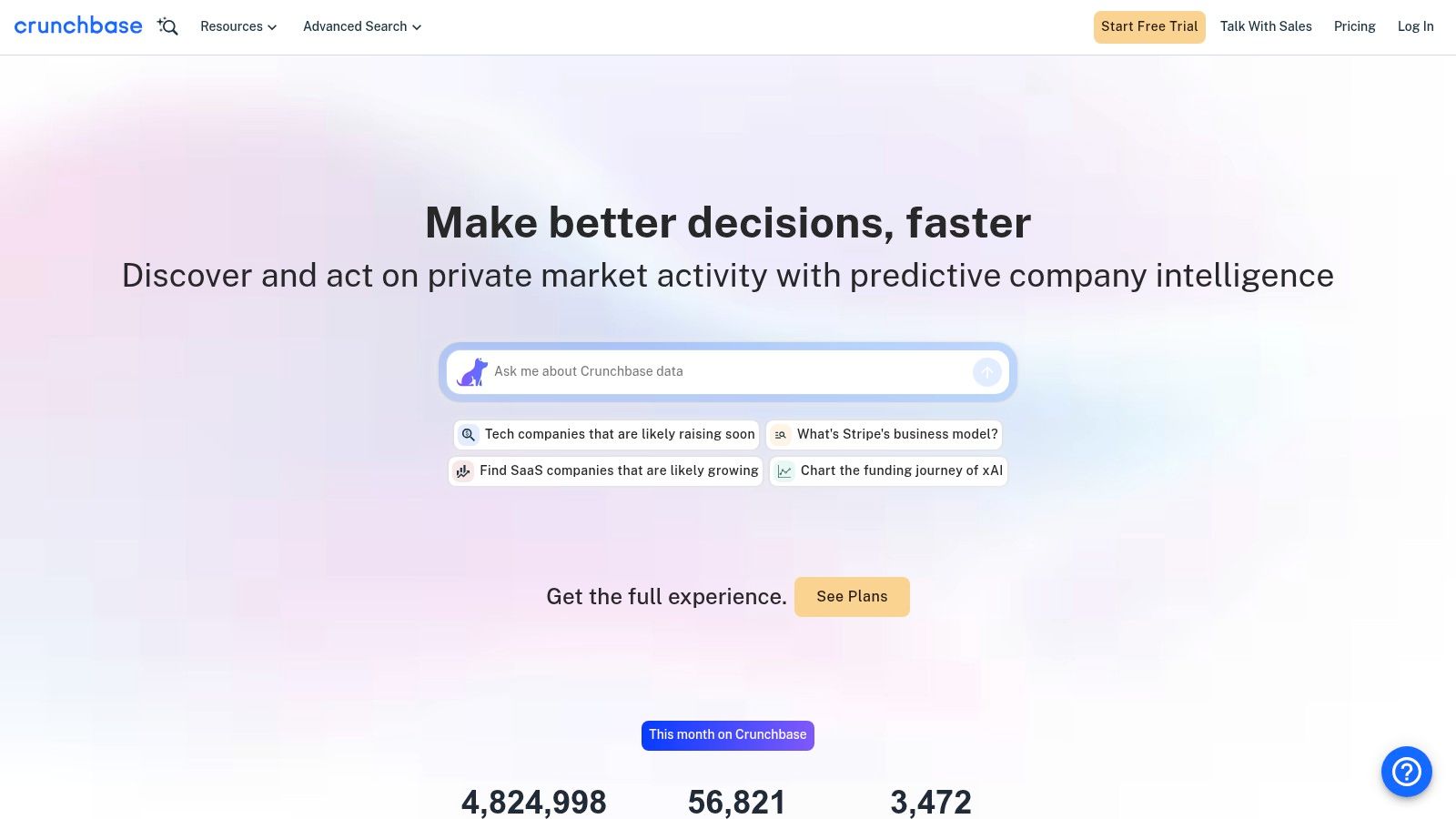
Crunchbase earns its place in an outbound stack because it helps teams decide which accounts deserve attention before reps spend time finding contacts or writing copy. It is strongest with startup, venture-backed, and high-change markets where funding, hiring, acquisitions, and leadership moves create a real reason to reach out now.
That is a different job from a contact database.
Crunchbase is an account selection tool first. SDRs can use it to build lists around company events, growth signals, investor backing, and category fit. Then the rest of the stack takes over. PitchSmart can turn those signals into outreach angles. A contact provider can supply verified people and emails. The sequencer handles execution.
Best used as the account-priority layer
Cold outreach still works when targeting is disciplined and timing is credible, as noted earlier. Crunchbase helps with that first part. It gives reps a cleaner way to answer a basic question: which accounts have a reason to care right now?
It tends to fit a few specific motions:
- Startup and growth-stage selling: Funding history, investor profile, and expansion activity help reps rank accounts.
- Event-led prospecting: Acquisitions, product launches, leadership changes, and hiring patterns can create a timely trigger.
- Account-first qualification: Teams can screen for momentum before paying for persona enrichment or sequence volume.
The trade-off is straightforward. Crunchbase does not replace the contact layer, and it does not solve messaging on its own. If a team treats it like a one-stop prospecting system, reps still end up switching tools to find people, verify records, and write outreach.
Used properly, it plays a narrow but valuable role. Start with Crunchbase to identify companies worth pursuing. Use PitchSmart to turn those company signals into relevant messaging. Then enrich contacts and push the final list into your sequencer. That workflow gives SDRs better timing without slowing them down with manual research.
Top 10 B2B Sales Prospecting Tools Comparison
Prospecting tools rarely fail because they lack features. They fail because teams buy overlapping products and still leave reps doing manual research between list building and outreach. The table below compares these tools by the job they do in an outbound stack, so it is easier to decide what to pair, what to skip, and where PitchSmart fits.
| Product | Primary role in the stack | Experience ★ | Value & Pricing 💰 | Best for 👥 | Standout ✨ |
|---|---|---|---|---|---|
| PitchSmart 🏆 | Research and messaging layer for existing account lists. Produces source-cited insights, draft outreach, and CSV or CRM-ready outputs | ★★★★☆, fast and easy to verify | 💰 Free tier + 14-day trial (no CC); transparent billing | 👥 SDR/BDR teams, outbound AEs, agencies working from target lists | ✨ Bulk research, cited signals, message drafts tied to each account |
| Apollo.io | Contact database, enrichment, extension, and built-in sequencing | ★★★★☆, convenient all-in-one | 💰 SMB-friendly; credits and add-ons can get messy | 👥 Small and mid-size teams that want prospecting and execution in one place | ✨ Database plus sequencing in a single workflow |
| ZoomInfo (SalesOS) | Enterprise data platform with broad coverage, org charts, intent, and integrations | ★★★★☆, strong scale and depth | 💰 Contract pricing; expensive once add-ons stack up | 👥 Enterprise sales orgs and RevOps teams | ✨ Broad coverage, deep account mapping, intent data |
| Cognism | Contact data with phone-verified mobiles, EMEA strength, and compliance controls | ★★★★☆, strong connect-rate focus | 💰 Custom pricing; premium cost for EMEA coverage | 👥 Teams selling across EMEA or working under tighter compliance rules | ✨ Compliance-first data and strong mobile coverage |
| LinkedIn Sales Navigator | Buyer and account context from LinkedIn, including search, alerts, and list building | ★★★★☆, strong role and company-change signals | 💰 Predictable self-serve plans | 👥 SDRs and AEs mapping buying committees | ✨ Fresh role changes and relationship context |
| Lusha | Lightweight contact lookup and enrichment through a browser extension | ★★★☆☆, simple and fast | 💰 Credit-based; free entry plan | 👥 Lean teams that need quick contact pulls | ✨ Fast lookups without much setup |
| Clay | Workflow builder for enrichment, provider waterfalls, and AI-assisted research | ★★★★☆, flexible but ops-heavy | 💰 Mid-range to variable; credit planning matters | 👥 RevOps and data teams building custom prospecting workflows | ✨ Multi-source waterfalls and customizable automation |
| LeadIQ | Contact capture, enrichment, and first-touch messaging support | ★★★★☆, predictable UX and credits | 💰 Transparent credit pricing; trial available | 👥 Teams that want lower cost and cleaner rep workflows | ✨ Simple capture-to-CRM process |
| Seamless.AI | Real-time email and phone discovery with intent and enrichment add-ons | ★★★☆☆, useful when live lookup matters, but hit rates vary | 💰 Credit model; pricing can be less clear | 👥 Extension-first SDR teams and call-heavy motions | ✨ Live discovery instead of relying only on a static database |
| Crunchbase | Account research built around funding, news, firmographics, and company lists | ★★★☆☆, best at company-level qualification | 💰 Affordable company plans; add-ons available | 👥 Account-based teams and startup-focused sellers | ✨ Funding and investor signals for account prioritization |
The practical takeaway is simple. No single tool handles account selection, contact coverage, research, and relevant messaging equally well.
For many teams, the stack works best in this order: use Apollo, ZoomInfo, Cognism, Lusha, or LeadIQ for contacts; use Sales Navigator or Crunchbase for people and company context; use PitchSmart to turn those inputs into outreach that sounds specific instead of generic. That setup cuts manual prep without forcing reps to write every message from scratch.
The trade-off is cost versus control. All-in-one platforms reduce tool sprawl, but they often leave teams with weaker research and average messaging. Best-of-breed stacks produce better outbound, but RevOps has to manage handoffs, credits, and data quality more carefully.
Stop Researching, Start Selling
The point of modern B2B sales prospecting tools isn't to give your team more software. It's to remove the work that keeps reps from selling. Sales departments generally have plenty of places to find contacts. What they lack is a clean system for turning target accounts into conversations without burning half the week on manual prep.
That's why a flat “best tools” ranking is usually the wrong way to think about this category. These tools do different jobs. ZoomInfo, Apollo, Cognism, Lusha, and LeadIQ help with discovery and enrichment. LinkedIn Sales Navigator helps with role context and buying committee visibility. Crunchbase helps with account qualification. Clay helps operations teams stitch together custom workflows.
But the biggest bottleneck usually sits between those steps. Reps get a list, maybe even a decent one, then they still have to figure out why this account matters now and what to say. That's where pipeline gets stuck. Data without context creates generic outreach. Generic outreach creates silence.
The fix is a stack built around workflow, not feature checklists.
A practical setup looks like this:
- Use a data source for list building: Apollo, ZoomInfo, Cognism, LeadIQ, Lusha.
- Use a company-context layer when needed: LinkedIn Sales Navigator for people context, Crunchbase for company signals.
- Use a research engine to create relevance: PitchSmart is the strongest fit here because it turns your existing list into source-backed hooks and draft messaging.
- Use a sequencer for execution: Apollo, Outreach, or Salesloft can handle delivery once the message is worth sending.
That structure matters because the market has changed. Prospecting tools are no longer just contact finders. As noted earlier, the major platforms now combine data, signals, and workflow automation. Buyers are also investing more heavily in intent and prioritization. So the winning teams won't be the ones with the biggest lists. They'll be the teams that move fastest from account selection to relevant outreach.
This is also where ROI gets clearer. If reps spend most of their day on admin, research, and cleanup, then the highest-return tool usually isn't the one with the biggest database. It's the one that gives rep time back without lowering message quality. In many orgs, that means reducing manual research first, then improving contact coverage second.
For SDR leaders, the operational question is simple. Where is your team losing hours right now? If the answer is list building, buy a stronger data source. If the answer is segmentation, buy better filtering and intent inputs. If the answer is “my reps have names but still send weak emails,” fix the research layer first.
That's why PitchSmart stands out in this category. It addresses the most expensive gap in outbound. The time between having a prospect and having a good reason to contact them. Solve that, and your reps spend less time researching and more time in real conversations.
If your team already has target accounts but still wastes hours turning them into usable outreach, try PitchSmart. It gives SDRs and RevOps teams a faster way to research lists in bulk, pull source-backed signals, segment by buying context, and generate email plus LinkedIn sequences built from real hooks instead of generic templates.