Your SDR has a list, a phone, a quota, and almost no time. That's the core operational problem behind most debates about cold calling vs warm calling.
One path says: dial more. The other says: research more. In practice, sales teams often get trapped between the two. If reps blast through a raw list, they burn hours on bad connects and weak conversations. If they research every account by hand, they protect quality but lose the volume needed to feed pipeline. Meanwhile, admin work, tab-hopping, CRM cleanup, and one-by-one prospecting steal huge chunks of selling time. PitchSmart describes that burden directly, noting that repetitive research, admin, and data entry consume roughly 70% of a rep's day on many teams through the normal outbound workflow on PitchSmart's platform overview.
The result is familiar. Reps sound generic because they don't have context. Or they sound relevant on the few accounts they had time to prepare, but the rest of the list never gets touched. Neither model scales cleanly.
That's why the useful question isn't whether cold calling or warm calling is better in theory. It's how to systematically turn more cold calls into warm calls without slowing the team to a crawl.
The Unwinnable War Between Dials and Research
A BDR opens the day with a spreadsheet of accounts that all look the same. Names, titles, company domains, maybe an industry tag if the data vendor did decent work. By noon, they've made a pile of calls, left voicemails, hit dead lines, and had a few conversations that went nowhere because there was no reason for the prospect to care.
Outbound teams lose efficiency at this juncture. Not because reps don't work hard. But because they're forced to choose between speed and context.
According to Close's cold calling benchmarks, it usually takes 6 to 10 attempts to reach a prospect via cold call, average success rates hover around 2%, and even top-performing SDR teams generally hit 5% to 8% meeting rates. Those numbers explain why pure unresearched dialing feels like running uphill in sand.
Why the old volume model breaks
A high-volume cold calling engine can still create pipeline. It can also create a lot of wasted motion.
If a rep has to:
- Find contact details across multiple systems
- Check the account manually for any relevant trigger
- Decide who to call first without clear buying signals
- Write follow-up notes after every weak conversation
they're spending a large share of the day on work that isn't live selling.
Operational reality: Most teams don't have a cold calling problem or a warm calling problem. They have a research bandwidth problem.
Why manual warm calling also stalls
The obvious reaction is to warm every lead first. That's directionally right and operationally messy.
A rep can absolutely produce better calls after reviewing company pages, LinkedIn activity, hiring moves, product launches, content engagement, or recent website behavior. But if each lead takes manual prep, the team's coverage collapses. The best accounts get attention. The rest rot in the CRM.
That's the unwinnable war. Dial fast and stay generic, or research thoroughly and lose throughput.
Cold Calling vs Warm Calling A Head-to-Head Comparison
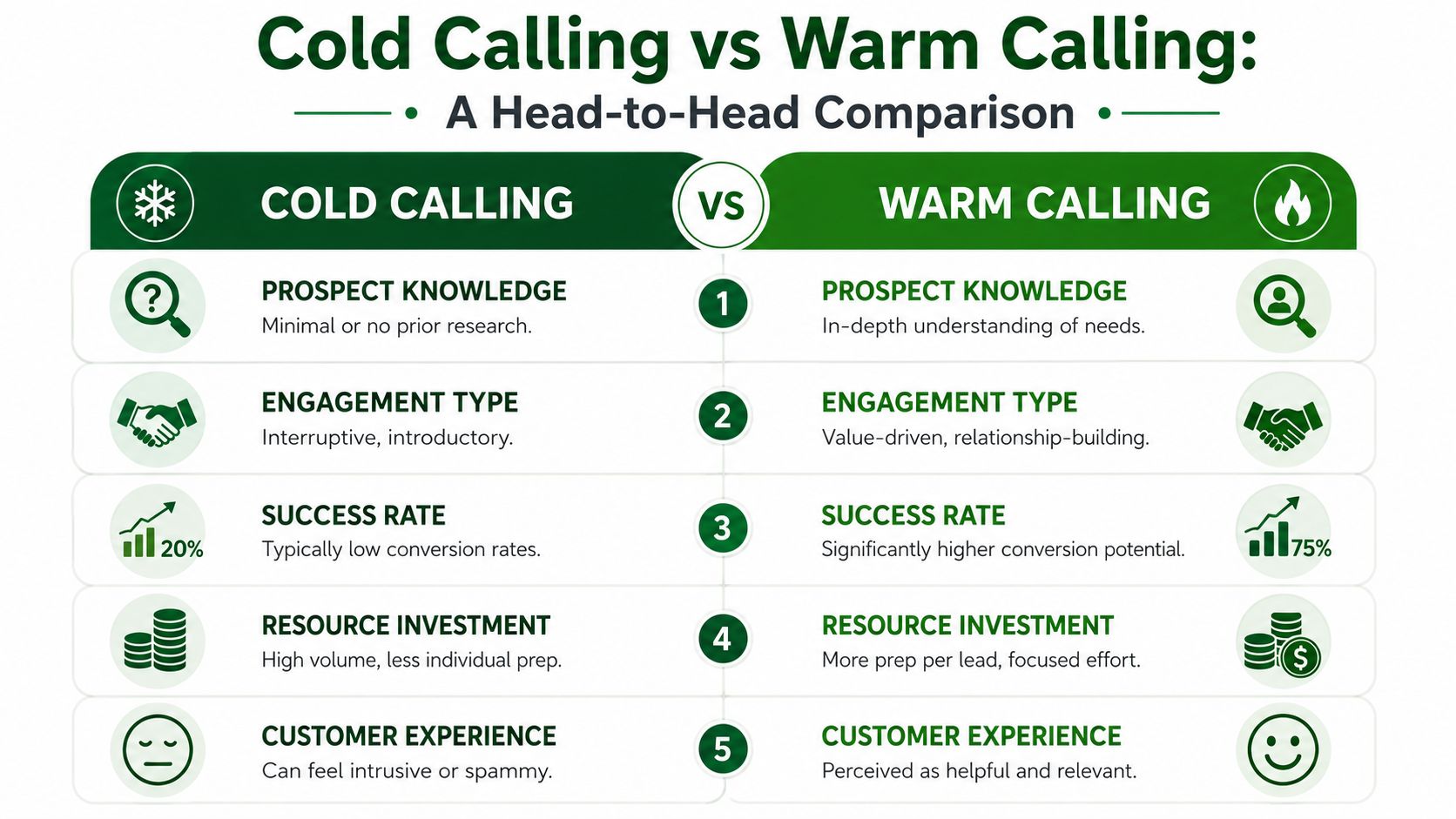
Cold calling and warm calling aren't just two flavors of the same activity. They're different operating models. They require different expectations, different messaging, and different management.
What each approach actually means
Cold calling starts with little or no prior relationship, context, or visible engagement. The prospect didn't request the call. They may not know your company. The rep's first job is to earn attention.
Warm calling starts with some form of context. That might be prior engagement, buyer intent, a referral, a website visit, a content download, a triggered event, or a prior interaction from another channel. The rep begins with a reason for the call that the buyer can recognize.
The practical distinction matters because the conversation starts in a different place. Cold calls need permission and fast relevance. Warm calls can move sooner into diagnosis and fit.
Cold Calling vs. Warm Calling At a Glance
| Attribute | Cold Calling | Warm Calling |
|---|---|---|
| Prospect awareness | Usually little or none | Some prior awareness or signal exists |
| Context level | Minimal | Built on engagement, intent, or trigger context |
| Opening objective | Earn attention and permission | Use context to continue an existing thread |
| Prep model | Light prep, higher dial volume | More focused prep, fewer but better calls |
| Rep experience | Often interruptive | More relevant and conversational |
| Best use case | Net-new coverage and market entry | Prioritized follow-up on engaged or signaled accounts |
| Core trade-off | Scale without context | Context without easy manual scale |
| Likely outcome pattern | More activity needed for each meeting | Higher yield per conversation |
The performance gap is stark. Apollo reports that hot calls driven by buyer intent or prior engagement convert at 15% to 35%+, while traditional cold calls convert at only 2.3% to 4.8% in its breakdown of hot calls vs cold calls.
That data is the clearest reason the cold calling vs warm calling debate keeps resurfacing. A little context changes everything. Not because the phone channel changed, but because buyer resistance drops when the rep has a credible reason to call.
What sales leaders usually miss
The wrong takeaway is “stop cold calling.”
The right takeaway is that warming steps matter more than call volume once the list quality is good enough. If the rep can call after a meaningful signal, the conversation starts from relevance instead of interruption.
For most B2B teams, the better system looks like this:
- Use cold calling to reach accounts that aren't yet engaging
- Use warm calling to prioritize the accounts showing signs of movement
- Build a process that moves leads from the first bucket to the second as fast as possible
That's how modern outbound teams solve the volume-versus-quality trade-off. They don't choose one method. They build a machine that creates more warm starts.
Benchmarking Success KPIs and Realistic Expectations
A lot of managers break this motion by measuring everything the same way. If you score warm calling teams by raw dial volume, you'll push reps toward rushed conversations. If you score cold calling teams only on booked meetings, you'll miss the upstream work needed to create enough shots on goal.
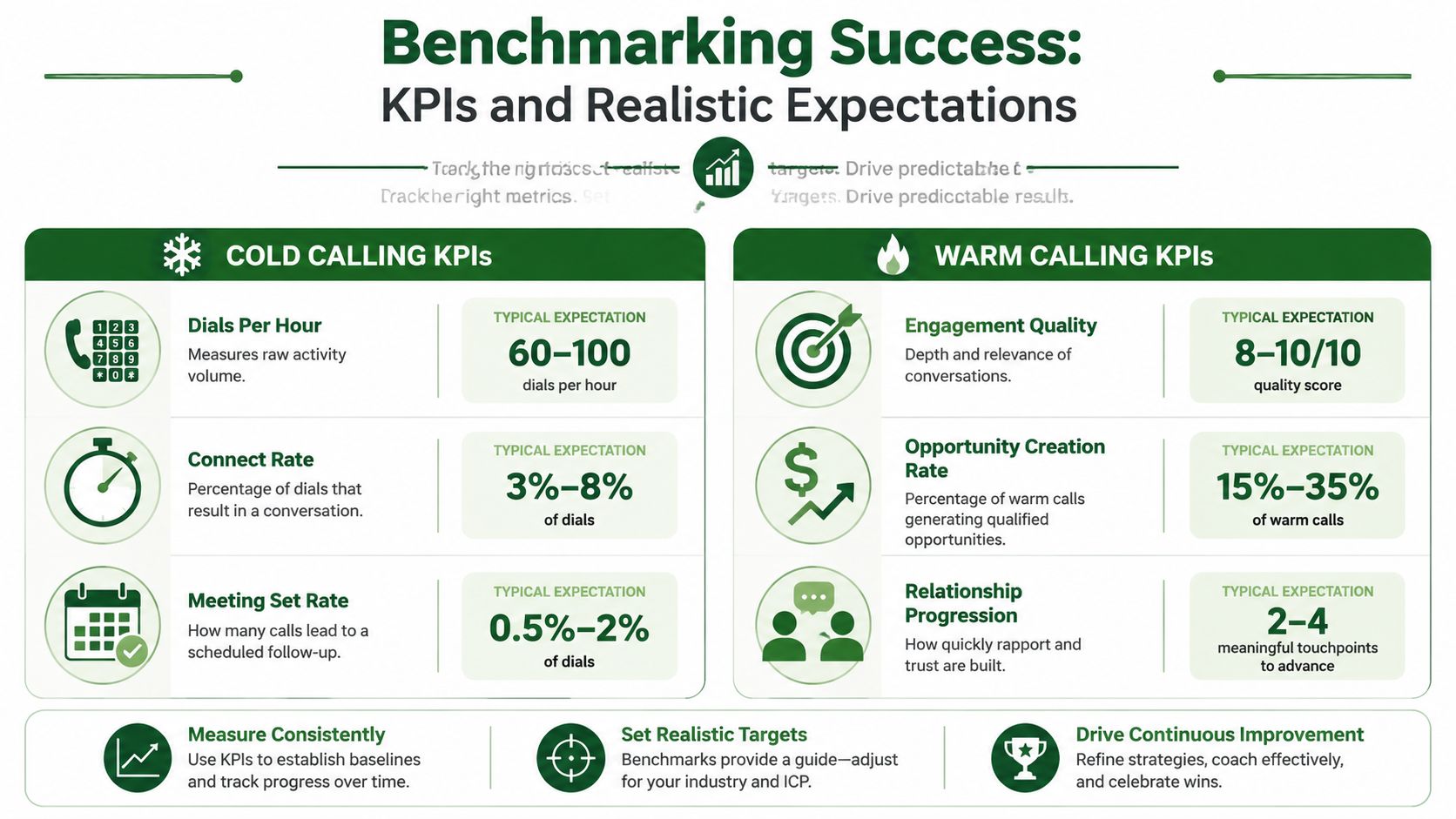
Track different metrics for different motions
For cold calling, managers should watch activity and contact mechanics closely:
- Dial volume: Is the rep creating enough opportunities to connect?
- Connect quality: Are conversations reaching the right persona?
- Conversation rate: Are live connects turning into actual discussions, not instant brush-offs?
- Follow-up discipline: Does the rep complete the next step when interest appears?
For warm calling, the center of gravity shifts:
- Signal-to-conversation rate: Are the prioritized leads converting into meaningful calls?
- Meeting quality: Are meetings being booked with real fit and timing?
- Opportunity creation: Are conversations advancing into qualified pipeline?
- Speed to progression: Does the account move faster once context exists?
What good management looks at
According to Superhuman Prospecting's comparison of cold and warm calling, cold calling typically converts about 1-3% of live conversations into qualified meetings, while warm calling often converts about 10-20% when prior engagement exists. The same analysis frames that as a major gain in per-conversation yield.
That's why rep-hour efficiency matters. A rep who makes fewer calls but works stronger signals can still produce more pipeline than a rep who logs a huge dial count against a raw list.
Practical rule: Cold calling KPIs tell you whether the engine is moving. Warm calling KPIs tell you whether the engine is pointed at the right accounts.
A useful dashboard separates three layers:
Activity metrics
Calls placed, call attempts per account, follow-up completion.Conversation metrics
Live connects, conversation rate, objection pattern by segment, next-step acceptance.Revenue metrics
Meetings held, qualified opportunities, pipeline sourced from signal-backed outreach.
When teams blend those together, managers make bad calls. They pressure researched reps to dial like list-burners, or they give high-volume callers warm-call expectations without any warming infrastructure behind them.
Proven Workflows for Both Calling Strategies
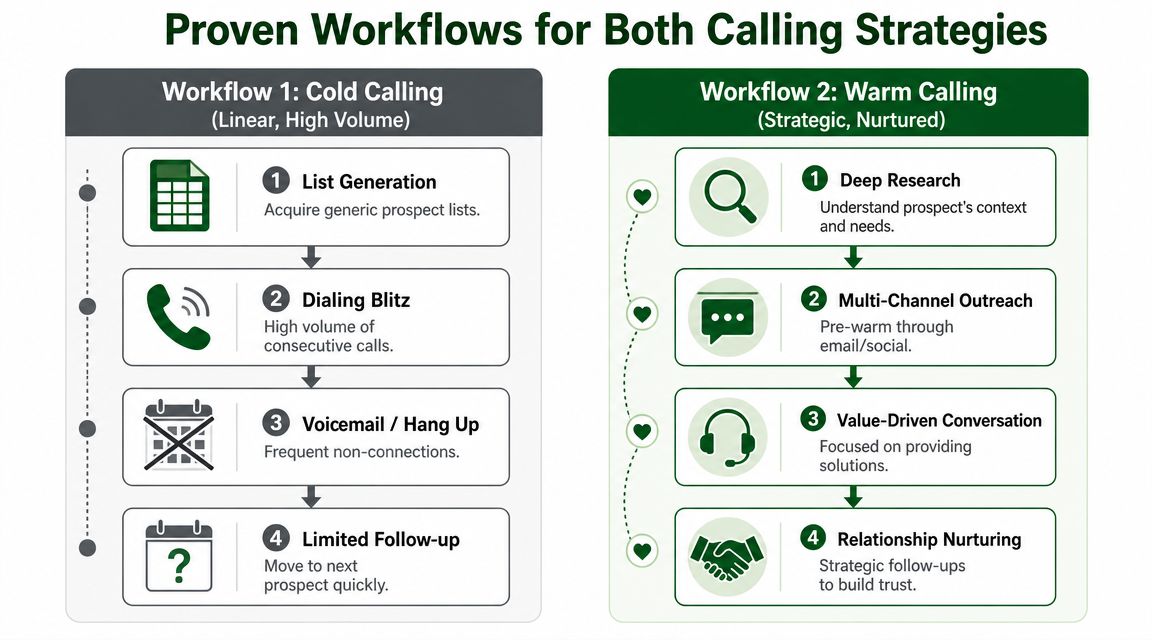
The easiest way to see the difference between cold calling vs warm calling is to map the work itself. One is a numbers game. The other is a context game.
The cold calling workflow
Cold calling usually runs in a straight line:
Pull a list
The team starts with a segment, territory, or named account list.Dial in volume
Reps place repeated call attempts across the list.Handle non-connects
Most activity is voicemail, gatekeepers, bad timing, or no answer.Move quickly
Reps leave a short follow-up, log the result, and keep going.
This workflow has one huge advantage. It covers ground.
It also has one major constraint. According to Instantly's review of B2B cold calling metrics, some reports show it takes around 8 attempts just to connect with a prospect, which tells you how much time disappears before a real conversation even starts.
The warm calling workflow
Warm calling is less linear and more deliberate:
Find the trigger
Something happened that gives the rep a reason to reach out.Research the account
The rep checks the company, person, and possible business relevance.Pre-warm through other channels
Email, LinkedIn, or prior touches establish familiarity.Call with context
The phone conversation opens around the signal, not a generic pitch.Nurture based on response
Follow-up depends on what the account did, said, or showed interest in.
Why manual warm workflows break
Teams frequently encounter a significant obstacle. Warm calling is better operationally, but only if the prep doesn't eat the day.
A rep who manually researches each lead across LinkedIn, company sites, job postings, product pages, news mentions, and CRM history can produce strong calls. They just can't do it at scale for hundreds of contacts without falling behind.
That's why sales leaders keep rebuilding the stack. They need a system that can:
- Segment accounts by signal
- Surface a reason to call
- Seed outreach before the call
- Keep reps inside a repeatable workflow
For teams trying to standardize that motion, the practical playbooks and process examples on the PitchSmart blog are closer to the right model than the old “smile and dial” approach.
A cold workflow maximizes coverage. A warm workflow maximizes yield. High-performance outbound needs both, but it also needs a way to move leads from one workflow into the other.
Sample Scripts and Rebuttal Frameworks
Scripts fail when they try to sound polished instead of relevant. The best cold scripts buy time. The best warm scripts use context to lower resistance.
A workable cold call opener
A cold call opener should do three things fast: identify you, acknowledge the interruption, and earn permission for a short question.
Example cold call opener
“Hi Sarah, this is Daniel with [Company]. You weren't expecting my call, so I'll keep it brief. I work with revenue teams that are trying to improve outbound efficiency when reps are spending too much time researching and not enough time selling. Can I ask how your team handles account prep before prospecting?”
Why this works:
- It doesn't pretend the call is warm
- It anchors on a real business problem
- It opens with a diagnostic question, not a demo trap
Warm call openers built around signals
Warm calls should start with the reason the rep is calling now.
After a content engagement signal
“Hi Sarah, this is Daniel with [Company]. I'm calling because your team engaged with our outbound workflow content, and that usually means one of two things: reps are spending too much time on prep, or managers want more consistency in outreach quality. Which one is closer to home right now?”
After a hiring signal
“Hi Sarah, this is Daniel with [Company]. I noticed the team is adding sales capacity. That usually creates pressure around ramp time, list quality, and message consistency, so I wanted to ask what you're doing to keep new reps from defaulting to generic outreach.”
After a referral or prior interaction
“Hi Sarah, this is Daniel with [Company]. We'd spoken briefly before, and I wanted to follow up because teams in your position usually hit a point where manual research starts slowing outbound down. Has that become an issue on your side?”
Rebuttals that keep the conversation alive
Warm call rebuttals work best when you return to the signal instead of arguing the pitch.
If the prospect says “We're all set”, don't push harder. Re-anchor.
Try:
- “Makes sense. The reason I called wasn't to assume a fit. It was the signal that your team may be revisiting outbound process, and I wanted to see if that's true.”
- “Understood. I'm not asking you to evaluate anything on this call. I wanted to understand whether the activity I saw reflects a real initiative or just casual interest.”
If they say “Send me something”, avoid treating it like a win.
Use:
- “Happy to. To make it relevant, what's the actual issue you'd want the material to address?”
Good rebuttals don't fight objections. They narrow the conversation back to the business reason the call exists.
How to Scale Warm Calling Without Manual Research
Teams already know warm calling performs better. The problem isn't belief. The problem is execution capacity.

Why manual warm calling breaks at team scale
Ask any sales manager what happens when they tell reps to “personalize more.”
A few things happen immediately:
- Coverage shrinks because reps can't prep every account thoroughly
- Quality becomes uneven because each rep researches differently
- Follow-up slows down because context gathering takes too long
- Prioritization gets fuzzy because not all signals are equal
That's why the volume-versus-quality trade-off has lasted so long. Warm calling is superior as a conversation strategy, but manual warm calling is fragile as an operating system.
The way out is to stop treating research as artisanal rep work.
What a scalable warming system needs
A scalable system needs four capabilities.
First, it needs bulk lead research, not one-by-one tab surfing. If a platform can process an entire uploaded list or CRM segment in parallel, reps stop spending hours doing detective work before they ever pick up the phone.
Second, it needs activity-based conversational hooks. Not generic personalization. Real reasons to call that connect to recent signals and can be traced back to source context.
Third, it needs automated sequence support. Warm calling works better when the prospect has already seen the rep's name in email or LinkedIn. A simple, signal-seeded three-step sequence can create familiarity before the first dial.
Fourth, it needs segmentation by buying signals so reps aren't treating a weak curiosity signal the same way they treat a stronger intent signal.
That's the model modern outbound tools are finally making practical. Instead of asking reps to research, score, write, and sequence each lead manually, the system handles the repetitive prep and gives the rep a usable conversation plan.
A pricing model only matters if it supports that workflow at scale. That's why it makes sense to review what's included in a platform built for signal-backed outbound on the PitchSmart pricing page.
For a quick product walkthrough of the workflow, this demo is useful:
The core idea is simple. Don't ask every rep to become a full-time researcher. Give them a system that warms leads at list level, surfaces the best hooks, and feeds those hooks into calls and multichannel follow-up.
The highest-performing outbound teams don't eliminate cold calling. They industrialize the steps that make cold outreach feel warm.
A Managers Guide to A-B Testing Your Calling Strategy
If you want budget, process change, or rep adoption, don't argue theory. Run tests.
Start with a simple control-versus-test structure for a defined segment. Keep territory, persona, and offer consistent. Change the outreach motion.
A practical test design
Control group
Reps call a qualified list using the current cold calling workflow.
Test group
Reps work the same type of list, but with signal-backed prioritization, pre-call warming steps, and context-led talk tracks.
Track outcomes at three levels:
- Rep efficiency: meetings booked per rep-hour
- Pipeline quality: qualified opportunities created
- Sales velocity: time from first touch to meeting and from meeting to opportunity
What to watch closely
Don't let raw dial totals dominate the review. A smarter motion may produce fewer calls and better output.
Also watch behavior:
- Are reps using the context in the opener?
- Are managers coaching to signal quality, not just call count?
- Are follow-ups aligned to the original reason for outreach?
Run the test long enough to get stable patterns, then decide whether the warmed workflow should replace part of the standard outbound motion or sit alongside it for higher-intent segments.
The goal isn't to prove that cold calling is dead. It isn't. The goal is to prove how much lift your team gets when more of those calls start warm.
If your team is stuck between low-yield dialing and slow manual research, PitchSmart is built for that exact problem. It helps outbound teams research lead lists in bulk, surface signal-backed conversation hooks, segment accounts by buying intent, and turn those hooks into automated email and LinkedIn sequences that make calls warmer before reps ever dial.