Every sales team can define cross-sell and upsell. Upsell sells the customer more of what they already bought: a higher tier, more seats, more volume, a longer term. Cross-sell sells them a different product. The definitions are settled, and they are not the reason expansion targets get missed.
The distinction matters for a practical reason most definition articles skip. The two motions run on different evidence, and that evidence lives in different places. Upsell evidence sits inside the relationship you already have: usage, seat counts, contract limits, the support queue. Cross-sell evidence sits in a part of the customer's business your account owner does not cover, with a buyer they have never met and a budget they cannot see. Treat both as one "expansion" motion with one research habit and you get a healthy upsell number next to a cross-sell number that stays flat, however many times it appears on the QBR slide.
This piece sets the two side by side, shows where each one's evidence comes from, and lays out a research workflow for the harder one.
The difference, in one table
The usual framing compares price and product scope. The rows that decide how you research each motion are different ones: who signs, and where the proof that they need it can be found.
| Question | Upsell | Cross-sell |
|---|---|---|
| What grows | The same product: tier, seats, volume, term | A second product line in the same account |
| Who signs | Usually the buyer you already have | Often a different function with its own budget |
| Where the evidence lives | Inside: usage data, license limits, support tickets, renewal terms | Outside: job posts, filings, press releases, leadership changes, stated initiatives |
| Who in your company sees it first | The account owner or CSM | Frequently nobody |
| Typical trigger | Hitting a plan limit, adding a team | A new problem appearing in a department you do not serve |
| Typical failure | Pushing a tier the customer does not use | Pitching to the wrong person at no particular moment |
Read down the cross-sell column and the problem is plain. Every row that decides whether the conversation goes well is a row your existing relationship cannot answer.
Upsell evidence lives inside the account
An upsell case builds itself out of data you already own. The customer bought 200 seats and has 212 active users. They are on the tier with a monthly export cap and hit it three months running. Support tickets keep asking for a feature that ships in the next plan up. The renewal is 90 days out and the champion was just promoted. None of this needs research in the usual sense. It needs somebody to read usage and contract data on a schedule, and an agreed threshold that turns a number into a conversation.
That is why upsell tends to be the steadier half of expansion in subscription businesses. It is measurable, one team owns it, and it lands with a buyer who already knows what the product does. It also shows up directly in retention figures. The SaaS Capital 2025 retention benchmarks for private B2B SaaS companies put median net revenue retention at 102% for companies selling at $25,000 to $50,000 in annual contract value, with the bottom quartile at 97% and the top quartile at 111%. Net revenue retention folds upsell, cross-sell and churn into one number, so it cannot tell you which motion is carrying it. That alone is a reason to measure them separately, which the last section covers.
Upsell has its own failure mode, and the fix is also evidence. When the trigger is a calendar date ("renewal is coming, propose the next tier") rather than a usage condition, the customer hears a price increase. Tie every upsell proposal to a specific limit they hit or a specific capability they asked for, and the conversation is about their operation instead of your quota.
Cross-sell evidence lives outside the relationship
Take a vendor with two products sold into mid-market companies: a payroll platform bought by HR, and a security awareness training product bought by IT or the security team. One account has run the payroll product for three years. The CSM talks to the HR operations lead every month and knows the account well.
Now list what would make that account ready for the security product this quarter. The company posts a job for its first compliance manager. Its CFO mentions an upcoming SOC 2 audit on an industry podcast. A press release announces a contract with a regulated customer, which will bring vendor security reviews with it. A new CISO arrives from a company known for running formal phishing simulations. Every one of those facts is public. None of them will come up in a monthly call with HR operations, because HR operations is not involved and may not even know.
That is the general shape of cross-sell. The opportunity announces itself through a signal from a part of the business the account owner does not cover, so a very good account owner can still be the last person to see it. Three things follow.
- Research starts from the second product, not the account. Reading an account's news and hoping something relevant turns up is how a rep loses an afternoon. Write down the conditions that make the second product urgent, then look for those conditions.
- The evidence travels with the ask. The account owner is about to spend relationship capital requesting an introduction to a stranger. A link to the job post or the filing is what makes that request reasonable rather than a fishing trip.
- The buyer is identified separately. Your champion is a useful route in. They are rarely the person who signs for a product outside their own function.
This is where cross-sell meets the broader discipline of buying signals in sales. A cross-sell signal is a buying signal scoped to one account you already own and one product that account does not have yet.
Why the cross-sell number stalls
Most teams do not lack interest. A 2024 HubSpot survey of more than 1,400 sales professionals across North America, Europe and Asia found that 87% of salespeople try to cross-sell during the sales process, and respondents put cross-selling and upselling at 21% of their organizations' revenue each, on average. The attempts are happening. What stalls is the step from an attempt to a qualified opportunity inside a new buying center.
Forrester's report on the science of cross-sell and upsell describes B2B expansion as a complex process that needs coordinated effort, and notes that many organizations have no defined plan for it. That matches the pattern above. Upsell has an owner and a data source. Cross-sell has neither, so it defaults to a line on the account plan reading "explore product B" with nothing underneath it.
Time makes it worse. Salesforce's State of Sales research, drawn from more than 4,000 sales professionals, reports that reps spend 60% of their time on non-selling tasks. A rep with that calendar will not volunteer to research a department they do not sell to, for a product they may not even be paid on. If cross-sell research depends on individual initiative, it does not happen at any scale.
Research each one differently
The fix is to give each motion its own workflow instead of one shared expansion checklist.
Upsell workflow
- Define three to five usage or contract conditions that predict a tier change: limits hit, seats over plan, feature requests tied to a higher tier.
- Pull them on a fixed schedule from product and billing data.
- Route each hit to the account owner with the specific number attached.
- Propose the change against that number, not against the renewal date.
Cross-sell workflow
- For each product the account does not own, write down the problem it removes and the function that feels that problem.
- Translate each problem into observable, public conditions: a role being hired, a regulation taking effect, a stated initiative, a leadership arrival, a system being replaced.
- Check every owned account against those conditions, and record the source for each one that holds.
- Name the likely buyer in that function, and decide whether the current champion is the right route in.
- Hand the account owner a short brief: product, condition, source, buyer, suggested ask.
The cross-sell list is longer because the account owner starts with none of those inputs. Steps two and three are where most teams stop, and they are the steps that work far better as a system than as rep homework. The same logic sits under an account whitespace analysis: the matrix shows which product each account is missing, and the conditions tell you which of those gaps is worth raising now.
Step three is the problem PitchSmart is built for. It reads every account on your list against what you sell, checks the buying signals you define for each product, and returns the ones that hold, each with its source.
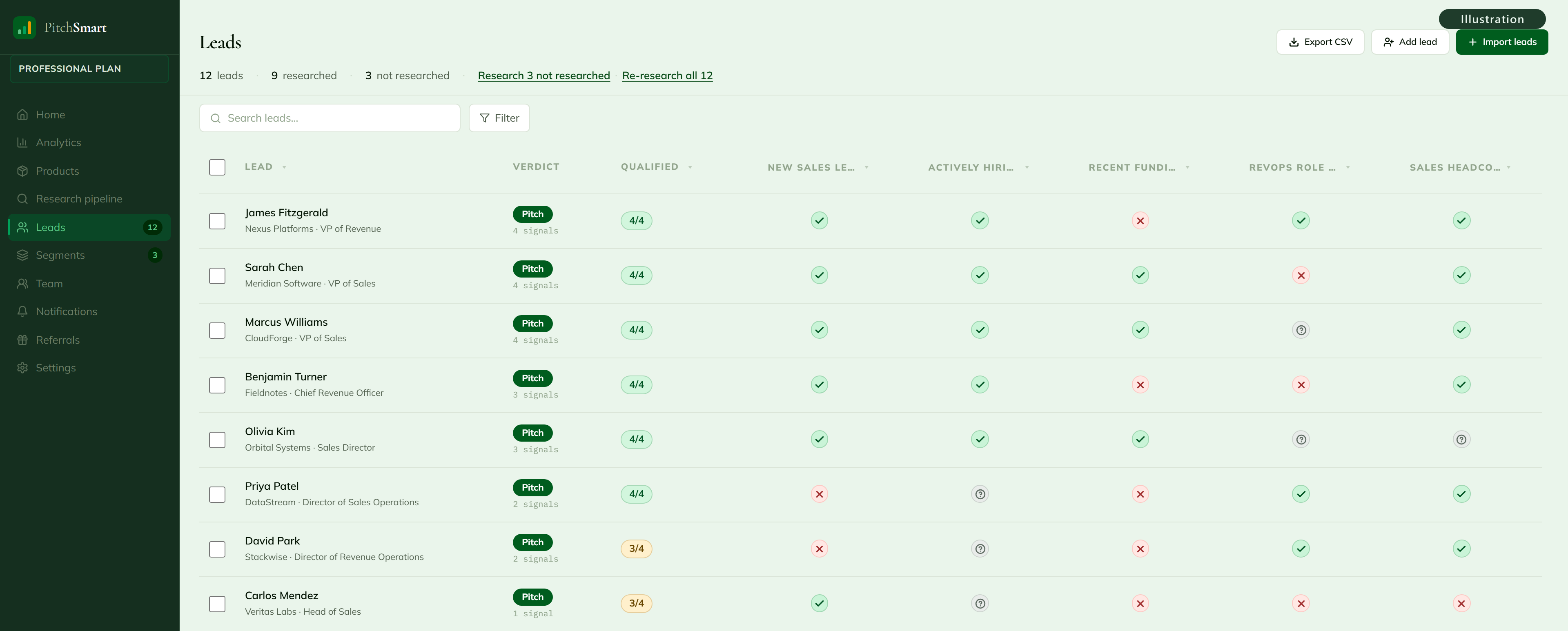
Illustration from a PitchSmart demo account. Every company and person shown is invented. This is step three answered per account: each column is one buying signal for one product, checked yes, no or unsure against every lead on the list, so the owner can see which accounts carry a reason to call before anyone writes a brief. To run the same check on your own accounts, start a free trial and define the signals for your second product first.
Measure them separately
One blended expansion number hides which motion is working. Split it into figures that point at a specific fix.
- Upsell rate: the share of accounts that moved up a tier or added capacity in the period.
- Multi-product penetration: the share of accounts owning two or more product lines, tracked per product pair.
- Cross-sell opportunities with documented evidence: the share of new cross-sell opportunities whose record links to the external signal that started them.
- Cross-sell win rate by origin: signal-backed opportunities against opportunities opened from an account plan line with no evidence behind it.
The last two are the ones most teams do not track, and they settle the argument about whether research is worth the time. If signal-backed opportunities convert better, the workflow earns more investment. If they do not, the conditions are wrong and need rewriting, which is the same review habit described in our piece on trigger events in sales.
Where to start this quarter
Pick one product pair: the product most of your base already owns, and the one you most want them to add. Write five public conditions that would make the second product urgent. Run them against fifty owned accounts and count how many have at least one condition that holds with a source you can link. That count is your working cross-sell pipeline for the pair, and unlike a whitespace matrix, every account on it comes with a reason to call and a person to ask for.
If expansion is the core of your growth plan rather than a side motion, our guide to the land and expand strategy covers how to sequence the second product once the first has landed.
The two questions are simple once they are separated. Upsell asks whether the customer is outgrowing what they bought, and your own data answers it. Cross-sell asks whether a part of the company you do not serve has a problem right now, and only outside research answers that. Give each question its own evidence and its own owner, and the cross-sell line on the account plan finally has something underneath it.