Your team probably knows the feeling. End of quarter. Salesforce is full of closed-won deals, the forecast finally looks clean, and everyone starts talking about a record month. Then finance posts the follow-up report. A few customers cancel fast. A few demand credits. A few only signed because pricing got pushed lower than anyone wants to admit.
That's when the celebration gets expensive.
For outbound teams, the difference between net and gross sales isn't finance trivia. It decides whether the pipeline you built turns into durable revenue or just a pile of contracts that leak value right after signature. It also exposes a brutal truth about prospecting. Weak targeting at the top creates discount pressure, buyer mismatch, and churn at the bottom.
Manual research makes that problem worse. Reps spend too much of the day buried in tabs, copying notes, and guessing who might care. That usually leads to generic outreach, the wrong meetings, and deals that were never a fit in the first place. Gross sales can still look good for a minute. Net sales tells the truth.
That Record Quarter That Wasnt Really a Record
The quarter looked perfect from the sales floor.
AEs hit quota. SDRs fed the pipeline. Managers started using words like momentum and breakout. The dashboard showed a big gross revenue number, and nobody wanted to interrupt the mood by asking how many of those accounts were shaky, over-discounted, or rushed through procurement.

Fast-growing outbound teams often learn a harsh lesson. Gross sales rewards the moment of the close. Net sales judges what happened after the handoff. If the customer wasn't a fit, if the promise outran the product, or if the rep had to bend pricing just to force a yes, the correction shows up later.
I've seen this pattern enough to call it a revenue quality problem, not a finance problem. The damage lands everywhere. Finance has to reconcile the mess. Customer success inherits the wrong accounts. Sales leaders deal with clawbacks and awkward comp conversations. Reps who thought they crushed the month realize they closed work, not value.
The part reps feel first
Most reps don't care about accounting definitions until it hits their paycheck.
The first sign is usually a clawback, a delayed payout, or a manager asking why several new logos are already at risk. Suddenly the deal that looked heroic in CRM turns into a warning sign. The rep did create gross sales. The company didn't keep enough of it.
Practical rule: If a deal needs heavy discounting, weak qualification, and a fragile handoff to close, it probably won't improve net sales.
That's why the difference between net and gross sales matters to SDRs and AEs, not just to finance. Your list quality, your message quality, and your qualification discipline all show up later in revenue quality. If you're building outbound on top of bad-fit accounts, you're feeding the company top-line noise instead of reliable revenue.
A lot of teams only realize this after the quarter closes. The smarter move is to build for fit earlier, with tighter qualification and better account research inside the outbound workflow. Teams that want cleaner revenue usually end up rethinking how they source and work accounts in the first place. That's the core operational gap most platforms try to solve, including tools like PitchSmart.
What Is Gross Sales The Top-Line Number
Gross sales is the total revenue from sales transactions before any deductions. It's the top-line number. No returns removed. No credits removed. No discounts backed out.
The simplest formula is:
Gross Sales = Sum of All Sales
If you sell a product or subscription, gross sales answers one question: how much value did the team book at the point of sale?
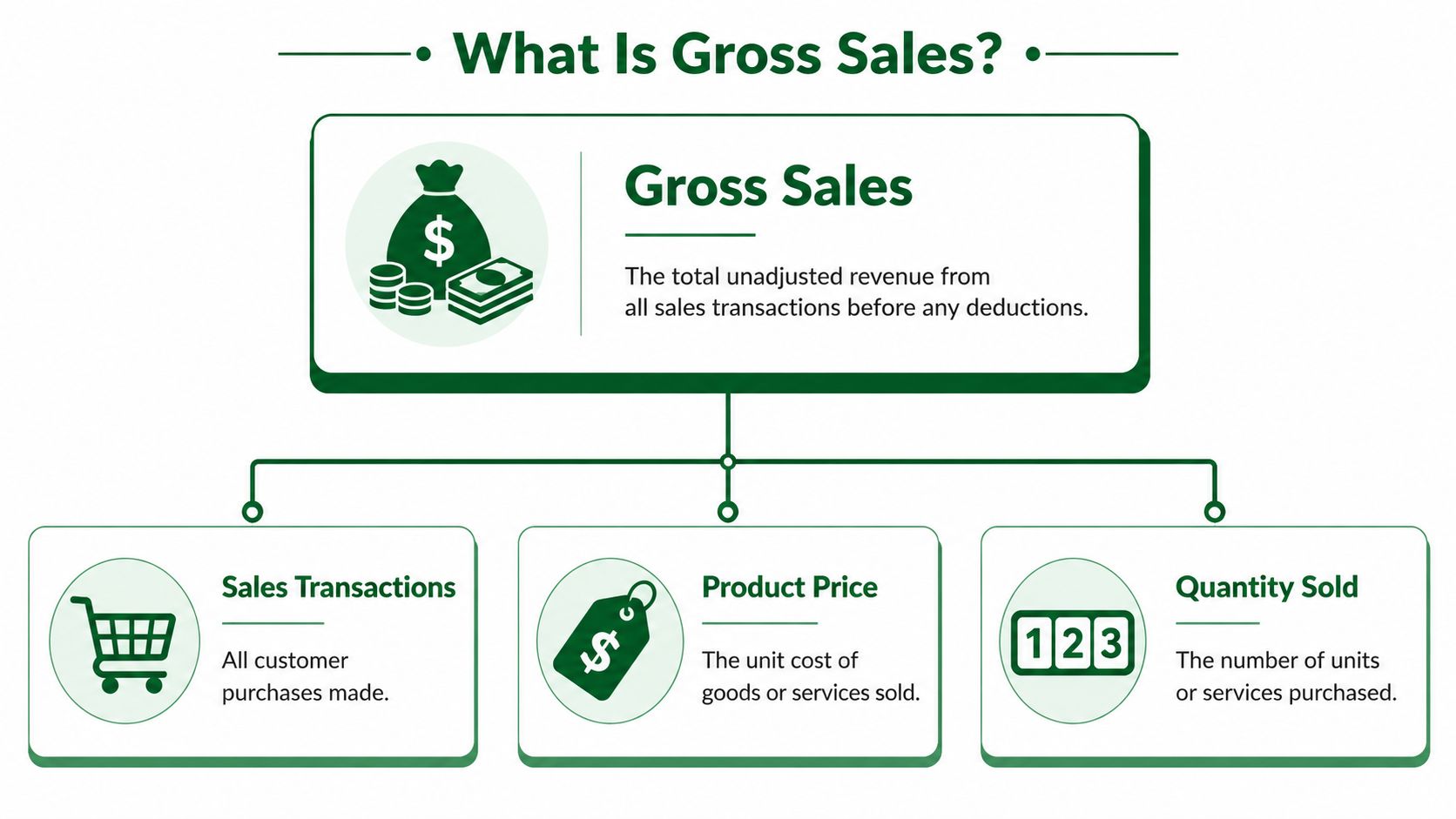
In B2B SaaS, think of it as contract value before reality kicks in. A rep closes a new annual subscription. The contract enters the system at full booked value. At that moment, gross sales looks clean and encouraging. It tells you demand existed and a deal got signed.
That's useful. It just isn't enough.
Why leaders still track it
Gross sales still matters because it helps sales leaders evaluate activity and output. It shows whether reps are creating opportunities, moving buyers through stages, and converting pipeline into signed business. When gross sales rises, it usually means the market is responding to the team's offer, message, or timing.
For front-line management, gross sales is often the fastest read on production. If your SDR team improves targeting and your AEs close more qualified meetings, gross sales usually moves first. It's the earliest visible sign that selling effort is turning into booked business.
Use gross sales well, and it can support decisions like:
- Territory analysis: Which segments are producing the most signed revenue
- Rep coaching: Which AEs are consistently creating booked value without stalling late-stage deals
- Offer testing: Whether a pricing package or positioning change improves conversion into signed contracts
Here's a simple way to think about it. Gross sales is the headline number from sales execution. It tells you what the team put on the board before the business absorbs post-sale friction.
This video gives a quick overview of how top-line revenue works in practice.
Where reps misread it
The mistake is treating gross sales like finished revenue.
A rep sees a signed order form and assumes the job is done. It isn't. Gross sales doesn't tell you whether the buyer will stay, whether onboarding will go smoothly, or whether the discount needed to win the deal erased value on the way in.
Gross sales is what the team sold on paper. It is not the same as what the company actually keeps.
This is why gross sales can flatter bad outbound habits. A rep can spray generic outreach, chase weak-fit accounts, and still produce a decent-looking top line for a while. If those buyers never should have entered the funnel, the corrections show up later. Gross sales stays important, but it's an optimistic number by design.
What Is Net Sales The Revenue That Sticks
Net sales is the revenue left after the company subtracts the deductions attached to those sales. It's the number that reflects what the business retains from signed deals.
The core formula is straightforward:
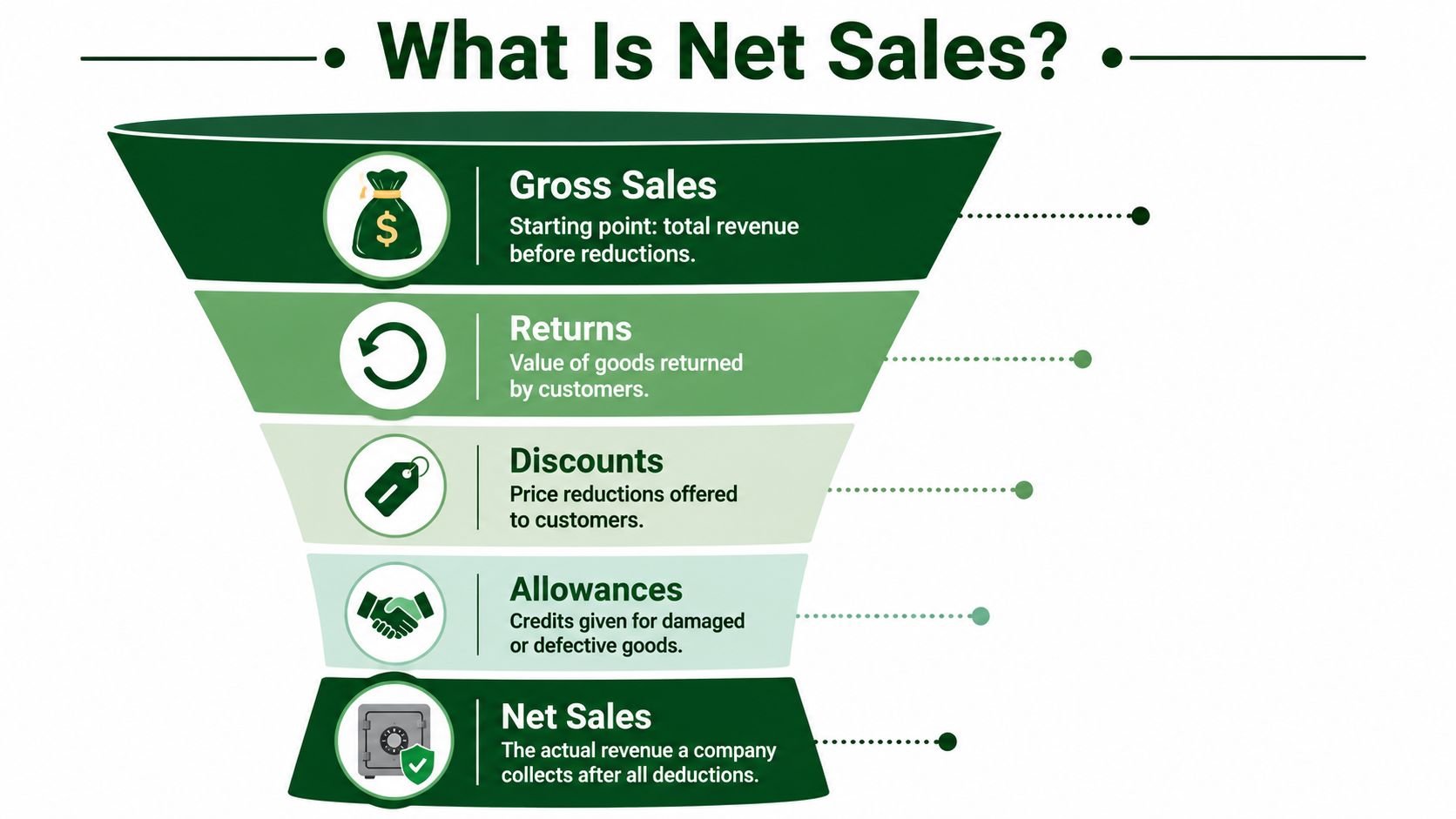
Net Sales = Gross Sales – (Returns + Allowances + Discounts)
That formula matters because it forces the team to look beyond bookings. A contract only becomes durable revenue when the customer stays, the pricing holds, and the business doesn't have to keep giving value back after close.
The formula that matters
In SaaS and services businesses, the deductions are rarely random. They usually point back to something operational.
- Returns: In a SaaS context, this often looks like a fast cancellation or refund during an early guarantee or trial-related window.
- Allowances: These are credits or concessions after the sale, often tied to service issues, implementation problems, or unmet expectations.
- Discounts: These reduce the original value of the sale at close because pricing had to move to win the account.
When net sales drops far below gross sales, leadership should ask uncomfortable questions. Are reps selling to poor-fit buyers? Is the product being oversold? Is discounting replacing positioning? Are onboarding and handoff weak enough that new customers regret the purchase almost immediately?
That's why net sales is the cleaner operational signal. It shows whether your go-to-market motion creates revenue that holds.
What each deduction usually means
A return often signals more than a cancellation. It often means the wrong customer entered the funnel, got persuaded by urgency, then discovered the solution didn't match the problem. In outbound, that usually starts with shallow research and generic messaging that got a meeting but not a properly qualified opportunity.
An allowance usually points to friction after signature. Maybe implementation took longer than expected. Maybe a promised workflow wasn't available. Maybe the account expected white-glove support that the contract didn't include. Sales doesn't own every post-sale issue, but sales often shapes the expectation that created the issue.
Discounts are the most visible deduction because reps choose them in real time. When an AE reaches for pricing early, it often means the buyer doesn't see enough differentiated value. Sometimes that's a market reality. Sometimes it's a messaging failure that started in prospecting.
If a team constantly needs discounts to create urgency, the problem often sits upstream in targeting and relevance, not downstream in negotiation.
Net sales is why RevOps cares about the full path from account selection to closed-won to customer adoption. It also explains why many teams revisit how they qualify accounts before they ever enter sequence. Better-fit buyers create fewer returns, fewer concessions, and less pricing pressure. For teams evaluating that kind of workflow change, the main commercial trade-offs usually show up in tools, process design, and package decisions like those outlined on PitchSmart pricing.
Gross vs Net Sales A Head to Head Comparison
The cleanest way to understand the difference between net and gross sales is to compare what each metric answers.
| Metric | Gross Sales | Net Sales |
|---|---|---|
| Purpose | Measures total booked revenue before deductions | Measures retained revenue after deductions |
| Formula | Sum of all sales | Gross sales minus returns, allowances, and discounts |
| What It Reveals | Sales activity, demand, and closing output | Revenue quality, pricing discipline, and post-sale retention of value |
| Primary Audience | Sales leadership, pipeline managers, board-level top-line reporting | Finance, RevOps, sales leadership, and compensation design |
That table looks simple, but the operational consequences are not.
Gross sales tells you whether the team can get contracts signed. Net sales tells you whether those contracts were worth signing in the form they were sold. When teams track gross and ignore net, they create a culture that rewards speed without checking durability.
What a widening gap tells RevOps
A growing gap between gross sales and net sales is rarely just an accounting issue. It usually points to one or more commercial problems that need intervention.
- Discounting is loose: Reps may be using price cuts as a default closing tool instead of defending value.
- Qualification is weak: SDRs may be pushing meetings with accounts that match a persona on paper but lack real urgency or fit.
- Sales promises are drifting: AEs may be framing implementation, product capability, or expected outcomes too aggressively.
- Post-sale execution is uneven: Customer success or onboarding may be inheriting deals that were never set up cleanly.
This is why high gross sales can still coexist with an unhealthy revenue engine. The team appears productive on dashboards. Behind the scenes, finance is reversing value, CS is managing churn risk, and leadership is trying to explain why bookings look better than actual retained revenue.
The most expensive bad deal isn't the one you lose. It's the one you win and then spend months discounting, crediting, and rescuing.
What a healthy ratio usually looks like operationally
A tighter relationship between gross and net sales usually comes from discipline, not luck.
First, reps target accounts that are more likely to become successful customers. They don't chase every company that vaguely fits the market category. They look for role-specific pain, timing signals, and operational context that suggest the account can implement and benefit from the product.
Second, the sales process protects value. Reps qualify harder, handle objections with substance, and don't collapse into pricing concessions the moment a competitor enters the conversation.
Third, handoff quality is strong. What the AE sold matches what onboarding and customer success can deliver.
In practice, healthy teams usually show a few behaviors:
- Cleaner account selection: Prospecting starts with fit, not list volume alone.
- Sharper discovery: Reps test urgency, workflow pain, and buying process early.
- Tighter deal desk controls: Discounts require genuine justification.
- Better expectation setting: AEs sell the actual implementation path, not the idealized one.
Gross sales and net sales should never be treated like competing metrics. Gross shows production. Net shows whether that production was commercially sound. If you only reward the first, you'll spend the next quarter repairing the second.
Why Sales Reps Should Obsess Over Net Sales
A rep closes three deals on the last day of the quarter. The dashboard lights up. Two months later, one account is asking for credits, another never properly launched, and the third only signed because pricing got pushed past what the business should have accepted. Gross sales made the quarter look strong. Net sales decides whether that quarter helped the company.
That matters to reps more than many realize. Net sales affects commission quality, forecast credibility, account allocation, and how leaders judge whether someone is building durable revenue or creating work for finance, onboarding, and customer success.
Gross heroes often create expensive problems
Some reps get praised for pushing deals over the line at any cost. They ask for end-of-month approvals, trade margin for speed, and celebrate the signature before anyone checks whether the customer was a real fit. On paper, they look productive.
In practice, those deals often come back. Finance sees credits. CS sees adoption issues. Managers listen to calls and hear promises the product team never agreed to deliver. If comp includes clawbacks or retention gates, the rep feels it in their paycheck.
I have seen this pattern enough times to treat it as an operating issue, not a personality quirk. Reps respond to the scorecard. If the scorecard only rewards closed-won volume, some people will fill the funnel with business that should have been filtered out earlier. Teams that want better revenue quality usually adjust the process, the approval rules, and the prospecting standard together. The PitchSmart blog on sales productivity and outbound execution makes a similar point from the top of funnel side. Bad inputs create expensive downstream fixes.
What strong reps do differently
Strong reps still care about quota. They just understand that a deal only counts in a meaningful way if the customer can succeed at the price and scope sold.
They slow down at the right moments. They test whether the buyer has a real problem, whether the team can implement, and whether the champion can hold up under procurement and executive review. They protect pricing when the value is real. They walk away when the account is forcing a shape the product cannot support.
That shows up in a few repeatable habits:
- They qualify for retention, not just conversion: They ask questions that surface rollout risk, internal ownership, and likelihood of adoption.
- They treat discounting as a trade-off: Every concession has a reason, a limit, and a clear give-get.
- They protect handoff quality: What they sell matches what onboarding and success can deliver.
- They disqualify without drama: A weak-fit account is not “pipeline coverage.” It is future churn waiting to happen.
Your job is to close business that holds up after the kickoff call.
For SDRs, this changes what a good meeting looks like. A booked intro with a poor-fit account is not a win just because it hit activity targets. For AEs, it changes which opportunities deserve real time. A full pipeline means very little if too much of it will convert into discounts, credits, and early churn.
Reps who understand net sales earn trust faster. Leadership gives better territories and more strategic accounts to people who bring in revenue the company gets to keep. Closing a lot of business gets attention. Closing business that sticks gets influence.
Boost Net Sales with Smarter Outbound Prospecting
If net sales is the number that sticks, outbound has to stop feeding the funnel with weak-fit accounts.
That's where sales operations still lose time and revenue quality. Reps do manual research one account at a time, jump between LinkedIn, company sites, job boards, and CRM notes, then send generic emails because they ran out of time to personalize properly. PitchSmart describes that operational drag directly in its own product positioning. It gives teams back time lost to repetitive research, admin, and data entry that consume roughly 70% of a rep's day, according to the PitchSmart blog.

Better targeting fixes downstream revenue quality
A healthy net-to-gross relationship usually starts long before the proposal. It starts with who made it onto the list.
When teams use bulk, customizable lead research with proprietary data points, they can segment based on buying signals instead of basic firmographics alone. That means prioritizing accounts with the right context, not just the right industry label. Activity-based conversational hooks drawn from recent online signals help reps open with relevance instead of noise.
That shift matters because relevant prospecting reduces the need for rescue tactics later. If the buyer already has a visible reason to care, the rep doesn't need to manufacture urgency through discounts or overpromising.
What changes in the rep workflow
The strongest outbound workflows are simple. Research happens across the full list, not one browser tab at a time. Hooks come from real account activity. Sequences are seeded from those hooks, then pushed into an automated 3-step email and LinkedIn flow. Segmentation gets tighter because the team can sort accounts by signal strength, not just by title and company size.
That changes what enters the pipeline:
- Fewer shaky meetings: Buyers have a reason to engage.
- Better discovery starting points: Reps enter calls with context tied to live signals.
- Less discount dependence: Relevance does more of the work that price cuts used to do.
- Stronger customer fit: The account was selected because there was evidence of need, not because it happened to be on a list.
If you want better net sales, don't just ask AEs to negotiate harder. Fix the quality of the opportunities they receive.
Once the net number is clean, the next question is what moved it. Price volume mix analysis splits a change in net revenue into price, volume, and what customers chose to buy.
PitchSmart helps outbound teams do that without the usual research bottleneck. Upload your list or pull prospects from your CRM, let the platform run bulk account research, surface signal-backed hooks, and turn them into outreach your reps can effectively use. If you want more full-price conversations with accounts that are likelier to stick, start with PitchSmart.