Your SDR has a clean list, solid messaging, and a full morning blocked for prospecting. By lunch, they've opened LinkedIn profiles, scanned company news, checked job boards, copied notes into the CRM, and drafted a few “personalized” emails. Most of that work never turns into a reply. The rep didn't fail. The process did.
That's the core problem with the typical lead qualification process in outbound sales. Prospects are still qualified one at a time, after burning time on research that should've been automated before outreach ever starts. The result is predictable. Reps spend their best hours gathering context instead of starting conversations, and managers wonder why list quality feels inconsistent from one week to the next.
If you run outbound, the job isn't just deciding whether a lead fits. It's deciding which accounts deserve attention before a rep sends the first email or LinkedIn message. That means shifting from manual prospect-by-prospect research to pre-qualifying entire lists with rules, signals, and a repeatable scoring system.
The Outbound Time Sink No One Talks About
A lot of new sales managers inherit the same bad workflow. Reps get a target list, open ten browser tabs per account, and try to piece together enough context to justify a cold email. It feels responsible. It also kills capacity.
The hidden cost isn't only time. Manual research creates uneven qualification standards. One rep cares about hiring activity. Another checks funding. A third glances at the homepage and calls it good enough. Soon the team isn't running one lead qualification process. It's running several personal versions of one.
That inconsistency matters because outbound lives or dies on selection. If the list is weak, even good messaging underperforms. If the list is strong but the rep can't get through enough accounts, pipeline stalls anyway. According to the Salesforce State of Sales reporting summarized here, sales reps spend only 28% to 30% of their week on actual selling activities, while 70% to 72% goes to non-selling work like research, data entry, and CRM updates.
What this looks like in the field
A typical morning goes like this:
- Rep starts with a raw list: Company names, titles, maybe a domain.
- Research expands manually: LinkedIn, company site, press mentions, job openings, recent posts.
- Context gets pasted into scattered tools: CRM notes, spreadsheets, drafts, maybe a sequencing tool.
- Outreach goes out too late: By then, the rep has only touched a fraction of the list.
The biggest outbound bottleneck usually isn't copy. It's the hours burned deciding who deserves the copy.
The old one-by-one model made sense when teams worked smaller books of business and tolerated slow prospecting cycles. It breaks when you need repeatable outbound at scale. A manager can't coach a process that exists mostly in browser tabs and individual rep judgment.
Why this problem compounds fast
Manual qualification also creates a quality illusion. Reps feel productive because they worked hard. Managers see activity and assume the list is being vetted carefully. But hard work isn't the same as a scalable system.
A workable outbound lead qualification process does two things before a human writes a message. It filters for fit, and it surfaces reasons to believe the account is worth contacting now. Without that second part, teams send generic outreach to broadly matched accounts and call it personalization.
Foundation First Defining Your Ideal Customer Profile
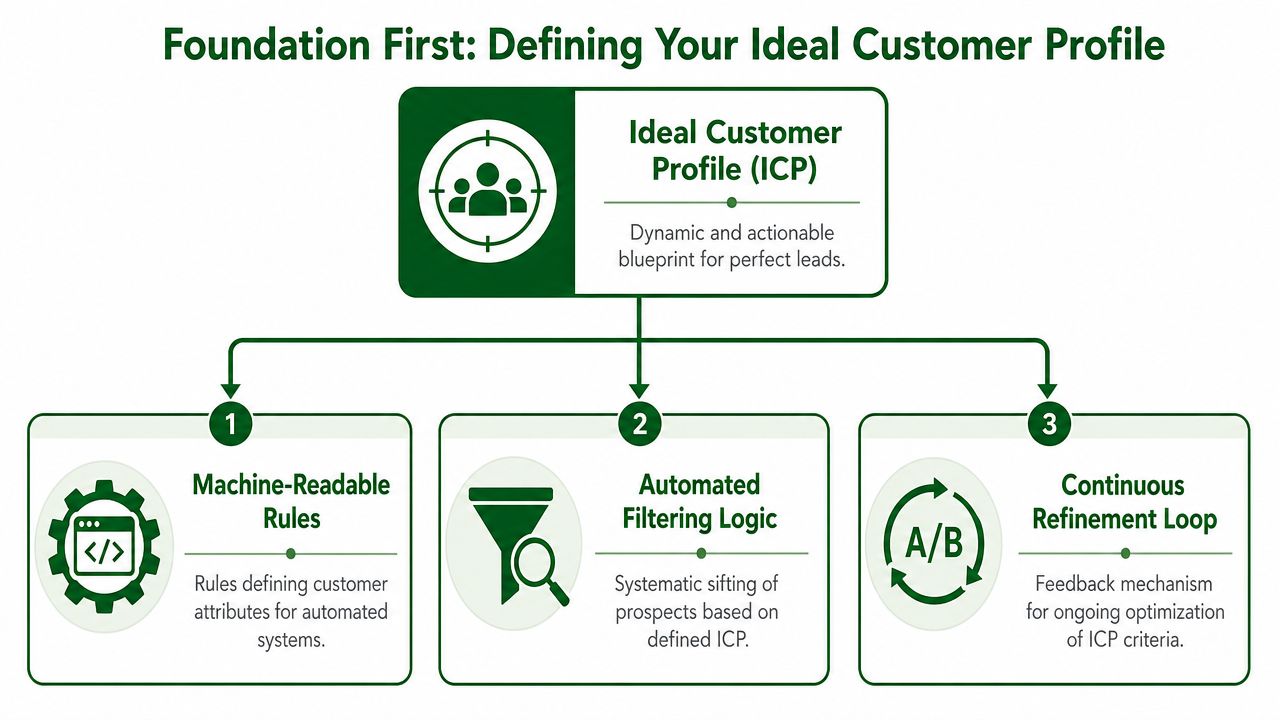
Most ICP documents are too soft to operationalize. They describe the buyer in presentation language, not system language. “Mid-market SaaS companies with growth goals” won't help a rep decide whether a specific account should be worked this week.
For outbound, your ICP needs to function like a filter. It should tell your team what to include, what to exclude, and which traits matter enough to prioritize. The best version is machine-readable. That means each attribute can be checked consistently across a list.
According to industry benchmarks, firms that score leads based on both firmographic fit and behavioral intent achieve a 2.5x higher lead-to-customer conversion rate than those using single-dimension scoring. That's the practical reason to move beyond a basic persona and build a more usable outbound model. Teams that want more examples of how RevOps turns definition into execution can browse the PitchSmart blog.
Turn the ICP into rules
Start by separating your ICP into three layers.
- Core fit rules: Industry, company size, geography, business model, and role targets.
- Operational context: Tech stack, hiring patterns, org structure, and signs the team can use your product.
- Pain indicators: Clues that the account has a reason to change, not just the ability to buy.
Many teams stop too early, defining who could buy and ignoring who is most likely to care right now. In outbound, that's a costly miss.
Practical rule: If a criterion can't be checked consistently across a prospect list, don't make it a core qualification rule. Make it a secondary note.
Build an outbound ready template
A strong outbound ICP usually answers these questions:
| ICP layer | What to define | Example of how to use it |
|---|---|---|
| Firmographic fit | Industry, size band, region | Exclude accounts outside core segments |
| Role coverage | Titles, departments, reporting lines | Route by persona and sequence type |
| Technographic context | Tools they use or likely workflows | Tailor angle around replacement or integration |
| Growth posture | Hiring, launches, expansion motion | Raise priority for active operators |
| Risk flags | Layoffs, budget pressure, churn signs | Lower score or suppress outreach |
Don't treat every attribute equally. Industry mismatch might be a hard stop. Weak title fit might still be workable if the account shows strong timing signals. The point is to design the logic before reps touch the list.
A useful ICP also needs exclusions. Teams rarely document these well enough. Add clear “do not work” conditions, such as student projects, agencies if you sell direct to brands, or companies with obvious mismatch on geography or compliance requirements. Exclusion logic saves as much time as prioritization logic.
From Gut Feel to Data Driven Building a Qualification Framework
Classic sales frameworks still have value. BANT and MEDDIC help reps structure discovery once a conversation starts. But they're reactive by design. They depend on access to the buyer, and outbound doesn't begin with access. It begins with a list.
That's why a modern outbound lead qualification process needs a different front end. Before you ask about budget, authority, or timeline, you need enough evidence that the account is a fit and that something has changed to make outreach timely.
Why classic frameworks stall in outbound
The problem with using BANT too early is simple. It pushes reps to guess at information they don't have yet. So they substitute assumptions. Big company must have budget. Senior title must have authority. Recent website refresh must mean urgency. That's not qualification. It's optimism dressed up as process.
Outbound works better when qualification starts with observable signals. The rep doesn't need to know everything. The rep needs enough evidence to justify relevant outreach and enough structure to rank accounts consistently.
A signal first model for outbound
Use three buckets.
Fit signals
These tell you whether the account belongs in your market at all.
Examples include:
- ICP alignment: The company matches your target segment, operating model, and buyer function.
- Environmental fit: Their team structure or workflow suggests your offer is usable.
- Contact fit: The person sits close enough to the problem to engage.
Fit signals stop wasted motion. They keep the team from personalizing outreach to accounts that should never have been touched.
Intent signals
These suggest the account is paying attention to the category or dealing with a problem tied to your offer.
A critical milestone in effective qualification is the early identification of positive growth signals such as company funding rounds, recent hiring, or product launches, which correlate with a 45% higher likelihood of purchase intent within the next six months. Use that signal class carefully. It doesn't mean every funded company is ready to buy. It means those changes deserve more weight than generic list attributes.
Timing signals
These help answer the question managers care about most. Why now?
Look for moments that create motion, such as a new executive owner, a newly formed team, or a visible operational change that implies new priorities. Timing signals are often the bridge between “good account” and “worth contacting this week.”
If your rep can't answer "why this account now?" in one sentence, the lead probably isn't ready for outbound attention.
The signal-first model also improves message quality. Once the list is ranked by fit, intent, and timing, your team can write outreach from something real. That's a much better starting point than forcing generic personalization from a LinkedIn headline and a homepage tagline.
Automating Research and Scoring at Scale
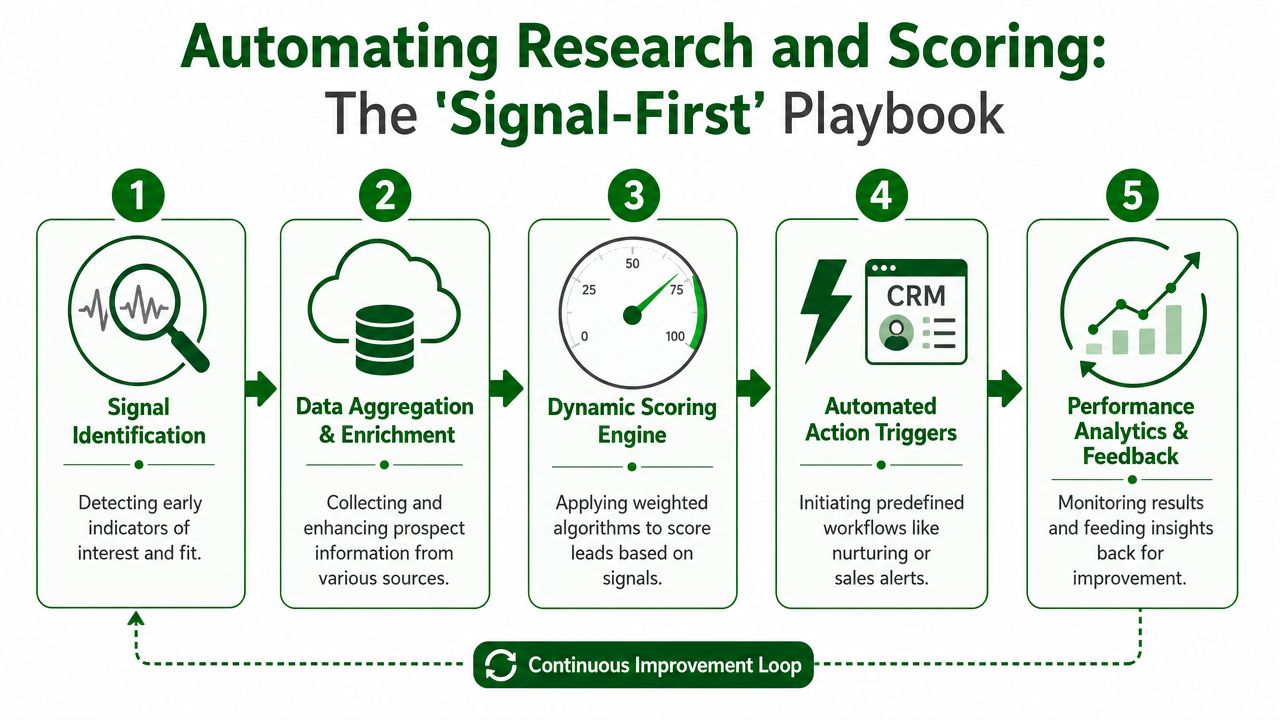
Once the qualification model is defined, the operational goal is simple. Stop making reps perform detective work account by account. Build the process around list-level research, automated enrichment, and scoring logic that routes work before a rep touches it.
Salespeople spend 71% of their time on non-selling tasks including prospecting, admin work, and data entry, according to Everstage's sales productivity statistics. That's why the workflow matters as much as the framework.
Build the workflow around the list not the rep
A practical implementation usually follows this order:
Start with a raw account list
Pull from your CRM, outbound tool, territory build, or agency source list. Don't ask reps to curate by hand at this stage.Apply hard filters first
Remove obvious mismatches. Wrong region, wrong company type, wrong segment, duplicate ownership.Enrich and research in bulk
Add company context, contact context, and recent signals across the full list. Teams gain a significant edge using a platform built for parallel list research and outbound execution.Score based on weighted evidence
Give more weight to high-value triggers than to background traits. A generic fit match shouldn't outrank a strong account showing current movement.Segment by action path
Don't hand one giant scored list to reps. Convert scores into outreach motions.
Here's a walkthrough that shows the broader workflow in action:
Manual vs automated qualification
| Metric | Manual Process | PitchSmart-Powered Process |
|---|---|---|
| Research unit | One account at a time | Entire list in parallel |
| Signal discovery | Depends on rep diligence | Standardized across accounts |
| Personalization input | Scattered notes and browser tabs | Structured signal-backed context |
| Segmentation | Usually spreadsheet-driven | Built from scoring and buying signals |
| Outreach readiness | Delayed until research is finished | Faster handoff into sequenced outreach |
| Manager visibility | Hard to audit | Easier to inspect and refine |
The biggest change isn't speed alone. It's consistency. When the same scoring logic evaluates every account, managers can finally compare rep decisions without guessing what happened in private tabs and notes.
Turn scores into action tiers
I recommend three working tiers because they force discipline.
- Tier A accounts: Strong fit plus strong current signals. These get the rep's best work. High-context email, a personalized LinkedIn angle, and a conversation path built around recent triggers.
- Tier B accounts: Good fit with some useful context, but not enough to justify heavy customization. Use semi-automated messaging with light edits.
- Tier C accounts: Fit-only or weak-signal accounts. Keep these in lower-touch sequences or hold them until stronger signals appear.
This structure also keeps managers from overpersonalizing everything. Not every account deserves handcrafted outreach. The lead qualification process should protect rep time, not consume it.
Effective Handoffs and Continuous Improvement
Qualification work is wasted if the AE opens a booked meeting and sees only a contact record plus a calendar invite. In outbound, the value sits in the pre-outreach judgment. Which accounts were screened out, which signals justified contact, and which message angle earned a reply all need to survive the SDR to AE transition.

Organizations with a mature lead qualification process see higher sales conversion rates than teams using ad hoc methods, according to Marketo research on lead qualification performance. The lift comes from consistent criteria, clean handoffs, and regular model updates. Scoring alone does not create that result.
What a usable handoff actually includes
A sales-ready handoff should answer four questions before the AE opens the account:
- Why this account: A short fit summary in plain language
- Why now: The timing, intent, or change signals that justified outreach
- Why this contact: The role relevance and likely connection to the problem
- What angle worked: The hook, message path, or reply context that got engagement
Good handoffs transfer judgment, not just fields.
Put that context in places the AE will use. A standard CRM field set works well for structured data. A required summary block works well for the rep's reasoning. Free-text notes buried three clicks deep usually fail in practice, especially when managers need to audit quality across dozens of handoffs each week.
Ownership also needs to be explicit. SDRs own research quality, scoring hygiene, and context capture. AEs own disposition feedback and must mark whether the signals held up in the first conversation. If nobody owns that feedback loop, teams end up arguing about list quality instead of fixing the model.
For teams pressure-testing workflow cost, operating overhead matters as much as feature depth. Reviewing a platform's sales workflow pricing can help you decide whether the process will hold up at scale or just replace one kind of manual work with another.
Close the loop with outcome data
Booked meetings are an activity milestone, not a qualification verdict. The model should be judged by what happens after contact.
Track patterns like:
| What to review | Why it matters |
|---|---|
| Conversion by signal type | Shows which triggers actually lead to pipeline movement |
| Conversion by segment | Exposes ICP drift or weak targeting |
| Accepted vs. rejected SDR handoffs | Shows where qualification quality breaks down |
| Lead velocity by score band | Tests whether scoring predicts real momentum |
The practical question is simple. Which pre-outreach signals keep proving useful after reply, discovery, and pipeline review? Once that answer is clear, update the scoring rules, remove weak inputs, and tighten the handoff template so reps spend less time re-researching accounts they already qualified once.
Avoiding Common Pitfalls in Your Qualification Process
Most bad qualification systems don't fail because the team lacks effort. They fail because the process still assumes outbound starts after research, one account at a time. It doesn't. Outbound starts when you decide which accounts deserve attention and which ones should stay off the rep's calendar.
That gap shows up in a lot of advice. Highspot's discussion of lead qualification notes that most existing content treats lead qualification as a linear, manual checklist but misses the problem of qualifying outbound leads before engagement, even though that work consumes 70% of sales reps' time. That's exactly where teams keep leaking productivity.
The mistakes that break outbound qualification
- Relying on static firmographics only: A company can match your size and industry filters and still be a poor outbound target today.
- Overbuilding the first scoring model: Teams add too many rules, then no one trusts or maintains the system.
- Ignoring negative signals: Budget pressure, layoffs, or visible contraction should lower priority.
- Treating personalization as qualification: A custom opener doesn't rescue a weak account.
- Letting reps research manually by default: This is the slowest and least scalable option, yet many teams still accept it as normal.
What disciplined teams do instead
They start simple. A few hard-fit rules, a handful of meaningful signals, and clear routing tiers are enough to produce better output than a messy “personalized” outbound motion.
They also revisit the model. Markets shift, segments change, and old assumptions go stale. A lead qualification process should behave like an operating system, not a one-time spreadsheet exercise.
They stop tolerating manual research as core sales work. Reps should spend their time writing better messages, handling objections, and moving opportunities forward. They shouldn't spend the morning stitching together public data that could've been processed before the workday even started.
If your team is still qualifying outbound leads one browser tab at a time, it's time to replace that process. PitchSmart lets you upload a list, run bulk lead research, surface buying signals, segment accounts by priority, and generate signal-backed outreach without the usual copy-paste chaos. It's built for the exact bottleneck that drags outbound teams down. Start the free trial and see what your lead qualification process looks like when research finally runs at scale.