You approved a pay per lead campaign on Monday. By Thursday, the CSV is in your CRM, routed, tagged, and technically “worked.” In reality, it's sitting there while reps open tabs, hunt for context, fix bad fields, and guess at messaging. The leads aren't dead because pay per lead is broken. They're dying in the handoff between acquisition and execution.
That's the often-underestimated part. Buying leads is the easy part. Turning raw contacts into qualified pipeline without crushing your reps with manual research is where the model succeeds or fails. If the follow-up process is slow, generic, or dependent on one-by-one rep effort, pay per lead turns into a pile of admin work disguised as growth.
For B2B teams, the key question isn't whether pay per lead can work. It's whether your operating model can absorb a sudden batch of new names and convert them into relevant outreach before the window closes.
The Hidden Cost of Unworked Leads
A sales manager buys into a pay per lead program to fill the top of funnel fast. The vendor delivers names, titles, companies, and contact details. Everyone feels productive for a day. Then the backlog starts.
Reps don't just need a list. They need context. They need to know what the account does, whether the contact is plausibly relevant, what changed recently, and what angle won't sound copied from every other cold email in the market. Without that, “new leads” become another research queue.
When lead volume outruns team capacity
The ugly truth is that many teams don't fail at buying leads. They fail at absorbing them. Sales reps spend up to 70% of their day on non-selling activities like manual research and data entry, which is exactly why a sudden influx of unresearched leads can stall a team instead of helping it, as noted in Forbes on why sales should sell rather than prospect.
That shows up in familiar ways:
- Reps cherry-pick easy accounts: They work the recognizable brands and ignore the rest.
- Managers confuse touches with progress: A generic first email gets logged, but no real qualification happens.
- Follow-up slows down immediately: The list may be “distributed,” yet nobody has enough context to start quality conversations at scale.
Practical rule: If your reps need to manually research every delivered lead before they can send a credible message, your pay per lead model is underbuilt operationally.
Why the list is rarely the only problem
Teams often blame the vendor first. Sometimes that's fair. Plenty of lead sellers pass off stale, thin, or mismatched data as demand generation. But even a decent list can underperform if the receiving workflow is weak.
A raw lead is not pipeline. It's a work order.
The operational cost lands after delivery. Someone has to dedupe records in Salesforce or HubSpot, enrich accounts, segment by fit, identify hooks, draft outreach, and sequence follow-up. If that work happens manually, the economics break fast. The more leads you buy, the more non-selling work you create.
That's why pay per lead should never be evaluated as a list-buying decision alone. It's a throughput decision. If your team can't convert delivered names into researched, prioritized outreach quickly, the leak isn't at the top of the funnel. It's in the middle of your process.
How a Pay Per Lead Model Really Works
Most B2B teams treat pay per lead as if they're buying qualified pipeline. They're not. They're buying the right to start faster with a pre-sourced pool of contacts that match agreed criteria.
Raw ingredients, not finished meals
The simplest way to understand pay per lead is to think of it as buying raw ingredients, not a prepared meal. You define what should be in the box. The vendor goes out and assembles it. Your team still has to turn those inputs into something useful.
If you want a closer look at how modern outbound teams operationalize list-based prospecting, PitchSmart's platform is built around the execution layer often missed after list acquisition.
A meeting booked on your calendar is a finished meal. A marketing-qualified inquiry is closer to a meal kit. A pay per lead list is the ingredients. That doesn't make it bad. It just means expectations need to be accurate from the start.
What you're actually buying
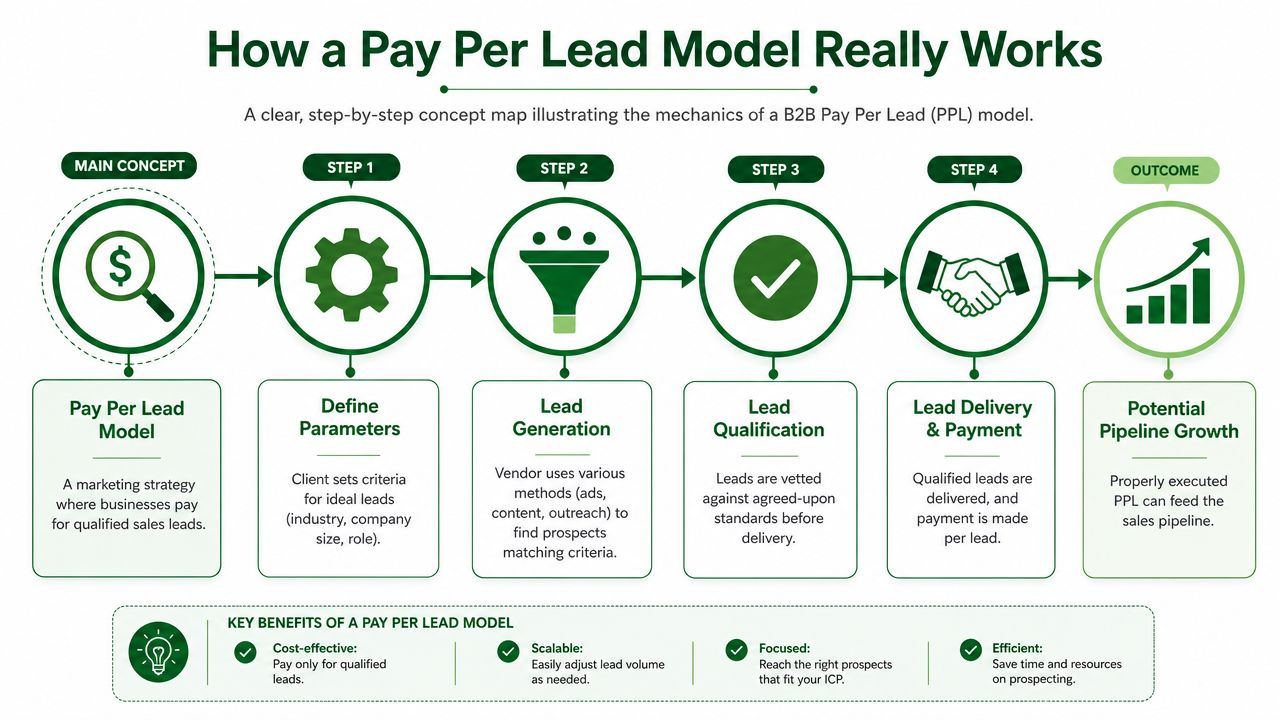
In practice, the flow usually looks like this:
You define the target
Industry, company type, geography, titles, exclusions, and sometimes account-level constraints.The vendor sources contacts
They may use outbound, forms, databases, partnerships, or a mix. At this stage, the quality gap between vendors starts.Leads are checked against the agreement
Not all vendors mean the same thing by “qualified.” Some validate only firmographics. Others add basic contact verification.
A short explainer helps make the mechanics more concrete.
- Leads are delivered and billed
Usually through CSV, CRM import, or periodic batch delivery.
What matters here is fit between the model and your sales motion. If your team sells into a narrow ICP with long cycles and multiple stakeholders, a lead that only matches firmographics is still very early-stage. It may be useful, but it's not ready for generic sequencing.
Pay per lead gives you access to potential conversations. It doesn't guarantee relevance, urgency, or message-market fit.
That distinction matters because many buyers judge the model too early or too late. Too early, and they expect the vendor to do qualification your team never contracted for. Too late, and they blame “lead quality” when the actual issue was slow, generic post-delivery follow-up.
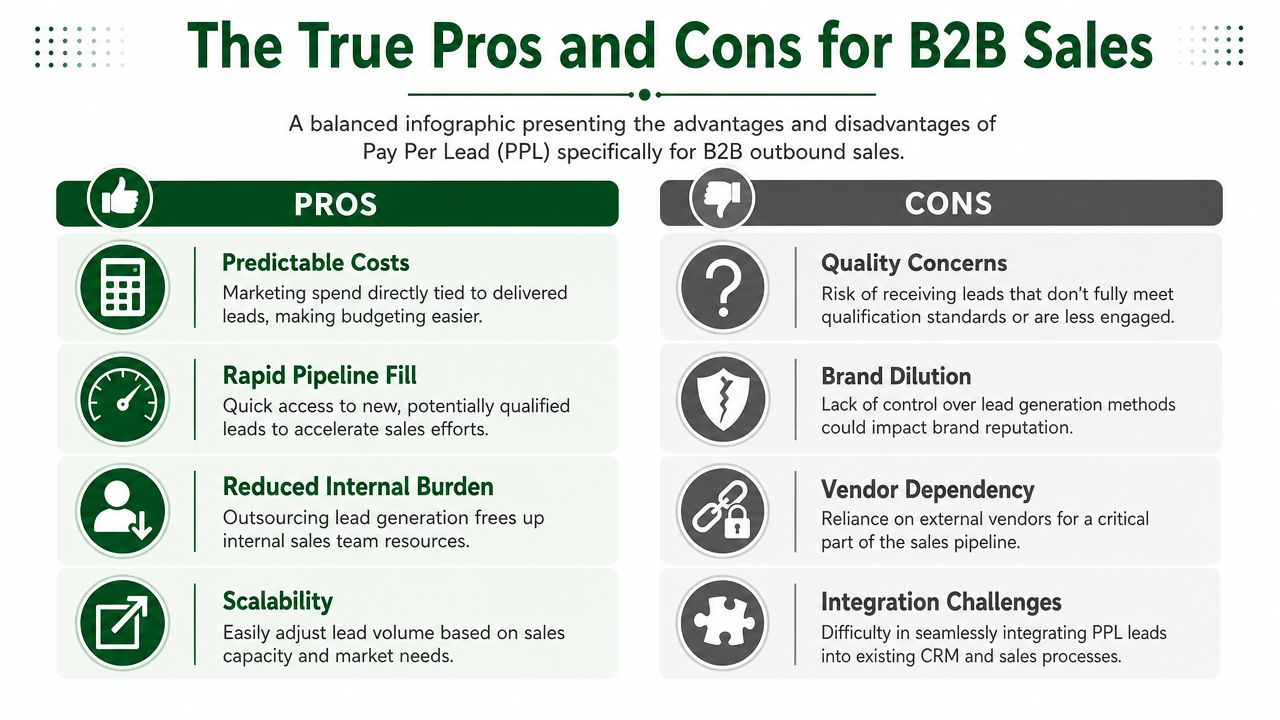
The True Pros and Cons for B2B Sales
Pay per lead has real advantages. It also creates predictable failure modes for B2B sales teams that mistake contact volume for sales readiness.
Where pay per lead helps
For the right use case, the model is useful.
| Advantage | Why teams like it |
|---|---|
| Predictable buying unit | You know what you're purchasing and can compare vendors more cleanly than broad retainer models. |
| Fast list building | It helps when entering a new segment, region, or title band without building everything in-house first. |
| Less sourcing burden | Internal teams spend less time assembling top-of-funnel contact pools from scratch. |
| Flexible testing | It's a workable way to test ICP assumptions before committing to a larger channel motion. |
Pay per lead is strongest when you need names in market, have a clear ICP, and your team already knows how to run outbound once contacts arrive.
Where B2B teams get burned
The common complaint is “lead quality,” but that phrase hides several different problems.
First, many pay per lead programs optimize for profile match, not buying context. A contact can fit your title and company filters and still have no timing, no active pain, and no reason to engage today. For complex B2B sales, firmographics alone are thin fuel.
Second, some vendors source from static or recycled data. Even when the record is technically valid, the account context may be outdated, the role may have changed, or the outreach angle may already be exhausted by other sellers.
The most dangerous pay per lead lists don't look obviously bad. They look usable enough to keep your reps busy while producing very few meaningful conversations.
There's also a control problem. When a vendor owns sourcing, you often lose visibility into how the lead was generated, how recently the data was checked, and whether the same contact has already been routed elsewhere.
A few practical cons matter more than the marketing copy suggests:
- Intent is usually missing: The lead may match your ICP without showing any active buying signal.
- Message quality becomes your burden: If the list arrives cold, your team has to create relevance from scratch.
- Process debt accumulates: CRM cleanup, enrichment, routing, and sequencing all expand after delivery.
- Vendor incentives can drift: Some providers optimize to hit delivery counts, not downstream sales usefulness.
Pay per lead can absolutely support outbound. It just works best when you treat it as an input stream that needs serious qualification and fast execution, not as a shortcut to pipeline.
Pricing Math and Essential Contract Terms
The pricing conversation gets sloppy fast when buyers focus only on the fee per lead. That's not the full exposure. The full cost includes every operational step required to make the lead usable.
Start with your internal economics
Before you negotiate with any vendor, get clear on four internal questions:
- What counts as a usable lead for your team: Not “someone in our market.” A record your reps can route, research, and contact without cleanup.
- What follow-up work happens after delivery: Enrichment, deduplication, ownership assignment, sequencing, and rep review.
- How quickly can your team act on a batch: If intake is slow, cheap leads become expensive clutter.
- What sales stage you expect the model to influence: Early conversation volume, qualified opportunities, or something further down-funnel.
Those questions help you avoid buying a low headline price that creates heavy downstream labor.
For budgeting, PitchSmart pricing is useful as a contrast point because it reflects the cost of accelerating research and outreach execution on lists you already own, rather than charging you for rented contacts.
Terms that belong in every agreement
A B2B pay per lead contract should be boringly explicit. If the language is loose, the vendor will usually interpret “qualified” more generously than you do.
Use this checklist during review:
Define a valid lead clearly
Spell out required fields, target role expectations, geography, company criteria, and duplicate rules.Set lead rejection criteria
Include a short review window and list exactly what makes a lead rejectable. Bad contact data, duplicate delivery, wrong market, wrong company type, and obvious mismatch should all be named.Require a replacement or return policy
If a lead fails the agreed standard, the contract should state whether the vendor replaces it or credits it back.Clarify exclusivity
If the lead is shared, say so directly. If it's exclusive, define what “exclusive” means operationally.Document sourcing transparency
You don't need the vendor's entire playbook, but you do need a truthful explanation of where leads come from.Set delivery format and timing
Batch delivery affects response speed, routing, and rep workload. So does CRM compatibility.
Contract test: If your RevOps lead can't read the agreement and tell sales exactly how a lead enters the system, what can be rejected, and how credits work, the contract isn't finished.
Short tables help keep everyone aligned.
| Contract item | What to specify |
|---|---|
| Lead definition | Required fields, ICP match rules, and exclusions |
| Acceptance window | How long your team has to review delivered leads |
| Replacement policy | What gets refunded or replaced |
| Exclusivity | Shared, partially exclusive, or exclusive |
| Delivery method | CSV, CRM push, cadence, and field mapping |
The best agreements reduce arguments later. The worst ones create a monthly ritual where sales says the leads are bad and the vendor says they met the brief.
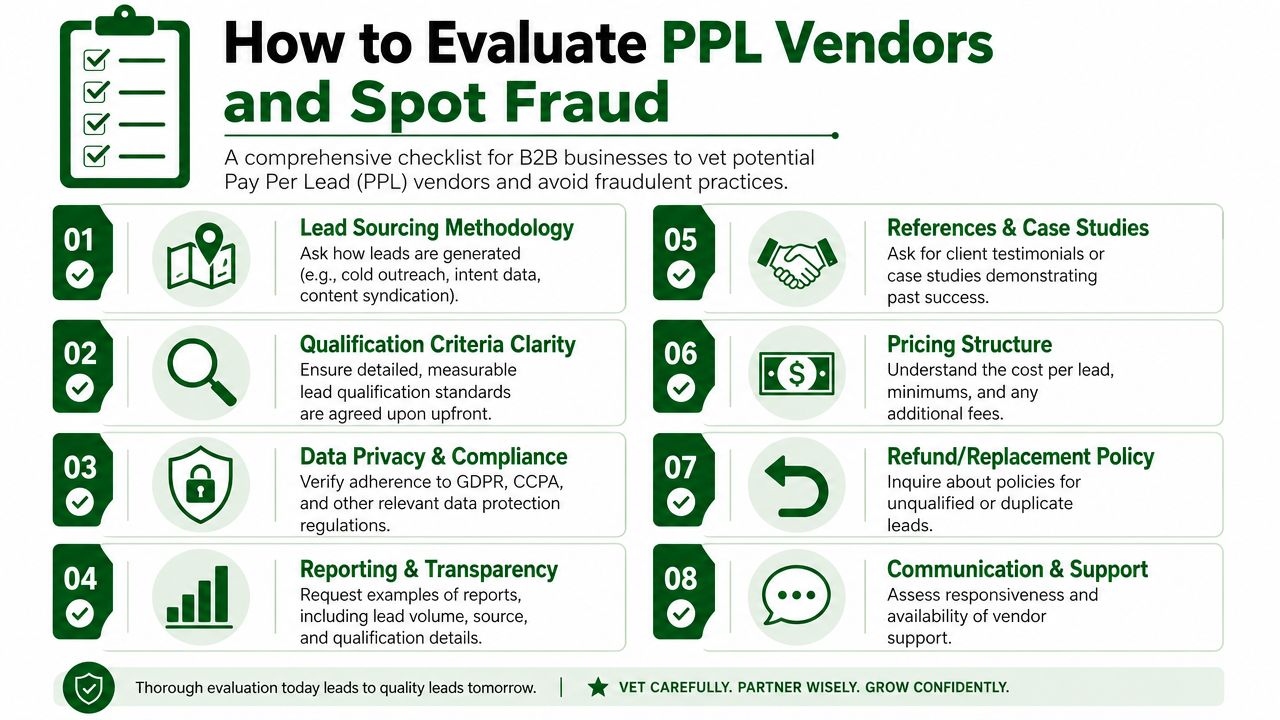
How to Evaluate Vendors and Spot Fraud
Most bad pay per lead deals can be avoided in the buying process. The mistake is treating vendor review like a pricing exercise instead of a sourcing audit.
Questions serious buyers ask
Start with direct questions that force the vendor to explain the mechanics.
How are leads sourced
Ask whether they come from outbound outreach, content syndication, partner channels, forms, database assembly, or a hybrid model.How are leads verified before delivery
You want to know what is checked. Email validity is not the same as role relevance.How recent is the underlying data
“Regularly refreshed” is not an answer. Ask what refresh looks like operationally.Can they provide sample records
Not cherry-picked screenshots. Real examples with the fields you'll receive.How do they prevent duplicates
Across your own historical records and within their own deliveries.What compliance standards do they follow
This matters if your team operates across regions or has strict legal review.
The goal isn't to interrogate for sport. It's to determine whether the vendor has a real sourcing process or just a flexible story.
Red flags that should stop the deal
Certain answers should end the conversation quickly.
Vague sourcing language is usually a sign that the vendor doesn't want you to know how thin the data really is.
Watch for these patterns:
- Unclear origin stories: If they can't explain where leads come from, they may be reselling or repackaging.
- No sample data: A vendor that refuses sample structure usually knows the structure will raise concerns.
- Overreliance on volume language: Heavy emphasis on “more leads” with little detail on qualification standards is a bad sign.
- Evasive duplicate policy: If they dodge this, expect overlap and disputes.
- Loose terminology: “Decision-maker,” “interested,” and “qualified” mean nothing without definitions.
- No operational handoff detail: If they've never thought about CRM mapping, routing, or rejection workflow, they're not set up for serious B2B buyers.
A simple evaluation matrix helps.
| Vendor question | Good sign | Warning sign |
|---|---|---|
| Sourcing | Specific, consistent explanation | Generic, shifting answers |
| Verification | Named checks and review steps | “Proprietary” with no detail |
| Sample data | Structured sample available | Refuses or stalls |
| Rejection policy | Clear and documented | Handled “case by case” |
| Delivery ops | Understands CRM intake | Treats delivery as your problem |
Fraud in this market isn't always fake names. More often, it's low-quality inventory sold with high-confidence language. The only defense is disciplined due diligence.
Turn PPL Lists into Pipeline with Smart Workflows
A pay per lead campaign lives or dies in the hours and days after delivery. That's when speed, segmentation, and message quality matter more than the purchase itself.
Speed matters after lead delivery
Many teams still process purchased lists the slow way. Someone uploads the file. Ops fixes fields. Reps research accounts one at a time. Outreach gets written manually or dropped into a generic sequence with weak personalization. By the time the campaign is live, the list is already aging.
That's the bottleneck that destroys ROI. Not because pay per lead is flawed in itself, but because manual post-acquisition work doesn't scale.
A workable system needs to do four things well:
Research the full batch at once
Not one lead per browser tab. Bulk account and contact research is the only way to keep pace with delivery volume.Segment by buying signals
A flat list treats every lead the same. Strong teams split by fit, urgency, market context, and likely angle.Generate real conversation hooks
Recent company activity, role changes, launches, hiring, partnerships, and other public signals matter more than generic “saw your profile” personalization.Push leads into a repeatable sequence
Email and LinkedIn follow-up should start from signal-backed context, not blank-page drafting.
What a workable post-acquisition process looks like
This is the missing layer many PPL buyers need. Upload the delivered list into a workflow that can run bulk, customizable lead research, pull activity-based conversational hooks from recent online signals, and use those hooks to seed automated three-step email and LinkedIn sequences. That turns a static file into a campaign your reps can run.
For teams building that motion, PitchSmart's outbound blog is a useful reference point because it focuses on the mechanics of list research, segmentation, and message creation rather than on buying more data.
A strong workflow usually looks like this:
- Ingest first: Clean the incoming file and standardize fields before reps touch it.
- Enrich second: Add account context and proprietary data points that make prioritization easier.
- Segment third: Group accounts by signal, fit, or likely narrative.
- Sequence last: Build outreach from the best hooks, not from a generic template library.
If your team buys leads in batches, your research and messaging process also has to run in batches. Otherwise volume becomes drag.
Modern outbound systems earn their keep. They replace copy-paste research with parallel execution, reducing the time between lead delivery and first credible touch. Moreover, they let reps spend more time in actual conversations instead of acting like part-time researchers and CRM clerks.
Pay Per Lead Alternatives and When to Use Them
Pay per lead is one acquisition model. It isn't the default answer for every B2B team.
Choose the model based on the job
If you need top-of-funnel list building in a new market, pay per lead can make sense. If you need guaranteed sales conversations and can tolerate tighter vendor control and higher cost, cost per appointment is often the better fit. If your team wants ongoing access to contact data and prefers to build sourcing internally, a subscription database may be cleaner.
The mistake is choosing one model and forcing every use case through it.
Here's the practical comparison:
| Model | You Pay For... | Typical Cost | Primary Use Case |
|---|---|---|---|
| Pay per lead | Delivered contacts that match agreed criteria | Varies by vendor, data depth, and qualification rules | Fast list building for outbound |
| Cost per appointment | A booked meeting | Higher than raw lead models | Teams that need calendar outcomes, not names |
| Performance media | Clicks, impressions, or form responses | Varies by channel and execution | Inbound demand generation and testing offers |
| Subscription data provider | Ongoing database access | Recurring platform fee | In-house prospecting and list building |
For many outbound teams, the strongest motion is hybrid. Use pay per lead when you need market coverage quickly. Use appointment-based models when sales capacity is tight and meeting quality matters more than list scale. Use your own curated lists when precision matters most.
PitchSmart helps B2B sales teams turn raw lists into usable outbound campaigns. Upload a CSV or pull records from your CRM, run bulk research across the whole list, uncover signal-backed conversation hooks, segment by buying cues, and launch personalized outreach without forcing reps into hours of manual prospecting. If your pay per lead workflow is dying in post-acquisition cleanup, see how PitchSmart closes that gap.