Your SDR team hits quota. Pipeline looks healthy. New logos are coming in. Then the finance review starts, and the tone changes fast.
The CFO isn't arguing with revenue. The CFO is asking a different question: why does every new dollar of sales still feel expensive to produce?
That's the trap a lot of B2B teams fall into. They celebrate top-line growth while the operating engine underneath gets sloppier. Reps spend huge chunks of the day on manual account research, list cleanup, CRM admin, and rewriting cold emails that still sound generic. Managers see activity. Finance sees cost. Leadership starts to realize that revenue alone doesn't tell them whether the go-to-market machine is healthy.
For outbound teams, return on sales transitions from an accounting term to a field metric. If your reps need too much labor, too much tool sprawl, and too much wasted effort to create each dollar of revenue, quota attainment can mask a profitability problem for a long time.
The Hidden Problem With Hitting Quota
A sales team can hit target and still damage the business.
That usually happens when leaders focus on bookings without looking closely at how much operating effort sits behind those bookings. Outbound is especially vulnerable. Reps can produce meetings while burning time on bad-fit accounts, weak segmentation, and one-off personalization work that doesn't scale. On paper, the team is productive. On the P&L, the sales motion is bloated.
Revenue can hide an efficiency problem
I've seen this pattern in growing B2B teams. Managers push for more output, so reps add more activity. More lists. More sequences. More hand-built research. More follow-up. The calendar gets fuller, but the work behind each opportunity gets heavier too.
That's why return on sales matters. It tells you whether sales are translating into operating profit, not just whether money came in. A useful historical reference comes from a U.S. cross-industry benchmark cited by Qymatix on return on sales: the median return on sales across all industries in the United States rose from 4.8% to 9.7% in 2021. The exact benchmark for your company will differ, but the lesson is clear. This metric can move materially when cost structure and demand conditions shift.
Revenue growth can make a sales leader look right for a while. Return on sales shows whether the operating model actually is.
The hidden leak sits inside sales operations
Organizations don't lose efficiency in one dramatic place. They lose it in hundreds of small, repetitive motions.
- Manual research drag means reps spend time gathering basic company context instead of starting conversations.
- Generic outreach produces low-quality engagement, which forces even more activity to generate the same pipeline.
- Poor segmentation pushes reps into accounts that were never likely to convert cleanly.
- Disconnected workflows create copy-paste work between spreadsheets, CRMs, sequencing tools, and notes.
When leaders finally audit the process, they realize the issue isn't just conversion. It's operating expense.
That's why tools built for outbound workflow design matter. Platforms like PitchSmart for outbound lead research fit this conversation because they attack the labor cost of prospecting itself. If you can reduce manual research, improve message relevance, and give reps cleaner account priority, you're not just making the team faster. You're improving the economics of how revenue gets created.
What Is Return on Sales
Return on sales is an operating margin metric. It's calculated as operating profit divided by net sales, and it isolates core operating efficiency by excluding interest, taxes, and non-operating items, as explained in Tipalti's return on sales guide.
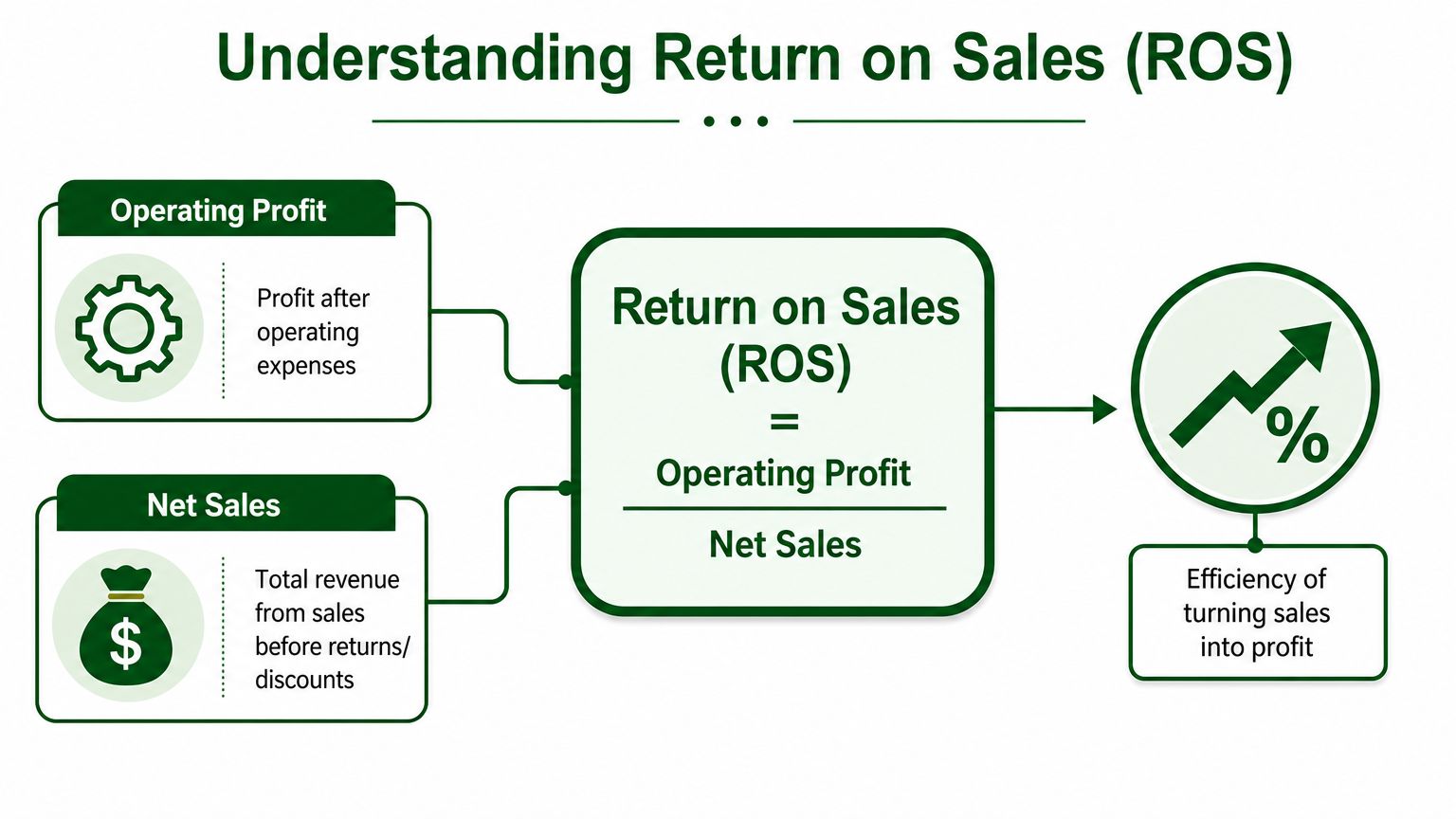
Think of ROS as profit quality, not just profit
Sales leaders usually live in bookings, pipeline coverage, conversion rate, and attainment. Those are necessary. They are not enough.
Return on sales answers a harder question: for every dollar of net sales, how much operating profit does the business keep from its core activity? That's why finance teams trust it. It strips away capital structure and tax effects and asks whether the business model itself is doing efficient work.
A team can grow revenue while making the business less efficient. Return on sales helps expose that.
Why sales managers should care
This isn't only for CFOs.
Your team's daily decisions affect the denominator and the numerator. If reps waste effort on weak accounts, operating costs rise without a matching improvement in sales. If your outbound engine gets more precise, the same headcount can create cleaner pipeline and better revenue conversion. That changes operating profit.
A simple way to explain it to a sales floor is this:
- Net sales tells you how much business you brought in.
- Operating profit tells you what was left after the company paid for the work required to run the business.
- Return on sales tells you whether those sales were economically efficient.
Practical rule: If activity goes up but return on sales doesn't improve over time, the team may be creating harder revenue, not better revenue.
That's why strong RevOps teams don't treat outbound productivity as a vanity topic. They connect rep behavior to operating performance.
How to Calculate ROS With a B2B Example
The formula is simple. The discipline is in using the right inputs.
Return on sales = Operating profit / Net sales
The key phrase is operating profit. In an Open University example using Marks & Spencer Group Plc data, return on sales is presented as the percentage of sales revenue left before finance costs and corporation tax, which makes it a core operating measure rather than a financing measure, as shown in Open University's financial statement analysis material.
What numbers to pull from the P&L
If you're a sales manager reading a company income statement, you're looking for two lines:
Net sales
This is the revenue figure after returns, discounts, or similar adjustments.Operating profit
This is profit from core operations after operating expenses are deducted, but before interest and taxes.
That distinction matters because return on sales is not trying to tell you whether the company has a smart debt structure. It's trying to tell you whether the core commercial engine produces profit efficiently.
A simple B2B walkthrough
Let's keep the mechanics practical.
Say your company closes business through a mix of outbound and inbound. Finance closes the period and shares the income statement. You take the operating profit figure and divide it by net sales. The result is your return on sales.
You don't need to be a controller to use this. You just need to know where the numbers live and what they represent.
Here's the checklist I give sales managers:
- Start with net sales, not gross bookings. Returns, credits, and adjustments matter.
- Use operating profit, not net income. Net income pulls in items that return on sales intentionally excludes.
- Compare periods consistently. Don't compare one quarter's return on sales to another period if accounting treatment or sales recognition changed materially.
What the result tells you
A higher result means the business is keeping more operating profit from each unit of net sales. A lower result means revenue is taking more effort and cost to produce.
For a revenue team, that creates useful accountability. If top-line performance improved but return on sales deteriorated, something in the sales motion may have become more expensive, less focused, or both.
That's often where RevOps earns its keep. The number itself is simple. The operating story behind it is where the work starts.
ROS vs Gross Margin vs ROI
These metrics get mixed together all the time, especially in sales conversations. They shouldn't be.
Each one answers a different question. If you use the wrong one, you diagnose the wrong problem.
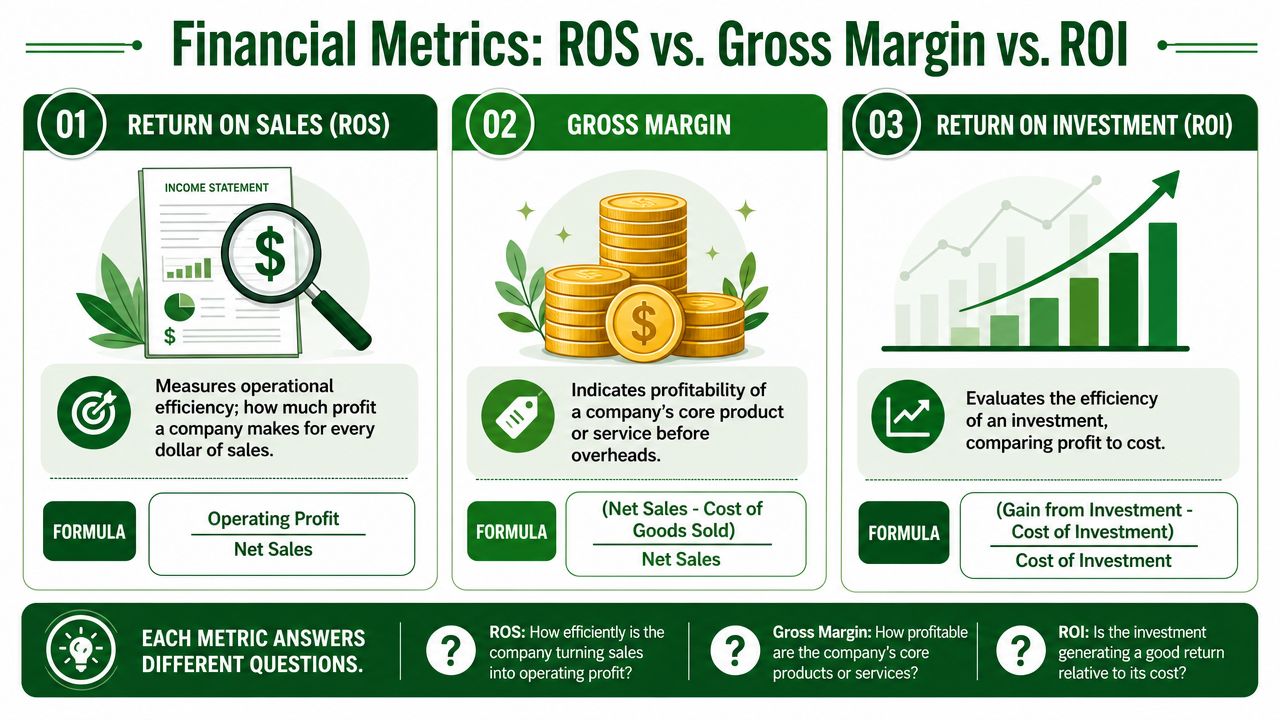
The quick comparison
| Metric | What it measures | Best use |
|---|---|---|
| Return on sales | Operating profit relative to net sales | Diagnose overall operating efficiency of the core business |
| Gross margin | Revenue left after direct delivery costs | Understand product or service delivery economics |
| ROI | Return relative to the cost of a specific investment | Evaluate a project, tool, campaign, or initiative |
Gross margin tells a narrower story
Gross margin looks at what's left after direct costs tied to delivering the product or service. For SaaS, that might help you understand hosting, support, or delivery economics. It's useful, but incomplete for sales leaders.
It doesn't capture the broader operating burden of running the company. Sales and marketing expense, management overhead, and operational support still sit outside that view. That means a healthy gross margin can coexist with poor operating discipline.
Return on sales shows whether the machine scales cleanly
Return on sales goes a step further because it includes operating costs, not just direct delivery costs. That makes it more relevant when the question is whether revenue growth is turning into scalable profit.
For outbound teams, that distinction is huge. You can have strong gross margin on your product and still run an inefficient go-to-market motion. Bloated SDR research time, poor territory focus, and weak message-market fit won't show up clearly in gross margin. They will pressure return on sales.
Gross margin says the product may be attractive to sell. Return on sales says the company may or may not be attractive to run.
ROI is project-specific, not business-wide
ROI is different again. It's usually the right lens for a specific investment decision.
If you're deciding whether to buy a sequencing platform, hire a sales enablement consultant, or overhaul a data enrichment workflow, ROI helps frame the return relative to that investment. It doesn't tell you whether the broader business is operationally efficient. It tells you whether a given bet paid off.
That's why I'd use ROI for vendor evaluation and return on sales for executive operating reviews.
A good example is outbound tooling. You might compare process options, team overhead, and vendor cost using PitchSmart pricing for outbound teams. That's an ROI conversation. Whether your company as a whole is converting sales into operating profit effectively is a return on sales conversation.
How to Directly Improve Return on Sales
An SDR books a solid month of meetings. Pipeline goes up. The CFO still asks why operating profit did not move with revenue. That gap is return on sales in plain English.
ROS improves when the revenue team produces more profitable sales, not just more activity. In practice, that gives sales managers two levers. Raise operating profit, or grow revenue without letting operating costs rise at the same rate. For outbound teams, both usually come back to the same question. How much time and money does it take to create one real sales opportunity?
Small operating gains change the math fast
ROS is sensitive to operating discipline. A modest improvement in how the team researches, prioritizes, and works accounts can expand profit faster than the headline revenue number suggests.
I want managers to take that seriously. If reps waste hours pulling context from five tabs, writing first-touch emails from scratch, and chasing low-fit accounts, those hours sit in operating expense whether the team hits activity targets or not. Quota can hide that problem for a while. ROS will not.
Reduce the cost of producing pipeline
The first lever is lowering the cost to create qualified pipeline.
Manual prospecting is expensive. Reps still book some meetings, but the labor behind each opportunity stays high, and that drags on profitability. The fix is not asking for more dials or more sequences. The fix is tightening the operating model so the same headcount creates better pipeline with less wasted effort.
That usually means four changes:
- Sharper account selection so reps spend time on accounts with stronger fit and timing
- Signal-based research so outreach starts from a real trigger, not a generic value prop
- Repeatable sequence structure so reps are not rebuilding core messaging every day
- Cleaner segmentation so different account types get different plays
PitchSmart fits that workflow in a practical way. It helps teams research leads from their own lists in bulk, pull relevant activity signals, segment accounts around buying context, and draft three-step email and LinkedIn sequences based on those signals. Used well, that cuts non-selling time and improves message quality at the same time. That is not just a productivity gain. It can improve ROS because the team is generating pipeline with less operating drag.
Improve revenue quality
The second lever is making each dollar of revenue less expensive to win.
A weak outbound motion often creates CRM pipeline that looks healthy early and collapses later. The root issue is usually poor relevance at the top of funnel. Generic outreach attracts the wrong prospects, misses the right ones, or forces reps to brute-force volume to get the same meeting count. More volume then adds labor cost, tooling cost, and management overhead.
That is expensive noise.
Field note: The best outbound teams narrow faster, write from live signals, and remove busywork before they add headcount.
A tighter process usually looks like this:
Segment before writing
Split lists by fit, trigger, and likely buying context.Anchor outreach to observed activity
Use recent signals instead of default messaging.Standardize the repeatable parts
Give reps a structure they can reuse while preserving room for account-specific hooks.Inspect conversation quality
Review whether the account was worth contacting, not just whether the rep got an open or a reply.
Supporting systems matter because managers cannot coach this consistently from spreadsheets and browser tabs alone. Teams that want more practical examples can review the PitchSmart blog on outbound prospecting and workflow design.
A short walkthrough helps make the point:
When list quality, research quality, and sequence quality improve together, ROS usually follows. The company gets more usable revenue from the same sales motion, and every SDR can see how better daily outreach shows up in the P&L.
ROS Benchmarks and Common Pitfalls
A VP of Sales can celebrate a strong quarter and still walk into a finance review with a ROS problem. Revenue came in. Quota got hit. But discounting climbed, ramp costs rose, and too many SDR hours went into low-fit accounts that never had a real path to pipeline.
That is why benchmark questions need context.
There is no single “good” return on sales number that applies across every company. The useful benchmark depends on your pricing power, delivery model, support load, sales efficiency, and how aggressively the business is investing for growth. A software company with high gross margins and disciplined acquisition costs should usually expect a different ROS profile than a services-heavy business or a company absorbing rapid hiring costs.

Use relative benchmarks first
Start with comparisons that can guide decisions.
Compare return on sales across:
- Your own historical periods, especially before and after pricing changes, territory redesigns, or hiring pushes
- Segments and motions, such as SMB outbound versus mid-market ABM-assisted prospecting
- Peer companies with similar economics, not broad industry averages that hide major cost differences
- Sales teams inside your own org, if one team needs more touches, more discounting, or more support resources to produce the same revenue
Sales managers can connect the metric to rep behavior. If one outbound team books the same revenue with cleaner targeting, fewer wasted steps, and better conversion from first meeting to qualified pipeline, that efficiency can show up in ROS over time. The SDR may not own operating profit on paper. Their prospecting habits still affect it.
The common mistake is treating ROS as a verdict
Analysts at Salesforce explain that return on sales is useful because it shows how much operating profit a company keeps from net sales, but it does not capture everything about financial health, including debt and taxes, in their return on sales analysis.
For operators, the practical mistake is simpler. Teams start treating ROS like a trophy metric instead of a diagnostic one.
A company can improve ROS for a quarter by cutting enablement, slowing hiring, delaying systems work, or squeezing support capacity. On paper, operating profit improves. In the field, reps lose productive selling time, onboarding gets worse, and pipeline quality slips two quarters later. Finance sees a better ratio now. Sales managers inherit a weaker machine later.
I have seen the reverse too. ROS can dip during a smart investment cycle if leadership adds experienced AEs, cleans up territory design, or gives SDRs better tools and tighter process control. Short-term profitability softens. The sales motion gets stronger.
Use ROS to judge efficiency, not to excuse short-term cost cutting.
The cleanest read comes from pairing it with cash flow, customer economics, pipeline quality, and conversion trends by segment. That combination shows whether the business is getting more profit from revenue, or just pushing costs around while frontline teams work harder for the same result.
Frequently Asked Questions About ROS
Can return on sales be negative
Yes. If operating profit is negative, return on sales will also be negative.
For a revenue team, that usually means the company's core operations aren't currently producing profit from net sales. It doesn't automatically mean the business is broken. Early-stage companies, aggressive expansion periods, or major go-to-market resets can create that condition. But it does mean leadership should be honest about whether current sales effort is creating efficient growth.
How often should we track it
Organizations review return on sales at the company level in regular financial reporting cycles. Sales managers don't need to wait for that to act.
Track the operational drivers more frequently. Look at rep research time, account quality, sequence relevance, meeting quality, and conversion by segment. Those are the behaviors that shape return on sales before finance closes the books.
Does a high return on sales guarantee a strong business
No. It tells you the business is converting net sales into operating profit efficiently. It does not tell you everything about scale, market position, debt risk, or future product strength.
That's why mature operators use it alongside other metrics. It's a strong signal. It isn't a full company verdict.
What can an SDR manager do about it this quarter
Focus on the sales motion you control.
Tighten list selection. Reduce manual research. Improve segmentation. Raise the standard for why an account enters a sequence. Audit cold outreach for signal quality, not just personalization theater. If your reps are spending less time assembling context and more time having relevant conversations, you're already working on return on sales whether finance labels it that way or not.
A margin ratio gives you the result. For the cause, price volume mix analysis shows whether the movement came from price, from volume, or from a shift in what sold.
If your team wants to connect outbound execution more directly to operating efficiency, PitchSmart is worth a look. It helps revenue teams research leads in bulk, surface buying signals, build signal-backed outreach, and cut down the manual prospecting work that inflates sales effort without improving sales quality.