A lot of reps look at their comp plan, see a decent percentage, and assume the money should follow. Then the quarter ends, the payout lands soft, and the first instinct is to blame the plan.
Usually, the bigger problem sits upstream. The rep didn't lose commission on the rate. They lost it in the hours burned researching accounts one by one, cleaning lists, and sending cold emails that sounded generic enough to be ignored. When pipeline creation is manual and inconsistent, even a fair plan underpays because there isn't enough qualified activity feeding it.
That's why talking about the sales commission average without talking about prospecting efficiency misses the point. Benchmarks matter. But top-quartile earnings come from a repeatable pipeline engine, not from staring at a percentage on a spreadsheet.
Your Commission Plan Is Not the Problem
A familiar scene plays out every quarter. An AE closes a few decent deals, works hard, still misses the number they had in mind, then opens the comp plan again looking for the hidden flaw. The percentage looked strong when they joined. The paycheck doesn't.
Most of the time, the leak isn't in compensation design. It's in execution capacity. Reps lose selling time to list building, account research, CRM cleanup, and writing first-touch emails from scratch. By the time they reach a buyer, they've already spent too much of the day on work that doesn't move revenue.

That's a key pain point for outbound teams. Manual research drains the calendar. Generic outreach compounds it because the message rarely earns a reply, which forces even more activity just to create the same amount of pipeline.
Practical rule: If your workflow needs constant tab switching, copy-paste research, and one-off email drafting, your commission plan isn't the first issue to fix.
I've seen reps with average plans outperform reps with better-looking plans because their pipeline motion was cleaner. They knew exactly which accounts fit, what signal to reference, and how to launch outreach without rebuilding the process every morning.
Three things usually separate strong earners from frustrated ones:
- Better account selection: They don't chase every logo that vaguely fits the ICP.
- Faster prep: They gather useful context quickly instead of researching like an analyst.
- Higher-quality first touches: Their outreach gives the buyer a reason to respond now.
It is a simple truth. A rep can have a competitive commission rate and still earn below average if their prospecting engine is slow.
Sales Commission Benchmarks in 2026
There isn't one universal sales commission average. Context matters more than the headline number. Industry, deal size, sales cycle, margin profile, and whether the role owns new business or expansion all change the answer.
Published benchmarks across major sales markets typically place commissions in the 5% to 20% range of sale value, with lower-margin, high-volume sectors closer to 5% to 10% and more complex, high-ticket sectors such as enterprise software, medical devices, and real estate closer to 10% to 20% or more when accelerators apply, according to CaptivateIQ's commission benchmark overview.
Why averages mislead
For B2B SaaS, the cleaner way to think about compensation is OTE, or on-target earnings. The commission rate is only one piece of the plan. Base salary, variable split, quota design, and payout timing all shape what a rep takes home.
A 2026 compensation snapshot summarized by SPOTIO's guide to typical commission structures puts the average field sales representative base salary at $61,200, with total compensation rising to $88,000 to $137,000 after commissions and bonuses. The same source reports SDR/BDR OTE around $85,000 with a 65:35 to 70:30 base-to-variable split, and account executives averaging $154,000 OTE with a typical 50/50 structure.
That's why the phrase sales commission average is incomplete on its own. Two reps can both be “on a 10% plan” and still have very different earning profiles.
2026 B2B sales commission averages by deal size and role
| Role / Deal Size | SMB (<$25K ACV) | Mid-Market ($25K-$100K ACV) | Enterprise (>$100K ACV) |
|---|---|---|---|
| Account Executive | 10% to 15% | 8% to 12% | 5% to 8% |
| SaaS benchmark at 100% quota | 11.5% of ACV | 11.5% of ACV | 11.5% of ACV |
| SDR / BDR | Usually part of OTE structure rather than a simple deal-value benchmark | Usually part of OTE structure rather than a simple deal-value benchmark | Usually part of OTE structure rather than a simple deal-value benchmark |
The deal-size ranges above come from CaptivateIQ's 2026 breakdown by ACV band, which notes that SaaS commission rates often start around 10% and commonly sit in the 10% to 12% band because long sales cycles and recurring revenue change payout logic.
The benchmark number helps you sanity-check a plan. It does not tell you whether you'll actually earn well on it.
If you're evaluating a comp plan, ask better questions than “what's the average?” Ask whether the quota is realistic, whether the segment has enough reachable demand, and whether your outbound process gives you enough quality conversations to earn the variable in the first place.
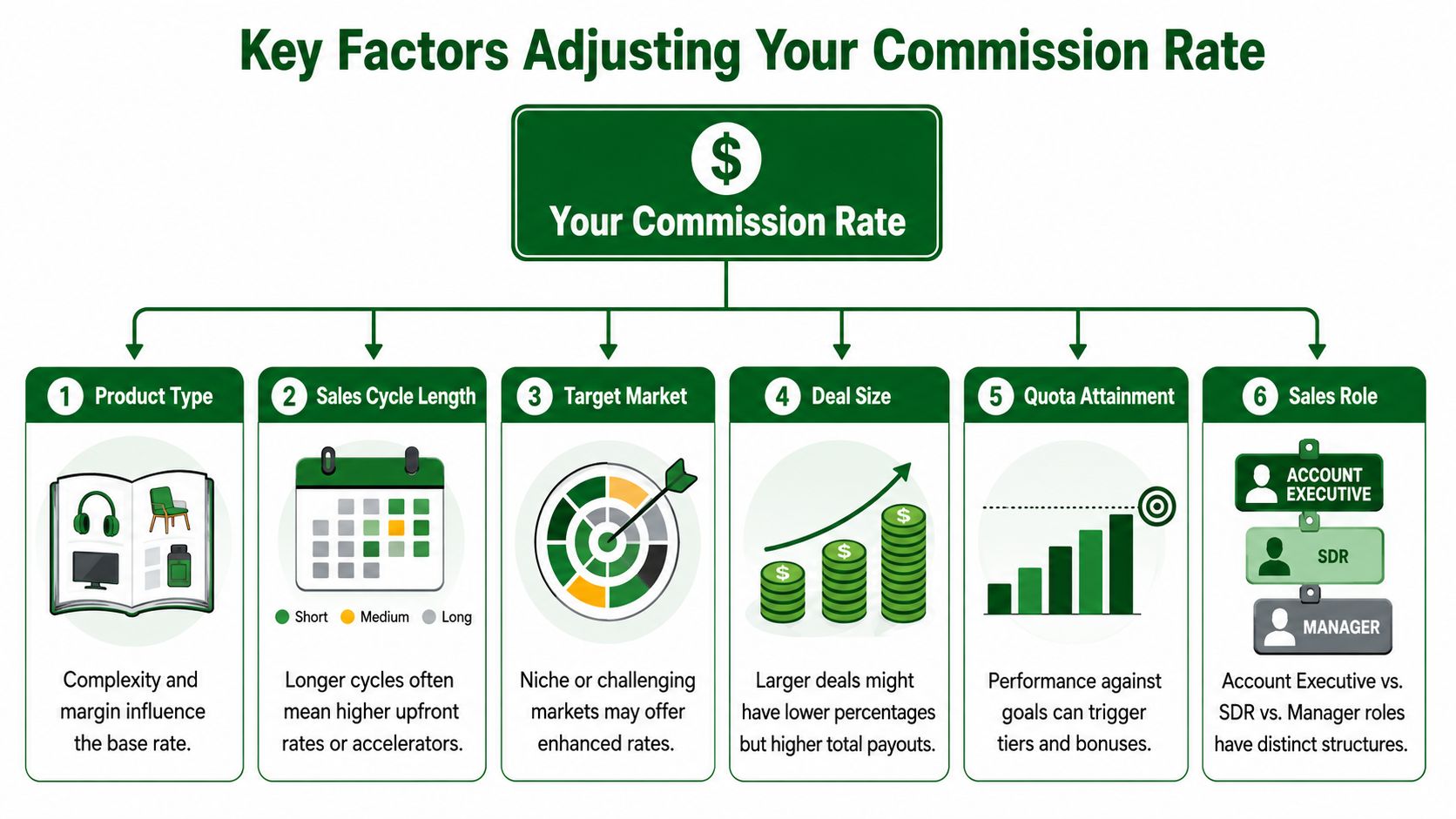
Key Factors That Adjust Your Commission Rate
A rep can join two companies with the same headline commission rate and earn very different money by year-end. The gap usually comes from plan design, territory economics, and how much effort the business expects before revenue shows up.
Margin and business model
Commission rates start with unit economics. If the company has strong gross margins and healthy retention, leadership has more room to pay aggressively for growth. If margins are tighter, comp plans usually protect profitability first.
The revenue model matters just as much. A one-time sale can support one payout logic. Subscription revenue often shifts comp toward ARR or ACV because the business cares about revenue quality, not just booked dollars. That changes what a rep should optimize for. A high rate on the wrong metric can still produce weak take-home pay.
New business versus renewals
New-logo commission is usually richer because the work is heavier. Prospecting, discovery, multi-threading, competitive pressure, and procurement drag all show up before the contract is signed.
As SalesCookie's overview of technology-industry commissions notes, new business is often paid in the 10% to 20% of ARR range, while renewals are commonly paid at a reduced rate such as 50% of the standard rate.
That split tells reps where the company wants effort. It also explains why two AEs with similar books can finish far apart on earnings. The rep sourcing fresh demand usually has more upside than the rep living on lower-effort renewal volume.
Deal size and segment
Bigger deals do not guarantee a bigger commission percentage. In many SaaS teams, the rate drops as deal size rises because the payout on a large contract is still meaningful at a lower percentage.
That creates a real operating trade-off:
- SMB roles usually offer higher rates, but they require more pipeline coverage, more meetings, and faster cycle control.
- Enterprise roles usually offer lower rates, but one closed deal can move a quarter.
- Mid-market roles sit between those two models and often reward reps who can balance volume with deal discipline.
This is why experienced reps look past the rate card. A lower percentage in the right segment can out-earn a higher one if the territory is productive and the pipeline machine is efficient.
Quota mechanics and accelerators
The commission rate on page one of the comp plan rarely tells the full story. Real earnings are shaped by gates, thresholds, accelerators, decelerators, clawbacks, and caps.
I tell reps to read the plan like an operator. Find the points where the payout curve changes. Crossing quota can matter more than the starting rate if the accelerator is strong. Missing a threshold by a few points can wipe out what looked like a good quarter on paper.
Multi-year bonuses follow the same logic. Companies use them to improve cash flow, retention, or payback period without raising commission on every deal. For reps, that can be useful upside if the product supports longer commitments. If it does not, the bonus is noise.
The broader point is simple. Commission rates are adjusted to shape behavior. Top earners do not just ask, "What percent do I get?" They ask whether the territory, quota, and pipeline motion give them enough quality shots to hit the parts of the plan where earnings jump.
How to Calculate Your Potential Earnings
A rep with a 10% commission rate and a thin pipeline will usually earn less than a rep on an 8% plan who consistently gets qualified deals into late stage. That is the calculation that matters. Start with the comp plan, but model it against how much revenue your process can realistically produce.
Example one with a standard AE plan
Use four inputs: base salary, variable pay, quota, and the revenue basis for commission. If any one of those is fuzzy, the earnings estimate will be wrong.
Start with pay mix. On a 50:50 plan, half of your on-target earnings comes from variable pay. On a 60:40 plan, the upside pool is smaller, so the same quota attainment produces a different payout profile.
Then confirm what the company pays on. Some plans pay on ACV. Others use ARR, total bookings, gross profit, or collected revenue. Reps miss this detail all the time, and it changes the math fast.
A simple model looks like this:
- Find your variable target. If OTE is $160,000 on a 50:50 plan, target commission is $80,000.
- Confirm your annual quota. If quota is $800,000 in eligible revenue, that is the production level tied to full variable payout.
- Calculate your target rate. Divide target commission by quota. In this example, $80,000 divided by $800,000 gives an effective target rate of 10%.
- Apply attainment. If you close $600,000 of eligible revenue and the plan pays linearly to quota, estimated commission is $60,000 before accelerators, bonuses, or clawbacks.
That gives you a working forecast based on your plan, not on a headline average.
Example two with an accelerator
Accelerators change earnings more than small changes in the starting rate. A rep who finishes at 120% of quota on a well-structured plan can out-earn a rep with a higher headline commission rate who lands at 85%.
Model the quarter in layers:
- Up to quota: Apply the standard payout rate.
- Above quota: Apply the higher rate from the accelerator table in your plan.
- Special incentives: Add any multi-year, product-line, or strategic-deal bonuses only if your plan explicitly pays them.
For example, if your effective rate is 10% to quota and 15% above quota, the first $800,000 pays one way and the next tranche pays another. That is why one late deal can have outsized impact in the final month of a quarter.
I tell reps to keep two models open at all times.
| View | What to model |
|---|---|
| Baseline view | Expected payout at current commit or planned quota attainment |
| Stretch view | Expected payout if late-stage deals close after the accelerator threshold |
The math itself is easy. The harder question is whether your current pipeline creation rate gives you enough real shots to reach the high-payout band. Top earners know their commission formula, but they also know the input that drives it. Qualified pipeline per week.
The Real Blocker to Above-Average Commission
Reps spend too much time debating percentages and not enough time auditing the machine that feeds those percentages. Above-average commission doesn't come from admiring the comp plan. It comes from creating enough qualified conversations for the comp plan to matter.
Why manual prospecting caps income
Manual prospecting looks productive because it feels busy. Tabs are open. Notes are scattered. LinkedIn, company sites, job posts, funding pages, and CRM records all get checked. But the output is thin for the effort.
When a rep researches one account at a time, they create a throughput problem. They can either go deep on too few accounts or go shallow on too many. Both outcomes hurt. The first starves volume. The second destroys relevance.
If most of your morning disappears before the first quality outbound touch goes live, your earnings are capped long before the quarter closes.
The downstream impact is brutal. Thin list quality leads to weak messaging. Weak messaging leads to low reply rates. Low reply rates force reps to send more volume. More volume creates more manual prep. The whole system slows down.
Why generic outreach makes the math worse
Generic cold emails fail for a simple reason. They ask for attention without proving relevance. Buyers can spot templated “personalization” immediately. Mentioning a company name, title, and vague compliment isn't research.
What top reps do differently is operational, not poetic. They anchor the message to something current and useful, such as a hiring pattern, product motion, market change, or visible trigger that creates a reason to talk now.
A weak outbound workflow usually has these symptoms:
- Lists are broad: The ICP exists in a slide deck but not in actual targeting.
- Research is inconsistent: Some prospects get detail, most get surface-level notes.
- Hooks are stale: Messaging reads like it could have been sent to anyone.
- Follow-up breaks: Reps write a good first email, then improvise the rest.
None of those issues are solved by a slightly higher commission rate. They are process problems. Until the prospecting engine gets faster and sharper, take-home pay stays constrained by preventable friction.
How Top Reps Systematize Their Way to Higher Earnings
Top reps don't rely on heroic effort. They remove repetitive work from the path to pipeline. Their advantage isn't that they somehow found a secret sales commission average. It's that they can produce more qualified activity with less drag.
They research in batches, not one lead at a time
The old workflow breaks because it's serial. One rep, one account, one browser maze at a time. That might feel careful, but it doesn't scale.
High-output teams shift to batch research. They start with a defined list from the CRM or a CSV, then enrich and qualify accounts in parallel. That changes the unit of work. Instead of spending most of the day preparing to prospect, they prospect from a research layer that's already assembled.
A better research system should let reps:
- Work from owned lists: Pull from CRM or uploaded targets instead of hunting ad hoc.
- See source-backed qualifiers: Keep the rationale attached to the account so reps trust what they're using.
- Prioritize by signal: Sort faster when buying cues and fit indicators sit in one place.
Platforms like PitchSmart for outbound research and sequencing come into play. The value isn't just convenience. It's the ability to replace one-by-one prep with parallel research across an entire target list.
They open with relevant signals, not recycled personalization
Good personalization isn't a first-name token or a compliment about the company's website. The strongest opens use a recent, observable business signal and connect it to a concrete reason for outreach.
That might be a hiring move, a category expansion, a product update, or another visible activity that changes timing. The key is specificity. Reps need conversation hooks that create relevance without sounding manufactured.
Strong outbound doesn't start with clever copy. It starts with a valid reason to contact that account now.
Systems that pull activity-based signals into usable hooks help reps skip the blank-page problem. Instead of drafting every opener from scratch, they can start from current context and tailor from there.
They sequence fast and keep segmentation tight
Strong reps also don't stop at the first message. They package the outreach into a sequence early so follow-up doesn't depend on memory and spare time.
That means pairing signal-backed hooks with automated multi-step execution across email and LinkedIn. It also means segmenting lists by buying signal, role, and relevance before launch so the sequence fits the audience.
A modern outbound workflow looks more like this:
- Upload or sync the target list.
- Run bulk account and lead research.
- Extract recent signals worth referencing.
- Generate customized opening hooks from those signals.
- Seed those hooks into a three-step sequence.
- Launch by segment instead of blasting one generic campaign.
This walkthrough shows the motion in action:
The commission impact is indirect but powerful. When reps spend less time assembling context and more time in live conversations, they create more shots on goal. More qualified pipeline gives the comp plan room to work. That's how above-average earnings usually happen in practice.
Actionable Takeaways for Reps and Managers
Compensation is getting tighter around performance. A 2026 industry report says two-thirds of companies are shifting to pay-for-performance models, reflecting a stronger preference for tying pay directly to outcomes, as noted by SPOTIO's commission structure analysis. That puts even more pressure on teams to remove wasted motion from the selling day.
For reps
If you're trying to improve earnings, audit your workflow before you complain about the plan.
- Critically examine your calendar: If admin and research dominate the day, commission won't fix that.
- Tighten targeting: Better list discipline beats sending more mediocre outreach.
- Use real hooks: Reference current account signals instead of generic personalization.
- Build sequences early: Don't rely on memory for follow-up.
The goal isn't to work harder. It's to get more selling activity from the same day.
For managers
Managers should stop treating underperformance as only a coaching or compensation issue. Often it's a systems problem.
Look at where the team loses time. If reps are still researching accounts manually, piecing together signals from scattered sources, and writing one-off emails for every prospect, you've built friction directly into quota attainment. The comp plan may be fair, but the workflow is expensive.
A stronger operating model usually includes:
| Focus area | What to fix |
|---|---|
| Prospecting workflow | Replace serial research with batch enrichment and qualification |
| Messaging quality | Standardize signal-based hooks instead of vague personalization |
| Sequence execution | Give reps structured outreach paths they can adapt quickly |
| Segmentation | Group accounts by fit and timing before launch |
The bigger takeaway is simple. The sales commission average is useful for context, but it doesn't determine who gets paid well. Process does. Reps who remove manual research and improve outbound relevance create more pipeline. Managers who enable that system give their team a better shot at earning the variable already sitting in the comp plan.
If your team wants more commission without relying on comp-plan surgery, fix the prospecting engine first. PitchSmart helps outbound teams run bulk lead research, surface activity-based hooks, segment lists by buying signals, and launch automated email and LinkedIn sequences without the usual manual grind.