Stop Wasting 70% of Your Day on Manual Research.
If you're in B2B sales, this is the bleeding neck problem. Reps spend up to 70% of their day on non-selling tasks, and manual research sits near the center of that mess according to Mordor Intelligence's sales intelligence market analysis. That means too much time in tabs, too much copy-paste into CRM fields, and too many cold emails built on weak assumptions.
The result is familiar. Outreach gets generic, reply rates sag, and teams stay busy without creating enough qualified pipeline. Top-performing reps protect more time for actual selling, while average reps lose the day to admin and low-value activity according to SalesMotion's sales time management analysis. That's the divide.
Sales intelligence tools are supposed to fix this. Some help you find contacts. Some help you spot timing signals. Some help you route data into your stack. A smaller group effectively reduces the research burden enough to change output. This guide focuses on that practical question: which tools help outbound teams spend less time gathering facts and more time starting real conversations.
1. PitchSmart
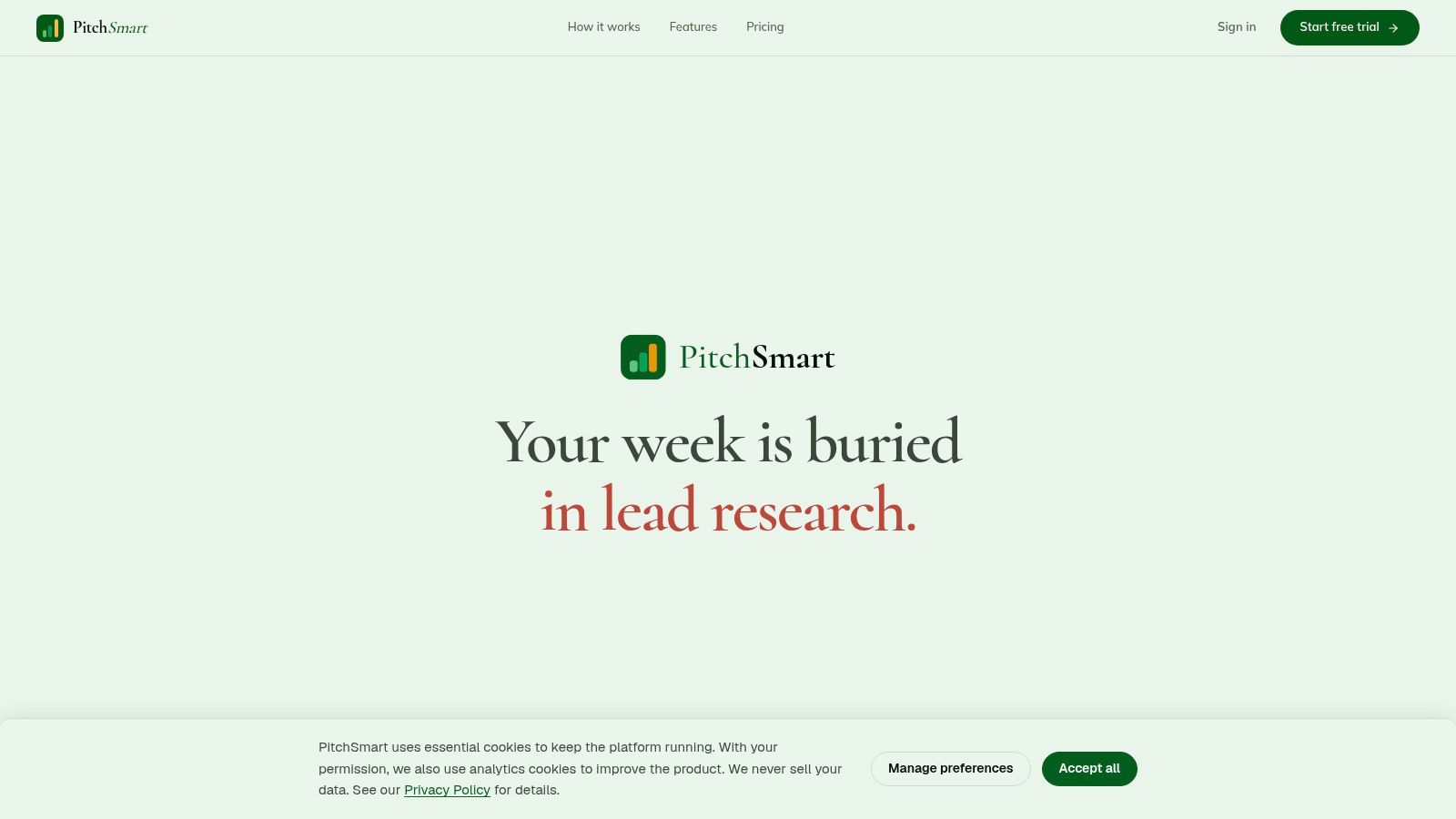
Most sales intelligence tools rent you access to records. PitchSmart takes a different angle. It assumes you already have a list from your CRM, Apollo, LinkedIn, or another source, and your real problem is the labor required to turn that list into outreach that is worth sending.
That matters because the market has moved hard toward AI-driven platforms. The global sales intelligence market was valued at USD 3.31 billion in 2024 and is projected to reach USD 9.02 billion by 2034, with growth driven by AI, ML, and NLP improving forecasting and real-time personalization according to Precedence Research's sales intelligence market report. But broad market growth doesn't solve the rep-level bottleneck by itself. Research workflow does.
Why PitchSmart stands out
PitchSmart is built for research automation first. Upload a CSV or export a segment from your CRM, and the platform runs bulk lead research across the list, surfaces activity-based hooks from public signals, scores accounts, and generates a three-step email and LinkedIn-ready outreach flow seeded from the strongest angles.
The practical value isn't just speed. It's that each signal is tied back to a visible source, so reps can review what the system found before anything gets exported. That's a better operating model than asking reps to trust vague AI summaries they can't verify.
Practical rule: If your rep still has to open ten tabs per account after enrichment, you didn't solve research. You just moved it.
PitchSmart also handles the last mile well:
- Bulk research on your list: It works on your existing accounts instead of forcing another database workflow.
- Signal-backed personalization: Hooks come from recent online activity, not generic company blurbs.
- Sequence-ready output: It prepares automated three-step outreach drafts your team can edit and push into Apollo, Outreach, Salesloft, Gmail, or Outlook through CSV exports.
- Segmentation by buying signals: RevOps can break lists by relevance and timing before launch.
Best fit
This is the best option here for teams whose biggest problem is manual prospect research, not top-of-funnel list discovery. SDR teams, agencies, and lean RevOps functions usually feel that pain first.
It isn't the right choice if you need a giant contact database as your primary system. It is the right choice if you already have leads and need to turn them into evidence-based outbound faster with PitchSmart.
2. LinkedIn Sales Navigator
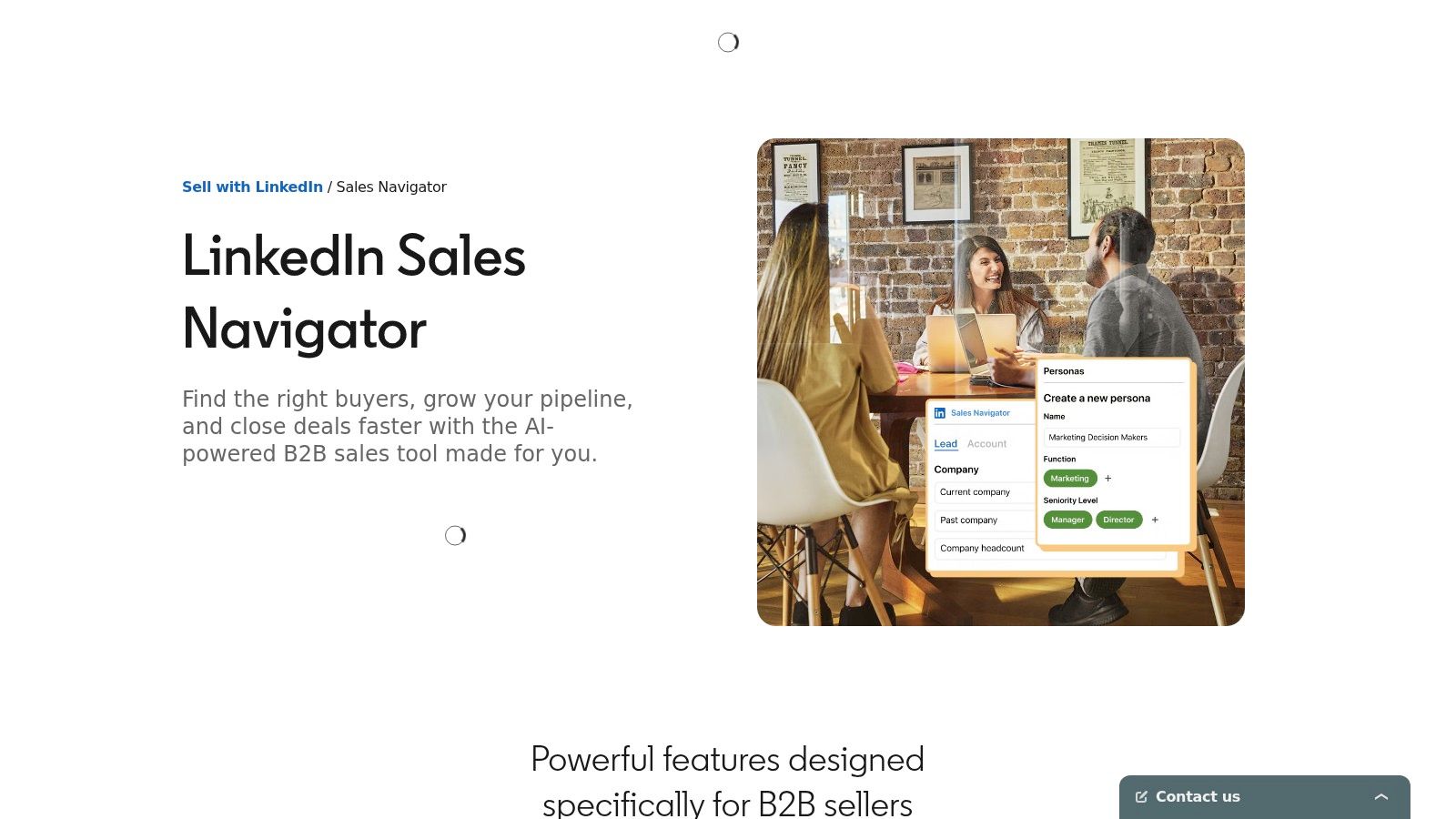
LinkedIn Sales Navigator is still the default relationship intelligence layer for a lot of B2B teams. If you sell into complex buying groups, it gives you the fastest path to understanding who sits where, who just changed roles, and who on your team might have a warm path in.
Its strength isn't contact data depth. Its strength is context inside the professional graph. Advanced search filters, TeamLink, relationship mapping, account alerts, and CRM sync make it useful for account planning and social selling.
Where it helps most
For outbound teams, Sales Navigator works best near the front of research. You use it to qualify the right people, confirm titles, and catch visible changes like role moves or account activity. Then you pair it with another system for contact data or outreach execution.
That split is important. Plenty of teams buy Sales Navigator and expect it to replace a full outbound stack. It won't. You still need a way to turn account context into timely, personalized messaging at scale.
Warm-path visibility is valuable. It doesn't remove the work of writing a relevant email for twenty accounts before lunch.
If your reps prospect one account at a time, Sales Navigator fits naturally. If they launch campaigns in batches, it usually becomes an input into a broader workflow, not the workflow itself. You can learn more on LinkedIn Sales Navigator.
3. ZoomInfo SalesOS
ZoomInfo SalesOS is what many teams buy when they want breadth. Large contact database, direct dials, company intelligence, technographics, intent add-ons, and enterprise integrations. For coverage alone, it's one of the most complete options in the category.
That broad scope is why it shows up in a lot of mature stacks. It can support sales, marketing, and ops in one environment, especially when governance and admin controls matter.
What it does well
The biggest use case is high-volume list building with downstream routing into the rest of your GTM stack. ZoomInfo is also useful when teams care about technographic and trigger-based targeting, not just contact retrieval. That's an important distinction because technographics are often discussed but rarely operationalized well for same-day outreach.
A practical issue shows up after purchase. The tool may centralize data, but many teams still struggle with fragmented workflows across CRM, email, and engagement systems. That data-silo problem is one of the more under-discussed failures in sales intelligence adoption. Great records don't help much if signals never land where reps work.
- Best for: Enterprise teams that need broad company and contact coverage.
- Less ideal for: Small teams that mainly need research automation on existing lists.
- Watch-out: Admin overhead and contract complexity can feel heavy if your workflow is still simple.
For more details, see ZoomInfo.
4. Apollo.io
Apollo.io wins a lot of deals because it compresses multiple jobs into one product. Database, sequencing, workflow automation, Chrome extension, and light CRM functionality all sit in the same UI. For startups and SMB teams, that usually means faster time to value and less tool sprawl.
Software remains the largest part of the sales intelligence market and is projected to exceed USD 6.6 billion by 2032 according to the earlier market report. The reason is straightforward. Teams don't just want data. They want systems that make the data usable inside day-to-day execution.
Best use case
Apollo is strongest when you need one platform to find contacts, launch outreach, and keep the motion moving without a long buying cycle. Self-serve onboarding helps. Public pricing helps. The free entry point also makes internal testing easier than tools that require a contract before anyone can touch the product.
The trade-off is familiar to anyone who has run Apollo at scale. Credit logic matters. Export usage matters. Teams that rely heavily on high-volume enrichment or APIs need to watch consumption closely.
Field note: Apollo is usually a good first stack. It isn't always the best final stack.
If your main pain is finding prospects and getting campaigns live quickly, it's a strong option. If your pain is deep research personalization on lists you already own, Apollo often becomes the feeder system rather than the final answer. Explore it at Apollo.io.
5. 6sense Sales Intelligence formerly Slintel
6sense is a prioritization engine more than a basic data tool. It focuses on identifying in-market accounts, surfacing buyer signals, and helping teams decide where to act next. If your sales motion is account-based and timing matters more than raw record count, 6sense earns a serious look.
The analytics and reporting segment is projected to command 42.9% of the sales intelligence software market in 2025 according to IMARC Group's sales intelligence market coverage. That tracks with how teams buy. Once contact access becomes table stakes, better prioritization and clearer action routing become the differentiator.
Where teams get value
6sense is most useful when RevOps has enough instrumentation to support predictive workflows. Strong CRM hygiene, account ownership rules, routing logic, and defined stages all matter here. Without that foundation, predictive signals can turn into another dashboard people admire and ignore.
Its biggest upside is timing. That's especially relevant for trigger-based outbound. Technographic shifts, hiring patterns, and buyer activity are more valuable when they route to reps quickly with a clear next action.
The drawback is adoption friction. This isn't usually the tool for a two-rep outbound pod trying to move faster next week. It's better suited to teams that already run coordinated sales and marketing programs. You can review the product on 6sense Sales Intelligence.
6. Cognism
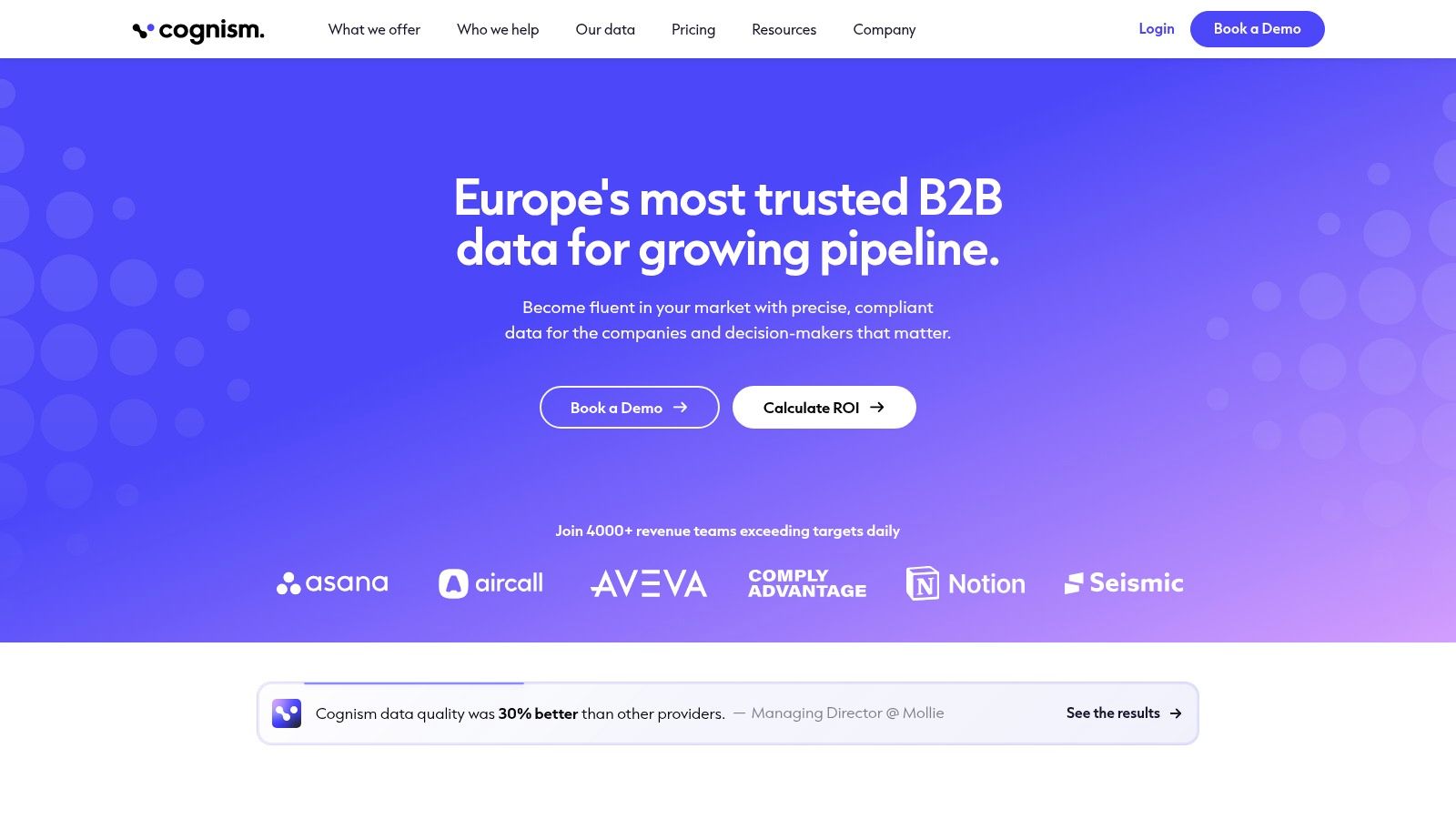
Cognism is a practical choice for teams that care about compliant prospecting, especially in EMEA. It leans into verified mobile numbers, prospecting filters, enrichment workflows, and DaaS options rather than trying to be an all-in-one outbound suite.
That focus makes it attractive to dialing-heavy teams and ops leaders who don't want to get sloppy with compliance controls. If your reps call more than they email, mobile verification can matter a lot more than another AI writing layer.
Who should buy it
Cognism fits teams that sell internationally and need a cleaner compliance posture around contact use. It's also a good match when prospecting and enrichment need to flow into other systems instead of being managed inside one monolithic platform.
The flip side is that it doesn't remove the manual research burden on its own. It gives you contact and account data. Your reps still need a process to convert that data into relevant outreach.
- Strong point: Compliance-minded data operations for outbound.
- Operational benefit: Useful for CRM enrichment and bulk delivery workflows.
- Main limitation: Research and message creation still need another layer.
For product details, visit Cognism.
7. Lusha
Lusha has stayed popular because it's easy to understand. Clear credit mechanics, straightforward browser-based prospecting, freemium access, and admin controls that don't require a full ops project. That simplicity matters for SDR teams that need quick lookups without buying into an enterprise platform.
For many teams, Lusha is less a system of record and more a practical utility. Open LinkedIn, reveal data, move on.
What to expect
The upside is speed. New reps usually understand the workflow quickly, and finance teams tend to like tools they can budget without decoding a complicated contract structure.
The limitation is depth. For niche ICPs or complex account-based motions, Lusha often needs backup from a broader data source or a research layer that can add context. It solves contact access better than message quality.
If your reps mostly need fast lookups and simple administration, Lusha does the job. If they need signal-based personalization across batches of target accounts, you'll outgrow it sooner. See Lusha.
8. Seamless.ai
Seamless.ai positions itself around real-time search and easy access. The permanent free tier lowers the barrier to testing, and API availability across plans makes it more interesting for teams that want to build programmatic workflows without waiting for an enterprise package.
That builder-friendly angle stands out. A lot of tools talk about automation but reserve usable API access for higher tiers.
Good fit for
Seamless.ai works best for teams that want contact discovery plus flexible enrichment hooks into their own systems. If your ops team likes experimenting with automations, it's easier to trial than many quote-only alternatives.
It also aligns with a broader market trend. North America currently holds a 35% global market share, with the United States accounting for 86% of that regional adoption according to the IMARC data cited earlier. That concentration helps explain why fast-moving, AI-heavy sales data products tend to gain traction quickly in US outbound environments first.
Still, the tool doesn't solve the full research problem. It helps find and enrich records. It doesn't replace the work of turning those records into strong, source-backed outreach. Learn more at Seamless.ai.
9. LeadIQ
LeadIQ is one of the more practical options for teams that care about capture, sync, and reducing CRM busywork. The Chrome extension is straightforward, pricing tends to be more transparent than enterprise-first tools, and job-change tracking makes it useful for champion monitoring.
LeadIQ proves stronger than anticipated. It isn't trying to win every category. It focuses on workflow friction reps feel every day.
Where it punches above its weight
Job-change and champion tracking are valuable because timing changes outreach quality fast. If a prior buyer moves to a new company, that's not just an enrichment event. It's an opening for a warmer conversation with actual context behind it.
LeadIQ also helps teams reduce manual entry, which matters more than most buying committees admit. Top-performing sales organizations have cut non-revenue rep time by about 16% by redesigning workflows first and then applying AI selectively to revenue-critical motions according to Blue Ridge Partners' analysis of sales productivity and AI workflow. LeadIQ fits that workflow-first mindset better than many bigger platforms.
If your team wants cleaner CRM movement and useful signal capture without a giant implementation, it's a solid option. Review it at LeadIQ.
10. Crunchbase ProBusiness
Crunchbase belongs on this list even though it isn't a contact database in the usual sense. It's a company intelligence tool. Funding rounds, investor activity, leadership changes, growth signals, saved lists, and alerts make it useful for building account lists around momentum.
That makes it especially handy for outbound teams that sell into changing environments. New funding, leadership movement, and growth narratives often create better outreach timing than static firmographics.
Where it belongs in the stack
Crunchbase is best used as a trigger source paired with a contact provider or research automation layer. You use it to identify who deserves attention, then another tool helps you reach those people and another may help you personalize.
Retail and e-commerce are projected to post the fastest CAGR at 14.7% through 2032 in sales intelligence adoption, according to the IMARC market data mentioned earlier. That's a useful reminder that high-velocity sectors tend to reward tools that help teams react quickly to company changes.
Good outbound timing usually starts with a company event. Good reply rates come from what your rep does with that event next.
Crunchbase is excellent for the first half of that problem. It won't finish the second half alone. Product details are on Crunchbase Pro.
Top 10 Sales Intelligence Tools Comparison
Manual prospect research is still the biggest drag on outbound productivity. The right tool should cut prep time, improve targeting, and give reps usable context without forcing them to stitch five systems together.
This comparison focuses on that bottleneck first. Some products are best for contact coverage, some for intent and account selection, and some for turning raw account lists into research-backed outreach. PitchSmart stands out because it is built to automate the research work itself, not just rent access to another database.
| Tool | Core features | UX & quality | Price / value | Target audience | Best fit |
|---|---|---|---|---|---|
| PitchSmart 🏆 | Parallel AI research on CSVs and CRM records, scored account summaries, verifiable source citations, 3 email drafts per lead | ★★★★★, Processes 20 to 50 accounts in minutes with source-backed output reps can review fast | 💰 Free trial and free tier, transparent usage, low-risk evaluation | 👥 SDRs, BDRs, AEs, Sales Ops, agencies | Research automation for outbound teams that need personalization at scale |
| LinkedIn Sales Navigator | LinkedIn graph search, advanced filters, TeamLink, account and lead alerts, AI-assisted messaging | ★★★★☆, Strong for live role changes, relationship mapping, and rep-led prospecting | 💰 Paid plans, Advanced and Enterprise usually require sales contact | 👥 Social sellers, enterprise account teams | Rep-driven account research and warm path identification |
| ZoomInfo SalesOS | Large contact database, direct dials, emails, intent data, technographics, visitor identification | ★★★★☆, Wide coverage and mature admin controls for larger teams | 💰 Quote-based pricing, usually highest cost in the category | 👥 Enterprises, sales and marketing ops teams | Broad data coverage and enrichment across a large GTM stack |
| Apollo.io | Contact data, sequencing, deliverability tools, AI assistant, Chrome extension | ★★★★☆, Fast to deploy for SMB teams that want one platform for prospecting and outreach | 💰 Freemium entry, then tiered plans and export limits | 👥 Startups, SMB SDR teams | Budget-friendly all-in-one outbound workflow |
| 6sense Sales Intelligence | Predictive scoring, Sales Copilot, intent data, firmographic signals | ★★★★☆, Strong for prioritizing in-market accounts and timing outreach | 💰 Free tier with limits, advanced modules are quote-based | 👥 ABM teams, RevOps, enterprise sellers | Account prioritization and buying-stage signals |
| Cognism | Global B2B data, CRM enrichment, pooled credits, compliance-focused features | ★★★☆☆, Useful for teams selling in EMEA and working under tighter data rules | 💰 Quote-based pricing | 👥 EMEA sales teams, compliance-conscious orgs | International prospecting with a stronger compliance posture |
| Lusha | Chrome extension, contact reveals, credit-based usage, CRM integrations | ★★★☆☆, Simple browser workflow for quick one-off lookups | 💰 Freemium plus tiered credit plans | 👥 SDRs who need fast contact access | Lightweight contact lookup with easy credit management |
| Seamless.ai | Real-time search and enrichment, free tier, API access on paid plans | ★★★☆☆, Works best for teams that want frequent lookups and basic enrichment in one place | 💰 Free plan plus quoted paid tiers | 👥 SMBs, builders, teams needing real-time lookup | Ongoing search and enrichment with API options |
| LeadIQ | Prospect capture, enrichment, job-change tracking, direct CRM sync | ★★★★☆, Clear workflow for capturing leads from LinkedIn and pushing them into sequences | 💰 Transparent pricing, credits, 30-day trial | 👥 SDRs, RevOps, CRM-driven teams | Fast prospect capture with dependable CRM handoff |
| Crunchbase Pro/Business | Company intelligence, funding and growth signals, alerts, exports | ★★★★☆, Best used for account selection and event-based prospecting | 💰 Pro monthly, team and enterprise tiers available | 👥 Account-based sellers, GTM and growth teams | Finding companies worth researching before contact sourcing starts |
A practical way to read this table is by job to be done.
If the main problem is finding names, tools like ZoomInfo, Apollo, Cognism, Lusha, and LeadIQ compete on coverage, credits, and workflow fit. If the main problem is deciding which accounts deserve rep time, 6sense and Crunchbase are stronger options. If the main problem is the manual work between “we have a list” and “we can send relevant outreach,” PitchSmart addresses that gap more directly than list-first platforms.
That distinction matters for ROI. A bigger database does not fix a workflow where reps still spend hours reading websites, scanning LinkedIn, checking recent news, and writing first lines from scratch. For teams already sitting on account lists in a CRM, warehouse, or CSV, research automation often produces faster payback than buying more records.
How to Choose Your Buyer's Checklist and Next Steps
Many organizations don't have a sales intelligence problem. They have a workflow problem disguised as a tooling problem. They buy another database when the bottleneck is that reps still research one lead at a time, still rewrite the same opening lines by hand, and still lose context between CRM, browser tabs, and sequencing tools.
That's why this category keeps expanding. The market is growing because teams want faster, more accurate, more automated selling motions. But growth in software options doesn't automatically mean better rep productivity. If your stack adds more signals without reducing manual work, you'll just create better-informed inefficiency.
The Sales Intelligence Buyer's Checklist
- Problem: Is your main issue finding new leads, or personalizing outreach to leads you already have?
- Data versus workflow: Do you need a large contact database, or do you need a tool that removes research and admin work from the rep's day?
- Scale: Are reps researching one prospect at a time, or are you launching campaigns across dozens or hundreds of accounts?
- Output: Do you only need emails and phone numbers, or do you also need contextual hooks and ready-to-edit messages?
- Team: Are you buying for one SDR, a small outbound pod, or a RevOps-backed sales org with complex routing and governance needs?
One practical point gets missed in most buying guides. Data silos break ROI. If signals don't move cleanly into CRM, outreach, and rep workflows, the tool underdelivers even when the data itself is strong.
When to Choose PitchSmart for Outbound-Heavy Teams
Most tools on this list help you find people. PitchSmart helps you engage them. That's a different job, and for many outbound teams it's the more painful one.
If your reps already have lists from Apollo, LinkedIn Sales Navigator, HubSpot, Salesforce, or another source, PitchSmart handles the hard part that usually eats the day. It automates bulk, customizable lead research. It pulls in proprietary and public data points, finds activity-based conversational hooks from recent online signals, segments lists around buying signals, and assembles automated three-step email and LinkedIn sequences seeded from the strongest angles.
That approach lines up with what high-performing teams already know. Better outreach doesn't come from renting more records. It comes from reducing the time between identifying a prospect and sending a relevant message.
Turn Intelligence Into Pipeline Faster
The best sales intelligence tools don't just improve visibility. They improve action. Reps should spend more time in pre-calls, account engagement, and deal advancement, not in browser tabs assembling facts by hand.
If your main bottleneck is list building, a tool like ZoomInfo, Apollo, Lusha, or Cognism may be the first purchase. If your main bottleneck is timing and prioritization, 6sense or Crunchbase may deserve attention. If your main bottleneck is the manual research work required to turn a target list into credible outbound, PitchSmart is the better fit.
The simplest way to test that is operational. Take one outbound list your team already plans to work. Run the old process once. Then run the same list through a research-first workflow that produces signal-backed hooks and draft outreach at scale. The gap becomes obvious fast.
If your team is still burning hours on manual prospect research, try PitchSmart on a real outbound list. Upload your prospects, let the platform run bulk research in parallel, review the source-backed hooks and draft sequences, and hand reps a campaign they can send instead of a spreadsheet they still have to decode.