In 2026, U.S. total compensation for a Sales Ops Manager typically ranges from $85K to $175K. That spread is so wide that a single “average” salary is almost useless unless you know what sits underneath it: scope, variable pay, company stage, industry, and whether the job is really Sales Ops or a quieter version of RevOps.
That's the part most salary roundups miss. They treat Sales Operations Manager as if it were one stable job family with one reliable market rate. It isn't. In one company, the role is mostly CRM hygiene, reporting, and pipeline cleanup. In another, the same title owns forecasting, territory design, compensation administration, tooling decisions, and cross-functional revenue planning. Those are not the same jobs, and the paycheck usually reflects that difference.
A better way to think about sales ops manager salary is this: the title gets you into the broad pay band, but scope determines where you land inside it. If your role touches revenue architecture rather than only sales support, you're often benchmarking against a different market than the title suggests.
Why an Average Sales Ops Salary Is Misleading
If you search for a sales ops manager salary, you'll usually get one neat figure. That number feels useful because it looks precise. In practice, it can distort your expectations more than it helps.
The title covers too many operating models. Some teams use Sales Ops Manager for a tactical operator who keeps Salesforce clean, builds reports, and supports rep workflows. Others use the same title for someone who effectively runs part of RevOps by owning forecasting cadence, pipeline inspection, KPI architecture, territory planning, compensation logic, and tool integration across sales, finance, and marketing.
Those jobs don't just differ in workload. They differ in business impact. A manager who maintains systems is valuable. A manager who redesigns systems that change forecast quality, rep productivity, and leadership visibility usually gets paid on a different curve.
The biggest mistake in salary benchmarking is assuming title equals market value. In sales operations, scope is the stronger signal.
There's another problem with averages. They flatten the distinction between base salary and total compensation. If one company pays mostly fixed cash and another pays lower base with stronger bonus or equity, the same title can look underpaid or overpaid depending on which number you compare.
That's why the right question isn't “What's the average sales ops manager salary?” The useful question is “What specific version of this role am I performing?” Once you answer that, the market starts making sense.
- Pure sales support scope: expect benchmarking to lean on CRM administration, reporting, and process maintenance.
- Broader commercial operations scope: expect benchmarking to shift toward revenue systems ownership, planning, analytics, and cross-functional influence.
- Hybrid scope with RevOps traits: expect employers to pay for decision quality, not just task coverage.
National Sales Ops Salary Benchmarks for 2026
A national benchmark for Sales Ops Manager pay is useful only if you treat it as a spread, not a target. The title covers jobs with very different operating scope, so the national numbers swing more than many candidates expect.
According to Built In salary data for U.S. Sales Operations Managers, average total compensation is $122,872, average base salary is $106,759, average additional cash compensation is $16,113, the common range runs from $40K to $210K, and the median is $100,000. Built In also reports women averaging $106,151, men averaging $126,028, and professionals with 7+ years of experience averaging $128,425.
PayScale's 2026 Sales Operations Manager salary benchmark lands lower. PayScale lists average pay at $96,239, with a base range of $66K to $137K and total pay of $65K to $146K once bonus, profit sharing, commission, and overtime are included.
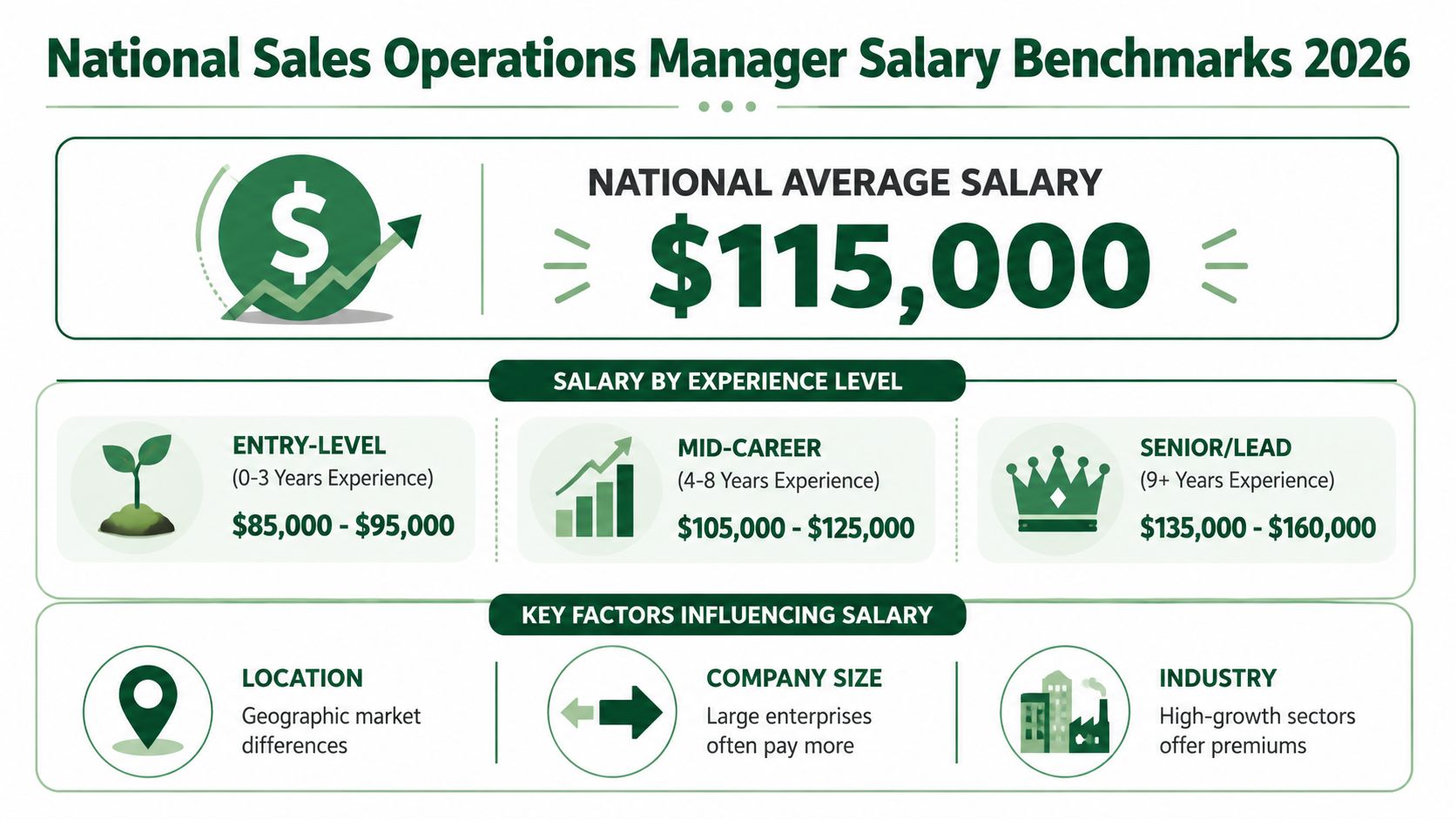
Benchmark reality: one major source places average total compensation at $122,872, while another places average pay at $96,239. A gap of that size usually means the market is sorting different versions of the job under the same title.
The obvious explanation is sample mix. Built In tends to capture more tech-centered compensation, where bonus structures and higher-growth employers are more common. PayScale often reflects a broader employer set and can pull the benchmark closer to the middle of the market. Neither source is wrong. They are measuring different slices of the same title.
That matters because a Sales Ops Manager who mainly administers CRM, runs standard reporting, and maintains process discipline is usually benchmarked differently from a manager who owns forecasting design, territory logic, compensation support, and cross-functional systems decisions. Salary aggregators rarely separate those scopes cleanly. Employers do.
A more useful reading of the national data looks like this:
| Benchmark lens | What it helps you benchmark |
|---|---|
| Built In total compensation | Higher-velocity companies, bonus-bearing offers, and roles with broader commercial impact |
| PayScale average and range | Lower-to-mid market cash expectations and how total pay can stay compressed even as responsibilities expand |
| Wide national range | How unstable title-based benchmarking becomes once employer type, geography, and operational scope start to diverge |
The non-obvious conclusion is that volatility itself is the benchmark. A wide spread does not just show disagreement between data providers. It shows that the market pays a premium for scope expansion. Once the role starts to resemble RevOps, compensation often moves faster than the title does.
Historical trend lines support that caution, but they do not solve the benchmarking problem. Broader market medians can drift up or down while high-scope roles still command stronger offers. For that reason, national benchmarks work best as boundary markers. They show where the market starts and where it stretches, but they do not tell you where your specific role should land unless you map the actual scope first.
Deconstructing Your Total Compensation Package
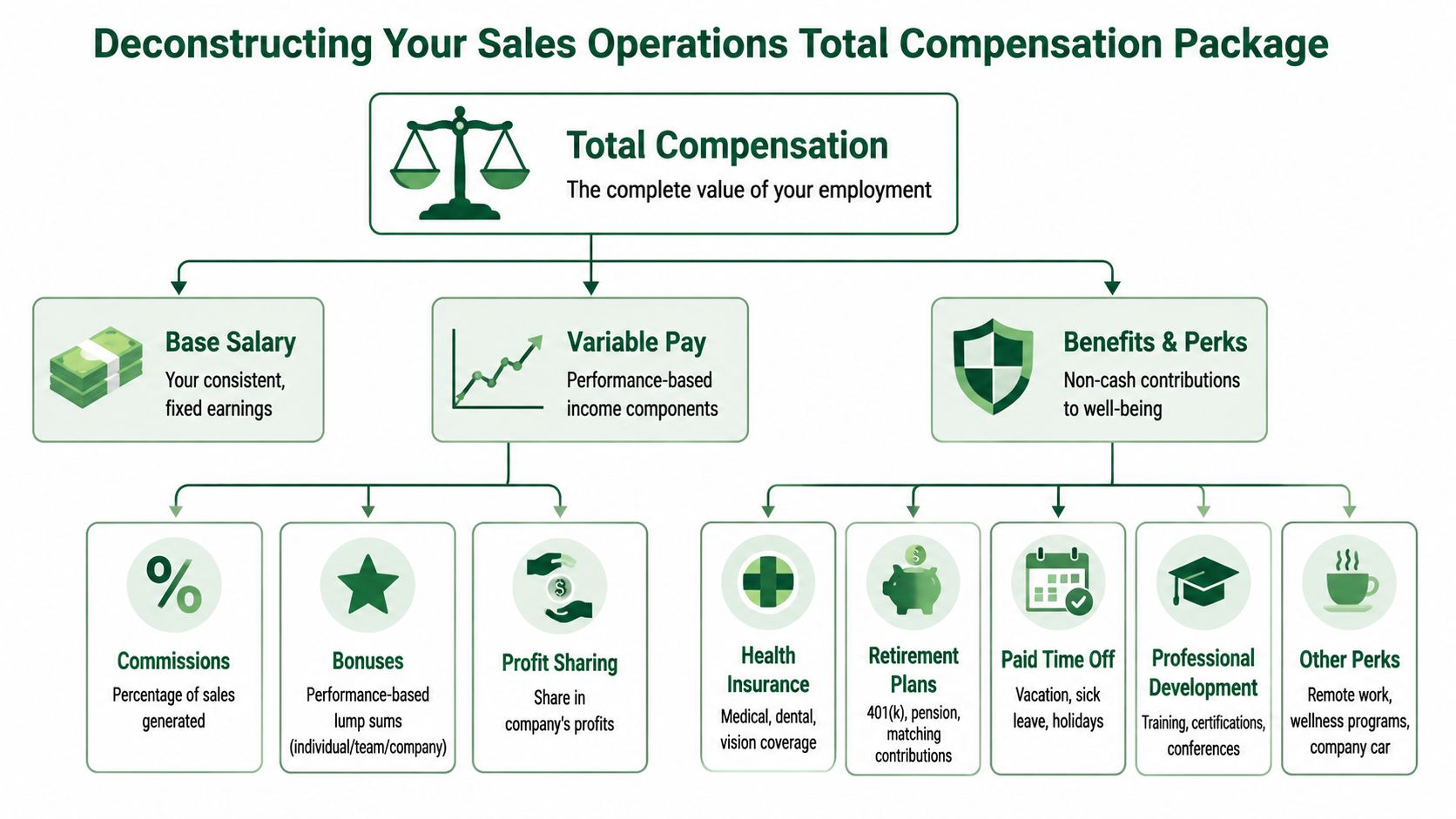
Compensation for a Sales Ops Manager gets volatile the moment the role extends beyond reporting and CRM hygiene. Two offers with the same title can differ sharply because one is a support job and the other is effectively a commercial systems role with revenue accountability. If you only compare base salary, you miss the part of the package that reflects scope.
Base salary is only one pricing signal
Base pay covers guaranteed cash and usually sets the reference point for raises, bonus targets, and future offers. It also tells you how the company classifies the role. A manager hired to maintain dashboards, clean data, and support existing process often gets a different cash profile than a manager expected to redesign forecasting, territory coverage, rep capacity, and compensation operations.
That distinction matters because employers often widen pay faster than they update the title.
A useful test is to ask what happens if this role performs well for 12 months. If success means cleaner reporting and faster admin turnaround, the package often stays cash-heavy and relatively flat. If success means better forecast accuracy, tighter pipeline governance, and fewer handoff failures across sales and marketing, the company is pricing strategic impact, even if the title still says Sales Ops Manager.
Variable pay usually reflects measurable business ownership
Bonus structure tends to be the clearest sign that the role reaches beyond pure support. Companies do not attach variable pay by accident. They use it when they expect outcomes that can be measured against plan, such as forecast reliability, sales process adoption, planning accuracy, or pipeline inspection quality.
The important question is not whether variable pay exists. It is what the business is paying for.
Use this framework when you review an offer:
- Execution-focused sales ops: variable pay may be limited because the role is judged on service level, accuracy, and internal responsiveness.
- Analytical and planning-heavy sales ops: bonus becomes more common because leadership expects operating decisions to improve.
- Hybrid Sales Ops and RevOps work: variable pay is easier to justify because the role influences multiple revenue drivers at once, including systems design, planning cadence, and funnel visibility.
If your remit includes forecasting, compensation support, automation, and CRM ownership, assess the package against a broader revenue operations benchmark, not against a narrow administrator profile. That distinction shows up in tooling expectations too. Teams evaluating system depth often compare platforms across workflow, reporting, and pipeline management requirements, as seen in this PitchSmart vs HubSpot Sales Hub comparison for sales workflow and CRM fit.
Equity changes the risk profile, not just the upside
Equity can make a lower-cash offer reasonable, but only under specific conditions. The role needs unusual scope, close proximity to leadership decisions, and enough influence over go-to-market systems to affect company performance. Otherwise, equity can function as a substitute for salary rather than a meaningful addition to it.
Early-stage offers deserve extra scrutiny. Broad scope sounds attractive, but broad scope without decision authority often produces title inflation rather than compensation growth. Ask who owns final decisions on headcount planning, territory design, compensation changes, and systems architecture. If those decisions sit elsewhere, the equity story may be doing more work than the actual role.
Break every offer into separate components:
- Fixed cash
- Variable cash and the payout mechanics
- Equity, including whether it replaces cash or sits on top of it
- Benefits, retirement match, and any material perks with real dollar value
This approach gives you a cleaner comparison across offers. More importantly, it helps you price the real question employers are answering: are they hiring a Sales Ops Manager to support the revenue engine, or to help run it?
Key Factors That Influence Your Salary
Once the national range is clear, the next step is to locate yourself inside it. The most reliable way to do that is to look at market structure, not just geography.
According to UpFront Operations market commentary on Sales Ops compensation, U.S. averages sit around $82.8K to $106.7K base across major job sites, while Los Angeles can reach about $124.8K total compensation. It is worth noting that the same source says fintech and SaaS pay 10% to 20% above the broad market for comparable sales ops experience.
Experience changes the center of the range
Experience matters, but not in a simple time-served way. Employers usually pay for judgment, not just tenure. Someone with fewer years who can redesign a territory model, rationalize lead routing, and build executive reporting in Salesforce or Power BI may out-earn someone with a longer resume but narrower operating scope.
Built In's data earlier showed that workers with 7+ years average $128,425. That number is useful, but the deeper lesson is this: experience raises pay fastest when it expands what you can own.
Company stage changes what gets paid in cash
Early-stage companies often need broader operators. One person may manage CRM administration, dashboarding, compensation support, and forecasting process all at once. That can create scope of significant impact, but not always high immediate cash.
Later-stage or public companies tend to define the role more narrowly. Sometimes that lowers strategic ownership. Sometimes it increases compensation because the company can pay more for specialized system leadership.
Here's a practical comparison framework.
| Experience Level | Startup (Seed-Series A) | Growth Stage (Series B-D) | Enterprise (Public / Late-Stage) |
|---|---|---|---|
| Early career | Often broad scope, lighter structure, cash may be tighter | Clearer function, faster specialization | Narrower ownership, stronger process maturity |
| Mid-career | Opportunity to become indispensable quickly | Often the best blend of scope and cash | Strong systems exposure, but title can lag actual influence |
| Senior | High ownership, more equity discussions | Frequently where quasi-RevOps pay appears | Higher formal compensation bands, slower title mobility |
If you're mapping role breadth against tooling complexity, this comparison of PitchSmart vs HubSpot Sales Hub for sales workflow context is useful because it highlights how differently companies structure operational work around systems.
Industry often matters more than city
This is the most underused benchmark. SaaS and fintech don't just pay more because they're trendy. They often ask Sales Ops Managers to manage more complex revenue machinery: recurring revenue logic, lifecycle reporting, forecasting discipline, and integration across multiple GTM tools.
That's why an industry premium can tell you more than a national average. If you work in a traditional sector with limited systems ownership, you may be benchmarked against a lower operational ceiling. If you work in SaaS or fintech and own revenue-critical systems, your real market may sit above what generic salary sites imply.
Practical rule: benchmark yourself against the complexity of the revenue model you support, not just the city listed on the job description.
Geography still matters, just not by itself
Los Angeles data points to a higher local market, but city premiums only become meaningful when paired with role scope and industry. A tactical sales ops role in a high-cost market can still underpay relative to a broader role in a lower-cost market.
That's why candidates should stop asking only, “What does this title pay in my city?” A stronger question is, “What does this scope pay in my industry, at this company stage, in this market?”
Skills and Certifications That Boost Your Pay
A Sales Ops Manager does not get paid more for stacking software badges. Pay rises when the role carries revenue risk, planning authority, and system ownership that leadership depends on.

That distinction matters because this title covers two different jobs in the market. One version is a tactical sales support role focused on CRM hygiene, reporting requests, and process maintenance. The other is a broader operating role that blends sales ops with forecasting, territory design, compensation support, and GTM systems strategy. Salary aggregators often compress those jobs into one average, which hides where the pay premium comes from.
Higher pay tracks scope, not tool exposure
The best-compensated managers usually own work that changes commercial outcomes. A company will pay more for forecast accuracy than for dashboard volume. It will also pay more for clean routing logic, quota mechanics, and territory coverage than for basic CRM administration.
Skills that tend to shift compensation upward include:
- CRM architecture and governance: Salesforce administration, data model design, permissions, workflow rules, and process controls tied to reporting accuracy
- Forecasting and pipeline management: building inspection cadences, stage definitions, and forecast processes leaders use for planning
- Territory and capacity planning: translating headcount, coverage, and segmentation decisions into a workable field model
- Compensation operations: supporting quota logic, crediting rules, and incentive administration without creating trust issues
- Analytics and data fluency: SQL, BI tools, spreadsheet modeling, and the judgment to turn noisy data into operating decisions
- Automation and integrations: routing, enrichment, handoff logic, and system connections across the GTM stack
The pattern is straightforward. Pay increases when your work moves from reporting on the machine to designing how the machine runs.
That is why a manager who can connect lead flow, routing, and conversion quality often prices above a peer with similar years of experience but narrower ownership. For teams trying to reduce manual work before records even hit the CRM, this article on automating lead research workflows is a useful example of how operational scope starts upstream, not just inside Salesforce.
Certifications help only when they match the job's economic value
Certifications can help at the screening stage. They rarely explain the top end of the pay band by themselves.
A Salesforce Administrator credential can support a case for higher pay if the role includes architecture decisions, governance standards, or cross-functional system ownership. The same credential carries less weight in a role limited to field updates and report maintenance. BI certifications and platform training follow the same pattern. They matter when they support a broader mandate.
Hiring teams usually pay for evidence, not certificates. They want proof that you can:
- clean and govern unreliable sales data
- build reporting leaders use to make planning decisions
- reduce friction in routing, handoffs, or rep workflows
- improve forecast inspection quality
- support quota or territory changes without breaking internal trust
A useful test is simple. Does your work answer executive questions, or does it only fulfill admin requests?
If leaders rely on you to define process, pressure-test assumptions, and keep revenue systems aligned, your role is already closer to RevOps than basic sales support. That is often where compensation gaps appear. The title stays the same, but the market value does not.
How to Research and Negotiate Your Offer
A Sales Ops Manager offer usually breaks down at the classification stage, not the negotiation stage.
Employers often price the title first and the workload second. That is how candidates get compared to a narrow, lower-paid version of the role even when the actual job includes forecasting, territory design, compensation support, systems ownership, and planning work across finance, sales, and customer success. If you do not correct that framing early, every later discussion starts from the wrong band.
Research the role before you react to the number
Start with the job description, then translate it into scope categories. The title matters less than the operating surface area of the job.
A manager who maintains dashboards, hygiene rules, and CRM fields is in one market. A manager who also owns forecast mechanics, routing logic, planning inputs, and tool decisions is in another. Many companies still label both roles "Sales Ops Manager," which is why simple salary aggregators flatten a market that is not uniform.
Build a benchmark file with notes under these headings:
Workstream breadth
Separate pure sales support tasks from work tied to planning, forecasting, compensation administration, systems architecture, or cross-functional process design.Decision rights
Note whether you are expected to execute requests or define policy, priorities, and operating rules.Business exposure
Identify which leaders depend on the role. A job that supports only frontline managers is different from one that regularly informs finance, executive staff, or board reporting.Pay mix
Record base salary, annual bonus, equity, sign-on pay, and any performance-based upside.Market context
Add location, company stage, and hiring urgency. A late-stage SaaS company replacing a departed operator often prices differently than a mid-market firm building the function for the first time.
For outreach-heavy teams, the tooling stack can widen the role faster than the title suggests. A manager who owns sequencing rules, handoff logic, rep workflow design, and performance reporting is already handling work adjacent to RevOps. This comparison of PitchSmart vs Outreach and Salesloft workflows is a useful example of how operational scope can extend well beyond CRM administration.
Negotiate the package with scope as the anchor
Base salary is only one part of the offer. Scope should determine how you discuss the rest.
Use your benchmark notes to explain why the role belongs in a broader pay band. If the company expects you to improve forecast accuracy, support compensation changes, manage tooling decisions, or keep cross-functional reporting aligned, say that directly. Those are not minor add-ons. They change the economic value of the role because they affect planning quality, rep productivity, and leadership confidence in the numbers.
A practical negotiation checklist helps:
- Ask how the company defines success in the first 12 months. If success is tied to measurable business outcomes, bonus structure should reflect that.
- Clarify whether equity supplements cash or replaces it. Those are different offers.
- Ask who owns the hardest operational problems today. If the answer points back to this role, the scope is broader than the title implies.
- Request detail on bonus mechanics. A target bonus means little without payout history, performance gates, and control over the inputs.
- Tie your ask to responsibilities, not internet averages. The argument should be about role design and business impact.
Short version: negotiate the job you will perform.
Use scope-based language in the conversation
A strong response sounds like this:
“I'm valuing this as a broader operations role because it includes forecast support, systems ownership, and cross-functional planning. I'm assessing the full package, including variable pay and equity, against roles with similar scope.”
That framing changes the conversation. It makes it harder for the employer to anchor you to a generic title benchmark, and it forces a more useful discussion about what the company expects this role to own.
If the recruiter references a national average, return to scope. Ask which responsibilities would fall outside a standard Sales Ops Manager remit. If they cannot draw a clear line, the company may be trying to buy RevOps-level coverage under a cheaper label.
Good negotiation is not about sounding aggressive. It is about classifying the work correctly, then pricing it on that basis.
If your team wants cleaner prospect research, less manual admin, and better signal quality before leads ever hit your workflow, PitchSmart is worth a look. It helps outbound teams research entire prospect lists in parallel, tie insights back to original sources, and generate signal-backed outreach without the usual tab switching and copy-paste.
Enhanced by the Outrank app