You're probably dealing with this right now. The quarter starts with a healthy-looking pipeline, reps are logging activity, the CRM says coverage looks fine, and the forecast feels defensible. Then the month closes and too many “real” opportunities turn out to be contacts that were never properly researched, never qualified, and never likely to convert.
That's why “what are sales forecasts” is the wrong question unless you answer a harder one first. What exactly are you forecasting? If the top of funnel is full of generic outbound, weak account research, and leads that entered the CRM because someone needed activity volume, your forecast is already compromised long before a deal reaches proposal stage.
A good sales forecast isn't a heroic spreadsheet exercise at the end of the quarter. It's the output of disciplined pipeline construction, consistent qualification, and clean data.
The High Cost of a Bad Sales Forecast
The ugly version of forecast failure doesn't happen in a dashboard. It happens in a leadership meeting.
A sales leader presents a confident number, finance builds around it, hiring plans move forward, marketing spend gets approved, and everyone leaves thinking the quarter is under control. A few weeks later, the number slips. Commit deals stall. Best Case was never really best case. Pipeline included accounts that looked active but had no real buying signal behind them.

This isn't rare. A cited SiriusDecisions study found that 79% of sales organizations miss their forecast by more than 10%, while another industry source reports that companies with accurate sales forecasts are over 7% more likely to hit revenue and sales quotas, according to Forecastio's write-up on sales forecasting accuracy and analysis.
Where the miss actually starts
Forecast failure is often attributed to late-stage inspection. Organizations respond by tightening review calls, forcing managers to justify commits, and adding more dashboards.
That helps, but it usually starts earlier.
When reps spend most of their time researching accounts manually, copying notes between tabs, and guessing which prospects might care, they create pipeline clutter. Some of that clutter gets stage progression because the rep did work, not because the buyer showed intent. Once those weak opportunities hit the CRM, they distort conversion assumptions all the way up the chain.
Practical rule: If your pipeline is built on poor research and loose qualification, forecast meetings only give you a cleaner view of the problem.
What a bad forecast costs beyond revenue
The direct cost is obvious. You miss the number.
The second-order cost is worse:
- Finance loses trust: Budget decisions get more conservative.
- Hiring gets delayed or rushed: Headcount planning swings with every forecast revision.
- Managers coach the wrong deals: Attention goes to the loudest opportunities instead of the most real ones.
- Board credibility erodes: Once leadership stops trusting the number, every update becomes a debate.
If your team is trying to clean this up, it's worth looking at the operational side as hard as the analytics side. Even a quick review of PitchSmart pricing and workflow options makes the broader point clear. Forecast quality improves when research quality improves, because cleaner top-of-funnel inputs create a pipeline that deserves to be modeled in the first place.
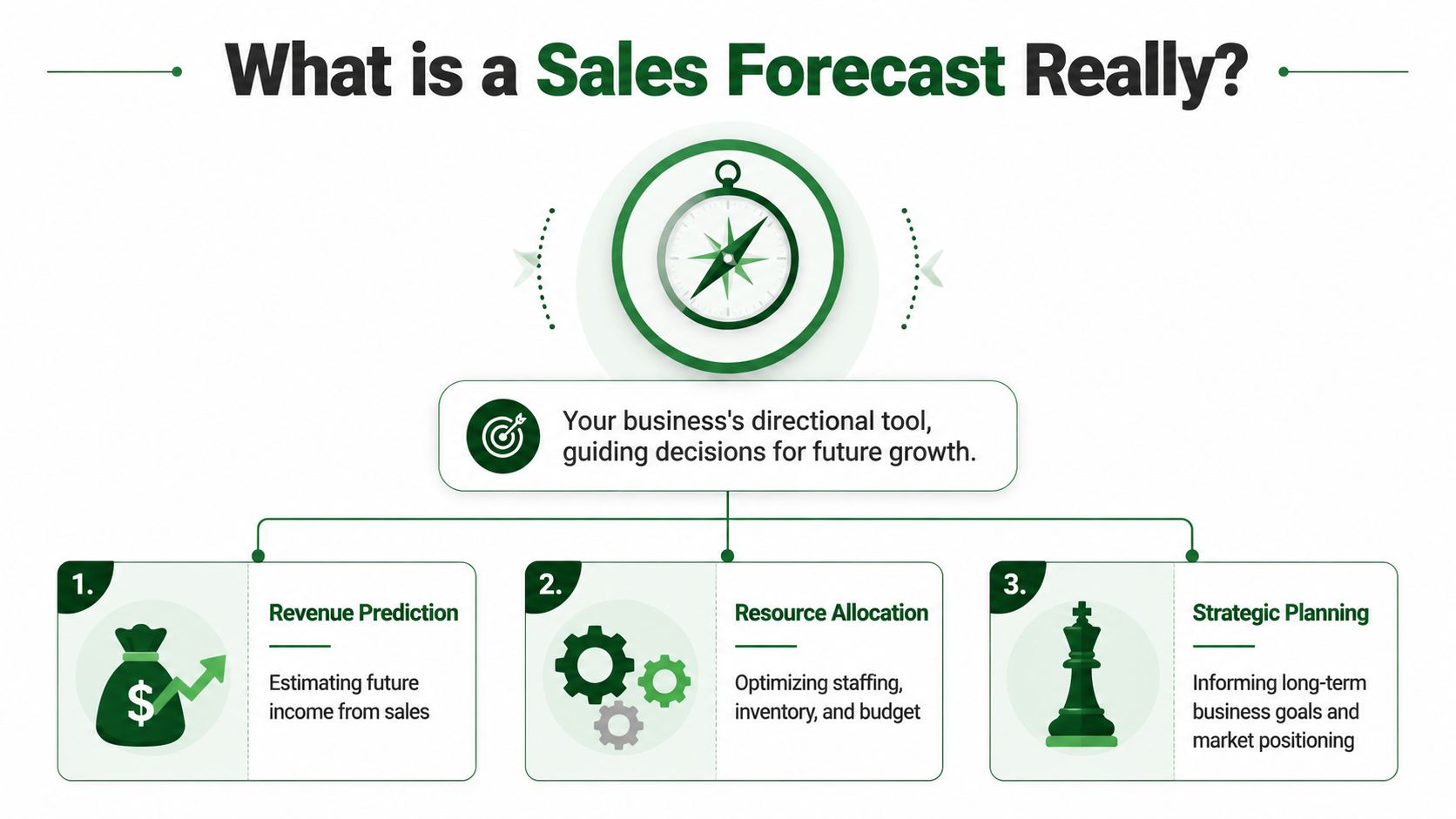
What Is a Sales Forecast Really
A sales forecast is a prediction of future revenue over a defined period using historical sales data, market trends, and pipeline information, and practical guidance recommends collecting at least 12 to 24 months of historical sales data to improve accuracy, especially when seasonality and year-over-year shifts matter, as explained in Outreach's guide to what a sales forecast is.
In practice, it is the number leadership uses to make decisions before the quarter is over.
A manager reviews commit deals on Monday, finance asks for hiring guidance on Tuesday, and the CEO wants to know on Wednesday whether the quarter is still on track. The forecast sits underneath all three conversations. If it is built on weak qualification or inflated pipeline, every downstream decision gets worse.
A sales forecast works as a probability-based view of what the team is likely to close with the evidence available now. It is not a target. It is not a motivational number. It is a planning number.
That distinction matters because new managers often mix up three different things:
| Term | What it means in practice |
|---|---|
| Sales goal | What leadership wants to achieve |
| Sales forecast | What the team is likely to close based on evidence |
| Market demand | What the market may support overall |
Forecasting measures execution quality
In formal planning, sales forecasts estimate the volume of transactions a company expects in a defined period and connect frontline execution to broader business strategy. They should reflect real buying activity inside the pipeline, not just coverage ratios or rep optimism. Demand forecasting tells leaders what the market may support, while sales forecasting measures how much of that opportunity the business can convert into booked revenue, as outlined in Workday's explanation of sales vs demand forecasting.
For RevOps teams, forecast accuracy is often misunderstood. Teams often treat forecasting as a late-stage pipeline exercise. In reality, the forecast starts much earlier, with who gets into the pipeline in the first place.
If outbound reps are adding poorly researched accounts, low-intent contacts, or companies that do not fit the ICP, those records still create stage movement, activity volume, and false confidence. The CRM looks busy. The forecast gets noisier. By the time managers review late-stage deals, the damage was already done at the top of the funnel.
That is why research discipline matters to forecasting, not just prospecting. Better account selection and cleaner qualification criteria produce a pipeline that is worth modeling. Teams trying to tighten that process can study practical outbound and pipeline hygiene examples in the PitchSmart sales execution blog.
What good managers use it for
A useful forecast supports decisions that reach beyond sales meetings:
- Hiring timing
- Territory planning
- Budget pacing
- Campaign expectations
- Capacity and coverage decisions
The best managers use the forecast to pressure-test reality. If demand looks healthy but the forecast keeps slipping, the problem is usually inside execution. Qualification is loose, follow-up is slow, deal progression is inflated, or pipeline creation is coming from the wrong accounts.
A forecast is only as reliable as the pipeline underneath it. Clean data and sound methodology matter, but the first fix is often earlier than teams expect. It starts with better research, better lead selection, and fewer weak opportunities entering the system at all.
Common Sales Forecasting Methods Explained
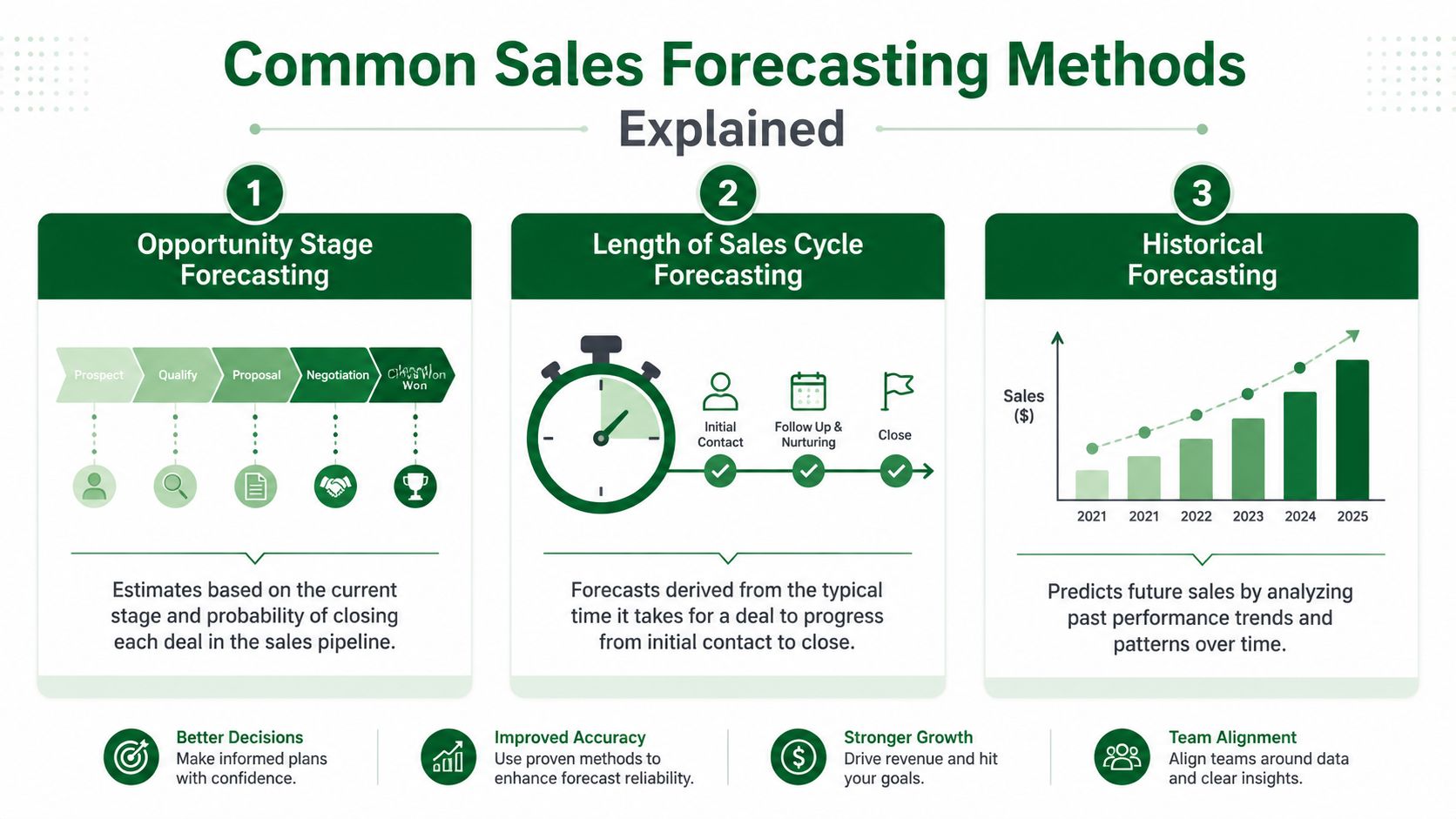
Most B2B teams don't use one pure forecasting method. They blend a few and adjust by segment, sales motion, and deal size.
The technical backbone is straightforward. Stronger forecasts are commonly built from historical data, pipeline stage probabilities, and time-to-close analysis, sometimes supported by regression or trend methods. Teams often assign a probability-to-close by funnel stage, multiply deal value by win likelihood, and then aggregate across the pipeline. More advanced models also analyze average days to close and the historical relationship between variables and outcomes, as described in Creatio's glossary entry on sales forecasting.
Opportunity stage forecasting
This is the most common method in SaaS.
You assign a close probability to each pipeline stage. A deal in discovery gets a low probability. A deal in proposal gets a higher one. The weighted values roll up into a forecast.
What works well
- It's simple enough for managers and reps to understand.
- It maps cleanly to CRM stage structure.
- It gives fast visibility into quarter risk.
What breaks
- Reps move deals forward too early.
- Stage definitions are loose.
- A stale deal in a late stage looks healthier than it is.
If your stages aren't governed tightly, this method becomes a polished version of rep optimism.
Length of sales cycle forecasting
This method focuses less on what stage a deal is in and more on how long deals usually take to close.
That's useful when stage movement is inconsistent across reps or segments. A new opportunity that somehow jumped to demo doesn't automatically deserve late-stage confidence if the average cycle says it's still early.
Best fit: Teams with a consistent process and enough closed-won and closed-lost history to understand timing patterns.
Main trade-off: It's stronger than stage-only forecasting when the CRM is messy, but it still depends on disciplined date tracking.
A practical way to improve this model is to split by inbound, outbound, referral, partner, or segment. Different motions rarely close on the same rhythm.
The walkthrough below is helpful if you want more operational sales workflow guidance beyond forecasting itself. The PitchSmart blog is useful for seeing how research quality, segmentation, and outreach execution affect pipeline shape before forecasting even starts.
A short explainer can help make the differences more concrete:
Historical forecasting
Historical forecasting projects future outcomes from past performance.
If your business is mature, your motion is stable, and your market hasn't shifted much, this can work as a baseline. It's useful for sanity-checking whether the current quarter is tracking above or below normal patterns.
Strengths
- Easy to explain to finance and leadership
- Good for trend baselines
- Helpful for seasonality if enough history exists
Weaknesses
- Weak in changing markets
- Weak for new products or new territories
- Dangerous if past pipeline quality was poor
Historical data is only as trustworthy as the process that created it. Bad qualification repeated over time doesn't become reliable. It becomes institutionalized error.
What experienced teams actually do
The best RevOps teams usually blend methods rather than picking one winner.
| Method | Best use case | Main risk |
|---|---|---|
| Opportunity stage | Fast quarter visibility | Rep bias and stage inflation |
| Sales cycle length | Motions with predictable timing | Bad timestamps and inconsistent entry data |
| Historical | Stable business with strong history | Blindness to change |
If you're deciding where to start, begin with the method your current data can support reliably. The wrong “advanced” model is worse than a simpler model with clean assumptions.
A Step by Step Forecasting Example
Let's make this concrete with a simple weighted pipeline example.
Assume you run a B2B SaaS team and want a near-term forecast using opportunity stage weighting. The logic is basic: list open deals, assign a close probability by stage, multiply each deal value by that probability, then total the weighted amounts.
Sample Opportunity Stage Forecast Calculation
| Deal Name | Deal Value | Sales Stage | Probability (%) | Weighted Forecast Value |
|---|---|---|---|---|
| Northstar CRM | $20,000 | Discovery | 10% | $2,000 |
| BluePeak Systems | $35,000 | Demo | 25% | $8,750 |
| Harbor Analytics | $18,000 | Proposal | 60% | $10,800 |
| Cedar Cloud | $50,000 | Negotiation | 80% | $40,000 |
| Atlas Security | $12,000 | Qualification | 10% | $1,200 |
How to calculate it
Start with agreed stage probabilities. The exact percentages above are illustrative for this example, not benchmark data. What matters is internal consistency. Every manager should use the same stage definitions and the same weighting logic.
Then multiply each deal value by its assigned probability.
- Northstar CRM: $20,000 × 10% = $2,000
- BluePeak Systems: $35,000 × 25% = $8,750
- Harbor Analytics: $18,000 × 60% = $10,800
- Cedar Cloud: $50,000 × 80% = $40,000
- Atlas Security: $12,000 × 10% = $1,200
Add those weighted values together and you get a forecast of $62,750.
Why this helps and where people misuse it
This method is useful because it forces you to separate raw pipeline from probable revenue. A pipeline total looks impressive. A weighted pipeline is closer to reality.
But managers often make a mistake. They treat the math as objective when the inputs are subjective.
If BluePeak Systems is marked as “Demo” but the rep still hasn't identified a decision-maker, the stage may be wrong. If Cedar Cloud is in “Negotiation” but legal hasn't engaged and the buyer went quiet, the probability may be inflated.
The spreadsheet isn't the model. The model is the discipline behind stage entry, exit criteria, and inspection.
A good forecast review doesn't just ask, “What's the number?” It asks, “Why does this deal deserve this probability?”
Why Most Forecasts Fail The Garbage In Garbage Out Problem
Monday morning forecast call. The dashboard shows healthy pipeline coverage, but half the deals were created from accounts nobody researched properly, contacts with weak fit, and meetings booked off generic outreach. By the time that pipeline reaches a manager, the forecast is already off.
Forecast problems usually start before stage weighting, commit calls, or end-of-quarter inspection. They start when low-intent leads enter the CRM and get treated like real opportunities.
Forecasting breaks at the top of funnel first
A lot of teams try to fix forecast accuracy at the bottom of the funnel. They tighten close dates, reclassify stages, and pressure reps for cleaner commit numbers. That helps, but it misses the earlier failure point.
If an SDR starts with a weak account list, rushed research, and shallow personalization, the team creates opportunities that look active without being properly qualified. Those deals carry bad assumptions from day one. Later-stage forecasting gives those assumptions a cleaner spreadsheet veneer.
That is the root issue behind the garbage in, garbage out problem. Forecasts inherit whatever standard the team uses for pipeline entry.
How weak outbound research contaminates forecast data
Poor research does more than lower response quality. It distorts the inputs managers rely on.
- Accounts enter too early: A meeting gets logged before anyone confirms fit, urgency, or buying context.
- Segments get mixed together: High-converting accounts and low-fit accounts end up in the same funnel, which muddies conversion assumptions.
- Activity gets mistaken for intent: Replies and booked calls look promising, even when there is no clear business pain or project motion.
- Source quality disappears: Managers cannot tell whether pipeline came from real signals, careful research, or pure volume.
I see this often with outbound teams that optimize for meetings booked. The calendar fills up, the CRM fills up, and forecast confidence diminishes because the underlying opportunities were never strong enough to model reliably.
Historical conversion data can preserve bad habits
Teams often assume more historical data automatically improves forecasting. It only helps if the process behind that data was sound.
If the last four quarters were full of loosely qualified outbound opportunities, your conversion rates may be teaching the wrong lesson. The model will reflect a pipeline creation problem, not just buyer behavior. Clean math on dirty pipeline still produces unreliable forecasts.
Better forecasts usually start with fewer, better-researched opportunities.
That trade-off matters. A smaller pipeline with clear fit, clear trigger, and documented buying context is easier to forecast than a larger pipeline built on weak qualification.
What actually improves forecast reliability
When I coach a new sales manager, I start upstream. Before debating probabilities, inspect how opportunities are allowed into the funnel in the first place.
Teams using a research workflow like PitchSmart have an advantage here because they can standardize the account context captured before outreach starts. That improves messaging, but its greater impact lies in improving the trustworthiness of pipeline data later.
Use questions like these during pipeline inspection:
| Question | Why it matters |
|---|---|
| Why did this account enter the pipeline? | Confirms there was a real trigger, not just outbound activity |
| What was researched before outreach? | Shows whether the team understood fit, context, and likely pain points |
| What segment does this belong to? | Keeps conversion expectations tied to the right buyer group |
| What buying signal existed at entry? | Separates curiosity from actual timing |
If those answers are weak, the forecast is weak. If those answers are consistent, even a simple forecasting method becomes much more dependable.
Key Forecasting KPIs and Pitfalls to Avoid
Many teams track the headline number and stop there. That's not enough.
A forecast is a system. You need to know whether it's accurate, whether it's biased, and whether it's getting worse. Broader forecasting guidance recommends evaluating accuracy with explicit error measures such as Mean Percent Error, Root Mean Squared Error, Tracking Signal, and Forecast Bias, a gap that many sales-focused explainers ignore, as noted in the demand forecasting reference on forecasting error metrics.
The KPIs worth watching
You don't need a huge analytics stack to improve forecast management. You do need a few consistent review lenses.
- Forecast accuracy: Compare forecasted outcomes to actual results over time.
- Forecast bias: Check whether the team tends to be systematically high or low.
- Pipeline coverage: Understand whether open pipeline supports the target realistically.
- Quota attainment: Compare team performance against assigned goals, not just forecast confidence.
The first two are where mature teams separate themselves. Missing high one month and low the next is one problem. Missing high repeatedly means your process has optimism baked in.
Behavioral pitfalls that quietly wreck forecasts
Some forecast issues are mathematical. Most are human.
- Happy ears: Reps hear interest and log certainty.
- Sandbagging: Managers keep numbers conservative to outperform later.
- Stage inflation: Deals move forward because activity happened, not because buying progress happened.
- Single-model dependency: One method becomes “the answer” even when conditions change.
A weekly review should challenge assumptions, not just collect updates.
If every forecast revision is explained by “timing slipped,” you probably don't have a timing problem. You have a qualification or stage-definition problem.
A better review rhythm
Strong review calls usually include three layers:
- Deal inspection for critical opportunities
- Metric inspection for bias and error pattern
- Input inspection for CRM hygiene and stage discipline
That last layer keeps the team honest. Forecasts don't deteriorate suddenly. The input quality starts slipping, then the number follows.
Your Action Plan for Accurate Forecasting
If your current forecast feels fragile, don't start by rebuilding the spreadsheet. Fix the operating inputs.
Audit how opportunities enter the pipeline
Look at a recent set of new opportunities and ask basic questions. Was the account researched? Was there a visible trigger, business context, or buying signal? Did the rep understand the segment and likely use case before the first message went out?
If you can't answer those questions quickly, your forecast problem starts before stage one.
Standardize one method and one review cadence
Pick a forecasting method your data can support. Define stage entry and exit criteria clearly. Run the same inspection rhythm every week so managers challenge assumptions the same way across the team.
Consistency beats sophistication when the process is still immature.
Improve top-of-funnel data quality
The forecast becomes more reliable when the pipeline becomes more selective. Better account research, cleaner segmentation, and stronger qualification create opportunities that deserve to be modeled.
If you want to tighten that workflow from the first touch through pipeline creation, start with PitchSmart. The win isn't just faster prospecting. It's a cleaner revenue engine, because better-researched outbound creates better opportunities, and better opportunities create better forecasts.
Frequently Asked Questions About Sales Forecasting
What's the difference between a sales forecast and a sales goal
A sales goal is the target leadership wants the team to hit. A sales forecast is the evidence-based estimate of what the team is likely to close. Good managers keep those separate. If you blend them, the forecast turns aspirational and loses planning value.
How often should a sales forecast be updated
For high-velocity sales motions, weekly updates usually make sense. For enterprise motions, monthly or structured weekly-inspection-plus-monthly-rollup can work better. The right cadence depends on deal velocity, pipeline volatility, and how quickly key assumptions change.
How do you forecast a new product with limited data
This is one of the hardest scenarios. In low-data situations such as new products, new markets, or rapidly changing demand, mainstream guidance often breaks down. One source notes that for new products forecasting becomes an “educated guess,” and recommends building a range of outcomes rather than a single number, as discussed in Salesloft's sales forecasting guide.
In practice, that means using scenario bands, comparable segments, and direct pipeline evidence instead of pretending certainty exists.
What's the biggest forecasting mistake new managers make
Trusting CRM stage labels too much. A late-stage deal with weak qualification is still weak. Stage names don't create deal quality. Process does.
A forecast is only as good as the read on the period behind it. Price volume mix analysis tells you whether the base you are forecasting from grew on price, on volume, or on mix, which are three different things to repeat.
If your team is still building forecasts on top of rushed manual research, generic outreach, and weak qualification, fix that first. PitchSmart helps outbound teams research accounts in bulk, surface activity-based conversation hooks, segment lists by buying signals, and generate automated multi-step email and LinkedIn sequences from the strongest angles. That gives reps more time for real selling and gives managers a cleaner pipeline to forecast from. Start with the free trial and see what happens when better inputs reach your CRM from day one.