In business, ICP stands for Ideal Customer Profile. It defines the kind of company most likely to buy, succeed with, and keep getting value from your product, which is different from the individual buyer inside that company.
That sounds basic until you look at how most outbound teams work. Reps spend more time hunting for fit than selling, and weak targeting turns every cold email into a guess. If you want to know what does ICP stand for in business, the useful answer isn't just the acronym. It's the operating system behind better lists, sharper messaging, and fewer wasted hours on companies that were never a fit in the first place.
For SDRs, BDRs, and RevOps teams, that's the issue. A blurry ICP creates bloated lists, generic messaging, and low-quality meetings. A sharp ICP cuts all three.
The High Cost of Unfocused Outbound Sales
Most outbound problems start before the first email goes out. They start with a bad list.
Sales reps allocate only 35.2% of their time to actual selling activities, while 64.8% goes to non-selling work like research, admin, and list-building. In a standard work week, that works out to roughly 25.9 hours on work that doesn't directly move deals forward, according to Convex's breakdown of the sales productivity problem.
That's the bleeding neck. Not copy. Not subject lines. Not whether the sequence should be three steps or five. The problem is that teams are burning their best hours on account selection, tab-juggling, manual qualification, and patchy personalization.
What bad targeting looks like in the real world
A weak outbound motion usually has the same symptoms:
- Lists are too broad. Reps pull “SaaS companies in North America” and call it targeting.
- Research is one-by-one. Every prospect requires LinkedIn, company site, job board, news search, and CRM cleanup.
- Emails sound personalized but aren't relevant. A line about a recent post doesn't fix poor account fit.
- Meetings don't convert. Even when a rep gets a reply, the account often lacks the right pain, budget shape, growth stage, or operating environment.
Practical rule: If reps need to “figure out fit” account by account after the list is already built, the team doesn't have a usable ICP.
This is why the acronym matters. Ideal Customer Profile isn't branding language. It's the filter that decides who deserves research time, who gets sequenced, and who should be disqualified before a rep touches the account.
Why the ICP comes first
A sharp ICP gives outbound structure. It tells the team which companies belong in the queue based on company-level fit, not gut feel. It also gives RevOps a standard for segmentation, scoring, routing, and list QA.
Without that, teams default to volume. And volume without fit just creates more research work, more generic emails, and more false positives in pipeline.
ICP Explained The Blueprint for Your Perfect Customer
An Ideal Customer Profile is a company-level definition of the businesses most likely to get strong value from your product. It's built from concrete attributes like industry, company size, revenue profile, technology stack, pain points, and buying triggers. The core idea is simple: stop targeting any company that could buy, and focus on the companies most likely to buy and succeed.
That distinction matters because the ICP isn't about a person. It's about the account.
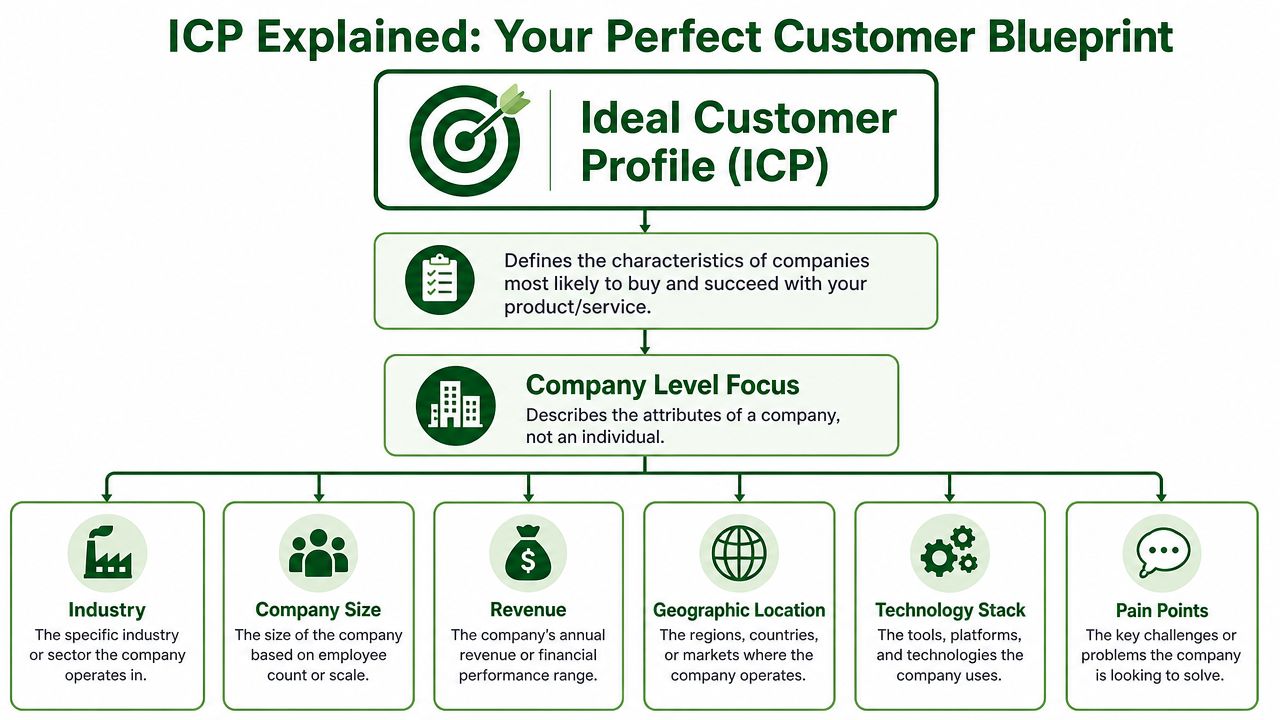
ICP works at the account level
A proper ICP uses firmographic, technographic, behavioral, and pain-point data to define best-fit companies. NanoGlobals' ICP glossary describes it as a company-level framework that helps teams focus on accounts with high lifetime value, low churn, and lower support burden, rather than just anyone who looks reachable.
That's why the question “what does ICP stand for in business” needs a practical answer. It stands for the company blueprint your go-to-market team uses to decide where effort goes.
The biggest confusion is between ICP and buyer persona. They work together, but they aren't interchangeable. Datadab's explanation of ICP meaning notes that this confusion causes 60% of SDRs to waste time prospecting firms that match broad demographics but don't have the pain points or buying triggers needed for conversion.
ICP vs Buyer Persona At a Glance
| Attribute | Ideal Customer Profile (ICP) | Buyer Persona |
|---|---|---|
| Scope | Company | Individual |
| Focus | Account fit | Message fit |
| Questions answered | Should we target this company? | Who inside the company should we speak to, and how? |
| Data used | Industry, company size, revenue, tech stack, operating model, buying signals | Job title, goals, objections, priorities, decision role |
| Main owner | RevOps, sales leadership, marketing leadership | Sales enablement, marketing, sales |
| Output | Target account criteria | Persona-specific messaging and talk tracks |
| Wrong use case | Personalizing outreach to one stakeholder | Building target account lists |
A team with personas but no ICP can write polished emails to the wrong companies.
That's why account selection comes first. If the company isn't a fit, better personalization won't rescue the campaign. It just makes wasted effort sound more polished.
Why a Razor-Sharp ICP Is Your Best Sales Weapon
Teams with a defined ICP outperform teams that chase broad segments. Salesforce's write-up on ideal customer profiles cites benchmark data showing higher win rates and faster time-to-value when teams quantify who they should target.
That improvement shows up in daily execution, not just in a dashboard.
A sharp ICP gives SDRs permission to ignore accounts that look busy but rarely buy. It gives AEs a cleaner pipeline because first meetings start with companies that already match the product's strongest use case. It gives RevOps a standard for routing, scoring, territory design, and list building. Without that standard, every rep builds a private definition of a good account, and pipeline quality gets noisy fast.
Precision improves throughput
More volume does not fix weak targeting. It usually hides it for a few weeks, then the team pays for it in low reply rates, weak discovery calls, and deals that stall after interest fades.
A clear ICP improves three operating points at once:
- Prospecting quality. Reps start with accounts that match the conditions where the product wins.
- Message relevance. Outreach connects to actual business pain, buying triggers, and urgency.
- Team alignment. Sales, marketing, customer success, and product use the same definition of fit instead of debating it account by account.
The biggest gain is productivity. Reps spend less time clicking through random company pages, guessing at fit, and hand-building lists that never convert. If your team wants a practical model for reducing manual prospecting work, the PitchSmart RevOps and outbound workflow articles are useful for seeing how tighter targeting connects to automation.
A good ICP protects pipeline quality
The benefit goes beyond booking meetings.
Managers can coach against fit instead of praising raw activity. RevOps can score accounts based on criteria that correlate with conversion. Marketing can stop sending SDRs companies that download content but never had a realistic path to purchase. Customer success can flag a pattern sales teams often miss early: some accounts close quickly, then churn because they were easy to excite and hard to support.
If the accounts that renew and expand look different from the accounts your team is prospecting, the problem is targeting, not effort.
Strong ICPs also force trade-offs. They rule out attractive edge cases. They cut down logo chasing. They expose whether the team is selling where the product is strongest today or where leadership hopes it will be six months from now.
That is why I treat ICP work as core revenue infrastructure. Once the criteria are clear, you can automate list building, account scoring, enrichment, and routing. Until then, automation only helps your team do unfocused work faster.
How to Build Your B2B Ideal Customer Profile Step-by-Step
Teams usually miss on ICP work for one simple reason. They start with opinions instead of customer evidence.
A useful ICP comes from accounts that closed, adopted, renewed, and expanded with less friction than the rest. If you build it from a whiteboard session, you get a wish list. If you build it from revenue data and post-sale reality, you get targeting criteria your SDRs can use.
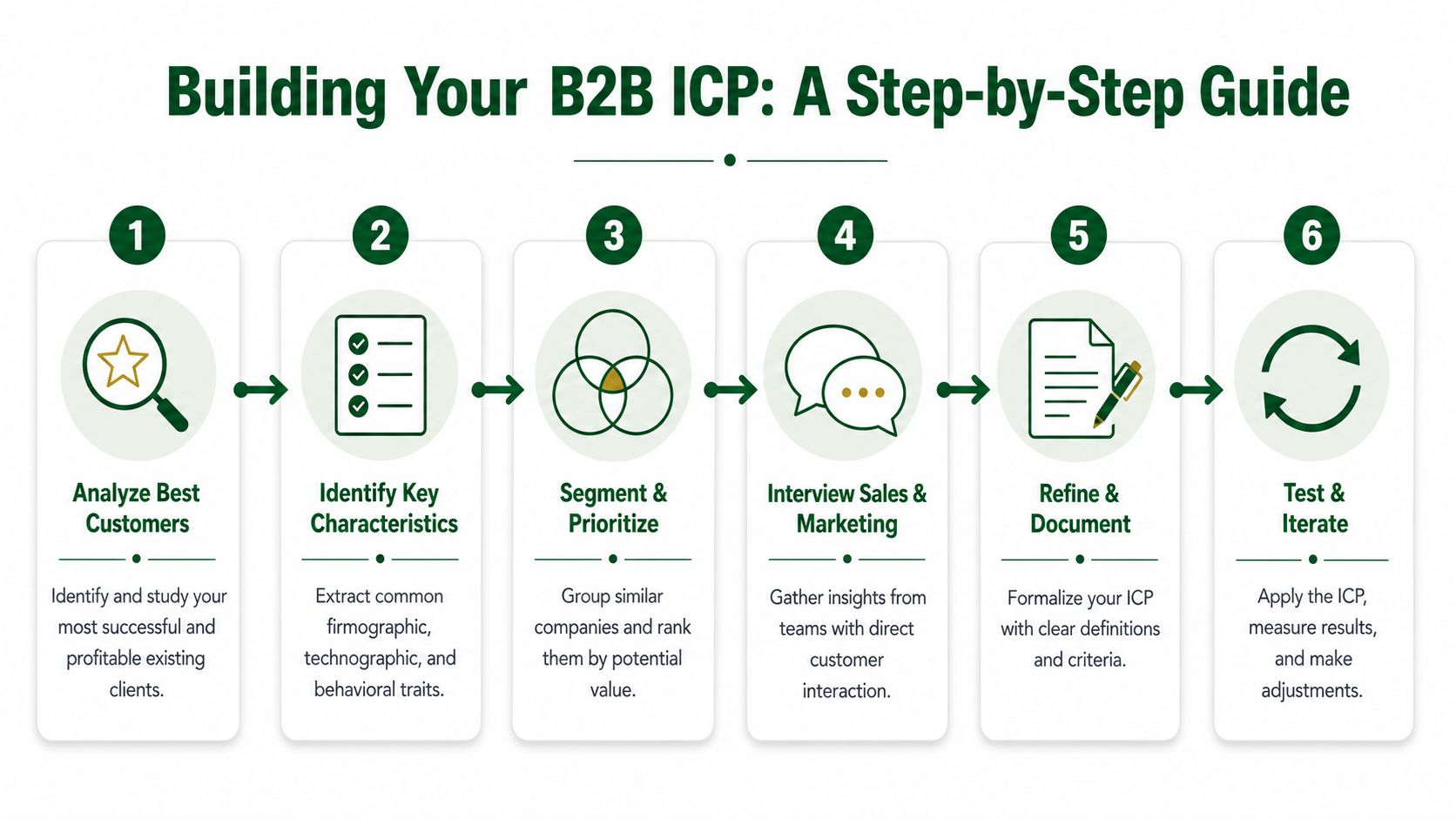
Start with your best customers
Begin with a clean sample of accounts that produced good revenue, low friction, and clear product value. Skip vanity picks. A big logo that demanded custom work, stalled onboarding, and churned after a year should not shape your ICP.
Look at the accounts that hit value quickly, renewed on time, and gave sales, success, and support fewer problems. For early-stage teams, use the customers who needed the least hand-holding and understood the product fast.
Review four sources together:
- CRM data for deal size, sales cycle, source, and stage history
- Call notes and recordings for stated pain, urgency, and buying language
- Onboarding records for time-to-value and implementation effort
- Customer success data for renewal health, expansion, and support load
Then ask the questions that matter in the field:
- Who gets value fastest
- Who renews with less friction
- Who is easiest to expand
- Who had a clear operational problem before buying
- Who would hurt the business if they churned
That group gives you the baseline. Everything else is noise until proven otherwise.
For teams building repeatable outbound around this process, the PitchSmart blog on RevOps and outbound workflows shows how teams turn ICP criteria into day-to-day execution.
A short walkthrough can help if your team wants a visual overview before documenting the profile:
Pull out the traits that repeat
Once the sample is right, look for patterns that show up often enough to guide prospecting.
Start with firmographics. Then move into the operating details that reps usually research by hand. Consequently, a weak ICP wastes hours. If your profile only says "mid-market SaaS," reps still have to open ten tabs to decide whether an account is real fit. A better ICP includes traits you can score, enrich, and route automatically.
Focus on repeatable clusters such as:
- Firmographics such as industry, employee range, revenue band, geography, and business model
- Technographics such as CRM, ERP, warehouse, or adjacent tools already in place
- Operating context such as SDR headcount, sales leadership, RevOps support, or outbound maturity
- Growth signals such as hiring activity, new leadership, territory expansion, or category movement
Separate hard requirements from supporting signals. If employee count and sales motion are true fit criteria, mark them as required. If a certain tech stack improves conversion but is not mandatory, treat it as a positive signal instead of a gate.
That distinction matters. It keeps your team from filtering out good accounts and keeps automation rules from becoming too rigid.
Capture pain points and buying triggers
Often, many ICPs get vague and stop being useful.
"Needs pipeline" is not a usable pain point. It does not help an SDR write a first line, qualify an account, or prioritize one prospect over another. Strong ICP pain is specific, observable, and tied to how the company operates.
It usually sounds more like this:
- Their reps are doing one-by-one research before first touch
- They struggle to keep messaging quality high across large prospect lists
- They have data on accounts, but no clear way to spot active buying signals
- Their outbound workflow depends on manual copy-paste across tools and tabs
Then define the triggers that tell your team the pain is active now. Recent hiring, a new sales leader, tool changes, expansion into a new segment, or visible outbound hiring can all signal timing.
Good ICPs do two jobs at once. They tell reps who fits, and they tell reps why the account is likely to care right now.
Turn it into a one-page operating document
Keep the final version short enough for an SDR to use during list review and clear enough for RevOps to translate into rules.
A practical ICP document usually includes:
| Section | What to include |
|---|---|
| Core fit | Industry, size, revenue shape, geography, business model |
| Tech environment | Systems or tools commonly present in best-fit accounts |
| Pain points | Operational problems your product solves well |
| Buying triggers | Observable signals that suggest urgency or readiness |
| Negative ICP | Accounts you should disqualify quickly |
| Messaging notes | The business outcomes and hooks most likely to resonate |
If the document runs long, reps stop using it. If the criteria are vague, every rep interprets fit differently. The best version is tight, specific, and easy to operationalize in enrichment, scoring, routing, and list building.
That is the standard to aim for. An ICP should reduce manual research, not create another document people ignore.
From Theory to Pipeline How to Operationalize Your ICP
Teams often fail after they finish the document. The profile exists, but the workflow doesn't.
An SDR gets a list, opens LinkedIn, checks the website, scans job posts, reviews recent activity, and tries to decide whether the account matches the profile. Then they repeat that process dozens of times. SalesMotion's analysis of sales time management notes that manual account research can take 1 to 3 hours per account, and across a weekly prospect list that can consume 15 to 20 hours per rep.
That's where the ICP gets stuck as theory instead of becoming a pipeline tool.
Manual ICP application breaks at scale
The manual version usually looks like this:
- List first, logic later. Someone exports a broad segment from CRM or Sales Navigator.
- Rep-level qualification. Each rep decides fit using their own judgment.
- Inconsistent research depth. Strong reps go deep. Busy reps skim.
- Weak handoff into outreach. Insights live in notes, not in the sequence itself.
That process creates three problems. It burns time. It lowers consistency. And it makes reporting almost useless because every rep is effectively using a different ICP in practice.
What operationalization looks like
A usable outbound system applies ICP criteria before the rep starts writing. It should help the team:
- Segment lists by fit and signal strength so not every account gets the same treatment.
- Surface current business signals that can become email and LinkedIn hooks.
- Standardize qualification logic across the team.
- Generate a conversation plan that sales can use immediately.
Modern outbound tools are essential. Bulk research, customizable account qualification, and signal-based sequencing solve the actual bottleneck. Instead of researching one account at a time, teams can evaluate an entire list against ICP criteria in parallel, then build outreach around the strongest signals.
Tools built for this workflow are most useful when they support:
- Bulk, customizable lead research across uploaded lists or CRM pulls
- Activity-based conversational hooks grounded in recent online signals
- Automated three-step email and LinkedIn sequences seeded from those hooks
- Advanced segmentation based on buying signals, fit markers, and priority tiers
If you're evaluating what this looks like commercially, PitchSmart pricing shows the kind of packaging teams usually compare when deciding whether to keep manual research in-house or automate it.
Good operationalization means reps spend their time responding to fit and signal, not hunting for them.
That's the difference between having an ICP and running an ICP-driven outbound engine.
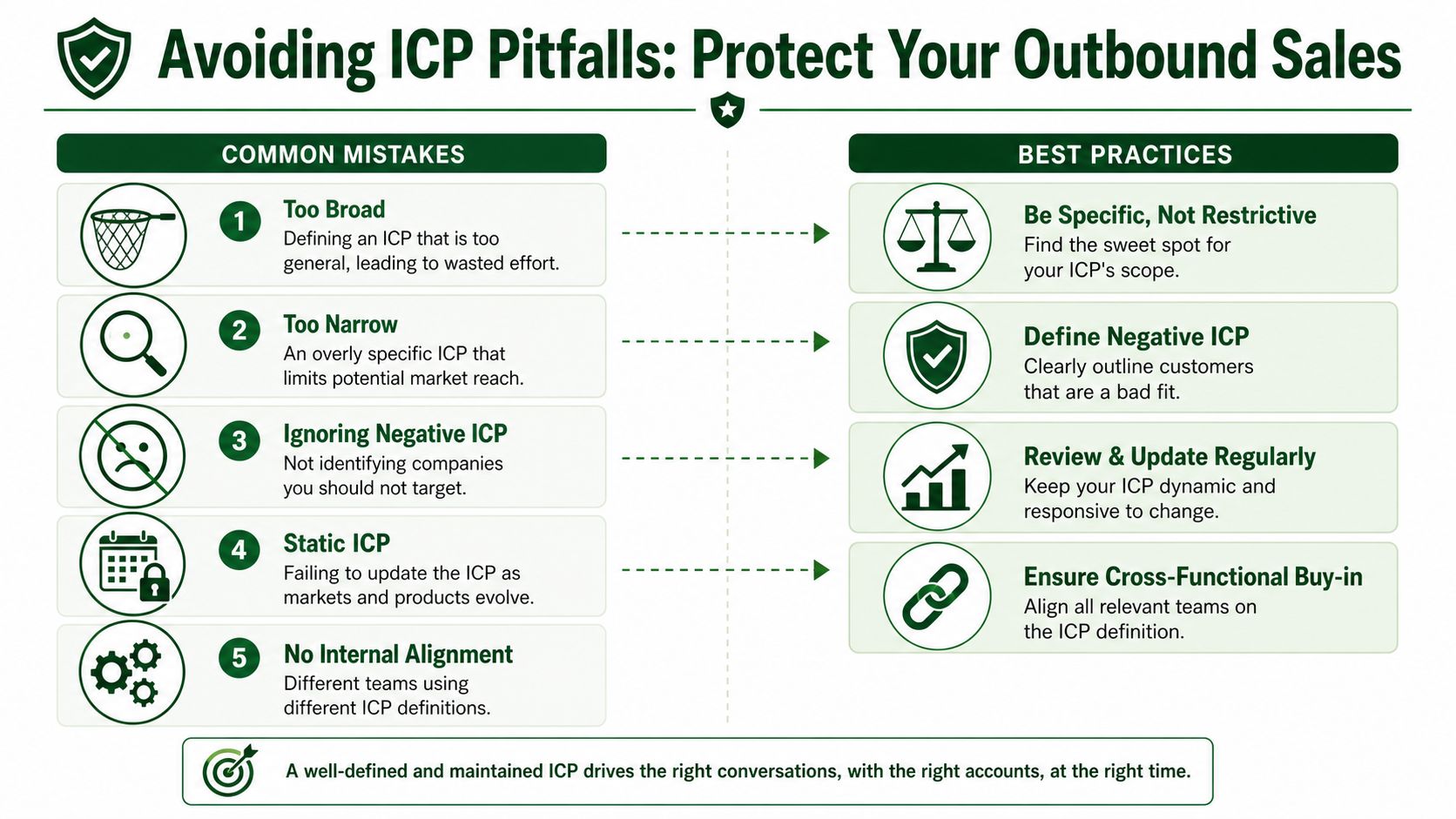
Common ICP Mistakes That Sabotage Outbound Sales
Bad ICPs usually don't fail because nobody tried. They fail because the team made the profile too generic, too rigid, or too isolated from real pipeline outcomes.
Broad isn't better
“All SaaS companies” isn't an ICP. Neither is “B2B companies with a sales team.”
Those are markets, not profiles. A useful ICP narrows the field based on evidence. If your definition is so broad that almost any company qualifies, your reps still have to do manual filtering downstream. You haven't removed work. You've relocated it.
Common examples of broad thinking:
- Category-only targeting without size, stage, or operational context
- Persona-led targeting before account fit is clear
- Ignoring negative ICP so obviously bad-fit accounts still reach sequences
Static ICPs go stale fast
A lot of teams build the profile once, save it in a deck, and never revisit it. That's a mistake.
Apollo's article on ICP meaning in sales reports that 72% of winning sales teams refresh their ICP quarterly using retention and expansion data, and that practice correlates with a 35% increase in pipeline velocity. The point isn't just the cadence. It's the discipline of updating the profile based on what the business is learning now.
Your best-fit customer can shift when pricing changes, product maturity changes, or the market starts rewarding a different use case.
Alignment matters as much as accuracy
An ICP built by one function in isolation rarely survives first contact with outbound reality.
If RevOps owns scoring, sales owns outreach, marketing owns segmentation, and customer success sees the strongest retention patterns, all four groups need a shared definition. Otherwise each team applies different standards and the profile fractures in execution.
A living ICP is only useful if the team uses the same version in lists, routing, messaging, and qualification.
The fix is straightforward. Keep the document short. Review it on a schedule. Compare it against retention, expansion, and disqualification patterns. Then update the operating rules, not just the slide.
Stop Searching Start Selling with a Smarter ICP
If you asked only “what does ICP stand for in business,” the simple answer is Ideal Customer Profile. The more useful answer is that it's the control system for outbound quality.
A sharp ICP tells your team which companies deserve time, which signals matter, and which accounts should never enter the queue. That's how you reduce wasted research, tighten targeting, and give SDRs a realistic path to quota. Without it, reps keep doing one-by-one investigation and writing “personalized” emails to accounts that were wrong from the start.
Manual prospecting breaks because it asks reps to be researchers, analysts, list builders, and copywriters before they get to sell. The better model is to define fit clearly, apply it consistently, and build outreach on live signals instead of guesswork.
For teams that want to move from theory to execution, the right platform isn't a nice-to-have. It's how the ICP becomes real in day-to-day outbound. You can see that shift in action on the PitchSmart homepage.
PitchSmart helps outbound teams turn a static ICP into a working prospecting system. Upload your list, research accounts in bulk, surface signal-backed hooks, and launch customized email and LinkedIn sequences without the usual tab-juggling and copy-paste. If your reps are still spending their best hours figuring out who to contact and what to say, try PitchSmart and give them those hours back.