Most articles answering what lead scoring is start in the wrong place. They start with marketing automation, website visits, and email engagement. That's useful if buyers are already raising their hands. It's not useful when your SDR team is staring at a CSV, building lists manually, and sending cold outreach to accounts that haven't touched your site.
The productivity problem is more significant than often realized. Sales representatives spend 70% of their time on non-selling tasks such as logging next steps, updating fields, and data entry, leaving only 30% of their work week dedicated to actual revenue generation, according to Salesforce's State of Sales Report summarized here. If reps already have limited selling time, wasting it on poorly prioritized accounts is expensive. Generic, unresearched cold emails only make it worse.
For outbound teams, lead scoring isn't a marketing exercise. It's a triage system for deciding who deserves research, who deserves personalized outreach, and who should stay out of sequence until the data changes. The teams that get this right stop treating every name on a list as equally valuable.
Why Your Sales Team Is Drowning And How to Fix It
Pipeline coverage often looks healthy on paper right before rep productivity falls apart. The reason is simple. A full list is not the same as a workable list.
Most sales managers are not dealing with an effort problem. They are dealing with a ranking problem. Reps are touching too many accounts with too little reason to believe those accounts deserve the time. In outbound, that usually happens because the team is working from static lists with limited intent data, so every name starts to look equally urgent.
The result is predictable. Reps spend hours checking company pages, scanning LinkedIn, verifying titles, and deciding whether an account is even worth a first message. That work feels responsible, but it slows pipeline creation and makes good reps look average.
Busy work is usually a systems failure
I see this in outbound teams all the time. Leadership asks for more activity, reps get larger lists, and managers wonder why meetings do not rise with volume. The bottleneck is not effort. The bottleneck is that the team has no shared way to separate strong-fit prospects from background noise before work starts.
Practical rule: If every account gets the same research depth and the same sequence, your team is not prioritizing. Your team is guessing at scale.
Lead scoring gains importance for outbound. Not as a marketing exercise, and not as a model built around page visits or ebook downloads. For B2B outbound teams, the first job of scoring is to rank cold prospects by fit so reps spend time where pipeline is most likely to come from.
Focus is the fix.
A useful score gives managers a way to direct effort toward accounts that match the ICP, contacts with buying relevance, and segments that have a real chance to convert. Low-fit accounts can still be worked later. They just should not consume prime rep time.
That changes the day-to-day work quickly:
- Research effort drops: Reps stop rebuilding the same account judgment from scratch.
- Outbound quality improves: High-fit accounts get tighter messaging and better personalization.
- Rep time gets protected: Fast follow-up goes to the prospects most likely to justify it.
Teams that clean this up usually end up building the same capability found in tools like PitchSmart's outbound research workflow. The goal is not bigger lists. The goal is better decisions before the first touch.
What Is Lead Scoring for Outbound Teams
At its simplest, lead scoring is a method for assigning value to prospects so the team can decide who to work first.
The easiest way to think about it is triage. In an emergency room, staff don't treat people in random order. They assess urgency and fit for care, then prioritize accordingly. Outbound sales should work the same way. You don't want reps spending the same time on a weak-fit account as a company that looks like a real buyer.
The standard definition breaks for outbound
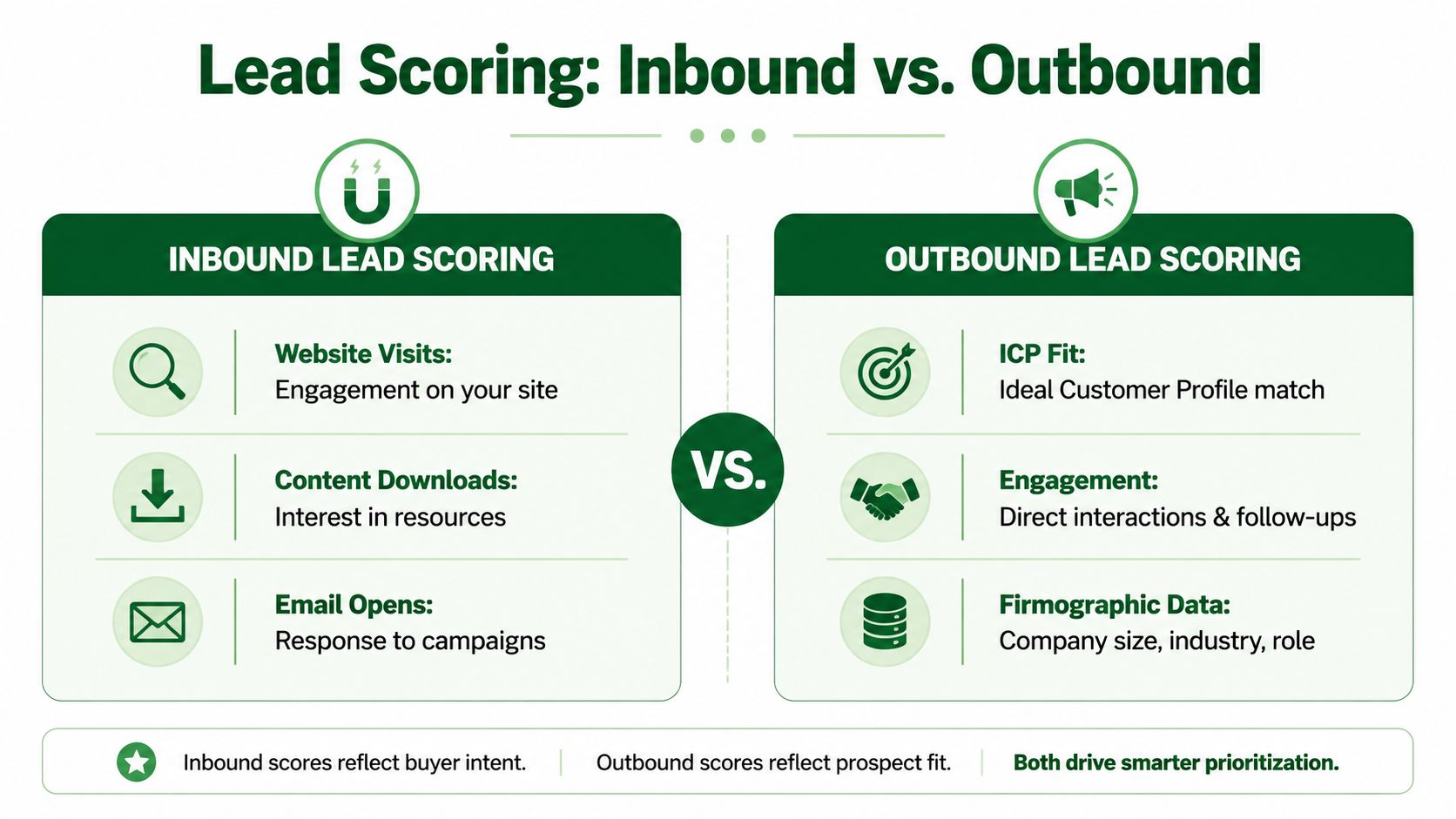
Most lead scoring content assumes the lead has already interacted with your business. It assumes you can watch for pricing page visits, content downloads, email clicks, or form fills. That works for inbound programs with a functioning demand engine.
Outbound teams often don't have that luxury.
An SDR working a static prospect list usually starts with names, companies, titles, and whatever firmographic data is available. There may be no website behavior at all. No meaningful email history. No on-site engagement. In that environment, classic inbound scoring models become weak because they depend on signals cold prospects haven't produced.
Outbound scoring is mostly about fit first
For outbound, the practical question isn't “who clicked?” It's “who looks like the right account before they click anything?”
That changes the model. You score for fit. Then you layer in whatever useful signals you can find, such as role relevance, company attributes, visible business changes, or activity that gives a rep a reason to start a conversation.
A working outbound score usually answers questions like these:
- Account fit: Is this company in the right industry, segment, geography, or operating environment?
- Role fit: Is this contact close enough to the problem to care?
- Trigger relevance: Is anything happening that makes the outreach timely?
- Disqualification risk: Is there a reason this account should drop in priority?
Good outbound scoring doesn't predict intent with perfect certainty. It reduces wasted effort and improves the odds that a rep starts in the right place.
That's why the best outbound teams don't obsess over scoring as a theoretical number. They use scoring to rank list quality, shape messaging, and decide where personalization is worth the time.
The Anatomy of a High-Impact Outbound Score
Outbound scoring works best when it reflects the reality of how reps prospect. Early in the cycle, the strongest signal usually is not behavior. It is whether the account belongs on the list at all.
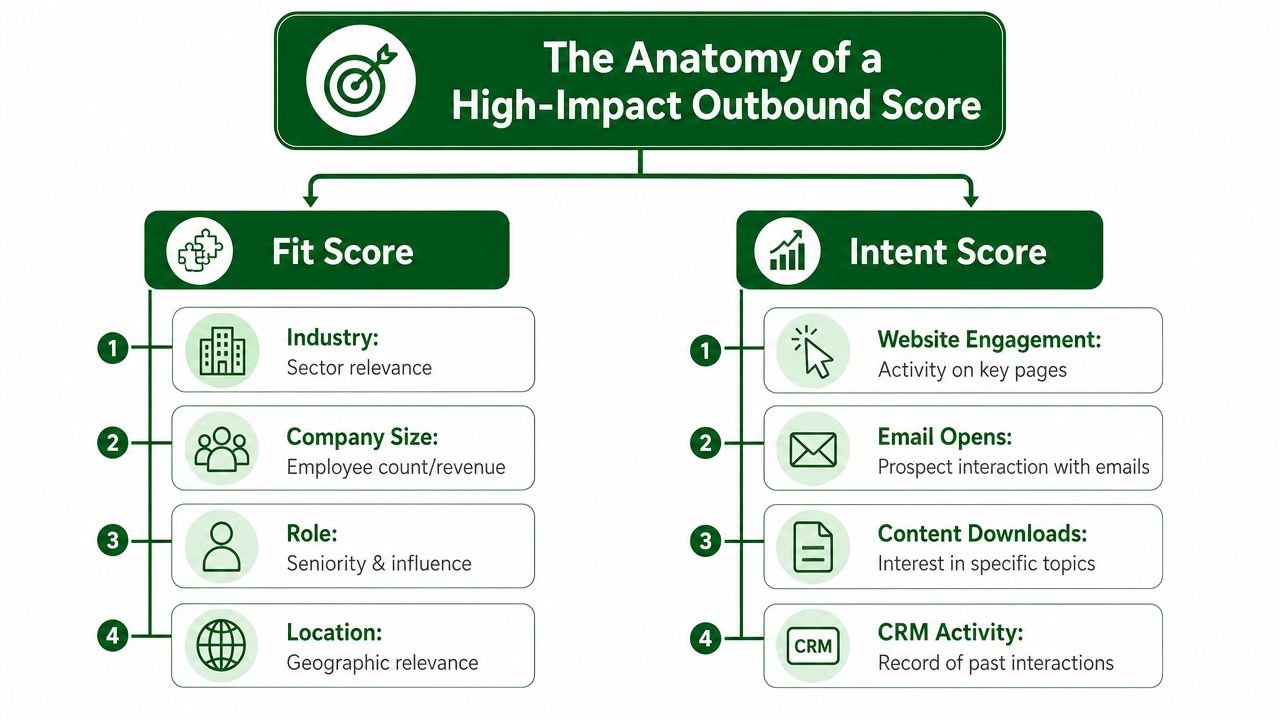
For B2B teams working static prospect lists, a high-impact score has two components. Fit and intent. The difference is how much weight each one carries. In outbound, fit usually does most of the work at the start, because many prospects have not visited your site, opened an email, or taken any trackable action yet.
Fit carries the model in outbound
A rep with a named-account list needs a fast answer to one question. Is this account worth time from a seller who already has too many names to work?
That is why fit should sit at the center of the model. If the company falls outside your market, the contact sits too far from the problem, or the account is in a segment your team rarely closes, no amount of forced scoring logic will turn it into a good prospect.
A strong fit score usually includes a few practical layers:
- Industry relevance: Some industries feel the problem more sharply, buy with less education, or match your proof points better.
- Company size: The best range is rarely "bigger is better." Smaller companies may lack budget or process. Larger ones may require a sales motion your team is not built to run.
- Role and seniority: Title alone is a weak shortcut. Ownership matters more. A director inside the right function often matters more than a VP outside it.
- Geography and territory: Coverage, language, compliance, and serviceability all affect whether the opportunity is real.
- Operating context: Hiring, expansion, leadership changes, funding, new product launches, or stack clues can raise or lower priority.
Many scoring models frequently fail in practice. They reward surface-level attributes because these are easy to collect, causing reps to waste time on accounts that look good in a spreadsheet and go nowhere in sequence.
Intent still matters, but it enters later
Intent belongs in an outbound model. It just should not dominate before the prospect has done anything visible.
For cold outbound, early intent often comes from weaker external clues. A public initiative, a new executive hire, active expansion, or a visible systems change can give a rep a timely angle. Those signals are useful, but they are not the same as a demo request or repeat pricing-page visits. Treating them as equal usually inflates scores and creates false confidence.
The practical weighting rule is simple. Start with fit. Add intent as a modifier once there is something real to modify.
If a prospect has not engaged, the score should rank list quality first, not pretend it can predict buying behavior with precision.
What strong scoring logic looks like
The best outbound scoring models are easy for sales managers to explain and easy for reps to trust. If a model needs a long training session to justify why one account scored 84 and another scored 79, it is probably too complicated to improve rep behavior.
Good scoring logic usually has four parts:
- Positive criteria that reflect the accounts and personas your team closes.
- Negative criteria that remove bad-fit prospects early.
- Point values tied to patterns from pipeline and closed-won review.
- Clear action thresholds that tell reps what to work now, what to park, and what to ignore.
The trade-off is straightforward. A detailed model can look smarter, but every extra rule adds maintenance and gives reps another reason to ignore the score. In most outbound teams, a tighter model with sharper priorities produces better pipeline coverage than an elaborate system built on weak assumptions.
Sample B2B Lead Scoring Scorecard in Action
Static lists create a simple productivity problem. Reps can only research and write so many good outbound touches in a day, so the scorecard has to push the best-fit accounts to the top before time gets burned on plausible but weak prospects.
For outbound teams, that usually means a fit-first model. You are scoring accounts and contacts from firmographic, role, territory, and use-case signals you can verify, then using a few timing clues when they exist. If you want more examples of how teams apply this in practice, the Pitchsmart RevOps blog covers related outbound workflow decisions.
Sample Outbound Lead Scorecard
| Scoring Attribute | Category | Points | Prospect A (High Fit) | Prospect B (Low Fit) |
|---|---|---|---|---|
| Target industry match | Profile | +20 | Yes | No |
| Right company size band | Profile | +15 | Yes | No |
| Relevant decision-maker or strong influencer role | Profile | +15 | Yes | Partial |
| Supported geography | Profile | +10 | Yes | No |
| Clear business trigger from public research | Intent | +15 | Yes | No |
| Existing process or stack suggests strong use case | Profile | +10 | Yes | No |
| Generic role with weak ownership of the problem | Profile | -10 | No | Yes |
| Disqualifying territory or segment mismatch | Profile | -20 | No | Yes |
| No visible reason for timely outreach | Intent | -10 | No | Yes |
Prospect A earns immediate rep time.
The account fits the segment, the contact has credible ownership, and public research gives the rep a reason to reach out now. That combination usually justifies manual research, a personalized opener, and a place in the current sequence queue.
The score also gives the rep message direction. If most of the points came from industry fit, role relevance, and a visible trigger, those inputs should shape the first email and call opener. Good outbound scoring does more than rank names. It reduces blank-page time for reps.
A useful scorecard answers two rep-level questions fast: is this account worth working, and what angle should I lead with?
Prospect B is the record that clogs outbound motion. On the surface, it looks workable. Recognizable company. Senior-sounding title. Complete contact data.
Once you score it, the weaknesses are obvious. The account sits outside the target segment, the geography is wrong, and there is no sign of timing. A rep can still force outreach here, but the trade-off is real. Every hour spent on this lead is an hour not spent on an account with a higher chance of turning into qualified pipeline.
That is the main value of a scorecard for outbound teams with static prospect lists. It creates a shared standard for list triage before research gets expensive. Managers get cleaner prioritization, reps get a clearer daily queue, and the team spends less time debating edge cases one record at a time.
How to Build Your Outbound Scoring Model
Organizations often build scoring models backward. They start by asking what data they can access, then they assign points to it. That produces noisy models because available data isn't the same thing as useful data.
A better model starts with deal reality. Predictive lead scoring works by using machine learning to analyze historical CRM data and identify the attributes and behaviors most associated with closed deals, replacing manual rules with statistically derived weights, as described in NC Squared's explanation of predictive lead scoring.

Start with closed-won reality
Pull a sample of deals your team wants more of. Look for common patterns across account type, role, use case, segment, and business timing.
Then look at closed-lost or stalled opportunities and ask the opposite question. Which attributes kept showing up in deals that looked promising but went nowhere?
That gives you the first version of your scoring logic.
A practical build process looks like this:
- Define the ICP clearly: Segment by industry, company size, geography, and buyer function.
- List observable fit signals: Use only data your team can reliably collect or verify.
- Add disqualifiers: Bad territory, weak role fit, wrong segment, or other consistent deal killers.
- Identify real trigger signals: Favor signals that change outreach timing, not vanity data.
- Set follow-up rules: Decide what happens when a lead reaches your high-priority band.
Don't build a spreadsheet job for your reps
Outbound scoring usually breaks here.
The model may be sensible, but the execution is painful. Reps end up opening tabs, checking websites, searching LinkedIn, copying notes, and manually calculating who deserves attention. By the time the list is scored, it's already aging.
That's why the operating model matters as much as the scoring logic. If reps have to research every lead one at a time, you haven't solved prioritization. You've just formalized the manual work.
Teams that want to standardize this process usually need a system that can research many accounts in parallel, organize the evidence behind each score, and turn those findings into actionable segmentation. Resources like the PitchSmart blog are useful because they focus on the operational side of outbound, not just the theory.
Move from model design to execution
Once the scoring model exists, it should power the rest of the workflow.
A good execution layer does four things well:
- Bulk research across the full list: Not one account at a time.
- Signal collection with traceability: Reps need to know why a lead scored highly.
- Segmentation by priority and message angle: High-fit leads shouldn't sit in the same sequence as weak-fit leads.
- Outreach creation: The best signals should feed message hooks and sequence logic.
That last point is where many teams miss the payoff. Scoring alone doesn't create pipeline. Reps still need a reason to reach out. The strongest outbound workflows use score-driven research to generate conversational hooks, then feed those hooks into automated email and LinkedIn sequences.
Here's what that looks like in practice:
If the highest-ranked segment shows strong fit plus a visible business trigger, they get a sharper opener and a faster first touch. If another segment has decent fit but weaker timing, they might get a lighter sequence or a hold status until new signals appear. That's how a scoring model becomes a working outbound system instead of a static scoring chart no one trusts.
Common Pitfalls and How to Avoid Them
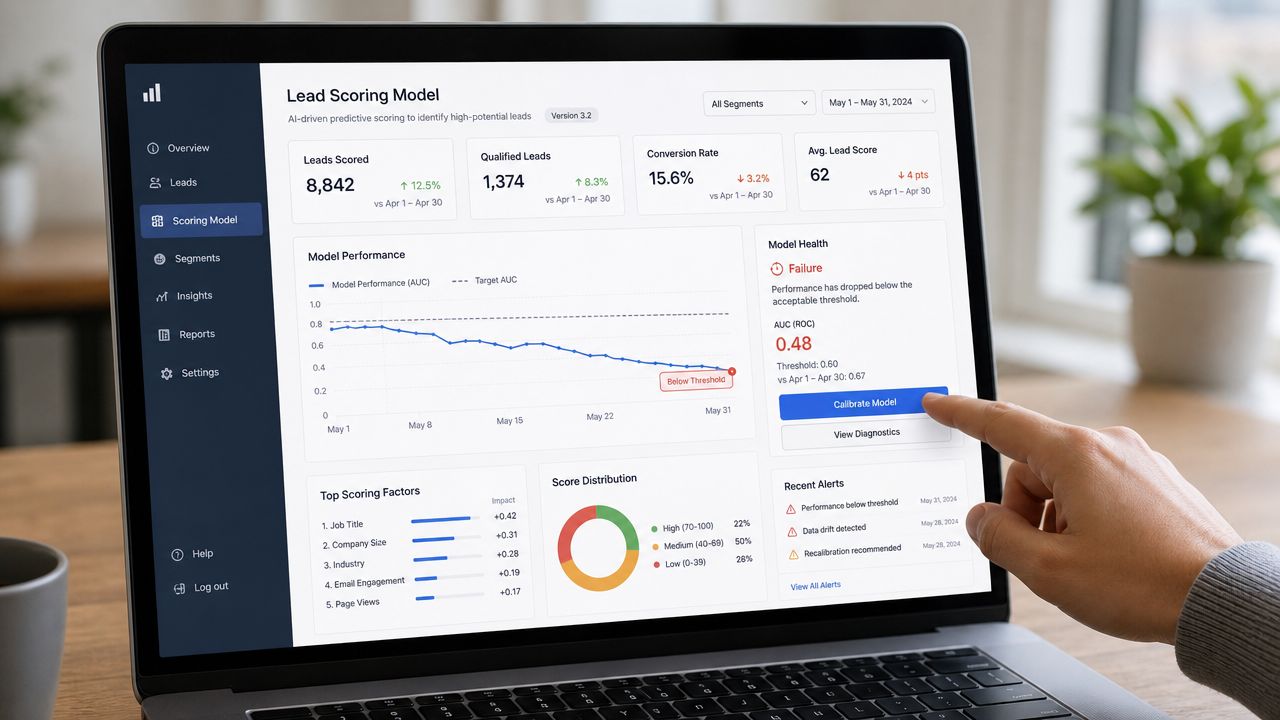
Even a well-built scoring model can fail once reps start using it. For outbound teams working static lists, the failure usually comes from one of three places: the model stops matching the market, reps stop trusting it, or the input data gets sloppy.
That problem shows up faster in outbound than in inbound. Outbound teams often score accounts before any email opens, site visits, or form fills exist, so the model has to carry more weight early. If the fit logic is weak, SDRs spend prime calling hours on accounts that never had a real chance to become pipeline.
Pitfall one, freezing the model
A scorecard is not a set-and-forget asset.
If your team changes territory, moves upmarket, adds a new product line, or learns that a specific segment stalls after demo, the model needs to change with it. I've seen teams keep the same scoring weights for six months after their ICP shifted. The result is predictable. Reps keep prioritizing accounts that look good on paper but do not convert into qualified meetings or revenue.
Review the score against actual outcomes on a fixed cadence. Monthly is usually enough for fast-moving outbound teams. Look at which score bands create meetings, which create pipeline, and which just create activity.
Pitfall two, scoring without sales trust
Reps do not follow a score they cannot explain.
If an SDR sees a low-value account ranked above a known strong fit, confidence drops fast. Once that happens, the team goes back to manual picking, rep judgment gets inconsistent, and manager coaching gets harder because nobody is working from the same priority logic.
Keep the scoring logic visible. A rep should be able to see the main reasons an account scored highly, such as company size, hiring pattern, tech stack, region, or role mix. For outbound, this matters even more because fit-based scoring is often the first filter on a cold list.
A frontline manager should be able to walk a new SDR through the top scoring factors in a few minutes, using real accounts from the patch. If that explanation takes a long time, the model is too abstract to drive daily behavior.
Pitfall three, bad inputs
Bad data creates bad prioritization.
That sounds obvious, but the cost is easy to miss. If headcount is outdated, titles are wrong, or your industry labels are inconsistent, reps end up researching false positives. That is a rep productivity problem before it becomes a reporting problem.
Use a simple operating checklist:
- Validate core fit fields: Industry, employee range, geography, role, and segment need to be current enough to act on.
- Score only fields that change decisions: If a variable does not affect targeting or messaging, remove it.
- Keep negative scoring in place: Poor-fit accounts should drop out early so reps do not waste touches.
- Audit high-score misses: If top-ranked accounts consistently fail, inspect the inputs before changing the whole model.
- Connect score to action: Priority tier should influence routing, sequence selection, and research depth.
One more trade-off matters here. Teams often want a richer model with more variables. In practice, a simpler model with dependable data beats a detailed model built on stale fields. Start with fit signals you can verify at scale, then add timing signals once the base score is stable.
If you want to pressure-test whether your current process supports that kind of scoring in practice, compare it against an outbound workflow built for bulk research and prioritization.
The teams that avoid these pitfalls do not chase a perfect score. They keep the model accurate enough to protect rep time and sharp enough to push better accounts to the top of the list.
From Manual Research to Automated Revenue
If you're still asking what lead scoring is, the simplest answer is this: it's a decision system for outbound prioritization.
For inbound teams, that system often leans on engagement data. For outbound teams, especially those working static lists, the model has to start with fit. Then it gets stronger as new signals appear. That's the shift many sales managers miss. They borrow an inbound framework, then wonder why their SDRs still waste hours researching the wrong accounts and sending generic outreach.
The practical goal isn't to produce elegant scores in a dashboard. It's to help reps spend less time gathering basic account context and more time starting good conversations with the right prospects. When scoring is connected to bulk research, activity-based hooks, segmentation, and automated multi-step outreach, it stops being a theory project and starts becoming a pipeline engine.
If you want to turn lead scoring into a working outbound process, the next step is operational. Review your current list-building and research workflow, then compare it against the kind of efficient system outlined on PitchSmart pricing.
If your reps are still researching leads one by one, copying notes between tabs, and building sequences from scratch, you're paying for admin time instead of conversations. PitchSmart helps outbound teams upload a list, run bulk research, uncover signal-backed hooks, segment prospects by buying signals, and generate customized 3-step email and LinkedIn sequences without the usual spreadsheet grind. Start with a free trial and see how much faster your team can move when lead scoring is connected to actual execution.