Sales teams don't have a selling problem. They have a workflow problem.
According to Salesforce's 2025 State of Sales reporting summarized here, reps spend only 28–30% of their week on direct selling. The other 70–72% goes to research, CRM data entry, email triage, account prep, and internal meetings. That single number changes how you should think about outbound. If most rep time disappears before a real conversation starts, better scripts alone won't fix it.
That's why the question isn't just what is agentic workflow. The primary question is whether your sales process still depends on humans doing browser-tab labor that software should already own. For RevOps teams, SDR leaders, and founders running outbound, agentic workflow matters because it turns scattered research, weak personalization, and generic sequencing into a coordinated system that can reason, act, and adjust.
The 70 Percent Problem Holding Your Sales Team Back
Sales teams lose roughly 70% of rep time to work that does not involve selling. For outbound teams, that waste usually starts before the first email is written.
A strong SDR can burn the first hour of the day assembling basic context. LinkedIn in one tab. Company site in another. CRM records half-complete. Notes pasted into a doc. No outreach sent yet.
That is a workflow problem, not a rep problem.
As noted earlier, sales reps spend far less than half their week in direct selling activity. The rest gets absorbed by admin, research, coordination, and prep work. In a B2B outbound motion, that shows up as slower list coverage, weaker follow-up discipline, and messages built from thin context because the rep ran out of time.
Manual research creates three failures at once
First, it kills speed. A team cannot work through target accounts fast enough when every contact requires fresh research from scratch.
Second, it kills consistency. One rep writes a sharp, relevant opener because they had time to dig. The next sends a generic line because they had 40 accounts left before lunch.
Third, it hurts message quality. Cold outbound usually fails for ordinary reasons. The rep lacked enough context to connect the offer to something the buyer already cares about.
Practical rule: If a rep has to open multiple tabs just to decide whether an account is worth contacting, the process still depends too heavily on manual work.
There is a RevOps cost behind all of this. Teams often respond with more templates, tighter task rules, or another sequencing tool. Those fixes improve organization, but they do not remove the bottleneck. They standardize the grind.
The bigger loss is not admin by itself. It is the opportunity cost. Time spent hunting for hiring signals, team changes, new initiatives, product launches, or account-level pain points is time not spent in live conversations or high-quality follow-up.
That leaves most outbound teams with two bad operating modes. Reps either personalize carefully for a tiny set of accounts, or they send broad sequences with weak relevance because volume pressure wins. Neither approach gives a modern B2B team enough coverage and enough quality at the same time.
The practical answer is to stop treating research, qualification, and outreach prep as separate manual chores. They need to run as one coordinated system that can gather context, assess fit, and prepare the next action before the rep steps in.
What Is an Agentic Workflow Actually
Most sales teams already know traditional automation. Trigger this email. Move this lead. Update this field. Wait two days. Send the follow-up. It's useful, but it's rigid.
An agentic workflow is different. It behaves less like a calculator and more like a capable research assistant working toward a goal.
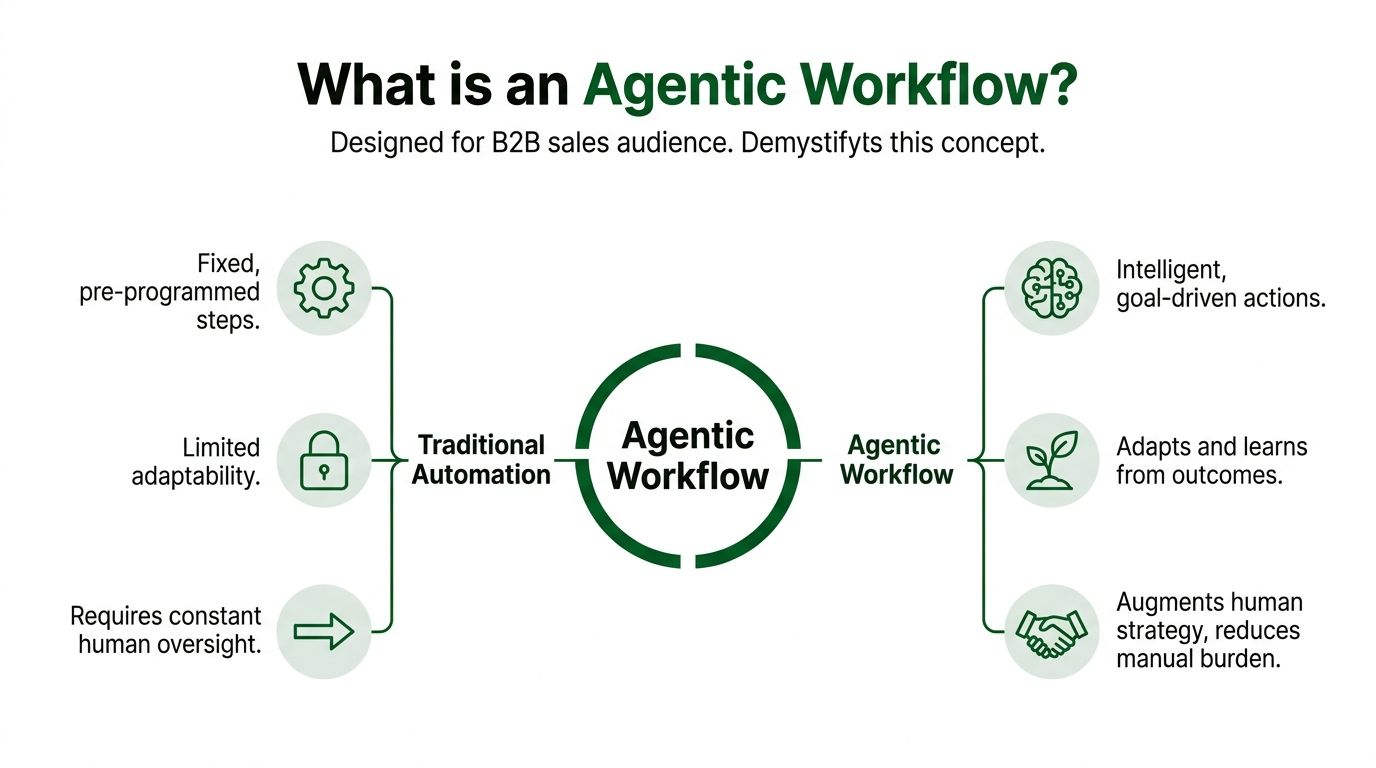
The UK government describes it this way in its AI insights on agentic workflow: agentic workflow is a novel approach in which autonomous artificial intelligence agents manage, coordinate, and execute tasks, marking a shift from rigid, predetermined processes to autonomous, intelligent systems that operate independently and make real-time decisions based on predefined rules, data inputs, and contextual insights without relying on human intervention.
In plain English, that means the system isn't just following steps you hardcoded upfront. It can evaluate the current situation, choose what to do next, use tools, and keep moving toward the outcome you asked for.
What that means in outbound sales
Say the goal is simple: find the best reason to contact a list of accounts and prepare personalized outreach.
Traditional automation can help send a sequence after someone uploads a CSV. But it usually can't decide which signals matter most for each account, which contact should be prioritized, whether the first hook is weak, or whether the next action should be more research instead of another email.
An agentic workflow can.
It can inspect a company, look for activity, compare what it found against your targeting rules, identify a stronger hook, and then assemble the next best action. That's the important shift. You define the objective and the guardrails. The system determines the path.
Later in the section, it helps to see the idea discussed from another angle.
The useful test
If you're still wondering what is agentic workflow, use this test:
- Traditional automation: follows a predefined script.
- Agentic workflow: pursues a predefined goal.
- Traditional automation: breaks when the expected input changes.
- Agentic workflow: adapts within guardrails.
- Traditional automation: handles repetitive steps.
- Agentic workflow: handles multi-step reasoning plus action.
The right mental model is simple. Automation repeats. Agentic workflow decides.
For sales teams, that distinction matters most in research and personalization. Those are messy tasks with incomplete information, moving targets, and constant exceptions. Static workflows struggle there. Agentic systems are built for it.
The Four Pillars of an Agentic System
The easiest way to understand how agentic workflow operates is to break it into four parts. Vellum defines the core architecture in its overview of emerging agentic workflow architectures: Planning, Execution, Refinement, and Interface. That structure works especially well in outbound because sales research is already a chain of decisions.
Planning starts with a goal, not a script
Planning is where the system interprets the assignment.
A sales example is straightforward. “Find accounts in this list that show active buying signals, identify likely decision-makers, and prepare outreach angles for reps.” That's not a sequence of exact clicks. It's an objective with constraints.
Good planning includes decisions like:
- Target logic: Which account traits matter for this motion.
- Signal priority: Which recent events should count as strong outreach hooks.
- Contact strategy: Which role or buying center should be approached first.
- Stop conditions: When enough research has been gathered to move on.
A rigid automation flow can't think through those choices. It needs them specified in advance. An agentic system can take the goal and build the route.
Execution is where the system touches the real world
Execution is the operational layer where the workflow uses tools, external systems, and data sources.
In sales, that could mean checking company websites, reading public signals, reviewing account context, enriching records, and assembling the findings into something usable. The key is that execution isn't random. It is directed by the plan.
This is also where complexity is often underestimated. Connecting AI to tools sounds easy until the workflow starts dealing with incomplete account data, duplicate contacts, weak signals, or stale CRM records.
Field note: The best systems don't try to automate everything at once. They start with one bounded job, then expand.
If you want more operational thinking on sales workflow design, the PitchSmart blog is a useful reference point for how modern outbound teams approach research and workflow standardization.
Refinement separates automation from intelligence
Refinement is the step many teams miss. The workflow has to assess what happened and decide whether the result is good enough.
That matters in outbound. An agent might find a weak personalization angle from a generic company description. A better system recognizes that the signal is thin, goes back for stronger evidence, and avoids drafting a bad opener.
Refinement can involve memory, feedback, confidence checks, and rework. In practical terms, it helps the system avoid shallow output.
Examples in sales include:
- Weak hook detection: “This insight is too generic. Search again.”
- Contact mismatch correction: “This title doesn't fit the campaign goal.”
- Segment reassignment: “This account belongs in a different outbound motion.”
Interface is what makes the system usable
Interface is the handoff layer. It's how the work becomes useful to an SDR, manager, or RevOps owner.
If the output is messy, hidden, or impossible to trust, the workflow won't get adopted. Good interface design means the rep sees clear next actions, source-backed insights, and outreach suggestions they can use.
A strong interface in sales usually includes:
- Concise account summaries
- Source-linked buying signals
- Recommended hooks for conversation
- Suggested sequence or channel mix
- A clean handoff into CRM or engagement tools
Without that last pillar, the system stays clever but impractical. In production, usability matters as much as intelligence.
Agentic Workflows vs Traditional Automation in Sales
Most sales teams don't need another abstract AI category. They need to know whether this is better than the automation they already have.
The cleanest difference comes from Neo4j's explanation of how agentic workflows work: agentic workflows decide the next step of action at runtime based on context and intermediate results, using tools and a feedback loop to reach a goal. Unlike traditional workflows that follow a script, agentic workflows decide the script as they run within defined guardrails, combining reliability with the intelligence of LLMs.
Why the old stack breaks under sales reality
Sales data is uneven. Buying signals are noisy. Contacts change. Websites are vague. Outreach quality depends on context, not just cadence.
Traditional automation handles stable, repetitive work well. It can schedule touches, assign tasks, and move records across systems. But the moment the workflow needs judgment, the cracks show.
That's why so many teams still do manual prospect research before launching outbound. They don't trust static systems to interpret context well enough.
A fixed sequence can send message two just because message one went out three days ago. It doesn't know whether the account started hiring, whether the contact changed roles, or whether the first hook was too weak to use again.
Traditional Automation vs Agentic Workflow in Sales
| Task | Traditional Automation (The Old Way) | Agentic Workflow (The New Way) |
|---|---|---|
| Account research | Pulls predefined fields from a fixed source | Investigates multiple signals and adjusts based on what it finds |
| Personalization | Inserts tokens into a template | Selects or generates hooks based on account context |
| Prospect selection | Uses static filters | Re-prioritizes based on relevance and signal quality |
| Sequence handling | Follows a calendar-based cadence | Chooses next action based on prior findings or engagement context |
| Error handling | Stops or misfires when data is missing | Loops back, tries another path, or flags the record for review |
| Rep handoff | Delivers tasks | Delivers context, reasoning, and recommended action |
Sales is not a factory line. A workflow that assumes every prospect should move through the same path will eventually produce generic outreach.
That doesn't mean traditional automation is obsolete. It still has a place. The better model is layered. Use fixed workflows where consistency matters, then use agentic logic where interpretation and adaptation matter most. In outbound, that usually means the front half of the process: research, qualification, prioritization, and message preparation.
A Practical Example An Agentic Outbound Sales Play
A practical outbound assignment makes this clearer.
You have a list of target accounts. The job is to identify relevant decision-makers, find timely reasons to reach out, and prepare outreach that doesn't sound copied from the last campaign. In many teams, that still means hours of tab-hopping and note-taking before the first message gets drafted.
An agentic workflow handles the same job as a coordinated system.
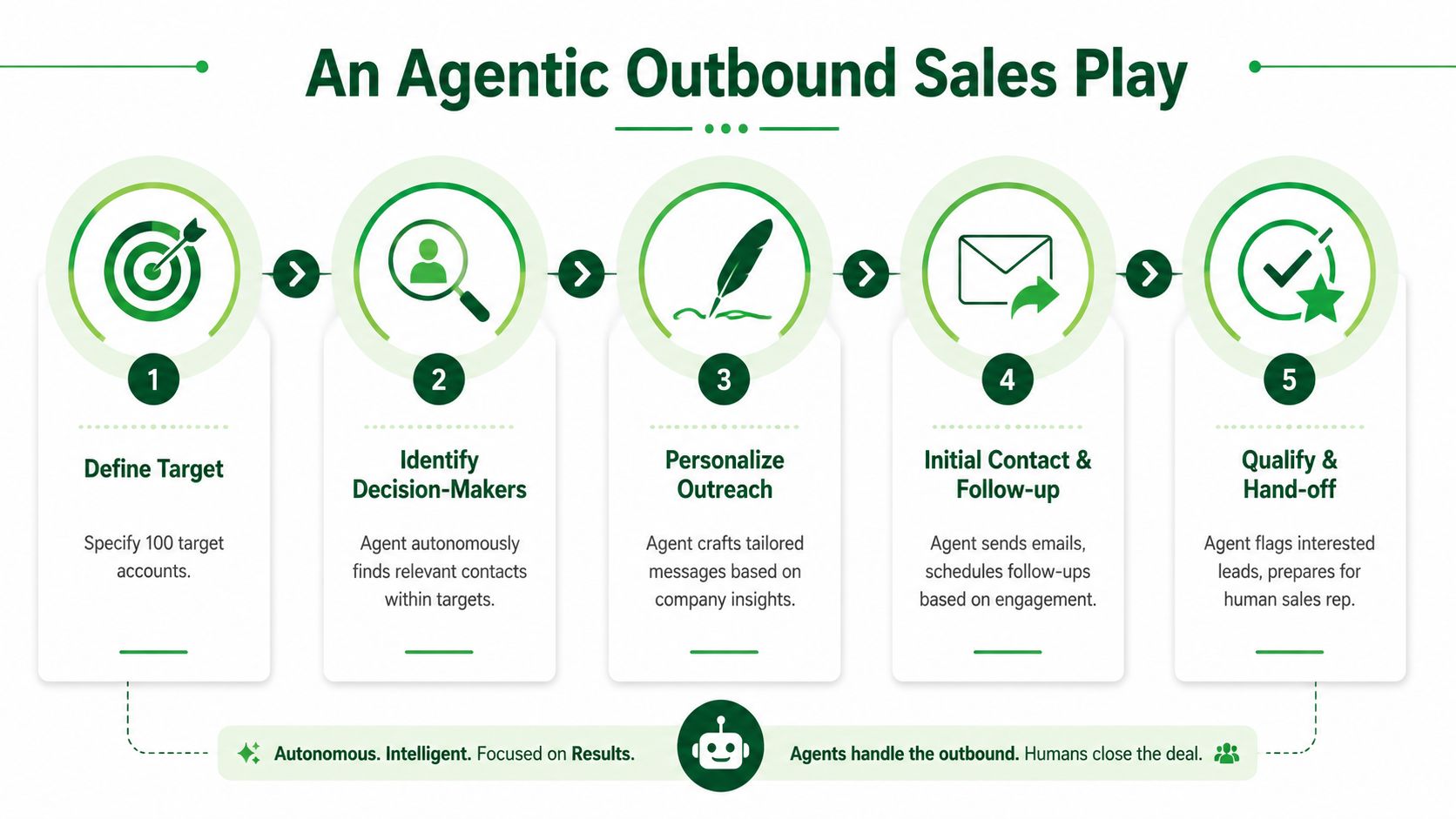
Step 1 through Step 3
It starts by ingesting the target list and understanding the campaign objective. Maybe the motion is aimed at hiring-heavy SaaS companies. Maybe it targets firms showing operational expansion. The workflow uses that context to decide what signals matter.
Next, it begins research in parallel. Instead of a rep checking accounts one at a time, the system scans for useful public context. Hiring patterns. Recent activity. Business changes. Messaging clues. Team structure. Anything that can sharpen prioritization or personalization.
Then it evaluates what it found.
Some accounts will surface obvious conversation starters. Others won't. A true agentic process doesn't force every prospect through the same template. It separates strong-signal accounts from weak-signal accounts and adjusts the next step.
That often looks like this:
- High-context accounts: Ready for personalized outreach based on specific signals.
- Medium-context accounts: Need a safer angle built from broader relevance.
- Low-context accounts: Better held back, re-researched, or moved to another motion.
Step 4 and handoff to the rep
After that, the workflow assembles a usable outbound package.
The rep shouldn't receive a dump of raw notes. They should get a clear conversation plan. Who to contact. Why now. Which signal matters most. Which message angle feels natural. Which sequence should start first.
A strong system can also seed follow-up logic. If the first hook is built around one signal, the next touch can anchor to a related angle rather than repeating the opener in different words.
Good outbound doesn't start with “Hi {FirstName}.” It starts with a reason the rep can defend.
In practical terms, the handoff might include:
- Ranked accounts based on fit and signal strength.
- Suggested contacts aligned to the campaign.
- Top conversational hooks pulled from recent activity.
- Drafted outreach paths for email and LinkedIn.
- A clean review layer so the rep can approve, edit, or send.
That's the useful translation of what is agentic workflow for sales. It's not a robot replacing the rep. It's a system doing the research and decision-support work that usually drains the rep before any selling begins.
How PitchSmart Enables Your First Agentic Sales Workflow
Sales teams do not need another theory deck on agentic AI. They need a system they can put in front of reps this quarter without rebuilding the stack.
PitchSmart is useful because it maps to the part of outbound where good process usually breaks down. Teams already have lists in the CRM, intent data in other tools, and reps stuck doing manual research anyway. PitchSmart closes that gap by turning a prospect set into researched accounts, usable signals, and ready-to-review outreach.
What practical deployment looks like
For a first rollout, keep the scope narrow. Start with one outbound motion, one segment, and one approval workflow. The goal is to remove repetitive prep work, not automate every sales decision on day one.
In practice, teams use PitchSmart for AI outbound research and sequencing to handle four jobs that usually eat rep time:
- Bulk, customizable lead research: Research runs across the full list instead of forcing reps into account-by-account digging.
- Activity-based conversational hooks: Recent signals become usable opening angles, not generic personalization filler.
- Automated 3-step email and LinkedIn sequences: The workflow moves from research to execution without another handoff.
- Advanced list segmentation based on buying signals: Accounts route into different motions based on fit and timing.
That matters in RevOps because these steps should work together. Research should shape prioritization. Prioritization should shape messaging. Messaging should shape sequence selection. When those steps live in separate spreadsheets, tabs, and one-off prompts, output quality drops fast.
Why auditability matters in sales AI
The first question leadership asks is simple. Why did the system pick this account, this contact, and this message angle?
If the tool cannot answer that, adoption stalls. Reps stop trusting the output. Managers cannot coach against it. Ops cannot diagnose why one segment performs and another misses.
That is why source-linked research and visible workflow logic matter more than flashy demos. In sales, auditability means a manager can review the signal, check the rationale, and approve or reject the recommendation without guessing how the system got there.
A workable rollout usually looks like this:
- Start with one outbound use case such as account research plus first-touch prep.
- Define signal rules upfront so the system knows what to prioritize by segment.
- Keep rep approval in place until output quality is consistent.
- Review reasoning, not just copy so the team can spot weak signals, bad assumptions, and segment drift.
That is the practical path. Use existing systems of record, add an agentic layer where manual work is heaviest, and keep human review on the decisions that affect pipeline quality.
Conclusion From Manual Grind to Intelligent Growth
The point of agentic workflow isn't novelty. The point is to stop wasting skilled sales time on low-value research labor.
The old outbound model asks reps to behave like part researcher, part data-entry clerk, part sequence operator, and only occasionally a seller. That's why so much effort disappears before pipeline gets created. The system burns time long before performance gets measured.
A better model is now available. Agentic workflows let teams define the goal, set the guardrails, and let software handle the messy middle. In sales, that middle includes list research, signal discovery, prioritization, personalization prep, and sequence assembly. Those tasks are necessary, but they shouldn't consume the week.
The strongest sales organizations will be the ones that treat this shift as an operating change, not a content trend. They'll keep human judgment where it matters most, and they'll remove manual prospecting work wherever software can do it faster and more consistently.
If you want a practical next step, review how your team handles outbound before the first email goes out. Count the tabs. Count the copy-paste. Count how often good reps are forced into admin work instead of live conversations. That's where the opportunity sits.
For teams ready to replace that grind with a cleaner system, the best next move is to evaluate tools that can operationalize bulk research, signal-backed messaging, and controlled automation. PitchSmart's pricing and trial options make that transition easy to test without redesigning your entire stack first.
PitchSmart turns the theory of agentic workflow into something a sales team can use this week. You can upload your list, let the platform run bulk research in parallel, pull in activity-based hooks, and generate signal-backed outreach without forcing reps through another day of manual prospecting. If you want to see how that works in practice, start with PitchSmart.